

NPCS has been helping entrepreneurs, startups, MSMEs, and industrial investors since 1992 with detailed project reports, feasibility studies, market research, and business consulting services across 50+ industries.
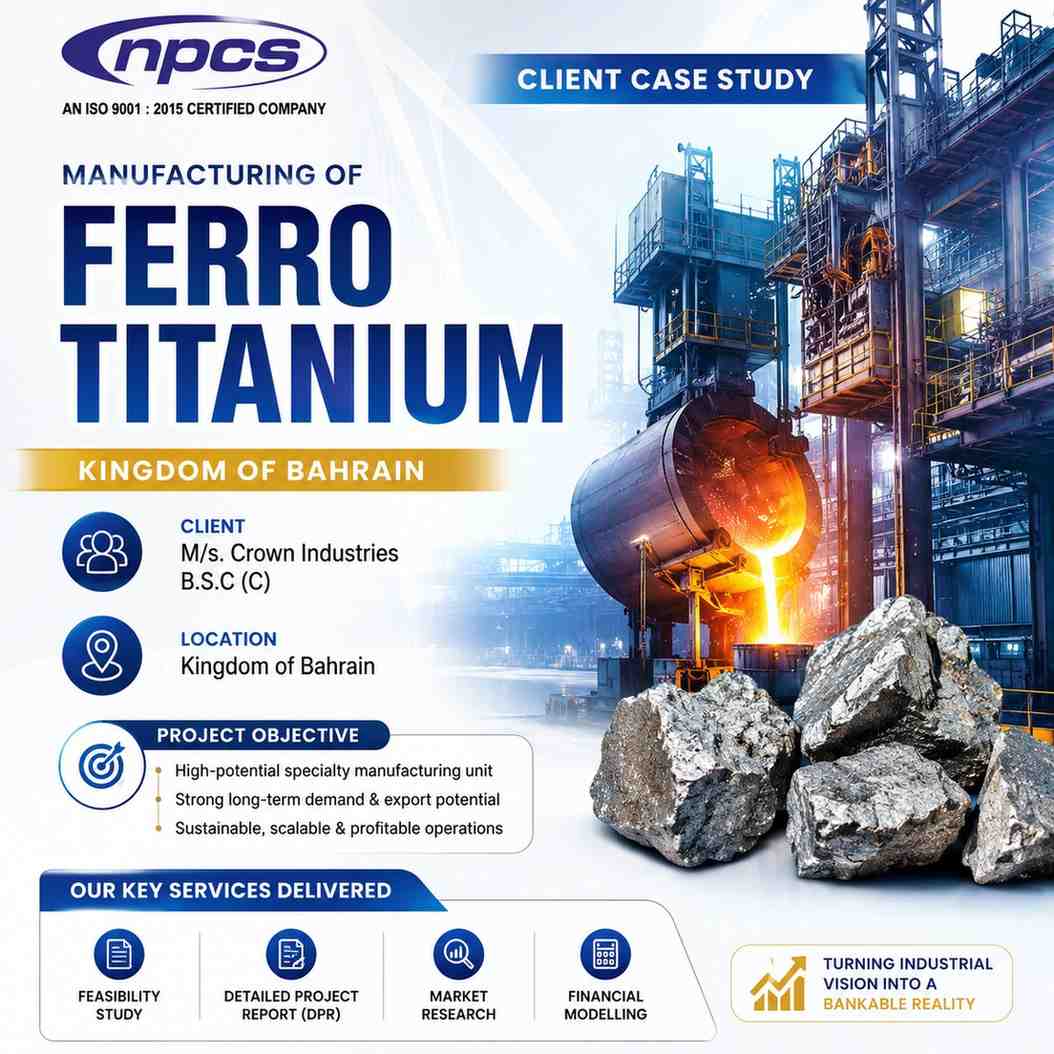
When Crown Industries B.S.C (C) came to us, they had a clear ambition — find a large-scale manufacturing opportunity that made commercial sense for Bahrain's industrial landscape and could hold its own in regional and international markets. What they needed was someone to do the hard work of validating it.
Ferrotitanium wasn't an obvious choice for the region. There was no established production facility in Bahrain, limited local market data, and real uncertainty around raw material costs and payback timelines. That's exactly the kind of challenge NPCS is built for.
We started where we always do — understanding the client's goals before recommending anything. Crown Industries wanted long-term profitability, export potential, and a product that aligned with where GCC infrastructure spending was heading. After evaluating multiple sectors, ferrotitanium checked the right boxes: steady global demand, strong end-use industries (steel, aerospace, automotive), and a genuine import-substitution opportunity across the Gulf.
From there, our team moved through a structured five-phase process — market research, technical review, financial modelling, and implementation planning. On the market side, we mapped global demand patterns, benchmark pricing, and the competitive landscape across key export destinations including Europe, South Korea, Japan, and India. Regionally, the picture was straightforward: the GCC was importing ferrotitanium. Local production offered a real cost and logistics advantage.
The technical work covered the full manufacturing process — from raw material preparation and induction furnace melting at temperatures above 1,700°C, through to casting, crushing, quality testing, and dispatch. We reviewed machinery requirements, plant layout, utility needs, and quality control protocols, giving Crown Industries a clear picture of what building and running this facility would actually involve.
Our financial model addressed the harder questions. Titanium scrap and sponge make up the bulk of input costs — typically 60 to 70% of the raw material bill — so our cost analysis paid particular attention to supply chain sourcing and price sensitivity. We modelled capital expenditure, working capital cycles, break-even capacity (achievable at around 60 to 65% utilisation), payback period, IRR, and NPV across different operating scenarios.
The final Detailed Project Report brought all of it together into a single bankable document — the kind that works with commercial banks, private equity, and development agencies.
Crown Industries reviewed the findings and decided to move forward with implementation planning. That outcome speaks for itself.
Entrepreneur India, an Industrial monthly magazine on industrial development, technologies & project opportunities aims at simplifying the process of choosing the suitable project for investment.

Entrepreneur India - Copyright 2017-. All rights reserved.



