

NPCS has been helping entrepreneurs, startups, MSMEs, and industrial investors since 1992 with detailed project reports, feasibility studies, market research, and business consulting services across 50+ industries.
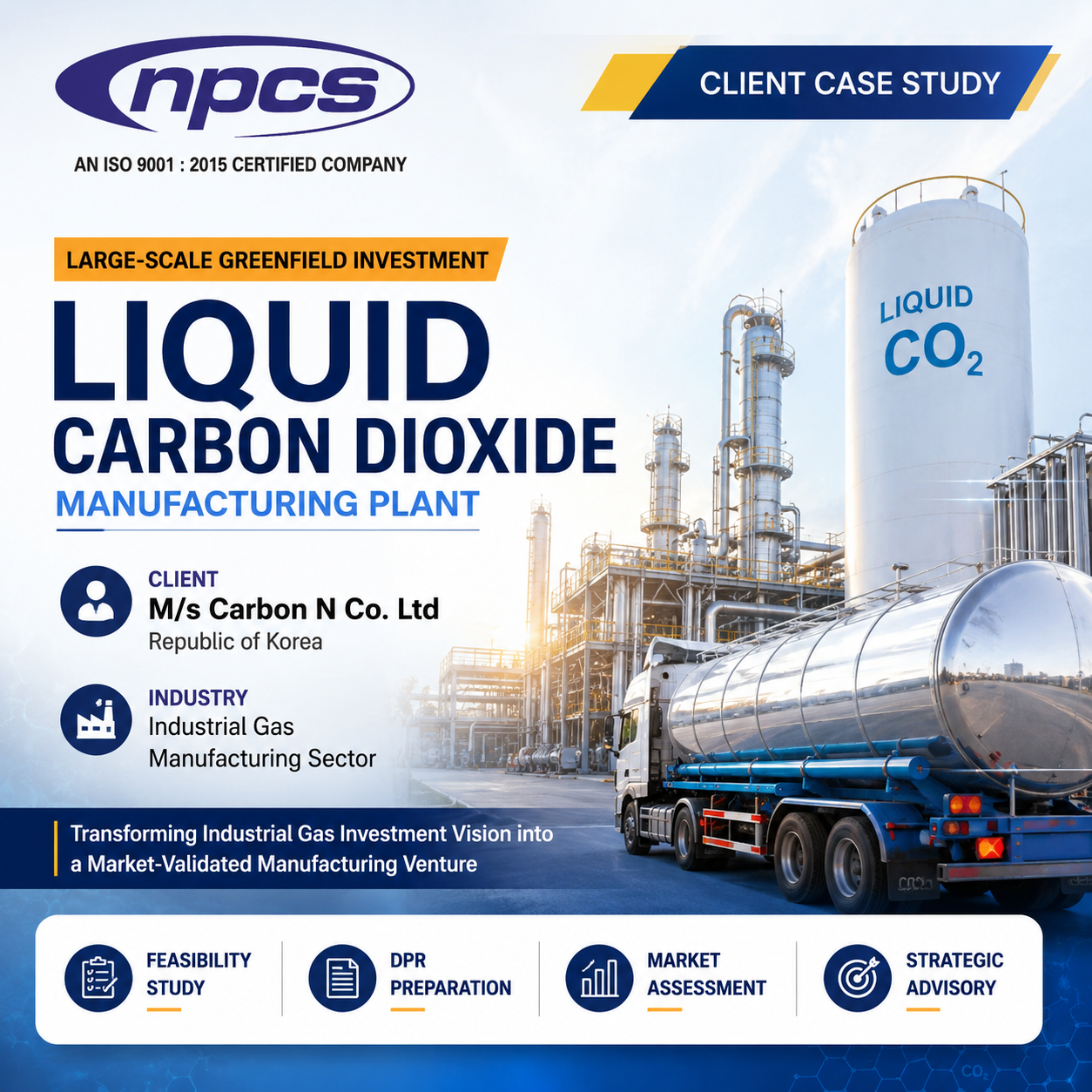
When M/s Carbon N Co. Ltd first approached us, they had capital, ambition, and a clear appetite for large-scale industrial manufacturing — but no specific product direction and understandably, no desire to commit resources to something unproven.
That's a position we've seen many serious investors in. The challenge isn't enthusiasm. It's finding the right opportunity and then being able to stand behind it with real numbers.
After evaluating several industrial sectors, our team identified liquid carbon dioxide as the strongest fit — a product with diversified end-use demand, a growing Asia-Pacific market, and infrastructure conditions in South Korea that worked in the client's favor. From there, the engagement moved through market research, technical feasibility, financial modeling, and risk assessment across roughly 14 weeks.
On the market side, the picture was compelling. The global liquid CO₂ market was valued at around USD 9.47 billion in 2025, with projections pointing toward USD 14.03 billion by 2035 — a steady 4% CAGR driven significantly by food and beverage sector demand, which accounts for over 70% of total consumption. Asia-Pacific leads both in size and growth rate, which positioned Korea well for both domestic sales and regional export.
Technically, the production process — raw CO₂ sourcing, multi-stage compression, purification through activated carbon beds, cryogenic liquefaction, and storage — is well-established. What matters in feasibility work is evaluating it properly: the right equipment choices, realistic utility planning, and a sourcing strategy for raw feedstock that doesn't leave the plant exposed. We mapped all of that out in detail, including machinery specifications, plant layout options, and quality control requirements for food-grade CO₂ certification.
Financial modeling confirmed the opportunity. Payback periods for industrial gas plants of this type typically fall in the 4–7 year range, with double-digit IRR potential when the plant is correctly sized and supply contracts are structured early. Korea's existing industrial infrastructure meaningfully reduces upfront capital requirements compared to greenfield builds in less-developed markets.
The risk assessment phase looked at market concentration risk, feedstock supply reliability, regulatory compliance requirements under Korean and international food-grade standards, and the longer-term opportunity around carbon capture integration — which opens up a cost-effective feedstock pathway as capture infrastructure matures.
By the time we delivered the final report, the client's leadership team had a clear, documented basis for their investment decision. The project has since moved into implementation planning.
Entrepreneur India, an Industrial monthly magazine on industrial development, technologies & project opportunities aims at simplifying the process of choosing the suitable project for investment.

Entrepreneur India - Copyright 2017-. All rights reserved.



