

NPCS has been helping entrepreneurs, startups, MSMEs, and industrial investors since 1992 with detailed project reports, feasibility studies, market research, and business consulting services across 50+ industries.
EA Brothers Contractors Co. Ltd had been a respected name in Tanzania's construction and infrastructure space for years. But like many established service businesses, they reached a point where diversifying into manufacturing made clear strategic sense — they just needed the right opportunity, and the confidence to act on it.
Operating out of Tabata, Dar Es Salaam, the team had first-hand exposure to a gap that was hard to ignore: East Africa's cold chain infrastructure was expanding fast, construction activity was picking up across the region, and quality insulated panels were largely being imported. The demand was visible. What was missing was a structured path to meet it.
That's where NPCS came in.
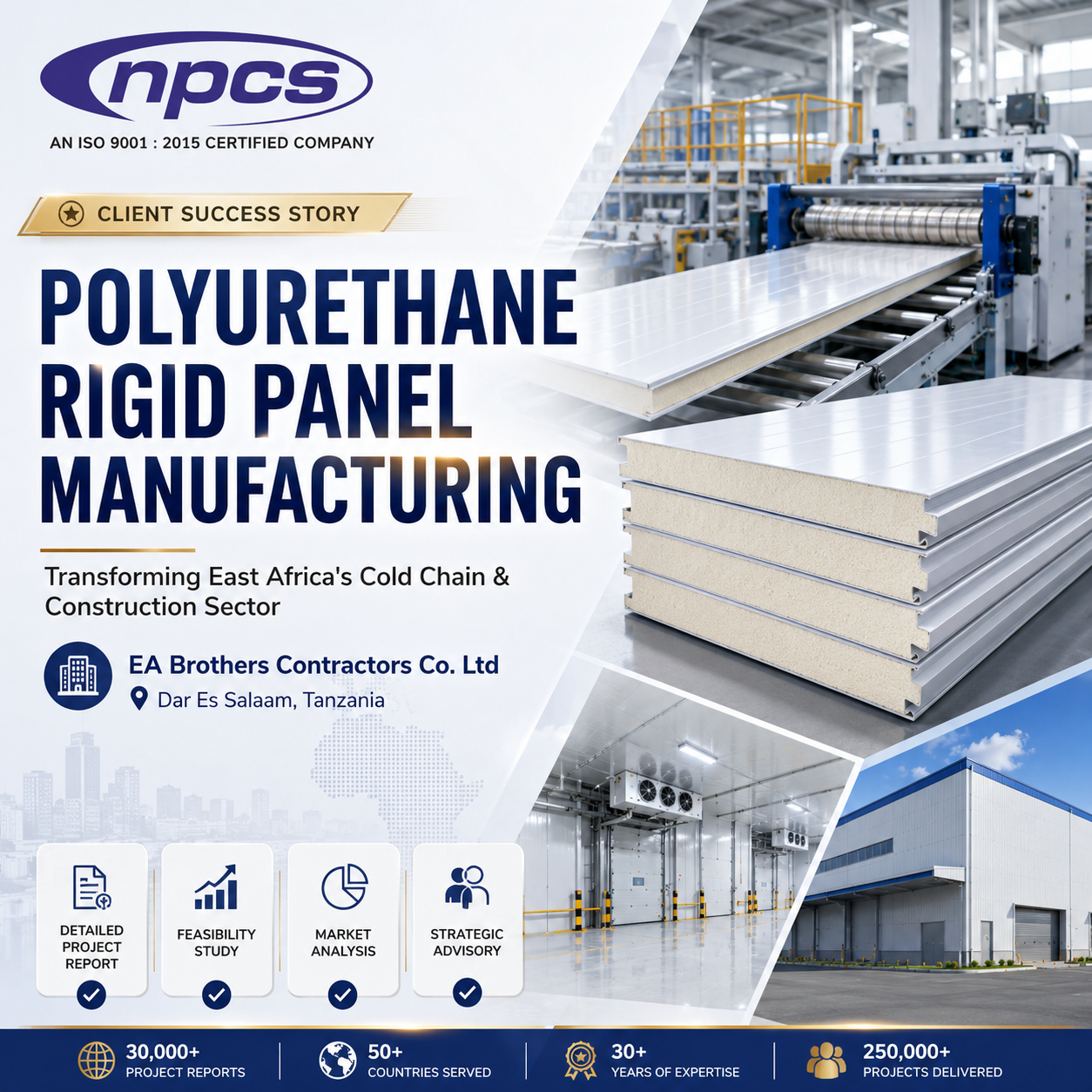
The client approached us with a broad question — which manufacturing sector should they enter, and was it genuinely viable? Before recommending anything, our team evaluated over 15 potential sectors against the client's capital position, existing industry relationships, and the regional market landscape. The answer that kept rising to the top was polyurethane rigid insulated panel (PUF panel) manufacturing — a product category directly tied to cold rooms, industrial warehouses, pharma storage, and modern commercial construction.
We took the engagement through five structured phases: sector identification, deep-dive market analysis, full technical feasibility, financial modelling, and an implementation roadmap. The market findings reinforced the opportunity — the global PUF panel market stood at approximately USD 9.5 billion in 2023 and is tracking toward USD 16.8 billion by 2032. More importantly for the client, Tanzania was importing a meaningful share of its insulated panel requirements, which meant local manufacturing carried a genuine cost and positioning advantage from day one.
On the technical side, we walked through the entire production process — from raw material handling and foam dosing to continuous lamination, edge profiling, quality inspection, and dispatch. We specified the machinery stack, recommended the plant layout, and benchmarked key equipment suppliers. The client's team came away from this phase with a solid working understanding of what the production floor would actually look like and how to engage with contractors and equipment vendors.
The financial model confirmed what the market analysis suggested: moderate capital requirement relative to comparable manufacturing categories, attractive gross margins through value-added production, and a payback trajectory that was realistic without being overly optimistic. We built the model to be credible for lender and investor review, not just internal decision-making.
The implementation roadmap laid out a 12-month phase plan — from pre-investment approvals and civil construction through to machinery installation, commissioning, trial runs, and commercial launch. Practical, milestone-driven, and built around how projects actually get executed in an East African operating environment.
By the end of the engagement, EA Brothers had moved from a broad idea to a fully documented, financially validated investment plan. They proceeded into implementation planning — with the kind of clarity that only comes from doing the groundwork properly.
Entrepreneur India, an Industrial monthly magazine on industrial development, technologies & project opportunities aims at simplifying the process of choosing the suitable project for investment.

Entrepreneur India - Copyright 2017-. All rights reserved.



