

NPCS has been helping entrepreneurs, startups, MSMEs, and industrial investors since 1992 with detailed project reports, feasibility studies, market research, and business consulting services across 50+ industries.
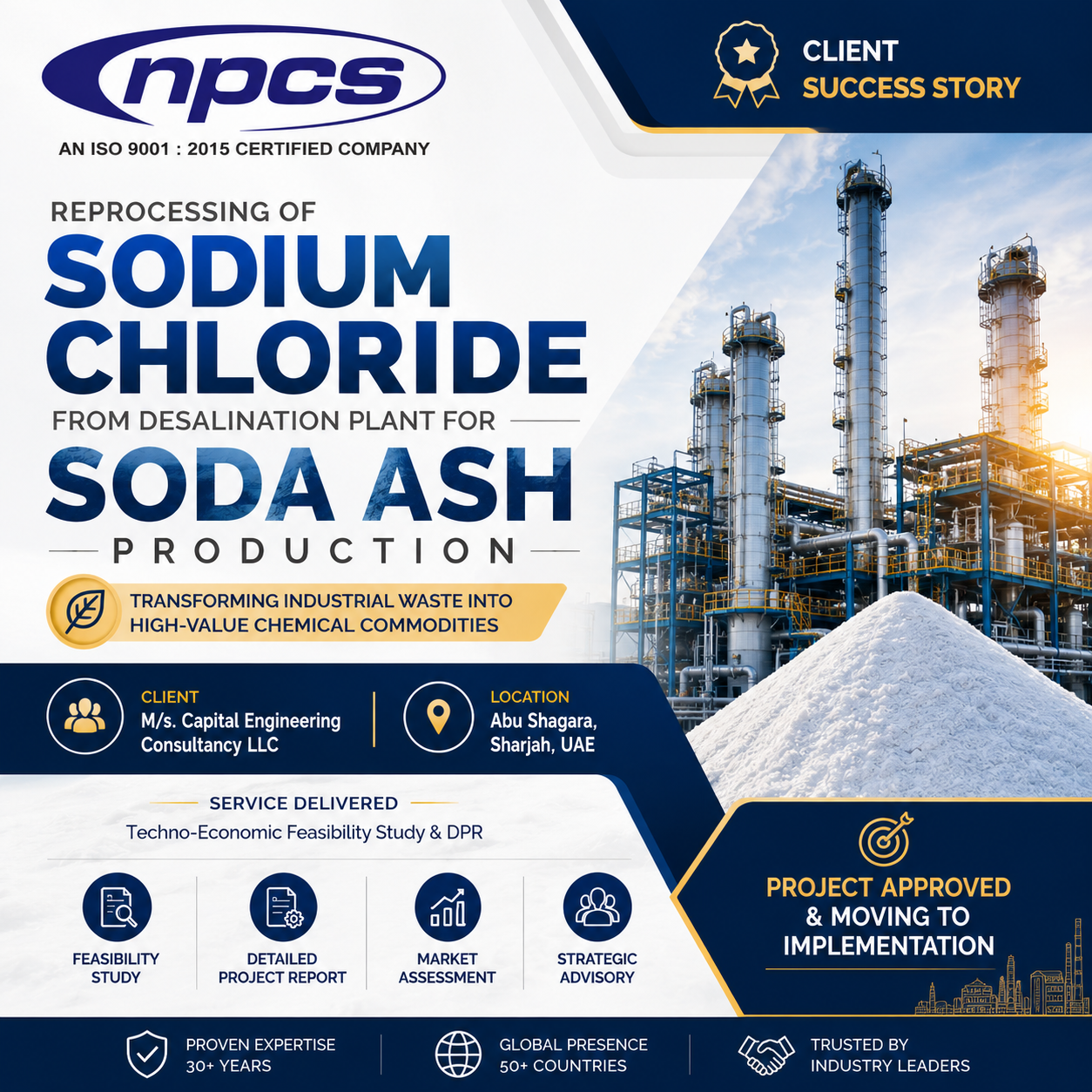
When Capital Engineering Consultancy LLC approached us, they weren't looking for a generic market report. They had a specific question: could the sodium chloride byproduct coming out of desalination plants in the UAE actually be the foundation of a viable soda ash manufacturing business?
It was a smart question. The Gulf runs on desalination. Brine discharge is an ongoing operational and environmental headache for plant operators across the region. And soda ash — used in everything from glass production to water treatment to detergents — is something the GCC imports in large volumes from China, Turkey, and Europe.
The opportunity was there on paper. But the client needed to know if it held up under scrutiny.
We started by getting clear on the fundamentals. Raw material access was the first gate. Our team mapped NaCl availability from desalination operations across Sharjah and the broader UAE, assessed brine purity profiles, and confirmed that feedstock could be secured at volume and at a cost that made the downstream economics work. That alone removed one of the biggest uncertainties the client walked in with.
From there, we went deep on the technical side. The production route — a Modified Solvay Process adapted to desalination brine — is commercially proven, but applying it to this feedstock required careful evaluation. We worked through process flow, utility requirements, equipment specifications, and environmental controls. The ammonia recovery loop, the CO₂ recycle from the calciners, the brine purification stages — all of it was mapped out in enough detail that the client's team could engage meaningfully with potential engineering contractors.
The financial model was built to be stress-tested, not just to look good on a slide. We ran sensitivity scenarios across pricing, capacity utilisation, and capital cost variations. At standard assumptions, the project breaks even somewhere between 55 and 65 percent utilisation, with a payback period in the four-to-six year range and an IRR of 20 to 28 percent over a ten-year horizon. Total project cost sits in the USD 15 to 25 million range depending on site and final capacity decisions. These aren't numbers we pulled from thin air — they reflect current equipment costs, regional utility rates, and realistic market pricing for soda ash in the MENA region.
The market side told a compelling story on its own. Global soda ash demand runs above 60 million metric tonnes annually, and the Middle East is one of the faster-growing demand zones with almost no local production to speak of. Glass manufacturing alone accounts for over 40 percent of end-use consumption — and with the infrastructure build-out happening across the GCC, that's not a sector that's slowing down.
The engagement ran over 26 weeks. By the end of it, Capital Engineering had a full Detailed Project Report covering every dimension of the venture — technical, financial, regulatory, and supply chain — along with a phased implementation roadmap and vendor identification guidance. The kind of document you can put in front of a lender or a government approvals desk and not feel nervous about.
The client formally approved the feasibility findings and confirmed they're moving to implementation.
That outcome speaks for itself.
Entrepreneur India, an Industrial monthly magazine on industrial development, technologies & project opportunities aims at simplifying the process of choosing the suitable project for investment.

Entrepreneur India - Copyright 2017-. All rights reserved.



