

NPCS has been helping entrepreneurs, startups, MSMEs, and industrial investors since 1992 with detailed project reports, feasibility studies, market research, and business consulting services across 50+ industries.
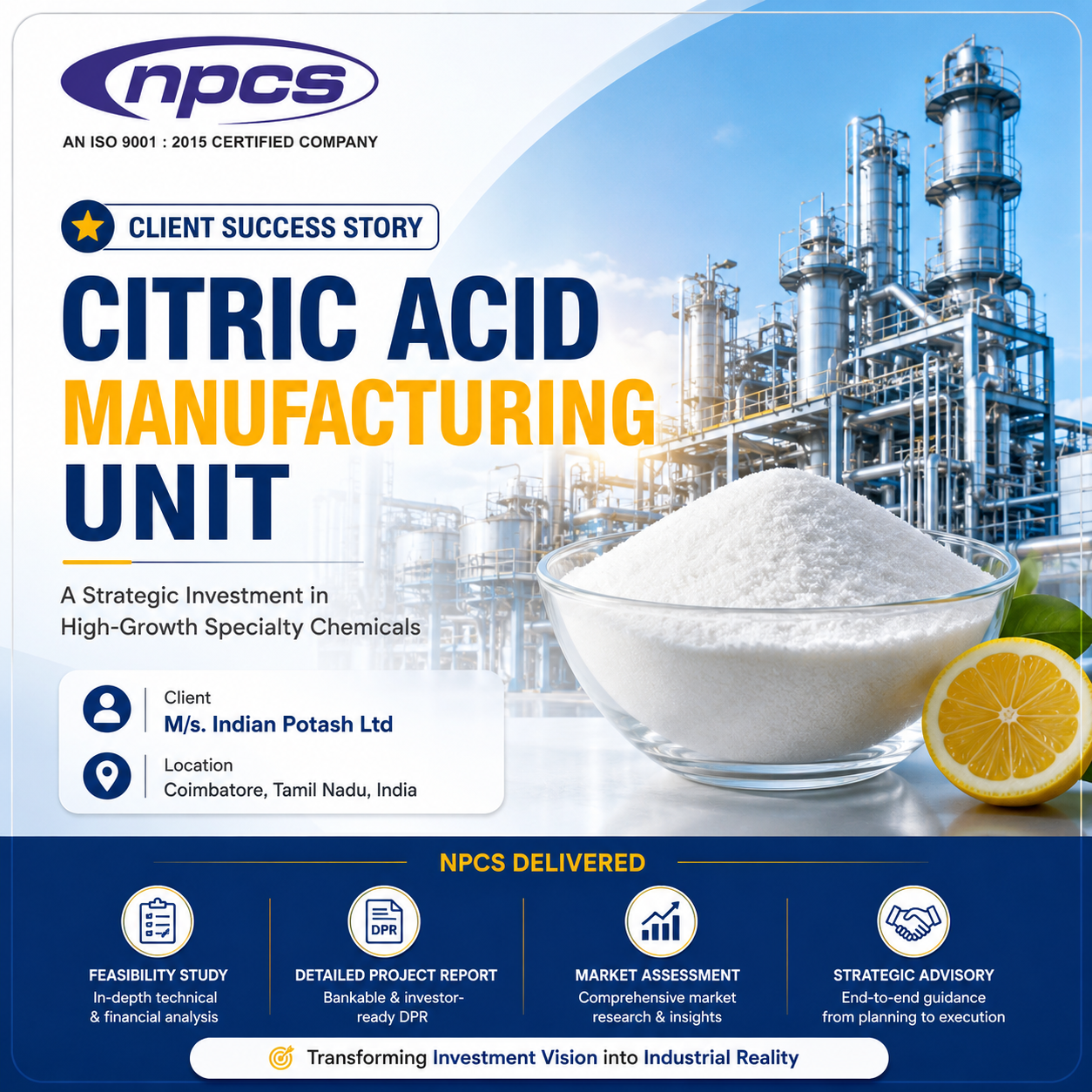
Indian Potash Ltd had built a solid reputation over the years in India's agri-input and industrial supply space. But like many established enterprises, they reached a point where leadership wanted to do something different — enter a new manufacturing segment with real long-term potential, rather than doubling down on familiar ground.
The challenge wasn't ambition. It was information. Where exactly should they invest? What product made sense given their location in Tamil Nadu, their supply chain strengths, and their appetite for a scalable, export-ready business? They didn't have an internal team equipped to answer those questions with the kind of technical and financial depth a decision of this size demands.
That's when they came to NPCS.
After a structured assessment of the industrial landscape — raw material availability in the region, domestic demand gaps, import substitution potential, and end-market growth trends — NPCS identified citric acid manufacturing as the right fit. It's the world's most widely consumed organic acid, with buyers across food processing, pharmaceuticals, cosmetics, detergents, and construction chemicals. India imports a substantial portion of its requirement, largely from China and Europe — which means a well-positioned domestic producer walks into a market that already needs them.
The engagement covered everything the client needed to make a confident decision: full process design for the submerged fermentation route using Aspergillus niger, plant layout and capacity planning, machinery identification, raw material sourcing strategy (molasses and maize substrates are readily available locally), CAPEX and OPEX estimation, IRR and payback modeling, regulatory roadmap, and effluent treatment planning.
The work was structured across a 14-week timeline with clear phase-wise milestones — from initial opportunity assessment through technical feasibility, financial modeling, and final DPR compilation. By the end, Indian Potash Ltd had a bankable, investor-grade project report covering every dimension of the proposed manufacturing unit. More importantly, they had the clarity to move forward.
The project has since been approved for execution. The Coimbatore plant is being set up to serve both domestic buyers and export markets across Asia, the Middle East, and Africa — with a production process that aligns with growing global preference for fermentation-based organic acids over synthetic alternatives.
Entrepreneur India, an Industrial monthly magazine on industrial development, technologies & project opportunities aims at simplifying the process of choosing the suitable project for investment.

Entrepreneur India - Copyright 2017-. All rights reserved.



