

NPCS has been helping entrepreneurs, startups, MSMEs, and industrial investors since 1992 with detailed project reports, feasibility studies, market research, and business consulting services across 50+ industries.
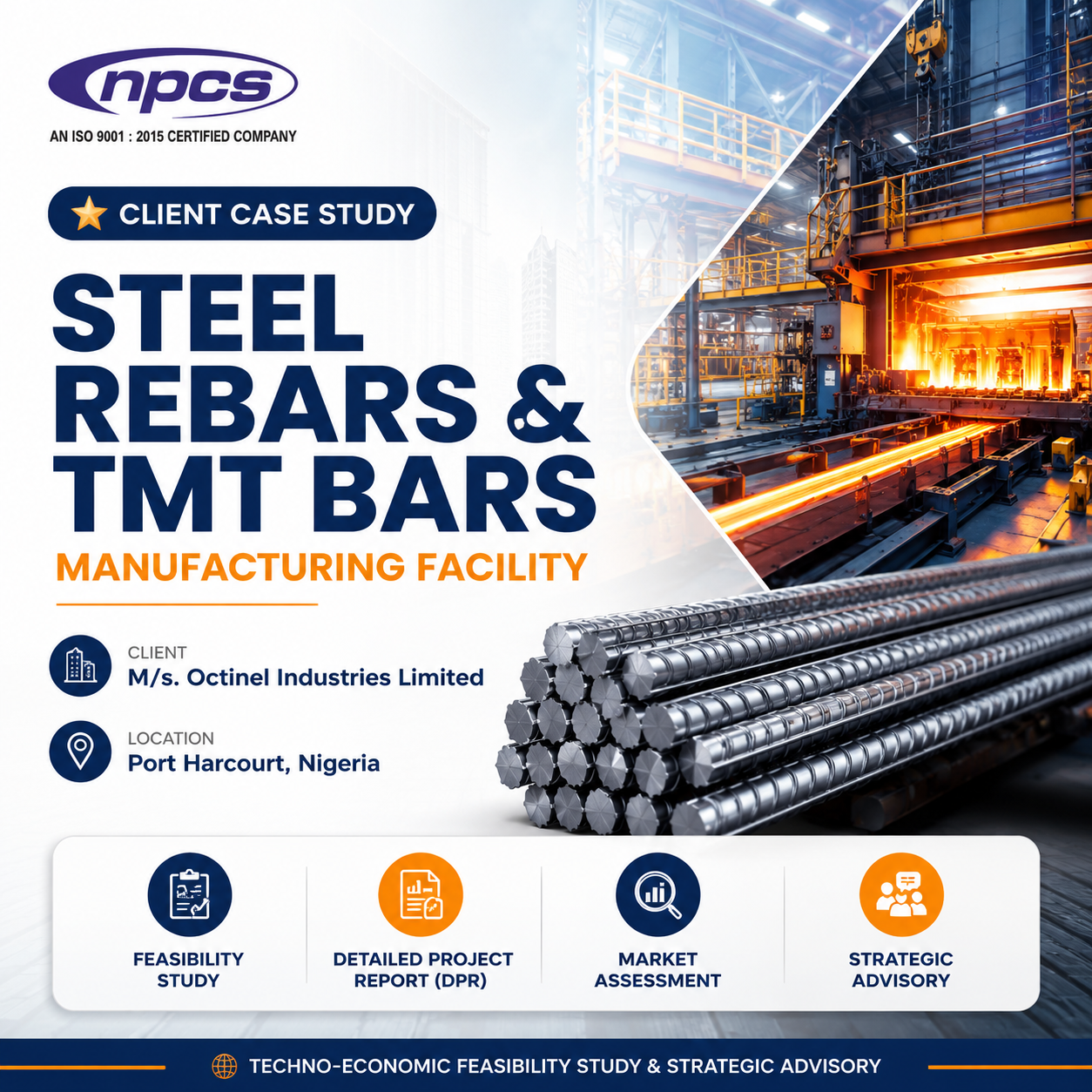
When M/s. Octinel Industries Limited came to us, they had a clear ambition but needed the right vehicle for it. Based in Port Harcourt, Nigeria, the company was looking to establish a large-scale manufacturing presence — something with long-term revenue potential that would align with where Nigeria's economy was clearly heading. After evaluating their investment profile and strategic priorities, we recommended steel rebars and TMT bars manufacturing as the most viable path forward.
Nigeria's construction boom isn't a prediction anymore — it's already underway. Government infrastructure spending, urban housing demand, and industrial expansion have created consistent appetite for structural steel that the country still imports in significant volumes. That import dependency is both a market gap and an opportunity, and Octinel was well-positioned to step into it.
Our work with them covered the full scope of what a project like this requires before a rupee — or in this case, a naira — gets committed. We started with a thorough market study, assessing regional demand patterns, competitive dynamics, and pricing benchmarks across West Africa's construction materials space. From there, we moved into the technical side: evaluating rolling mill configurations, TMT quenching systems, plant layout options, and the equipment specifications needed to run a facility at the scale they were targeting.
The financial modeling phase is where a lot of these projects either gain or lose momentum. We built out detailed cost structures, worked through capital allocation scenarios, stress-tested the break-even assumptions, and produced ROI and IRR projections that held up under scrutiny. At full operating capacity, the indicators looked strong — payback within three and a half to four and a half years, returns in the 22 to 28 percent range annually, and a break-even threshold achievable at roughly 60 percent of installed capacity.
On the supply chain side, we mapped out billet and scrap steel sourcing options across regional and international channels, factoring in cost, reliability, and lead times. We also addressed the regulatory and compliance environment, which in Nigeria's industrial sector requires careful navigation.
What Octinel walked away with was a comprehensive Detailed Project Report — a bankable document covering everything from plant layout to procurement timelines to workforce planning. More importantly, they had the clarity to move forward. The feasibility study was approved internally, and the project advanced into the implementation phase.
This engagement reflects the kind of work we do most consistently well: taking a well-capitalized client with a real investment intention and giving them the analytical foundation to act on it with confidence. Steel rebars and TMT bars manufacturing in West Africa is a sector with genuine long-term runway, and Octinel is now positioned to be a meaningful part of it.
Entrepreneur India, an Industrial monthly magazine on industrial development, technologies & project opportunities aims at simplifying the process of choosing the suitable project for investment.

Entrepreneur India - Copyright 2017-. All rights reserved.



