

NPCS has been helping entrepreneurs, startups, MSMEs, and industrial investors since 1992 with detailed project reports, feasibility studies, market research, and business consulting services across 50+ industries.
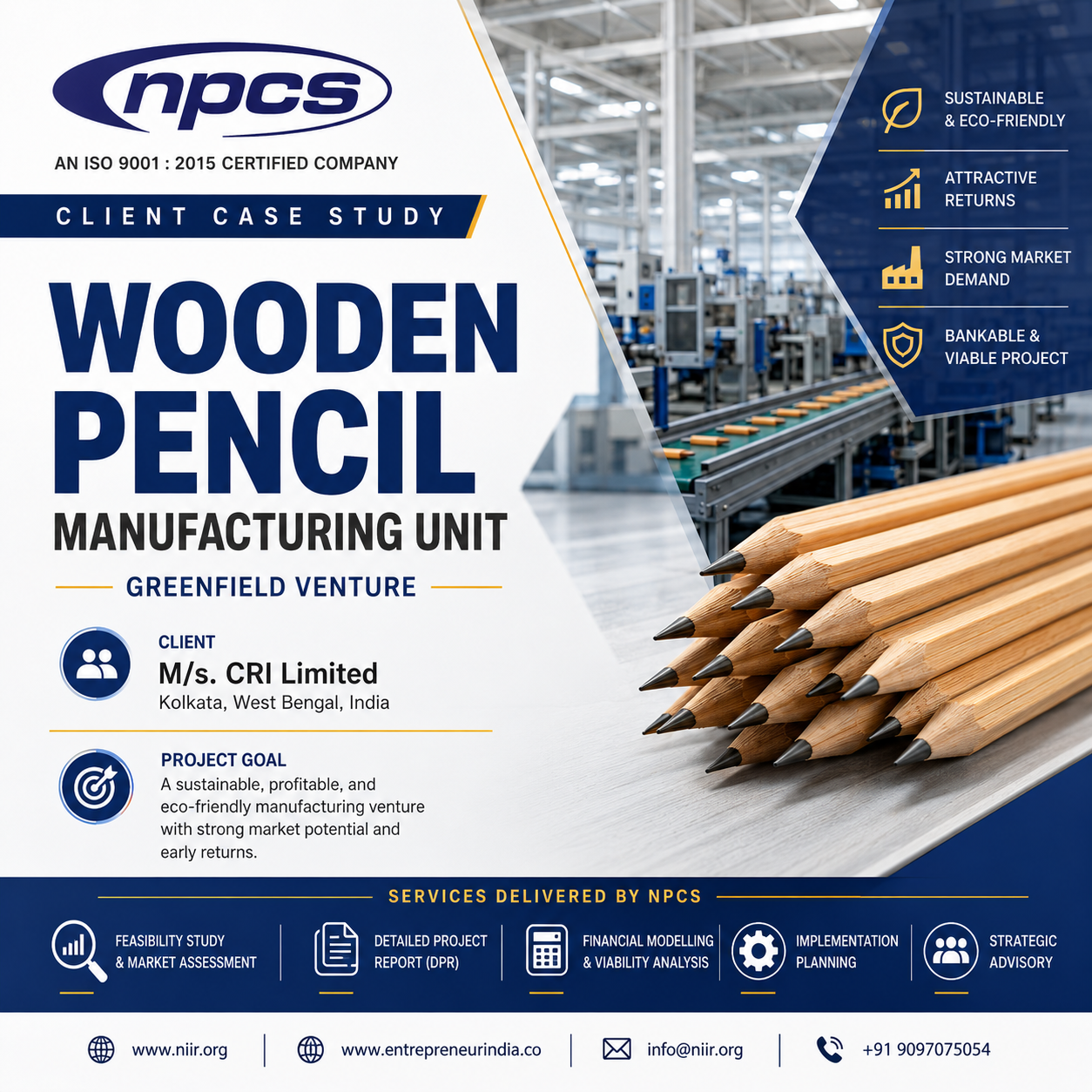
When M/s. CRI Limited came to NPCS, they weren't short on ambition — they were short on answers. The Kolkata-based business group wanted to diversify into manufacturing, but they needed more than just a promising idea. They needed data, a realistic cost picture, and a project report solid enough to walk into a bank with.
After screening more than ten manufacturing sectors against CRI's specific investment criteria — moderate capital, early payback, local resource availability, and alignment with sustainable consumer trends — NPCS recommended wooden pencil manufacturing. It wasn't an obvious choice, but the research made a compelling case.
India's pencil market was valued at close to US$ 600 million in 2025, growing steadily on the back of rising school enrolment, government literacy programmes, and a genuine consumer shift toward eco-friendly stationery. The timing was right, the raw material supply was accessible, and the economics worked.
NPCS then built the entire project foundation for CRI. That meant mapping the full manufacturing process — from wood slat procurement and kiln-drying through to lead insertion, lacquering, and final quality inspection — and translating that into a plant layout, machinery shortlist, and operational blueprint the client could actually use.
On the financial side, the numbers came out well. Total project cost was estimated at around ₹15.72 lakh, with a Debt Service Coverage Ratio of 2.59 and a break-even point below 1.0. Payback was projected at two to three years, assuming institutional supply contracts — a realistic assumption given the demand channels NPCS identified. The team also mapped out applicable MSME financing schemes, including PMEGP and CGTMSE, giving CRI a practical path to funding.
Regulatory clarity was built into the deliverable too. CRI received a step-by-step approval roadmap covering factory registration, Pollution Control Board clearance, BIS certification under IS 13729, and state-level MSME incentive applications — the kind of detail that typically takes months to figure out independently.
By the time NPCS handed over the final report, CRI had everything needed to move forward: a market thesis backed by data, a technical blueprint ready for procurement, a financial model ready for lenders, and a regulatory checklist ready for execution. The company initiated implementation shortly after — machinery procurement, site finalisation, permit applications, and key hires all underway.
It's the kind of outcome that only comes when research and execution planning are done properly from the start.
Entrepreneur India, an Industrial monthly magazine on industrial development, technologies & project opportunities aims at simplifying the process of choosing the suitable project for investment.

Entrepreneur India - Copyright 2017-. All rights reserved.



