

NPCS has been helping entrepreneurs, startups, MSMEs, and industrial investors since 1992 with detailed project reports, feasibility studies, market research, and business consulting services across 50+ industries.
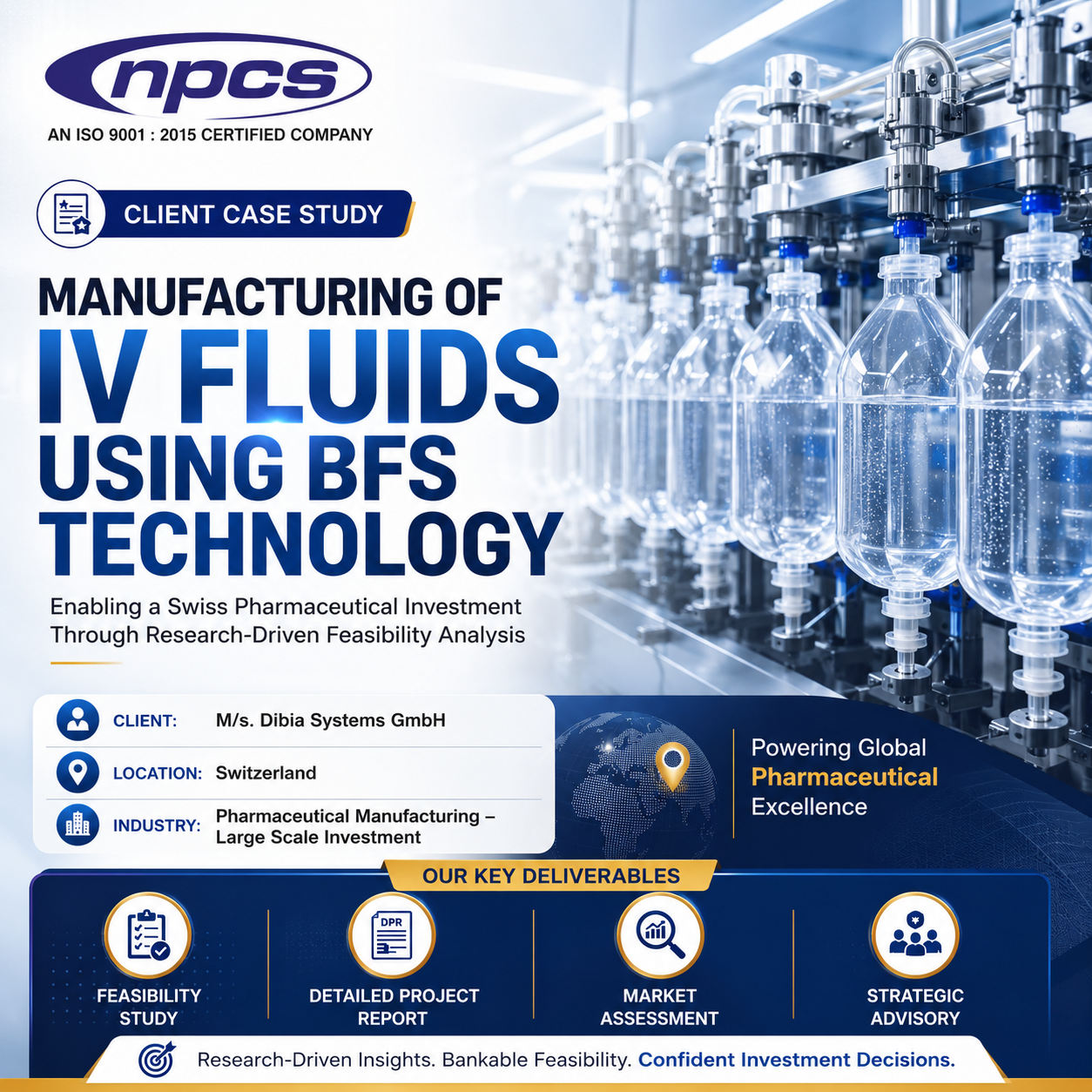
When Dibia Systems GmbH approached us, they had a clear goal but a lot of open questions. As a Swiss-based enterprise looking to diversify into pharmaceutical manufacturing, they needed more than general market optimism — they needed hard answers about which product segment made sense, whether the economics actually worked, and how to navigate one of the most regulated industries in the world.
After evaluating several pharmaceutical manufacturing verticals against the client's investment profile and Switzerland's regulatory environment, we identified IV fluid manufacturing using Blow-Fill-Seal (BFS) technology as the strongest fit. The reasoning was straightforward: consistent institutional demand, proven technology with strong regulatory acceptance, and a product category with genuine barriers to entry that would protect long-term returns.
From there, the engagement moved through six structured phases — market assessment, technical evaluation, raw material and supply chain analysis, financial modeling, and finally a full Detailed Project Report with strategic advisory. Nothing was left at a high level. The BFS process was mapped step by step, from API preparation and solution compounding through container formation, sterile filling, and quality release. Machinery specifications, cleanroom classifications, utility requirements, and GMP compliance pathways were all addressed in detail.
On the financial side, the modeling covered capital expenditure across land, civil works, BFS production lines, cleanroom infrastructure, WFI and HVAC systems, and QC lab setup — with revenue projections, break-even analysis, ROI and IRR outputs, and sensitivity testing across different capacity and cost scenarios. The numbers were built to hold up under scrutiny from financiers, not just to look good on paper.
Regulatory complexity was another area where the client needed clear guidance. IV fluid manufacturing for clinical use requires compliance with Swiss Medic, EU GMP Annex 1, and international pharmacopoeia standards. We mapped the regulatory pathway and built it into the implementation roadmap so the client wasn't discovering requirements after decisions had already been made.
By the end of the engagement, Dibia Systems GmbH had moved from an early-stage investment concept to a position where implementation planning could begin. That's the outcome that matters — not the volume of the report, but whether the client can actually move forward with confidence.
Entrepreneur India, an Industrial monthly magazine on industrial development, technologies & project opportunities aims at simplifying the process of choosing the suitable project for investment.

Entrepreneur India - Copyright 2017-. All rights reserved.



