

NPCS has been helping entrepreneurs, startups, MSMEs, and industrial investors since 1992 with detailed project reports, feasibility studies, market research, and business consulting services across 50+ industries.
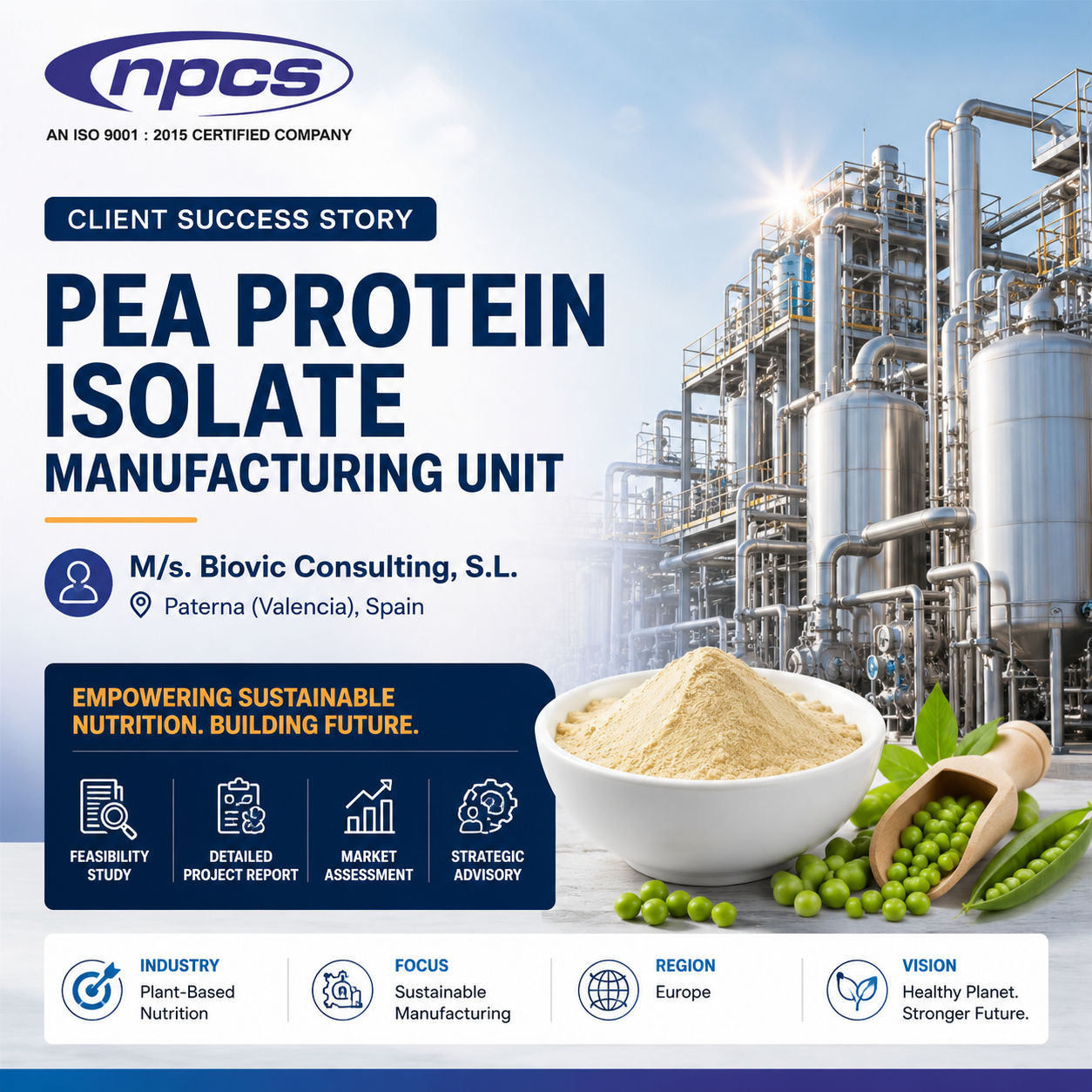
When Biovic Consulting, S.L. came to us, they weren't short on ambition. What they needed was clarity.
The Paterna-based investment consultancy had identified the plant-based nutrition space as a serious long-term opportunity — but the European market is fragmented, the technology options are technical, and the capital requirements are real. Before committing, they wanted a thorough, honest assessment of whether a pea protein isolate manufacturing unit made financial and operational sense.
That's exactly what we delivered.
Working across six structured phases, our team conducted a ground-up feasibility study covering every dimension of the project — from yellow pea supply chains across European agricultural regions to wet fractionation process technology, from CAPEX/OPEX modelling to regulatory compliance under EU food-grade manufacturing standards.
On the market side, the numbers were compelling. The European pea protein market was valued at around USD 556 million in 2023 and is growing at roughly 11.6% annually. Europe currently imports significant volumes of pea protein isolate — meaning a well-positioned domestic manufacturer enters a market with real import substitution potential, not just incremental demand.
The manufacturing process we evaluated centres on wet fractionation — extracting protein from yellow split peas through alkaline dissolution, isoelectric precipitation, and spray drying to achieve protein purity levels of 85–90%+. The resulting isolate serves plant-based meat, sports nutrition, dairy alternatives, and functional food segments — all of which are growing quickly.
Financially, the project modelling pointed to a total investment in the USD 8–15 million range depending on capacity, with realistic Year 3 revenue between USD 12–22 million at full utilisation. Gross margins for food-grade PPI at premium positioning typically run 35–45%, with a payback period in the four-to-six year range and an IRR between 18–26% across scenarios. Break-even falls at around 55–65% of installed capacity — reasonable for a first plant in a growing category.
Beyond the numbers, we mapped out a phased implementation roadmap: plant location selection, regulatory licensing, technology vendor evaluation, team structure, and go-to-market sequencing. Biovic left the engagement with a bankable report, a clear investment thesis, and the confidence to move forward into implementation planning.
The European plant-based protein sector is still early enough that first movers with solid manufacturing infrastructure stand to capture real market share. With the right process technology, procurement strategy, and product positioning, this is a category where a well-run plant can build durable competitive advantage.
Biovic Consulting chose to do it properly from the start — and that's the kind of decision that tends to pay off.
Entrepreneur India, an Industrial monthly magazine on industrial development, technologies & project opportunities aims at simplifying the process of choosing the suitable project for investment.

Entrepreneur India - Copyright 2017-. All rights reserved.



