

NPCS has been helping entrepreneurs, startups, MSMEs, and industrial investors since 1992 with detailed project reports, feasibility studies, market research, and business consulting services across 50+ industries.
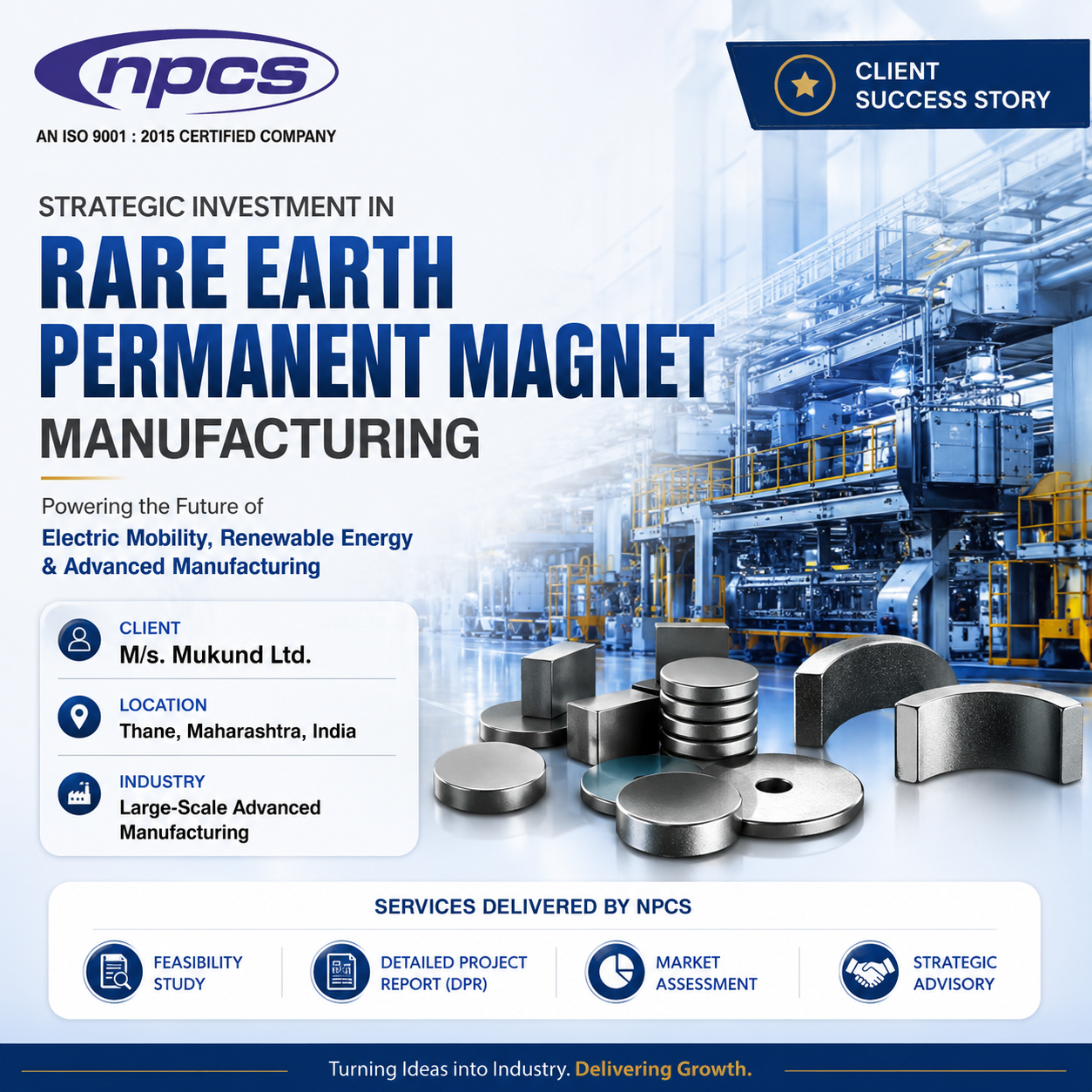
M/s. Mukund Ltd., Thane, Maharashtra, approached NPCS with the objective of identifying a future-focused manufacturing opportunity capable of delivering long-term growth, strong market demand, and sustainable profitability. The company sought a project that would not only align with evolving industrial trends but also offer scalability, technical feasibility, and attractive financial returns.
After a detailed assessment of investment goals, market opportunities, technical requirements, and industry trends, NPCS recommended the establishment of a Rare Earth Permanent Magnet Manufacturing unit. The recommendation was supported through a comprehensive Techno-Economic Feasibility Study and Detailed Project Report (DPR).
The study examined key aspects of the project, including market demand, import dependency, raw material sourcing, manufacturing technology, plant infrastructure, financial viability, and implementation planning. Special attention was given to the growing demand for rare earth magnets across electric vehicles, wind energy systems, industrial robotics, consumer electronics, aerospace applications, and defence equipment.
One of the major findings of the study was the significant dependence on imported rare earth permanent magnets in India. This created a strong opportunity for domestic manufacturing and import substitution. NPCS conducted extensive market research to evaluate demand trends, competitive dynamics, supply chain considerations, and potential customer segments in both domestic and international markets.
The technical evaluation covered the complete manufacturing process, from raw material procurement and alloy preparation to precision sintering, coating, magnetization, and quality testing. Suitable technologies, machinery requirements, plant layout considerations, and utility needs were identified to ensure operational efficiency and product quality.
A detailed financial analysis confirmed the project's commercial viability under standard operating conditions. The assessment indicated attractive return potential, sustainable operating margins, and a realistic payback period. The study also highlighted the possibility of leveraging government incentives, industrial development schemes, and manufacturing support programs to strengthen project economics.
Based on the findings and recommendations presented in the DPR, M/s. Mukund Ltd. gained the confidence required to move forward with implementation planning. The project established a clear roadmap for entering a strategically important manufacturing segment while reducing investment risk through structured planning and validated market intelligence.
This engagement demonstrates how a well-researched feasibility study can transform an industrial investment concept into a practical, bankable, and execution-ready business opportunity.
Entrepreneur India, an Industrial monthly magazine on industrial development, technologies & project opportunities aims at simplifying the process of choosing the suitable project for investment.

Entrepreneur India - Copyright 2017-. All rights reserved.



