

NPCS has been helping entrepreneurs, startups, MSMEs, and industrial investors since 1992 with detailed project reports, feasibility studies, market research, and business consulting services across 50+ industries.
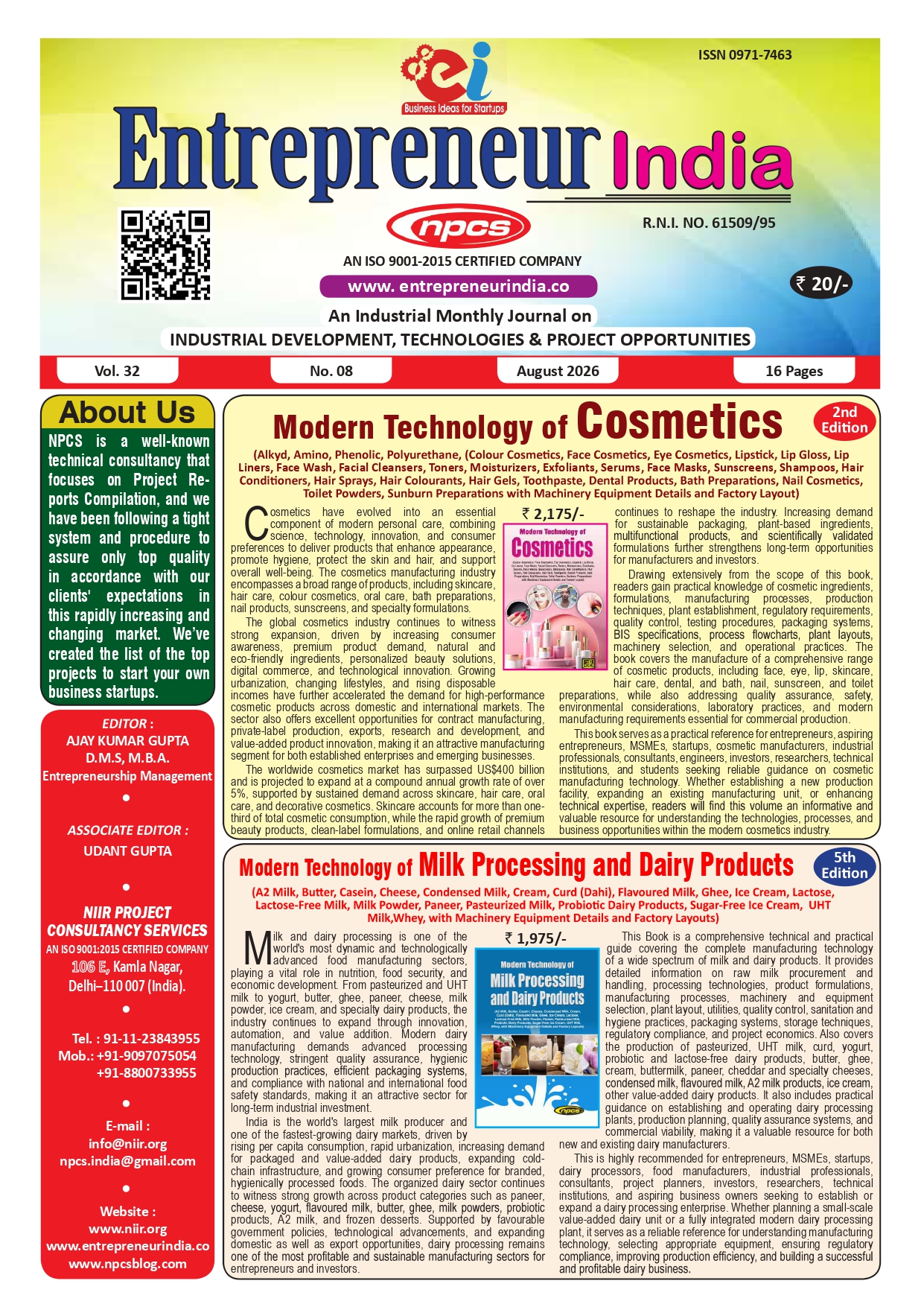
Entrepreneur India – August 2026: Turning Industrial Opportunities into Executable Business Plans
The August 2026 issue of Entrepreneur India, published by NIIR Project Consultancy Services (NPCS), brings together a wide range of manufacturing and processing opportunities spanning metals, pharmaceuticals, healthcare, agro-processing, packaging, chemicals, renewable energy and sustainable industries. The issue is designed to help readers look at business opportunities from a practical industrial perspective—considering not only market demand, but also technology, raw materials, machinery, investment requirements and project economics.
At its core, the issue reflects the NPCS approach of helping entrepreneurs move from an initial business idea towards a properly structured and executable project. For entrepreneurs, MSMEs, investors, consultants and financial institutions, this distinction is important. A business opportunity becomes meaningful when its technical feasibility, market prospects and financial viability can be evaluated together.
Why Business Planning Matters
Starting a manufacturing business requires considerably more than identifying a product with growing demand. Entrepreneurs need to understand the availability and cost of raw materials, appropriate production technology, plant and machinery requirements, manufacturing capacity, utilities, manpower, working capital and expected operating costs. Equally important are projected sales, profitability, break-even levels and the overall financial structure of the project.
This is where a techno-economic feasibility study and a structured project report become valuable. They provide a framework for examining whether an idea can realistically be converted into a commercially viable venture.
The August issue follows this project-oriented approach by presenting opportunities along with indicative capacities, investment considerations and business potential. The broader NPCS feasibility-report framework covers areas such as market assessment, manufacturing process, machinery and equipment, raw materials, plant layout, manpower, utilities, capital investment, working capital, cost of production, profitability, break-even analysis, cash flow and projected financial statements.
For an entrepreneur seeking finance or an investor evaluating a new proposal, such information can make the difference between a broad business concept and a clearly defined investment proposition.
India’s Industrial and Export Opportunity Landscape
One of the notable features of the August issue is the diversity of industries covered. The opportunities reflect an industrial environment in which conventional manufacturing is increasingly being combined with recycling, resource efficiency, value addition and sustainability.
The non-ferrous metals segment is represented through opportunities involving copper cathode, copper wire and aluminium ingots from scrap. These businesses connect recycling and secondary metal processing with demand from electrical, infrastructure, automotive and other industrial applications.
The issue also gives considerable attention to healthcare and hygiene manufacturing. Hospital disposables, sanitary napkins and intravenous fluids produced through Blow-Fill-Seal technology illustrate businesses supported by recurring consumption and the continuing need for reliable, quality-oriented manufacturing. The IV-fluid opportunity, in particular, highlights how automation and sterile production technologies can become important competitive factors in pharmaceutical manufacturing.
Sustainability and waste utilisation form another important theme. Compressed biogas from Napier grass, biomass pellets, bagasse-based animal feed and biodegradable cutlery made using rice husk demonstrate how agricultural residues and other resources can be converted into commercially useful products. These opportunities combine resource utilisation with the growing requirement for cleaner energy, alternative materials and value-added agricultural products.
Ventures Covered in the August 2026 Issue – Highlights
More Than a Magazine: A Practical Project-Planning Toolkit
The value of Entrepreneur India extends beyond the business ideas featured in each issue. Its supporting material connects industrial opportunities with the information required for further project evaluation.
NPCS’s Market Survey Cum Detailed Techno-Economic Feasibility Reports provide a more comprehensive route for entrepreneurs who want to investigate a particular business in greater depth. These reports address market position and future demand, import and export considerations, raw materials, manufacturing technology, machinery, manpower, land and building requirements, utilities, project cost, profitability, break-even point, cash flow and projected financial statements.
The August issue also provides access to a broad range of process-technology books and industrial reference material, covering chemicals and fine chemicals, pharmaceuticals, biotechnology, biofertilizers, biogas and biofuels, biodegradable products, packaging, food processing, agro-based industries, dairy, metals and several other sectors.
Together, these resources make the publication useful not only for discovering opportunities but also for taking the next steps towards project evaluation and business planning.
A Strategic Resource for Industrial Decision-Makers
The August 2026 edition of Entrepreneur India is ultimately a practical guide to understanding the relationship between industrial opportunity and project execution. It brings together manufacturing concepts from established sectors as well as newer opportunities emerging from sustainability, waste utilisation, healthcare demand, resource efficiency and technology-driven production.
For a first-generation entrepreneur exploring a manufacturing venture, an MSME considering diversification, an investor assessing new opportunities, or a consultant developing a project proposal, the issue provides a useful starting point for moving from business idea to feasibility assessment and informed investment planning.
In an environment where technology, capital efficiency, market access, compliance and financial viability increasingly influence the success of an industrial project, the August issue reinforces a simple but important principle: good opportunities require good project planning before they become successful businesses.
This is a digital version of the monthly print journal. For physical copies, please contact our circulation department.
Entrepreneur India, an Industrial monthly magazine on industrial development, technologies & project opportunities aims at simplifying the process of choosing the suitable project for investment.

Entrepreneur India - Copyright 2017-. All rights reserved.



