





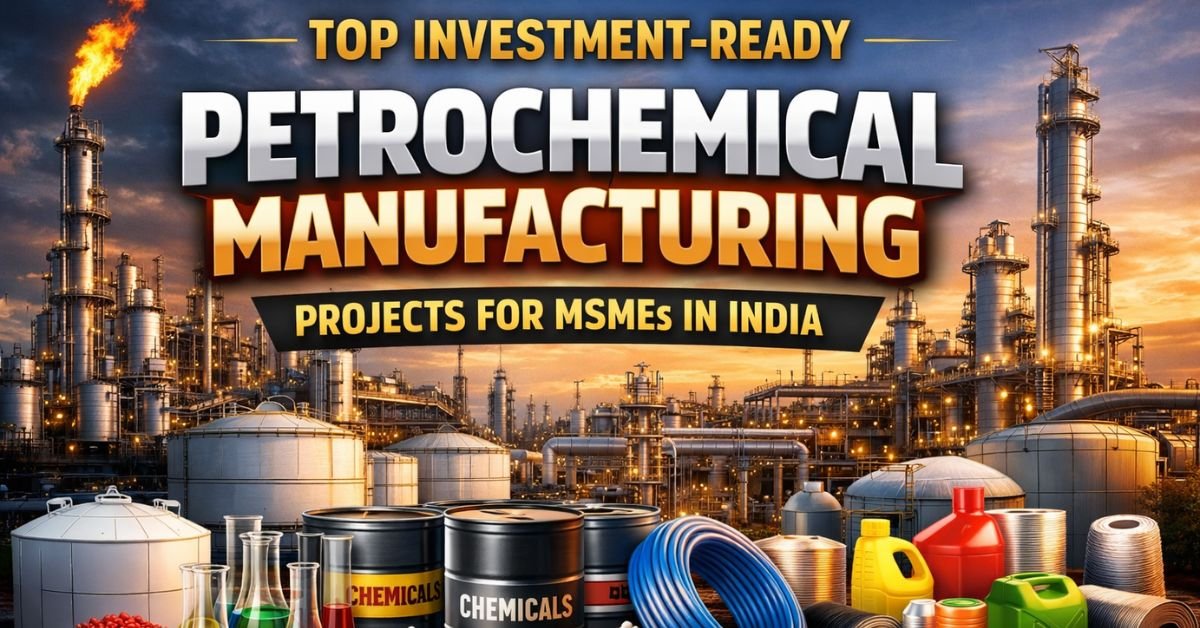
petrochemical business India
For many industrial entrepreneurs who are just getting into the business for the first time, the petrochemical industry seems full of large refineries, upstream crackers, and billion-dollar balance sheets. This perception often dissuades capable founders from looking at what is, in reality, one of India’s most startup-friendly manufacturing ecosystems – the downstream petrochemical sector.
While upstream petrochemicals demand huge capital investment and takes a long time to gestate, downstream petrochemical manufacturing is more of processing, compounding, blending and formulation which favors MSMEs and first generation entrepreneurs.
India’s petrochemical industry feeds the important sectors of automotive industry, packaging, construction, agriculture, electrical equipment, textile and consumer goods. According to industry data published by Department of Chemicals & Petrochemicals, polymers and olefins combined account for almost 60% of the entire production of petrochemicals which clearly shows sustained demand downstream.
For startup manufacturing units and MSME investors, this offers an interesting opportunity to enter the petrochemical value chain through value-added processing and not raw material production.
Table of Contents
ToggleRead More: Handbook On Chemical Industries (Alcohol Based)
Why Downstream Petrochemical Manufacturing Is Best for MSMEs
Downstream petrochemical projects are essentially different than upstream operations. Instead of refining crude oil or cracking hydrocarbons, downstream units produce standard polymers and chemical intermediates into high performance, application-specific materials.
Key Advantages for MSMEs
- Moderate capital investment (the range of 2-15 crore)
- Extrusion based or batch based production processes
- High value addition per unit of output
- Customization for industrial clients
- Long-term B2B supply contracts
- Easy scalability through modular capacity expansion
Unlike consumer product startups which depend a lot on branding and advertising, petrochemical MSMEs develop on the basis of process reliability, formulation consistency and performance compliance.
Understanding of Petrochemicals Demand Dynamics in India
Petrochemicals derivatives are industrial necessity, not discretionary products. Almost all the manufacturing industries rely on materials based on polymers and specialty chemical formations.
Important areas of application include:
- Automotive components and interiors
- Plastic packaging and films
- Electrical insulation and housings
- Construction chemicals, coatings
- Agricultural films and irrigation systems
- Medical disposables and tubing
Read More: Business Plans / Project Profiles
Petrochemical Production Share in India
Petrochemical Group | Approx. Share (%) |
Polymers | ~29.9 |
Olefins | ~29.8 |
Fiber Intermediates | ~12.2 |
Synthetic Yarn | ~9.3 |
Aromatics | ~6.0 |
Other Petrochemicals | ~5.8 |
Performance Plastics | ~4.3 |
The ongoing procurement activities from downstream industries take place because these segments maintain their operational capacity at full strength, which results in continuous revenue flow for MSME manufacturers.(petrochemical business India)
Investment Ready Downstream Petrochemical Manufacturing Projects
1. Manufacturing of Polymer Masterbatch
Polymer masterbatches are concentrated pigment and additives mixtures that are used to improve plastic properties such as UV resistance, flame retardancy, antistatic behavior, and color consistency.(petrochemical business India)
UFlex Ltd. and other industry leaders demonstrate that businesses need to focus on developing new polymer products for their downstream operations instead of making resin materials to establish their international competitiveness.
Why this project is suitable for startups:
- Extrusion-based manufacturing
- Strong demand from packaging converters
- High export acceptance
- Premium pricing for customized formulations
2. Thermoplastic Elastomer (TPE) Blend Manufacturing
Thermoplastic elastomers create an unsatisfactory solution because they provide rubber-like flexibility with plastic processing capabilities which cost more. These materials have many applications in:
- Seals and interior parts for automobiles
- Footwear and sports gears
- Medical tubing and devices
- Consumer electronics
Some of the key drivers of profit are:
- Mixing accuracy
- Controlled processing cycles
- Consistent quality assurance systems
Scalability is easy-infrastructure can be added and more blending lines added without duplication.
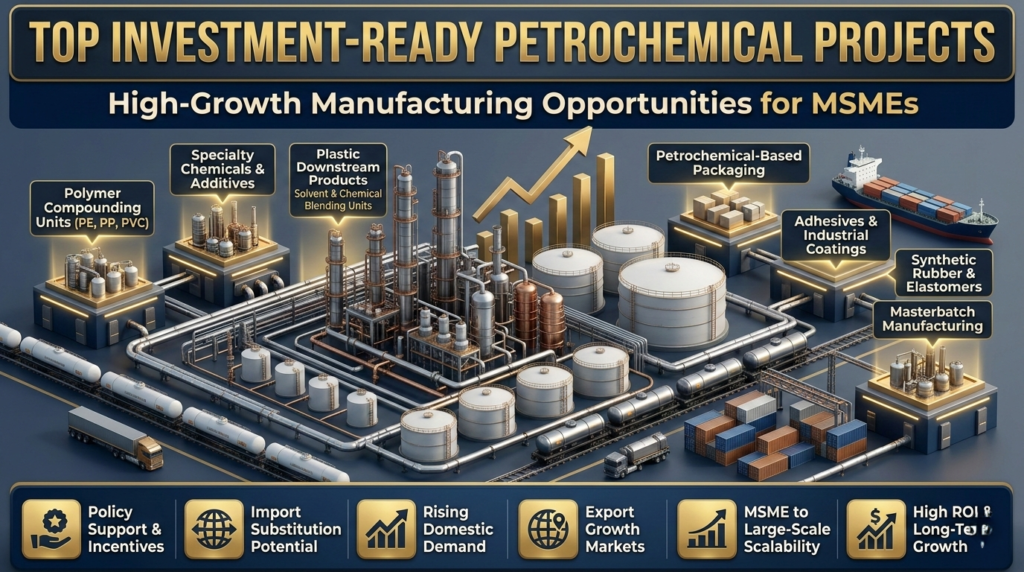
3. Synthetic Latex For Adhesives And Coating
Synthetic latex emulsions function as essential fundamental materials which manufacturers employ during their chemical production processes:
- Construction adhesives
- Textile and carpet backing
- Paper bonding
- Industrial paints and coatings
Nirma Group demonstrates how companies can achieve entrepreneurial success through their formulation discipline which supports their growth into robust chemical enterprises.(petrochemical business India)
Project advantages:
- Contract – based industrial demand
- Continuous consumption
- Modular reactor expansion
- Stable margins of consistent quality:
4. Engineering of Polymer Compounds
Engineering plastics are essential inputs for manufacturers of automobiles, electronics, and appliances that demand material with stringent standards of thermal, mechanical and flame retardant qualities.(petrochemical business India)
Companies such as Aarti Industries grew by concentrating on value added intermediates, as opposed to commodity chemicals.
Products with high demand include:
- Glass-filled polypropylene
- Flame Retardant Engineering Plastics
- Reinforced polymer compounds
These materials are supplied straight to automotive ancillaries, electrical equipment OEMs and consumer appliance brands.(petrochemical business India)
5. Specialty Coatings - Surface Treatment Chemicals
Surface treatment and specialty coatings have no second use in:
- Infrastructure projects
- Engineering fabrication
- Automotive manufacturing
- Export-oriented metal goods
Operational strengths are:
- Repeatedly industrial consumption
- Low dependence on branding
- Strong export viability
- Scalable batch-based processing
Export Potential for Petrochemical MSMEs
India has a well-integrated downstream petrochemical ecosystem embedded in global supply chains. MSMEs producing standardized polymer compounds, elastomeric blends and specialty formulations have access to international markets when certification requirements are met.(petrochemical business India)
Major channels of exports are:
- Automotive ancillary supply chains
- Solution providers for packaging
- Clustering of electronics manufacturing
- Exporters of medical and industrial components
Products like polymer masterbatches and TPE blends are often exported based on standards and the same specifications throughout the world.(petrochemical business India)
Major Things to Consider Before Making an Investment
A downstream petrochemical project would need to be examined through techno economic feasibility and not merely a market demand.(petrochemical business India)
Critical Evaluation Parameters
- Raw material yield & wastage rates
- Energy consumption per batch
- Working capital cycles
- Environmental compliance costs
- Quality certification requirements include
Professional feasibility analysis is useful for entrepreneurs to avoid common pitfalls like under designed capacity, cost over runs or compliance gaps.(petrochemical business India)
Role of Professional Project Consultancy
Organizations like Niir Project Consultancy Services are helping entrepreneurs in doing Market Survey-cum-Detailed Techno Economic Feasibility Reports (DPRs).
These reports usually contain:
- Manufacturing process descriptions
- Market demand and competition analysis
- Process flow diagrams
- Machinery and raw material specification
- Capacity planning, product mix
- Financial projections and profitability analysis
The studies enable founders to assess the feasibility together with risk assessment and scalability evaluation together with assessment of long-term business sustainability before they invest their funds.(petrochemical business India)
Final Perspective
The entry point of downstream petrochemical manufacturing represents the most effective business entry point which MSMEs can use to enter the Indian market. The projects have predictable demand together with export potential and they need investments which can grow with the business.(petrochemical business India)
The entrepreneurs who focus their efforts on process discipline and formulation stability together with quality certifications and B2B relationships will establish enduring manufacturing enterprises which generate high profit margins.
Petrochemical downstream processing provides new manufacturing startups with industrially relevant projects which they can develop into investment-ready ventures.(petrochemical business India)
Frequently Asked Questions (Founder-Focused)
Are downstream petrochemical projects suitable for first-time entrepreneurs?
Yes. Compounding, blending, and formulation-based units are highly suitable for first-generation founders.
What is the typical investment range?
Most MSME-level projects require ₹2 crore to ₹15 crore, depending on capacity and automation.
Do polymer-based products have export demand?
Yes. Automotive, packaging, and electronics industries actively source polymer compounds internationally.
What are the key risks?
Raw material price volatility and quality control lapses, both manageable through contracts and process discipline.
Can capacity be expanded easily?
Yes. Extrusion- and batch-based plants scale efficiently through additional production lines.


