


• Latest
  • Trending
  • All
Why India Imports Sorbitol Despite High Maize Production – A Golden MSME Manufacturing Opportunity

Why India Imports Sorbitol Despite High Maize Production – A Golden MSME Manufacturing Opportunity

May 26, 2026
MSME Manufacturing Business Ideas

42 MSME Manufacturing Business Ideas Up to ₹85 Lakhs

June 30, 2026
IV Fluid Manufacturing Business in India: Investment Guide

IV Fluid and IV Administration Set Manufacturing Business in India: Drug License, GMP and Investment Guide

June 30, 2026
Project & Profile
Medical Glove Manufacturing Business in India: Profit Guide

Surgical and Examination Glove Manufacturing Business in India: Latex vs Nitrile, Investment and Licensing

June 30, 2026
Battery Recycling Business India: MSMEs & Startups

India’s Rs 1,500 Crore Battery Mineral Recycling Revolution: 5 Profitable Business Opportunities for MSMEs & Startups in Critical Minerals

June 29, 2026
Gujarat Sports Equipment Manufacturing Hub in Chhota Udepur showcasing bamboo sports equipment manufacturing opportunities for startups and MSMEs

Gujarat’s Tribal-Skills Sports Manufacturing Hub: The ₹1,331 Crore Market Window Every Entrepreneur Must See

June 29, 2026
Critical Minerals Recycling Business Opportunity India

Critical Minerals Recycling: India’s ₹1,500 Crore Startup Goldmine

June 29, 2026
India Furniture Export Business Opportunity MSMEs & Startups

India’s Furniture Sector Is Sitting on a ₹2.5 Lakh Crore Export Opportunity — FTAs Just Opened the Gate

June 29, 2026
CBG Business Opportunity in India

Compressed Biogas (CBG) Business Opportunity in India: How Chhattisgarh’s CG-CBG Policy 2026 Opens the Door for Entrepreneurs and MSMEs

June 29, 2026
Green Ammonia and Green Methanol

Green Ammonia & Methanol from Odisha’s Coastal Ports: The Industrial Chemical That Could Power India’s Decarbonisation

June 26, 2026
India Logistics Cost Challenges: (13–14% GDP Logistics)

India’s Logistics Cost Is 13–14% of GDP vs the World Average of 8% — What This Means for Your Factory

June 25, 2026
Propylene Glycol Manufacturing Business in India

Production of Propylene Glycol: A High-Demand Industrial Opportunity for Indian Entrepreneurs

June 24, 2026
Waste to Energy Plant in India

Waste-to-Energy Plant in India: Investment, Technology & ROI

June 24, 2026
  • About
  • Advertise
  • Privacy & Policy
  • Contact
Wednesday, July 1, 2026
  • Login
Entrepreneur India Blog
  • Home
  • About
  • Books
  • Business Ideas
  • Contact
No Result
View All Result
Entrepreneur India Blog
No Result
View All Result
Home Agri Business Opportunities

Why India Imports Sorbitol Despite High Maize Production – A Golden MSME Manufacturing Opportunity

by P.K. Chattopadhyay
in Agri Business Opportunities
0
Why India Imports Sorbitol Despite High Maize Production – A Golden MSME Manufacturing Opportunity
511
SHARES
1.5k
VIEWS
Share on FacebookShare on Twitter

Maize Wet Milling Business

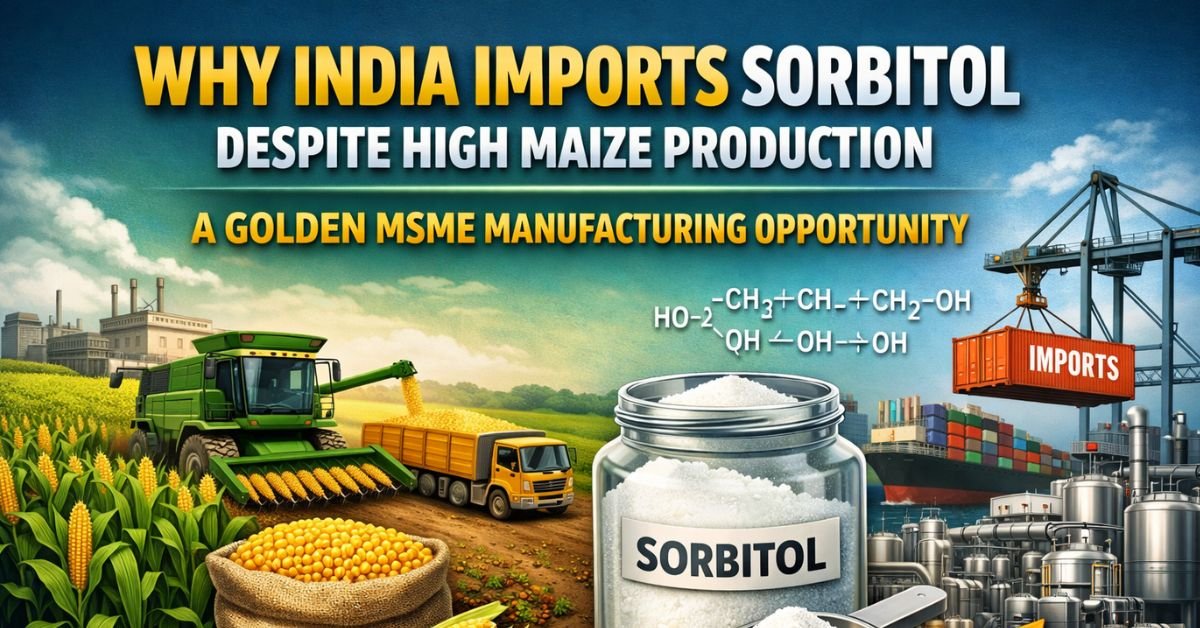
India’s strength in agriculture is well known but one of the best industrial opportunities in the country is underutilised – converting maize into high-value biochemical derivatives. While India is one of the leading countries in production of maize, the country has a structural demand-supply gap of starch, glucose, dextrose and sorbitol derivatives. This gap represents a great investment opportunity for MSME entrepreneurs looking to establish profitable agro processing ventures with a strong domestic demand, import substitution potential, and government policy support.

This market insight – SEO optimized covers the reasons why maize derivatives manufacturing is emerging as one of the best MSME business opportunities in India till 2032.

Table of Contents

Toggle
    • Read More: Maize (Corn) Products in India (Starch, Glucose, Dextrose, Sorbitol) Trends, Opportunities, Market Analysis and Forecasts (Upto 2030-31)
  • Strength of Maize Production in India vs Industrial Processing Facts
  • Increasing Industrial Demand for Maize-Based Derivatives
    • Read More: Maize (Corn) Products in India (Starch, Glucose, Dextrose, Sorbitol) Trends, Opportunities, Market Analysis and Forecasts (Upto 2017)
  • Import Dependence: A Missing Market Opportunity
  • Maize Wet Milling: A Multi-Product Revenue Model
    • Read More: Maize, Corn and its By Products, value added Products, Derivatives, Maize Processing Industry, Corn Starch, Dextrose, Liquid Glucose, Sorbitol, Oil, Gluten, Germ Oil, Wet Milling, Maize Starch Plant & related Products, High-Fructose Corn Syrup (HFCS)
  • Why MSME-Scale Units Make Business Sense
  • Government Incentives Help Boost Project Viability
  • Market Outlook Till 2032
    • Read More: Maize Processing Business in India: Opportunities in Starch, Dextrose & Sorbitol
  • Why Maize Derivatives Manufacturing is a High ROI MSME Opportunity
    • Read More: Why India Still Imports Sorbitol? Maize Processing Industry Capacity & Business Opportunity
  • Final Insight
  • Frequently Asked Questions (FAQ)

Read More: Maize (Corn) Products in India (Starch, Glucose, Dextrose, Sorbitol) Trends, Opportunities, Market Analysis and Forecasts (Upto 2030-31)

Strength of Maize Production in India vs Industrial Processing Facts

India produces more than 36-38 million metric tonnes of maize every year and this is supported by an increase in the area under maize cultivation, as well as an increase in the use of hybrid seed. However, under 25 percent of total maize production is industrially processed to starch and glucose derivatives. The majority is used by the poultry feed industry or traded as a raw material, which means that potential value is lost.

This imbalance points to a classic structural inefficiency:

strong agricultural supply + weak industrial infrastructure (secondary processing) = weak industrial demand.

As downstream industries grow further, this gap is predicted to widen further, if new processing capacity is not added – particularly at the MSME level.(Maize Wet Milling Business)

Increasing Industrial Demand for Maize-Based Derivatives

Maize derivatives are the sine qua non of functional inputs in several high-growth industries:

  1. Pharmaceuticals
  • Native starch – tablet binder, disintegrant
  • Liquid glucose Medical syrups
  • Dextrose monohydrate – IV fluids, fermentation media
  • Sorbitol – excipient, sweetener, stabilizer
  1. Food & Beverage Processing
  • Feeds & meals: – cake, biscuits, ice creams
  • Ready-to-drink beverages and nutrition products
  1. Personal Care & Cosmetics
  • Sorbitol used in toothpaste, creams, gels as a humectant
  1. Textiles & Paper
  • Starch based adhesives, warp sizing
  • Strengthening of paperboard

India’s processed food industry alone is expected to experience growth of more than 8% CAGR till 2030 and of those alone the demand for starch and glucose-based intermediates will skyrocket.(Maize Wet Milling Business)

Read More: Maize (Corn) Products in India (Starch, Glucose, Dextrose, Sorbitol) Trends, Opportunities, Market Analysis and Forecasts (Upto 2017)

Import Dependence: A Missing Market Opportunity

Despite adequate supply of maize, India is importing pharmaceutical grade sorbitol and specialty glucose syrups mostly from Southeast Asia. The reasons are structural rather than agricultural:

  • Limited domestic capacity for wet milling and refining
  • Insufficient number of plants that meet pharma and food grade purity standards
  • Regional imbalance of production and consumption clusters

Pharmaceutical hubs in Gujarat, Telangana and Himachal Pradesh still rely on imports of derivatives, driving up costs and exposing them to supply disruption worldwide.

For MSMEs, this import reliance represents immediate and local demand waiting to be filled.(Maize Wet Milling Business)

Maize Wet Milling: A Multi-Product Revenue Model

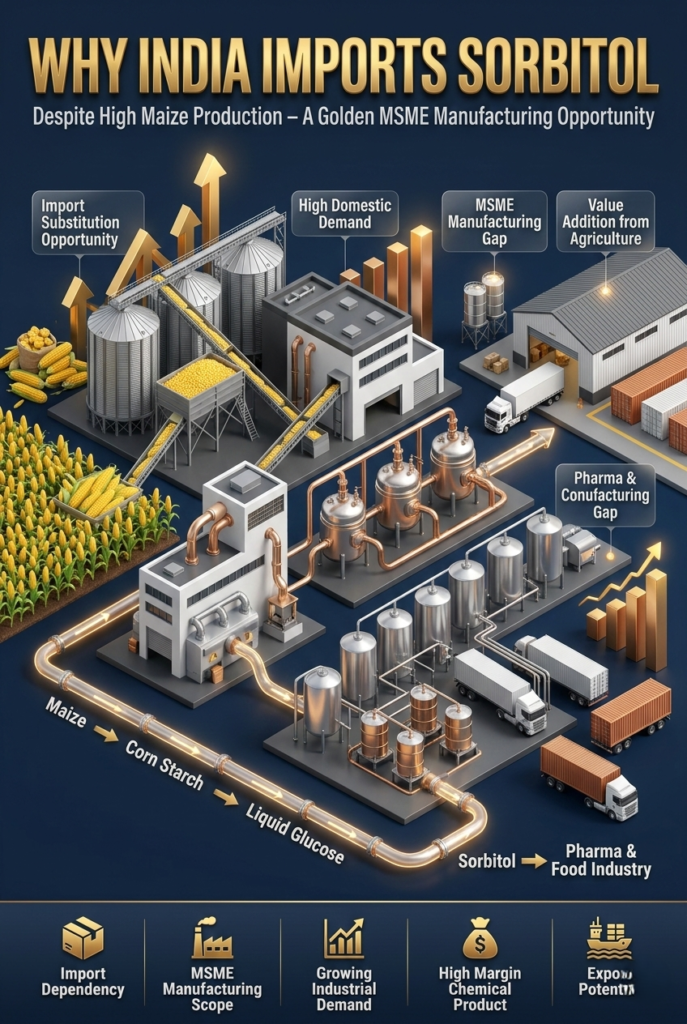
Maize wet milling is not business of one product – it is a portfolio manufacturing model to enhance profitability and risk diversification.

Core Process Overview

  1. 1. Steeping: Maize kernels softened in water with SO2
  2. Grinding & Separation: Starch, germ, fibre, gluten isolated
  3. Enzymatic Hydrolysis: Starch: liquid glucose
  4. Crystallization: Glucose: dextrose-monohydrate
  5. Hydrogenation: Glucose: sorbitol solution

Product Basket

  • Native maize starch
  • Liquid glucose
  • Dextrose monohydrate
  • Sorbitol solution

High-Value By-Products

  • Maize germ oil (edible oil market)
  • Gluten feed & fibre (animal feed industry)

This integrated output structure is very good for the stability of plant’s IRR and cash flows.(Maize Wet Milling Business)
Read More: Maize, Corn and its By Products, value added Products, Derivatives, Maize Processing Industry, Corn Starch, Dextrose, Liquid Glucose, Sorbitol, Oil, Gluten, Germ Oil, Wet Milling, Maize Starch Plant & related Products, High-Fructose Corn Syrup (HFCS)

Maize Wet Milling Business

Why MSME-Scale Units Make Business Sense

Some of the large players in the market are Gujarat Ambuja Exports Ltd., Sukhjit Starch & Chemicals Ltd., Riddhi Siddhi Gluco Biols Ltd., and Roquette India Pvt. Ltd. and dominate the supply of bulk.(Maize Wet Milling Business)

However, their plants are concentrated in small geographies, resulting in:

  • Increased freight costs to buyers
  • Regional supply shortages
  • Longer procurement cycles

MSME Advantage

  • Proximity to pharma & food clusters
  • Lower logistics costs
  • Faster customisation and deliveries
  • High B2B contract manufacturing potential

Decentralized wet milling units can effectively meet these regional shortfalls.(Maize Wet Milling Business)

Government Incentives Help Boost Project Viability

The Indian government actively promotes the agro-processing through financial and policy support:

Central Schemes

  • Pradhan Mantri Kisan Sampada Yojana
  • PM-FME Scheme
  • Argo Processing Cluster Infrastructure Scheme

State-Level Benefits

  • Capital subsidies
  • Interest reimbursement
  • Electricity Duty exemptions

These incentives have considerably lowered project payback periods to make maize derivatives manufacturing attractive to first-generation entrepreneurs.(Maize Wet Milling Business)

Market Outlook Till 2032

India’s maize Derivatives market is set for sustained growth owing to:

  • Rising consumption of processed foods
  • Pharmaceutical manufacturing growth
  • Industries include: – Personal care industry expansion
  • Fermentation-based chemical demand
  • Import substitution products in sorbitol & specialty glucose

By 2032, India will need significant new wet milling capacity, especially closer to consumption centres as opposed to solely the raw material centres.(Maize Wet Milling Business)

Read More: Maize Processing Business in India: Opportunities in Starch, Dextrose & Sorbitol

Why Maize Derivatives Manufacturing is a High ROI MSME Opportunity

Key Investment Strengths

  • Abundant domestic raw material
  • Multi-product revenue streams
  • Strong downstream demand
  • Government incentives
  • Import replacement advantage

Entrepreneurs who invest in wet milling plants optimized regionally early will have the advantage of a long-term market positioning and stable B2B demand.(Maize Wet Milling Business)

Read More: Why India Still Imports Sorbitol? Maize Processing Industry Capacity & Business Opportunity

Final Insight

India’s maize derivatives industry is a rare mix of agricultural plenty, industrial paucity and policy favouritism. For MSME entrepreneurs who are looking for manufacturing opportunities that scale and are future-ready, maize wet milling presents one of the best investment cases in India’s agro-industrial arena.(Maize Wet Milling Business)

Early entrants targeting quality, regional supply and pharma-grade compliance are the best placed to meet this growing demand until 2032 and beyond.(Maize Wet Milling Business)

Frequently Asked Questions (FAQ)

Q1. Is maize derivation manufacturing appropriate for MSMEs?

Yes. Modular wet milling plants can be designed at MSME scale with phased capacity expansion and diversified product output.

Q2. Which maize derivative is in the most demand?

At present, liquid glucose and sorbitol have the greatest demand with the food, pharma and personal care sectors growing.

Q3. Why is there still a sorbitol import in India?

Due to limited domestic refining capacity, which was not able to fulfill pharmaceutical-grade specifications – not because of maize shortage.

Q4. Where is the best place to establish a maize wet milling plant?

Near pharma clusters or food processing zones, to ensure close to end-users and lower logistics costs.

Q5. Are there government subsidies for such projects?

Yes. Central and state schemes give capital subsidy, support of interest, and infrastructure.

Q6. How profitable is maize wet milling unit?

Profitability is enhanced by by-product monetization, multi-derivative output and stable B2B contracts.

Tags: flint maizemaize
Share204Tweet128
Previous Post

Container Manufacturing Business in India: Budget 2026 ₹10,000 Cr Opportunity

Next Post

Top Petrochemical Products India Still Imports: MSME Import-Substitution Opportunities You Can Profit From

P.K. Chattopadhyay

P.K. Chattopadhyay

P. K. Chattopadhyay is a seasoned Project Consultant with over 45 years of hands-on experience in project consultancy across diverse industries. He has guided hundreds of companies and entrepreneurs through project planning, feasibility studies, and industrial setup — turning business ideas into practical, scalable ventures. A prolific author of business and startup-focused books, P. K. Chattopadhyay brings together real-world industry data, actionable insights, and proven execution strategies tailored for entrepreneurs and investors at every stage of their journey. His core expertise spans manufacturing projects, market analysis, and business viability assessment — making his work an indispensable resource for anyone building a sustainable and profitable business from the ground up.

Next Post
petrochemical import substitution manufacturing plant in India

Top Petrochemical Products India Still Imports: MSME Import-Substitution Opportunities You Can Profit From

Leave a Reply Cancel reply

Your email address will not be published. Required fields are marked *

Contact Us

    Categories

    • Agri Business Opportunities
    • Chemical Industry Business Opportunities
    • Cosmetics and Personal Care Business
    • Eco Friendly Sustainable Business
    • Entrepreneurship Leadership and Startup Growth
    • FMCG Consumer Products Business
    • Food Processing Business Industry
    • Future & Emerging Industries
    • Government Schemes Policies for Business
    • Import Export Business Opportunities
    • Industrial Project Reports Business Guide
    • Investment Funding for Startups
    • Manufacturing Business Ideas for Startups
    • Market Research Trends for Business
    • MSME & Small-Scale Industries
    • Paper Pulp Industry Business
    • Pharmaceutical Industry Business
    • Plastic & Packaging Business
    • Renewable Energy Startups
    • Startup Business Opportunities
    • Startup Business Planning and Strategy
    • Technology & Automation Business
    • Textile Industry Business
    • Uncategorized
    • Waste Management & Recycling Business
    • Water & Environmental Business
    Entrepreneur India Blog

    Copyright © 2026 Entrepreneur India

    Navigate Site

    • About
    • Advertise
    • Privacy & Policy
    • Contact

    Follow Us

    Welcome Back!

    Login to your account below

    Forgotten Password?

    Retrieve your password

    Please enter your username or email address to reset your password.

    Log In
    No Result
    View All Result
    • Home

    Copyright © 2026 Entrepreneur India

    Are you sure want to unlock this post?
    Unlock left : 0
    Are you sure want to cancel subscription?
    Call Us
    Whatsapp