




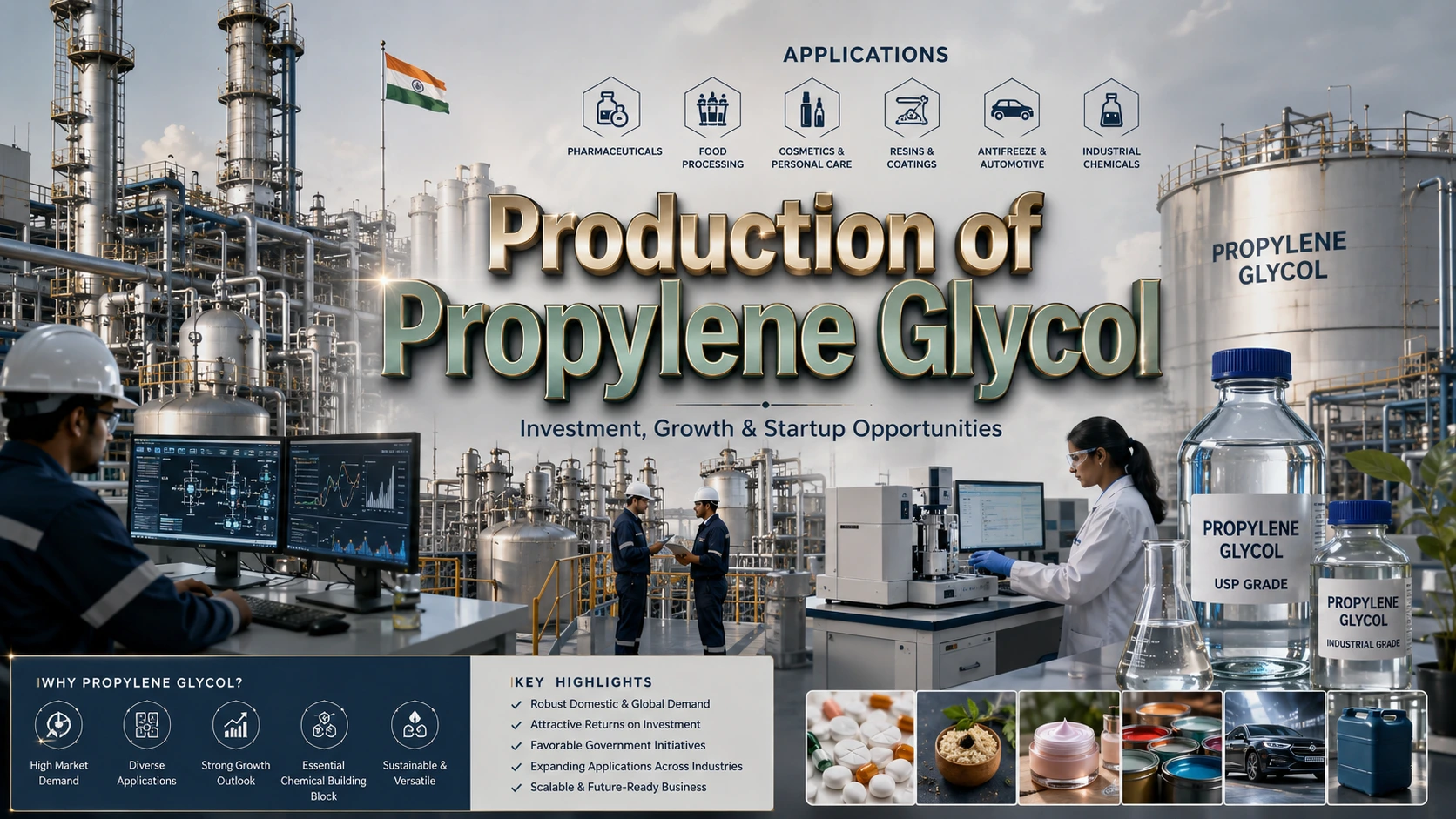
Propylene glycol is one of the most promising yet commercially viable business ideas that are untapped in the field of specialty chemicals in the Indian manufacturing industry. A clear, viscous liquid used in a broad range of industrial applications including pharmaceuticals, food processing, cosmetics, antifreeze and industrial fluids, among others. Though the domestic manufacturing has not been able to match the rising demand in India as it becomes a major manufacturing hub for the world. It’s exactly where a sound business plan can create a worthwhile, expanding role for a new business.
Why Propylene Glycol Manufacturing Is a Smart Market Entry Now
The propylene glycol market is in billions of dollars in the world and India is among the fastest growing consumers. The growth of the pharmaceutical industry alone should give this opportunity a close look. Propylene glycol is used as an excipient, carrier and solvent in dozens of drugs. The food industry uses it as flavours stabilizer and humectant in the meantime. Indian FMCG brands have scaled up significantly and its presence in cosmetics and personal care products has increased in leaps and bounds.
Domestic manufacturing, however, is concentrated in the hands of a handful of big chemical manufacturers. This creates a genuine opportunity for the MSME class entrepreneurs, especially in areas where feedstocks are available or in the vicinity of end-user industries. In the case of propylene glycol, Indian manufacturers have the advantage of import substitution logic as this is an import intensive product. The margin structure is nice. Propylene oxide or propylene from petroleum refining is readily available as a feedstock. Furthermore, this technology is well established and proven, which helps lower the risk of innovation for new players.
Specifically, the pharmaceutical industry is fueling the continued demand. As India’s pharmaceutical export industry grows, formulation manufacturers are in need of steady supply of high-quality, cost-effective propylene glycol. This is an added cost and risk of the supply chain. That is where a domestic MSME supplier can come in and can be able to negotiate for long term supply contracts. Likewise, the rising number of personal care startups in India will create a new niche for the demand of high-quality propylene glycol with local sources.
Related Article: Propylene Oxide Production: Business Ideas, Market Opportunity & Investment Guide for Indian Entrepreneurs
Government Policies and Schemes Supporting New Chemical Manufacturers
The policy regime in India has grown much more conducive for the establishment of chemical manufacturing enterprises. There are various central schemes that directly supports the propylene glycol production units, particularly the ones that come in at MSME scale.
Collateral-free loans of up to ₹2 crore are provided by the MSME Ministry to support new businesses through the Credit Guarantee Fund Trust for Micro and Small Enterprises (CGTMSE), which is a major assistant for early-stage financing of chemical plants. Even though the Production Linked Incentive (PLI) scheme for specialty chemicals primarily focuses on larger investments, it can provide opportunities for MSME sub-suppliers and contract manufacturing.
Chemical manufacturing is included in the priority sector under the Make in India program of the Ministry of Commerce and Industry. This translates to quicker approvals, special industrial areas and government-to-government linkages for the buyers. The DPIIT’s Start up India scheme provides 3 years exemption from income tax and also provides less regulatory burden to recognized startups in the initial stage of scaling up the business. This benefit may have a positive impact on cash flows in the early years for those who qualify for it.
The agro-processing clusters under ASPIRE scheme of the Ministry of MSME benefit not only the agro-processing units but also chemical processing units in the same vicinity. In addition, new entrepreneurs must look for schemes for capital subsidy by the state governments under state industrial policies and MSME loan schemes offered by SIDBI.
Business Ideas in Propylene Glycol: Specific Project Models for Startups
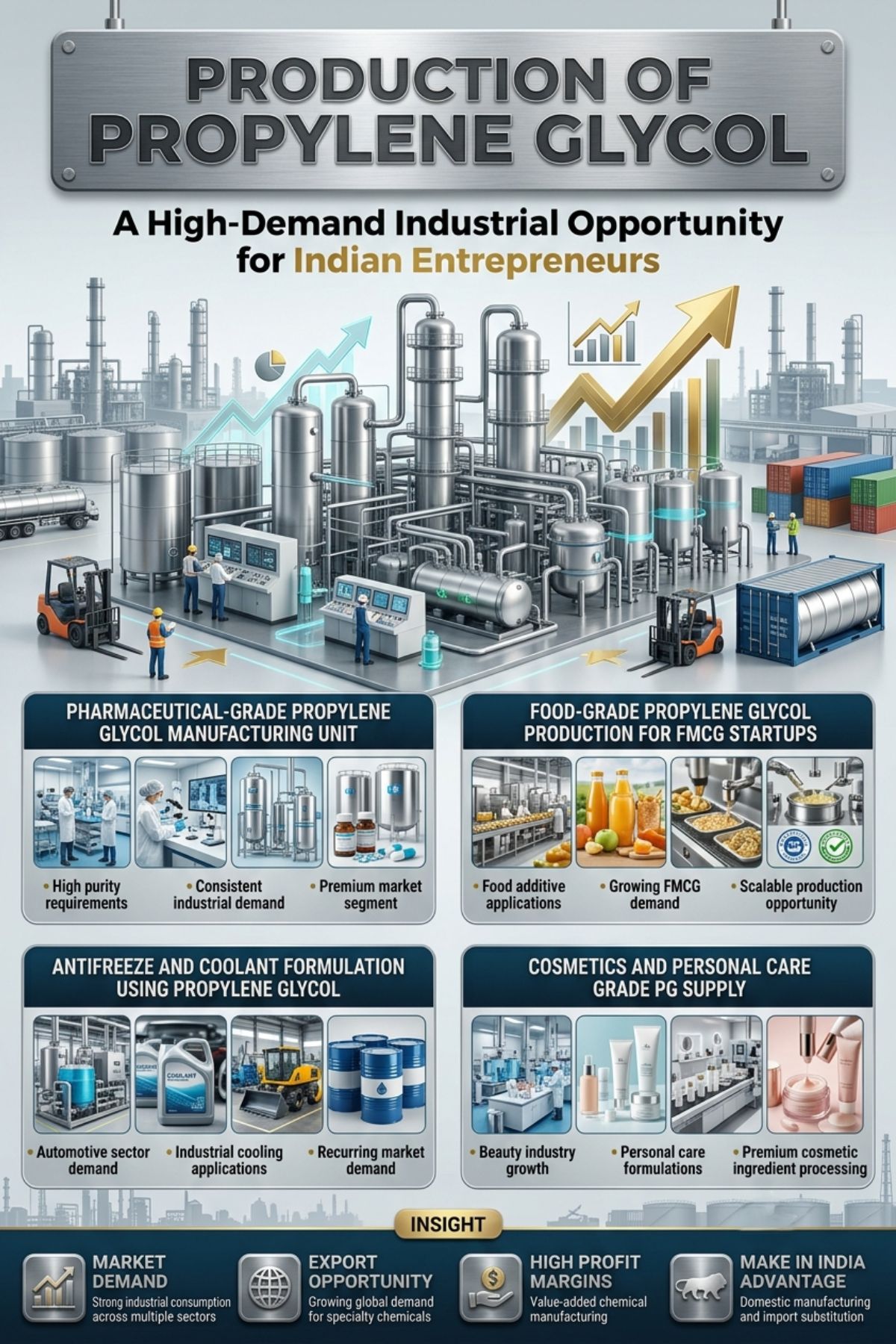
1. Pharmaceutical-Grade Propylene Glycol Manufacturing Unit
This is probably the most profitable starting point for a new business. Propylene glycol used in pharmaceutical applications should conform to USP (United States Pharmacopeia) and IP (Indian Pharmacopoeia) standards and should be of high purity, undergo rigorous quality testing and be produced in a certified GMP facility. It’s more difficult to get in — but it’s also more difficult to get people out, and more valuable to have good customers. A pharmaceutical formulation firm that qualifies a new supplier does not change suppliers without a reason, which means that the company will have long-term visibility of revenues. The estimated capital requirement for a mid-scale unit for pharma grade ranges from ₹2.5 crore to ₹4.5 crore. The target customers are domestic pharmaceutical manufacturers, API manufacturers, and export companies. Those who have a background in chemical engineering or pharma operations have an edge here. If approvals from FSSAI and drug controller are obtained beforehand, it will help to enter the market at a swift pace.
Get Detailed Insights from This Book: Drugs & Pharmaceutical Technology Handbook
2. Food-Grade Propylene Glycol Production for FMCG Startups
India has a big and growing market for food and beverages, which are significant propylene glycol consumers. The uses of PG in foods are as humectants in baked goods, as a carrier for food colours and flavours, and as a preservative for some packaged foods. Food-grade propylene glycol has a premium price tag to industrial-grade due to being approved by FSSAI. Flexibility in production and multiple revenue streams are provided by a dedicated food-grade production line (or hybrid production line that allows for the production of both food and industrial grade). The fast formalisation of the domestic food industry creates a demand for certified inputs from sources which are traceable to the domestic level. The growing packaged food start-up ecosystem in Tier 2 cities can be a great opportunity for an entrepreneur to establish a robust supply position.
3. Antifreeze and Coolant Formulation Using Propylene Glycol
Propylene glycol antifreeze is the better choice for the environment in many applications over ethylene glycol antifreeze. It is employed in HVAC systems, chillers for manufacturing and packaging processes, food-grade cooling loops, and has been increasingly applying to EV battery cooling systems. With the growing EV infrastructure in India, there is a significant increase in the demand for non-toxic, biodegradable coolants formulations. A downstream facility to formulate anti-freeze and coolant products, using the propylene glycol as raw material, can be started with an investment of ₹50 lakh to ₹1.5 crore by an entrepreneur. This model minimizes the complexity of the upstream chemical synthesis, and also includes formulation margins. Branding and distribution in the EV component supply chain becomes an opportunity for high growth revenue.
4. Cosmetics and Personal Care Grade PG Supply
Propylene glycol is in demand in cosmetic applications in the fast-growing D2C cosmetic & personal care sector in India, in significant and increasing quantities. It is used as a moisturiser, solvent, preservative booster, and agent in skin conditioning in lotions, serums, toners, and in hair care products. The domestic cosmetics industry is increasingly interested in suppliers of domestic ingredients with audit trail, thereby providing a natural market for a quality certified local PG producer. A startup may become a trusted MSME supplier to D2C brands, contract manufacturers, and Ayurvedic formulation companies that are going through a period of rapid growth. The investment range for this scale is ₹ 1.5 crore to ₹ 3 crore based on the output capacity & purity requirements.
Import–Export Opportunity Analysis for Propylene Glycol Entrepreneurs
India is an importer of large quantities of propylene glycol in the year, mostly from the United States, Germany, South Korea, and China. This reliance on imports is a weakness for domestic consumers, and a planned strength for new domestic producers. This would be a substantial business if we were to replace just some of that imported volume with proprietary, competitively priced, quality certified propylene glycol produced domestically. Import substitution is not only a policy story, it’s a reality for buyers who want a stable supply chain and predictable costs.
On the export side, Indian-made propylene glycol can appeal to customers in South Asia, Africa and Southeast Asia, where Indian chemical goods are becoming popular as a result of cost competitiveness and enhancement in quality certification. Useful trade data and facilitation support from the Chemicals and Petrochemicals Manufacturers’ Association (CPMA). Apart from that the import export incentives and market access programmes are provided by the Chemicals Export Promotion Council (Chemexcil) under the Commerce Ministry. An MSME unit that can manufacture USP grade propylene glycol can make an achievable export plan for generic drug manufacturing companies in Africa and Southeast Asia, for whom Indian API and excipient suppliers have built a good reputation.
Get Detailed Project Report (DPR): Project Reports & Profiles
Indian MSME Leaders in Specialty Chemical Manufacturing: Lessons for New Entrepreneurs
Vinati Organics – Built on Niche Chemistry
One of India’s most successful specialty chemical success stories is Vinati Organics, which was promoted by Vinati Saraf Mutreja. The company recognized a small niche (ATBS and IBB) and by implementing process efficiency and guaranteeing quality at every stage of production, they became global leaders in the market. Propylene glycol businessmen can learn from that; no need to compete with the commodity producers. Defensible market positions are developed based on purity, certifications, and specific end use applications. Vinati’s success story from a small unit in Maharashtra to a well-known specialty chemical company globally is a testament to the successful patient growth and quality approach adopted by the company in the Indian chemicals industry.
Aarti Industries – Integration and Scale from MSME Roots
Established by the Gogri family as a small trading and manufacturing company in basic chemicals, Aarti Industries has gradually expanded its backward integration and product diversification. The strategy of the company is: “go down and understand the economics, backward and then grow derivatives” and it is a strategy that is very relevant to propylene glycol. A start-up which starts its formulation from the downstream part of the process and later contributes to propylene glycol production is based on the same principle. The examples of Aarti’s journey clearly shows that with a disciplined financial management, a customer approach and reinvestment of technical resources, an MSME chemical unit can be transformed into a large entity over time and be listed on stock exchanges.
SRF Limited – Specialty Chemicals Built on Technical Depth
The chemicals business of SRF has matured from a highly technical, process-oriented MSME culture, and now is a major part of SRF’s operations. The focus of the promoter group on R&D, regulatory compliance and nurturing customer confidence through providing consistent product quality is the same focus new propylene glycol producers will need to have. Quality certifications like ISO, GMP, USP compliance don’t mean excessive paperwork. They are instruments of market access that lead to market-wide negotiated premium buyers and export contracts.
How Niir Project Consultancy Services Supports New Ventures in This Sector
If you’re considering investing in propylene glycol manufacturing, a proper feasibility study is a must. We, Niir Project Consultancy Services (NPCS) offer professional consulting services to prepare Market Survey cum Detailed Techno-Economic Feasibility Reports (DPRs) for setting up a new industry or business. Our reports comprise of in-depth manufacturing processes, market research, demand analysis, process flow diagrams, product mix, capacity planning, machinery and raw material’s details, and full financials of the project along with the profitability analysis. This goal is to assist entrepreneurs in conducting feasibility and profitability, and long-term scalability assessments prior to investment.
A well-defined DPR can help make some of the key factors more clear, such as optimal plant size, sourcing of feedstock, target grade (pharma vs. food vs. industrial) and realistic return timeframes in the propylene glycol space specifically. This is the type of evidence-based decision support that makes for a successful investment or an expensive learning experience.
Identify high-growth industries before others do
Propylene Glycol Production: Key Data Snapshot
| Parameter | Detail / Estimate | Remarks |
| Global Market Size | USD 4.5–5.5 Billion+ | Steadily expanding globally |
| India Import Volume | ~80,000–1,00,000 MT/Annum | Significant import substitution scope |
| Key Application Sectors | Pharma, Food, Cosmetics, Antifreeze, Industrial | Multi-sector demand base |
| Pharma-Grade Price Range | ₹120–₹180 per kg | Higher margin vs. industrial grade |
| Industrial-Grade Price Range | ₹80–₹110 per kg | Volume-driven margins |
| Minimum Plant Investment (MSME) | ₹1.5 Crore–₹5 Crore | Depends on grade and capacity |
| Typical Payback Period | 3–5 Years | Faster for downstream formulation |
| Top Feedstock | Propylene Oxide (PO) | Available via petrochemical suppliers |
| Key Certification Requirements | GMP, FSSAI, ISO 9001, USP/IP compliance | Grade-specific requirements |
| Key Export Markets | South Asia, Africa, SE Asia | Growing export opportunity |
Frequently Asked Questions (FAQs)
Q1. What is the minimum investment needed to start a propylene glycol production unit in India?
The investment varies as per grade and scale. 50 lakhs to 1.5 crore is the investment for formulation / blending unit downstream for cosmetics/antifreeze. For synthesis-based MSME plant for pharma/food-grade, you will be looking at 2.5 crore to 5 crore, including plant & equipment, utilities, laboratory setup, working capital. CGTMSE loan can help you keep the upfront equity low.
Q2. Which grade of propylene glycol is most profitable for a new startup?
Pharma-grade propylene glycol commands the highest margins — typically 25–40% above industrial grade — because of stringent purity requirements and long-term supply agreements with pharmaceutical buyers. However, it requires GMP-compliant manufacturing, validated analytical methods, and regulatory documentation. Food-grade PG offers a good balance of margin and relatively lower certification complexity. Entrepreneurs with pharmaceutical backgrounds will find pharma-grade the most strategically defensible entry point.
Q3. Is there strong export potential for Indian-made propylene glycol?
Yes, it does. Indian specialty chemical exporters have credibilty not just in South Asian countries, Africa, Middle East, but also in Southeast Asian regions. Especially pharma-grade/food-grade, the specialty propylene glycol conforms to the trend of export, which is promoted by organisations like Chemexcil. It takes the exporter (a new player who has certification for quality and can deliver faster with a competitive price) about 18-24 months from the launch of commercial production to build volume. There are also benefits like financial assistance and subsidies available under the Foreign Trade Policy.
Q4. What raw materials does a propylene glycol plant require?
PO is the chief feedstock which is converted into PG through reaction with Water at a given temperature & pressure. PO is purchased from the petrochemical supplier and is the active traded product in India. The input for the plant besides PO is utilities like steam, cooling water, power etc and deionised water and inert gas system if for high-purity pharmaceutical and food grade PG. The feedstock price contributes about 60-70% to the total production cost and hence feedstock contracts become critical in deciding the financial aspect.
Q5. What government approvals are required to start production?
Based on your planned facility size and area, you need: Factories Act manufacturing factory license, State Pollution Control Board EC or environmental permit, GST registration, MSME Udyam registration, Food Safety and Standards Authority of India (FSSAI) permission in case it is food-grade, and Directorate of Drug Control and Licensing or Drug Controller certificate in case it is pharmaceutical-grade. Setting your unit in designated Chemical Industrial Zones would simplify regulations. The single-window clearance portal by the DPIIT has helped registered startups simplify clearances and approvals from multiple government agencies.
Q6. How should a first-time entrepreneur validate the business case before investing?
Prior to any capital infusion the entrepreneur should make a Techno-Economic Feasibility Report (DPR) including the assessment of the demand in the target market, competitor mapping, process/ plant design, raw material availability, the financial viability, the likely project economics, and the breakeven of the proposed venture. It answers if the desired location with the proposed production size and grade mix will give a realistic return in a reasonable timeframe. Engaging a professional consultancy with sector-specific experience — like NPCS — ensures the feasibility study reflects real market conditions rather than optimistic assumptions.
Conclusion: The Commercial Case Is Clear — Execution Is the Edge
It’s not a get-rich scheme to make any money on propylene glycol. It is a proven, multi-sector opportunity with steady demand, import substitution momentum and government policy support. There is a lack of high-quality service in the domestic market. Pharma companies desire GMP certified local sources which are reliable. Food companies desire FSSAI compliant food suppliers from the home country. Personal care companies are demanding inputs that are traceable and have consistent quality.
The road to profitability is feasible in three to five years for an entrepreneur who is ready to invest in a quality system and proper plant design and strategic grade selection. The business ideas presented in this article range from pharma grade synthesis to formulation of antifreeze to supplying cosmetic ingredients, all of which provide a unique avenue for market access with different capital needs and risk portfolios. So the question is not whether to or not to enter this market, but how to do it intelligently. The main difference is a sound feasibility study, sector specific guidance and patience in execution. Successful specialty chemicals companies are seldom the first movers. They are the ones who are best-prepared.


