





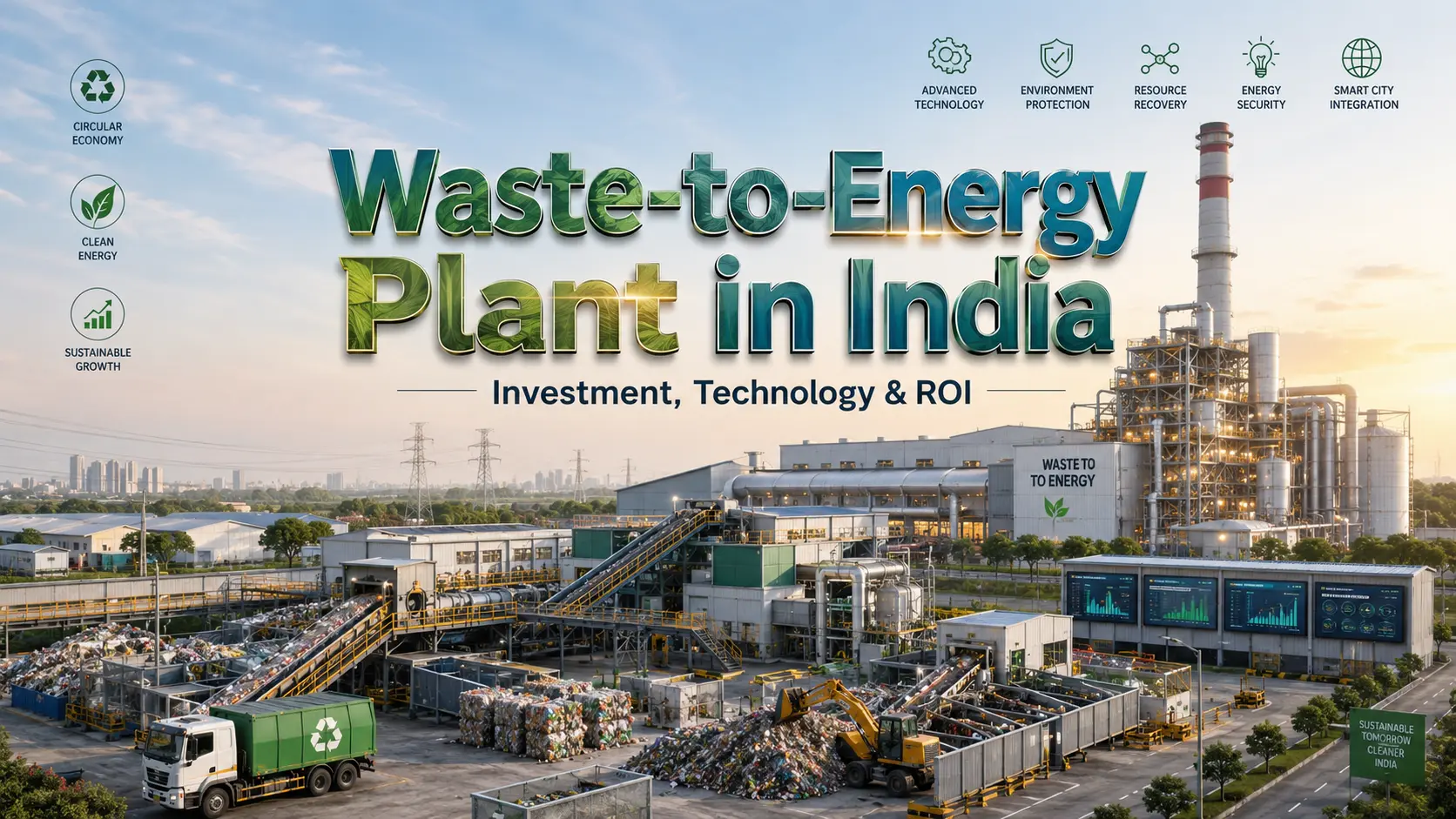
Waste to Energy Plant in India
Every Tonne of Garbage India Throws Away Is Worth ₹1,200 in Recoverable Energy
The Municipal Corporation of Greater Mumbai has collected more than 6500 tonnes of solid waste daily. It costs ₹3200 per tonne to landfill most of this at Deonar and Mulund, where it has been burning for decades, spewing toxic fumes into populated neighborhoods. What Mumbai doesn’t recover: about ₹780 crore of latent energy from that waste stream every year.
This isn’t a problem of Mumbai. The situation is the same in Delhi, Bengaluru, Hyderabad and Pune. As per the data of MNRE, India produces more than 62 million tonnes of MSW per year. Of this, 12 million tonnes are treated. The other 31 million tonnes are dumped into landfills.
Waste-to-Energy (WtE) plants are one of the least-discussed avenues for investment in Indian energy sector. What the urban local bodies pay to dispose of is turned into electricity, bio-CNG or syngas at the treatment plant, with the option to feed the electricity back into the grid, industries, or city bus depots — and even charge a tipping fee to the urban local bodies to collect the waste in the first place. Two streams of income from a raw material which is coming to your gate free of charge.
The Problem: 50 Million Tonnes of Untreated Waste and Rising
India has a waste problem? It has an opportunity to waste, but no one’s moving quickly enough to grab.
The MNRE estimates that the MSW in India is around 62 million tonnes per year. Just 43 million tonnes are collected. Only 12 million tonnes of the collected waste is treated. This amounts to 31 million tonnes per year which is deposited into open landfills, causing methane emissions, groundwater pollution and public health issues.
The statistics of the gap are frightening. With a conservative energy recovery rate of 500 kWh per tonne, India’s untreated MSW has the theoretical capacity of providing more than 15,000 MW of power generation capacity. As of now, there are 412.5 MW WtE installed in India and 48 construction-stage WtE plants as per Swachh Bharat Mission data. This is less than 3% of the waste stream support.
Maharashtra, Uttar Pradesh, West Bengal, Rajasthan, Tamil Nadu and Delhi NCR states are facing the worst shortage of capacity to treat waste compared to the generation. Tier-2 cities (Nagpur, Ludhiana, Surat, Coimbatore, Patna) have already been generating 500 to 1,500 TPD of MSW with no WtE plant.
The Central Pollution Control Board (CPCB) now requires the bulk waste generators, which are commercial complexes more than 20,000 sq. metres, industrial parks, hotels, to get their waste processed by them or pay to certified processors. This provides a guaranteed contractual supply of feedstock for any WtE developer that signs off-take agreements with the bulk generators prior to the plant construction.
Explore This Book: Recycling Business Handbook
TABLE 1: State-wise MSW Generation, Treatment Capacity & WtE Opportunity
| State | Est. MSW Generated (TPD) | MSW Treated (TPD) | Treatment Gap (TPD) | Active WtE Plants | Key Cities with WtE Potential |
| Maharashtra | 22,500 | 6,800 | 15,700 | 2 | Mumbai, Pune, Nagpur, Nashik |
| Uttar Pradesh | 18,000 | 3,200 | 14,800 | 1 | Lucknow, Kanpur, Agra, Varanasi |
| Tamil Nadu | 12,000 | 4,100 | 7,900 | 2 | Chennai, Coimbatore, Madurai |
| West Bengal | 10,500 | 2,900 | 7,600 | 1 | Kolkata, Asansol, Durgapur |
| Rajasthan | 9,200 | 1,800 | 7,400 | 0 | Jaipur, Jodhpur, Udaipur |
| Karnataka | 8,800 | 3,500 | 5,300 | 1 | Bengaluru, Mysuru, Hubli |
| Gujarat | 8,500 | 3,900 | 4,600 | 2 | Ahmedabad, Surat, Vadodara |
The Opportunity: Why This Is the Right Moment to Enter
There are three forces coming together now that haven’t come together this clearly before.
Demand is being driven by Policy mandate. The Solid Waste Management Rules, 2016, promulgated by Ministry of Environment, Forest and Climate Change (MoEFCC) prescribe scientific disposal of MSW and energy recovery. Waste is now a matter that needs to be handled by urban local bodies (ULBs) all over the country, instead of getting buried in landfills. Most municipalities are not able to construct WtE plants, so they are actively pursuing private developers, providing long-term concession agreements for 15-25 years.
The Energy Economy has changed. The cost of Bio-CNG from MSW is now at ₹46-54 per kg in most states which is far higher than the cost of production of a well-run plant. State electricity boards have signed power purchase agreements (PPAs) for waste-based power generation at rates between ₹7-9 per kWh which is above most renewable categories.
The tipping fee is charged for feedstock. The payment to the WtE operator is usually a tipping fee to the municipality, which ranges from ₹400 per tonne to ₹800 per tonne – this is in contrast to solar/ wind where no purchase of land or equipment is involved. You earn money from your raw material.
Government schemes directly supporting WtE:
- Central Financial Assistance (CFA) under the National Bioenergy Programme (MNRE): For Power projects based on Biogas – ₹ 0.75 crore per MW and for Bio-CNG plants – ₹ 4 crore per 4,800 kg/day.
- Project loans at preferential rates are available for WtE projects from IREDA Financing (Indian Renewable Energy Development Agency).
- Collateral-free loans up to ₹2 crore are available for MSME-scale biogas and gasifier units through CGTMSE.
- Swachh Bharat Mission: Urban component also offers the private WtE developers, who are partnering with municipal corporations, viability gap funding.
Get Detailed Project Report (DPR): Project Reports & Profiles
TABLE 2: Government Schemes Applicable to WtE Plants — Eligibility & Benefits
| Scheme | Nodal Agency | CFA / Subsidy | Eligible Technology | Max Benefit | How to Apply |
| National Bioenergy Programme | MNRE / IREDA | ₹0.75 Cr/MW (power); ₹4 Cr per 4,800 kg/day (Bio-CNG) | Biomethanation, Gasification (non-MSW) | ₹5 Cr per project | biourja.mnre.gov.in |
| Swachh Bharat Mission (Urban) | MoHUA | Viability Gap Funding via ULB concession | All WtE, including incineration | Project-specific | State Urban Dept / ULB |
| IREDA Green Energy Loan | IREDA | Concessional project finance | All renewable WtE | No cap | ireda.in |
| CGTMSE | SIDBI / Banks | Collateral-free credit guarantee | MSME WtE units | ₹2 Cr | Through empanelled banks |
| Make in India / PLI | DPIIT | Equipment manufacturing incentives | WtE equipment manufacturers | Sector-specific | dpiit.gov.in |
| NE States / Hilly State Bonus | MNRE | 20% higher CFA | All WtE technologies | +20% on base CFA | Through IREDA portal |
How to Set It Up: A Ground-Level Guide for First-Time Developers
WtE is not a single technology, it is a family of processes. This is dependent on your feedstock, your off-take market, and your capital. In India, there are three business models that are viable for MSME and first-generation entrepreneurs:
Bio methanation Plant (5-50 TPD): It is a plant where wet organic waste (food waste, market waste, slaughter house waste) is fed into an anaerobic digester. The products: Biogas or Bio-CNG. Best suited for Cities with segregated wet waste streams, food processing clusters or APMC yards. Ideal entry-scale: 10–20 TPD.
Option B: Gasification / Pyrolysis Unit (10-100 TPD) is a unit that can produce syngas / producer gas for powering genset or industrial furnace using dry combustible waste like RDF pellets, plastic-laden waste, agro-residues etc. For Industrial estates, textile parks, or places with a high amount of plastic/paper waste.
Option C: RDF + Thermal Co-Processing (100+ TPD) Refuse Derived Fuel production –Shredding, drying and pelletising of mixed MSW into fuel product is offered to Cement Kilns (ACC) or Thermal Power Plant (UltraTech and Shree Cement) (100+TPD). Reduced capex compared to full WtE, existing off-take contracts and able to receive gate fee revenue.
Related Article: How to Start a Plastic Waste Recycling Business: A Comprehensive Guide
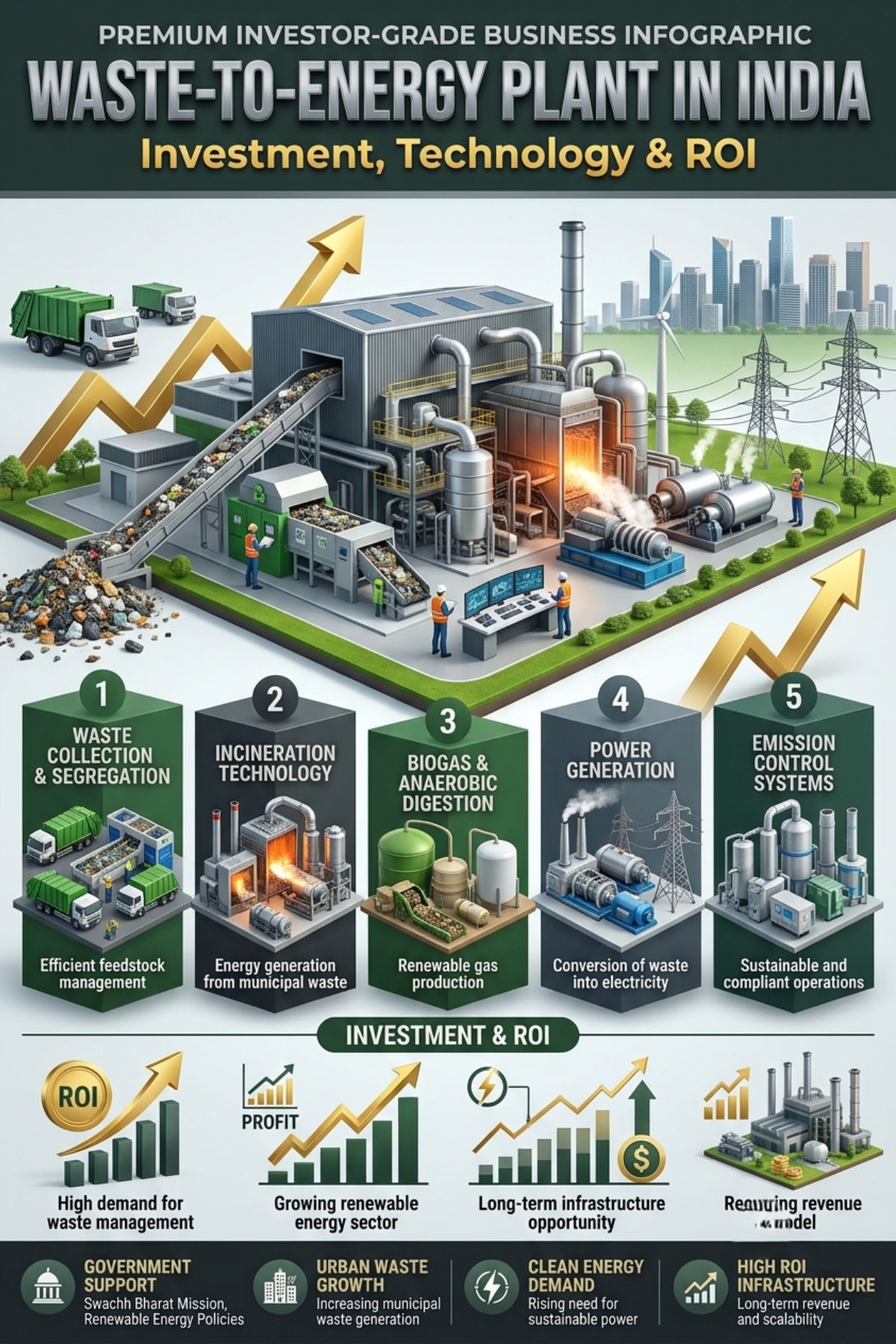
Step-by-step setup process:
Step 1 — Site and Feedstock Agreement (Month 1-2) Determine a land area within 5 km of a waste pile. Land requirement is 10 TPD bio methanation unit = 0.5 acre, 50 TPD gasifier or RDF = 2-3 acre. Conclude Memorandum of Understanding with urban local body or bulk waste generators (markets, hotels, food courts) to ensure the supply of feedstock.
Step 2 — Udyam Registration and Entity Formation (Month 1) Registering your entity (Pvt. Ltd. preferred for fund-raising, Partnership is viable for smaller plants). The Udyam Registration at udyamregistration.gov.in is mandatory to avail the MSME schemes and CGTMSE guarantees. Cost: nil. Time: 1 day.
Action point 3: Environmental Clearance and NOC (Month 2-5): For projects of more than 1MW, submit an Environmental Clearance (EC) application to the State Environment Impact Assessment Authority (SEIAA). Smaller sized MSME WtE projects need a No Connection (NOC) from State Pollution Control Board (SPCB) under the Air and Water Acts before construction. Reference: CPCB. Timeline: 60–120 days.
Step 4 – Apply for MNRE CFA (Month 3 – 4) Submit the Detailed Project Report (DPR) to the IREDA on the MNRE website biourja.mnre.gov.in. IREDA will appraise the project in 40 days. CFA is released in 2 parts: 50% when the commissioning process starts, 60% when the commissioning is completed after 3 consecutive months of Plant Load Factor (PLF).
Step 5 — Equipment procurement (Month 4-8) Key Indian equipment manufacturers: Mailhem Iko’s (Pune) – Bio methanation; Ankur Scientific (Vadodara) – Gasifiers; Forbes & Manhattan – RDF processing. Most of the imported components (biogas upgrading membranes, emission monitoring systems) are sourced from Germany or China. The total lead-time is 3-5 months.
Step 6 — Factory Registration and GST (Month 3-4) Factory Registration license from the labour department and GST registration. GST registration — standard. Plants selling power to the grid should obtain a licence from CERC/SERC under the Electricity Act.
Step 7 — Commissioning and Trial Runs (Month 9-12) Three months in a row at 60% PLF is needed for disbursement of MNRE CFA. This is a good time to test feedstock quality and to adjust operations.
Usual team size at launch: 1 plant manager (engineering background), 2 operators per shift (3 shifts), 1 maintenance technician and 1 loader/driver. Total: 8–10 staff for a 10–50 TPD plant.
TABLE 3: Investment Breakdown for a 20 TPD Biomethanation + Bio-CNG Plant
| Cost Head | Estimated Cost (₹ Lakh) | Notes |
| Land (1 acre, lease) | 8–15 | Owned land saves this; lease preferred for MSME |
| Civil Construction | 40–60 | Digester, gas holder, control room, plant building |
| Biomethanation Reactor | 50–70 | Includes agitators, piping, insulation |
| Gas Purification & Compression | 35–55 | Biogas scrubber, dehumidifier, compressor |
| Bio-CNG Dispensing Unit | 20–30 | If selling to vehicles/fleet |
| Electrical & DG Backup | 15–20 | Power panel, genset |
| SCADA / Monitoring | 5–8 | Emission monitoring as per SPCB |
| Pre-operative Expenses | 10–15 | DPR, EC, MNRE filing, legal |
| Working Capital (3 months) | 20–30 | Salaries, maintenance, utilities |
| Contingency (10%) | 20–30 | |
| Total Project Cost | ₹2.23 – ₹3.33 Crore | Before MNRE CFA deduction |
| Net After CFA (₹4 Cr / 4800 kg) | ₹0.23 – ₹1.33 Crore | Depending on Bio-CNG output |
Note: For 10 TPD biomethanation (biogas only, not Bio-CNG), total capex is ₹80 lakh – ₹1.5 crore. Figures based on MNRE programme guidelines and Indian equipment supplier quotes as of recent assessments.
Financial Snapshot: What a 20 TPD Bio-CNG Plant Actually Earns
Capital Expenditure: ₹2.5-3.3 crore (after MNRE CFA: ₹1-2 crore)
Monthly Operating Costs:
- Staff (8 people): ₹2.5 lakh
- Power utilities: ₹0.8 lakh
- Maintenance and consumables: ₹0.6 lakh
- Wages in transportation and logistics: ₹0.4 lakh
- The total monthly opex is of ₹4.3 lakh.
Revenue Streams (at 20 TPD, 25 days/month operation):
- ULB/bulk generators: ₹500/tonne × 500 tonnes/month = ₹2.5 lakh/month (tipping fee
- Bio-CNG sales at ₹48/kg; ~2,400 kg/day at 60% capacity × 25 days: ₹28.8 lakh/month
- By-product of organic compost/slurry: ₹1.2 lakh per month
Total monthly revenue at 60% capacity: ₹32.5 lakh Total monthly revenue at 100% capacity: ₹51.8 lakh
Gross margin (60% capacity): ~₹28.2 lakh/month (87% gross—feedstock is near-zero cost) Net margin after depreciation and loan servicing (60% capacity utilisation): 22 – 28% (full capacity utilisation): 22 – 28%) Pay back period (60% utilisation capacity): 3.5 – 5 years (full capacity utilisation): 2.5 – 3.5 years)
The margins are fantastic since there is no commission for waste purchases, only that it is delivered. It is essential to make contracts with private bulk generators (malls, food court, industrial canteen) before commissioning, as the biggest concern is feedstock consistency – municipalities are unreliable suppliers.
Find high-return business ideas based on your budget & ROI
Entrepreneur Spotlight
Vivek Choudhary, mechanical engineer from Nagpur, Maharashtra Vivek, established a 15 TPD bio methanation plant near Nagpur’s Kalamna market yard, which is the largest wholesale fruit and vegetable market in India, with the help of Nagpur Municipal Corporation. His harvesting system for APMC yard organic waste and providing biogas for a group of hotels around his plant was break-even in less than four years. His mantra: “Lock in five or six private generators first – APMCs, hotels, canteens – and use municipality waste as an additional source of income.” Now, Vivek wants to install another 30 TPD unit.
NPCS Can Take You from Idea to Operational Clarity
Niir Project Consultancy Services (NPCS) provides a detailed project report and techno-economic feasibility studies to entrepreneurs interested in the numbers before investing in the waste-to-energy plants based upon the various technologies involved in the process such as bio methanation, gasification, pyrolysis, and RDF. These reports include detail on the plant layout, equipment specifications, raw material sources, licence requirements, cash flow projections and break-even analysis — all of these are essential before the banker or investor will approve a term loan. NPCS has touched more than 5000 industries in India and is available at entrepreneurship india co and niir.org. Their resource centre is a useful resource centre for WtE project reports and consultations before hiring a consultant or submission of an MNRE project application.
The Decision in Front of You
India’s waste problem is not going away. It is getting worse, faster. The cities generating the most waste — and creating the best WtE investment opportunities — are not Mumbai and Delhi anymore. They are Surat, Varanasi, Patna, Indore, and Coimbatore. Secondary cities with 500–1,500 TPD MSW and zero treatment infrastructure.
You do not need ₹100 crore. A 10–20 TPD biomethanation or gasifier unit can be commissioned for under ₹2 crore net of MNRE subsidy. The feedstock is free. The tipping fee pays your operating costs. The gas or power is your upside.
The one thing to do today: identify the largest wet waste generator within 10 km of your target site — APMC market, food processing zone, hotel cluster — and approach them for a feedstock supply agreement. Everything else follows from that.
Contact MNRE’s WtE division at biourja.mnre.gov.in and download the latest programme guidelines. Download NPCS’s WtE project report from niir.org. Spend a week on due diligence. The window is open. It will not stay that way indefinitely.
Frequently Asked Questions
Q1. How much does it cost to set up a small waste-to-energy plant in India?
A 10 TPD biomethanation plant costs ₹80 lakh to ₹1.5 crore including civil works, equipment, and pre-operative expenses. A 20 TPD Bio-CNG plant runs ₹2.5–3.3 crore before MNRE Central Financial Assistance. After CFA, net project cost for a Bio-CNG unit can drop to under ₹1 crore depending on approved capacity. Costs vary by technology choice, state, and land status (owned vs. leased).
Q2. What licences and approvals are needed?
You need Udyam Registration, a No Objection Certificate from the State Pollution Control Board, Environmental Clearance from SEIAA for units above 1 MW, a Factory Licence under the Factories Act, and GST registration. Plants selling power to the grid additionally need a licence from the State Electricity Regulatory Commission (SERC). The full approval cycle typically takes 4–8 months from filing.
Q3. Where do I source the raw material (waste)?
Your primary sources are urban local bodies (through a tipping fee agreement), APMC markets, hotels and restaurant chains, food processing industrial estates, and bulk waste generators mandated by the CPCB under the SWM Rules 2016. Private bulk generator contracts are more reliable than municipal supply. States like Maharashtra, Gujarat, and Tamil Nadu have the most organised bulk generators.
Q4. Is this business profitable for a small entrepreneur?
The plant at 60 per cent utilisation with a 20 TPD capacity would likely produce 32-35 lakh a month on 4-5 lakh of operating expenses, making about 22-28 per cent net profit post loan servicing. However, a smaller plant of 10 TPD biogas may command lower revenues on lower capital investment. This is contingent upon guaranteed feedstock supply, a signed take-off agreement (either offtaking Bio CNG or power), and optimal functioning.
Q5. What government support is available for WtE in India?
For biogas plants, the MNRE under its National Bioenergy Programme provides central assistance of ₹ 0.75 crore /MW and for Bio-CNG plants ₹ 4 crore for 4,800 kg/day capacity. The central assistance gets an additional of 20% for projects in North-East states, J& K, Himachal, Uttarakhand & Andaman &Nicobar. IREDA provides cheap loans. CGTMSE covers collateral-free credit up to ₹2 crore for MSME WtE units. Apply via biourja.mnre.gov.in.
Q6. Where can I access a detailed project report for a WtE plant?
Niir Project Consultancy Services (NPCS) at niir.org and entrepreneurindia.co publishes techno-economic project reports for bio methanation, gasification, pyrolysis, and RDF plants with detailed machinery lists, layout plans, financial projections, and licence checklists. MNRE also publishes model DPRs. IREDA provides project appraisal support for loan-linked applications.
Key Sources & References
- Ministry of New and Renewable Energy (MNRE) — Waste to Energy Programme
- MNRE BioUrja Portal — Scheme Highlights & CFA Guidelines
- Swachh Bharat Mission (Urban) — WtE Plant Data
- Indian Renewable Energy Development Agency (IREDA) — Green Energy Financing


