






Introduction: D2C Manufacturing Business India
In India, the conventional manufacturing model used to depend on distributors and retailers to access the customers. This system established extensive distribution channels, but it also decreased the profits of small manufacturers considerably and deprived them of branding and customer relationships. Most businesspeople failed to expand as their profits were shared out with several middlemen.
The world of business is evolving fast today. The emergence of online platforms, low-cost logistics services, and online payment options has made suppliers sell directly to consumers. This model is referred to as the Direct-to-Consumer (D2C) model, which enables corporations to enjoy higher profit margins and establish good brand identities.
The D2C market in India is growing at a very high pace. As the internet penetration grows and more consumers demand branded products, the direct selling has emerged as one of the best opportunities to manufacturing entrepreneurs. Companies that embrace this model at an earlier stage are able to develop sustainable growth and profitability.
Learning the D2C Business Model.
The Direct-to-Consumer model removes redundant channels in supply chain. Manufacturers do not rely on wholesalers and retailers to distribute their products but instead sell directly to consumers using digital platforms, including websites, online marketplaces, and social media.
This model does not only enhance profitability, but also enhances customer relationship. When the businesses deal directly with the buyers, they get quality feedback that can be used to enhance the quality of their products and customer satisfaction.
Some of the essential benefits of the D2C model are:
- Increased levels of profitability over conventional retail.
- Face-to-face interaction with customers.
- Quickened product innovation and feedback.
- Strong brand recognition
- More pricing and marketing control.
The above advantages clarify the reason why a significant number of new entrepreneurs are adopting the D2C channel rather than the conventional distribution channels.
Why D2C Manufacturing Is Growing Rapidly in India
A number of technological and economic advancements have provided a positive environment to D2C businesses. The fact that internet use is rapidly expanding both in urban and rural regions is one of the most significant aspects. Online shopping has become more convenient and time saving so that millions of consumers make their choices.
This has also been aided by the use of digital payment systems. Quick and safe payment systems have enhanced the trust that people have in internet transactions. Meanwhile, the logistics networks have become much better and businesses can deliver products in an efficient and fast way.
Entrepreneurship has also been promoted by government efforts to promote small and medium enterprises. The risks of opening a new business have been minimized through financial assistance programs, the ease with which one can register his business and the incentives put in place to encourage domestic manufacturing.
Major factors driving D2C growth in India include:
- Growing the use of the internet and smartphones.
- Development of online stores.
- Good delivery and logistics services.
- Increase of demand of branded products.
- Governmental support of MSMEs and startups.
These patterns reveal that the D2C industry is going to grow in the years to come.
Access Complete Business Plan: Top Small scale Manufacturing Business Ideas with Investment of 50- 60 Lakhs (Plant and Machinery).
Strong Potential in the D2C Manufacturing.
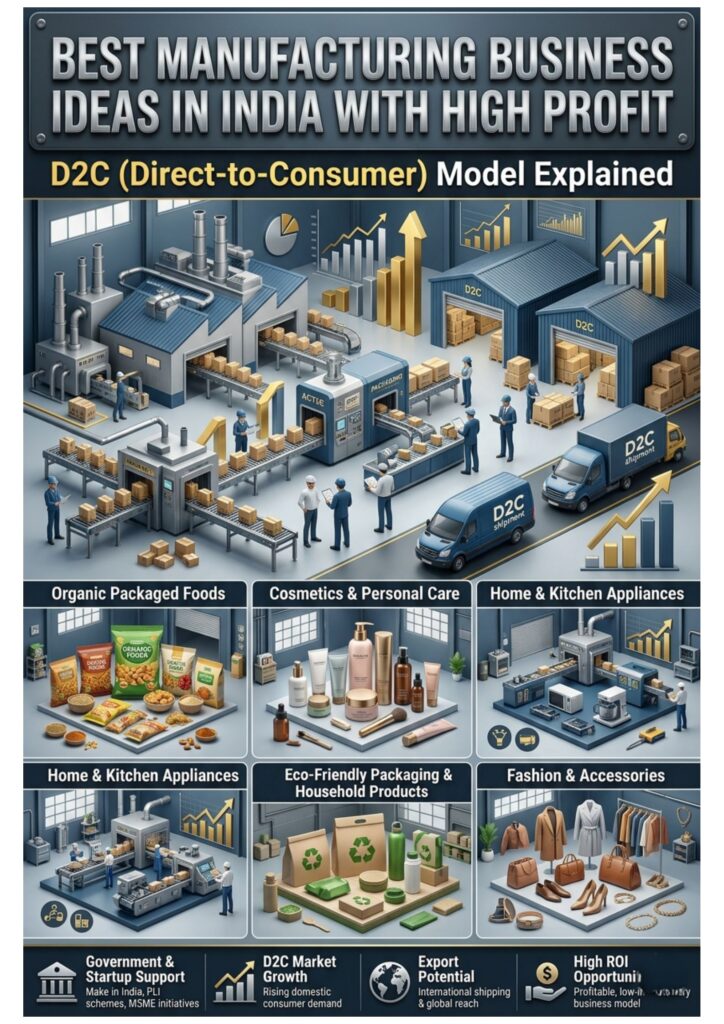
Personal care and skin care products are one of the most reachable opportunities among the other industries where the D2C model is applicable. Consumers are also being more aware of the ingredients that are being used in their products and this has led to more demand on natural and safe formulation. The entrepreneurs joining this industry can begin with small scale production and expand with increase in customers.
Another promising industry is nutritional supplements and wellness products. The increased attention to fitness and preventive medical care has generated a stable demand of protein powders, vegetal supplements, and immunity enhancers. The type of business in this category is likely to enjoy repeat purchases which in turn helps in keeping the revenue constant.
Green home products are also becoming popular due to the increase in the consciousness of consumers with regard to environmental concerns. Manufacturers that produce sustainable alternatives to plastic products are experiencing good demand in the local markets as well as in the overseas markets. Equally, the food processing industry has also remained on the rise because urban lifestyles have developed the need to consume food products that are convenient and ready to eat.
Popular D2C manufacturing business concepts are:
- Natural Cosmetic and Skincare products.
- Nutritional supplements and protein powders.
- Green house and packaging products.
- Specialty and processed food products.
- Consumer electronics accessories
These businesses have high demand, scaled operations and high future profitability.
Investment Requirements for Starting a D2C Manufacturing Business
The financial planning of starting a manufacturing business is important. The amount of investment will be determined by the nature of the product, the capacity of production and the degree of automation. Most of the time, an entrepreneur may anticipate spending an amount of between fifteen lakh and eighty lakh rupees on a small or a medium-scale manufacturing unit.
This investment is normally on machines, raw materials, packaging, and initial marketing. Working capital is also needed since companies require the cash to run their daily operations until the revenue stabilizes.
Entrepreneurs are advised to do a thorough feasibility study before committing their resources to a business to determine the financial feasibility of the business. This move will help in detecting the possible risks and also makes sure that the resources utilized are used effectively.
Typical elements of cost in a manufacturing start-up are:
- Machinery and equipment
- Raw materials and packaging.
- Plant installation and services.
- Marketing and branding
- Working capital
Long-term success depends on proper budgeting and financial planning.
The Role of Branding in D2C Success
Branding is also one of the most significant elements of customer choice in the D2C market. Consumers have a tendency of buying products on trust and brand reputation, and not necessarily on the price. Powerful brand image can make business more competitive in the competitive markets and create a long-term relationship with the customers.
Effective brands are devoted to the use of the same message, beautiful packaging, and the quality of the product. They also invest in the engagement with the customers on the digital platform and it assists in the building of the loyalty and the encouragement of the repeat purchase. A good brand is an important asset which adds the value of the business as it goes.
Why Professional Feasibility Reports Are Essential Before Starting a Manufacturing Business
Starting a manufacturing company without planning may result in losses and difficulties in the operations. A professional feasibility report is a document written by an expert giving a comprehensive examination of market demand, manufacturing expenses and projected profitability. The information assists the entrepreneur to make informed decisions and mitigate risks associated with the businesses.
The general contents of a feasibility report generally cover:
- Market demand and competition analysis.
- Technical specifications of the production process.
- Machinery and equipment needs.
- Estimation of costs and profit forecast.
- Financial planning and risk assessment.
These types of reports are specifically necessary when seeking bank loan or investor funding as they show the viability of the business.
How NPCS Helps Entrepreneurs Start Manufacturing Businesses
The Niir Project Consultancy Services has a major role in serving the entrepreneurs who desire to begin new manufacturing projects. The company is specialized in drawing elaborate project reports and feasibility studies based on various industries and investment levels.
NPCS assists businesses by offering correct market research and technical advice, allowing them to make expensive errors and increase their likelihood of success. Entrepreneurs get real world knowledge on how to plan production, choose machines, and budget financial resources and this is important in creating sustainable operations.
Services offered by NPCS are:
- Detailed Project Reports (DPR)
- Market research and feasibility studies.
- Machinery selection guidance
- Financial planning and estimating costs.
- Business setup consulting
These services assist business people to transform ideas to actions with a sense of confidence.
Future Outlook for D2C Manufacturing in India
D2C manufacturing in India has a very bright future. With the rise of digital commerce and the changing tastes and preferences of consumers, the number of businesses that will be implementing direct selling strategies is likely to increase. This change will be further enhanced through technological changes, advancement of logistic infrastructure, and favourable government policies.
Good entrepreneurs with concentration on quality products, good branding, and efficient operations will be in a good position to excel in this dynamic market. Manufacturing companies can attain consistent growth and profitability after proper planning and professional guidance.
Frequently asked questions (FAQ)
Q1. What is a D2C business model?
D2C business model enables manufacturers to market products to the end users bypassing the middle men like distributors or retailers.
Q2. What is the investment needed to open a manufacturing business in India?
Depending on the product and the scale of production, most small manufacturing businesses need an investment of between fifteen lakh and eighty lakh rupees.
Q3. What are the most profitable manufacturing companies in India?
The profitable industries are skincare products, nutritional supplements, environmentally friendly products, food processing, and accessories of consumer electronics.
Q4. Why should D2C businesses brand?
Branding fosters customer trust and awareness of the product, stimulates repeat purchases which enhances long-term profitability.
Q5. What is the way NPCS can assist entrepreneurs in opening a manufacturing business?
NPCS offers feasibility reports, market research, and technical advice that enable entrepreneurs to organize and open successful manufacturing projects.


