




Biodegradable Packaging Business in India
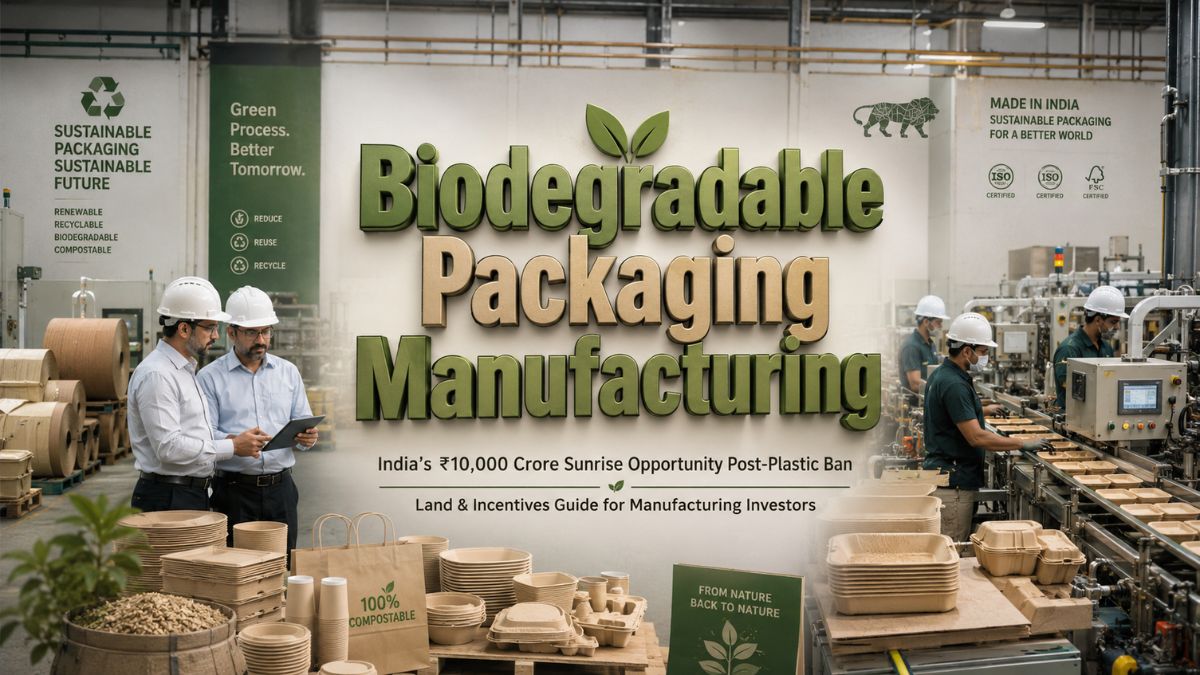
With the ban on single-use plastic, India has presented a huge opportunity for every entrepreneur to join the manufacturing business. Today, companies in every food delivery, FMCG, retail, hospitality, and e-commerce sector are keen to find sustainable packaging options. The change has made biodegradable packaging manufacturing India one of the quickest growing industrial sectors for MSMEs.
The market value is already standing at almost ₹10,000 crore and is growing annually by the government’s regulations, export demand, and growing awareness of sustainable packaging. For new manufacturers, the most beneficial aspect of the market is that supply is still essentially disorganized. Despite the presence of local biodegradable packaging suppliers in a few parts of India, the market is largely lacking in trusted and reliable local suppliers, offering significant opportunities for MSMEs to make an early breakthrough.
Why the Industry is Growing Rapidly
The single-use plastic ban marked the end of an era in the packaging and plastics sector. Before now, sustainable packaging was “nice to have” and “costly. Many companies are feeling the pressure to move to compostable and biodegradable options today, as customers, retailers and regulators all want it.
Several factors are driving this growth:
- Rising restrictions on plastic packaging
- Strong export demand from Europe and the UK
- ESG commitments by large corporations
- Growing awareness among consumers
- Government support for sustainable industries
This mix has helped to make biodegradable packaging a viable business opportunity in the industry.
Best Biodegradable Packaging Business Opportunities
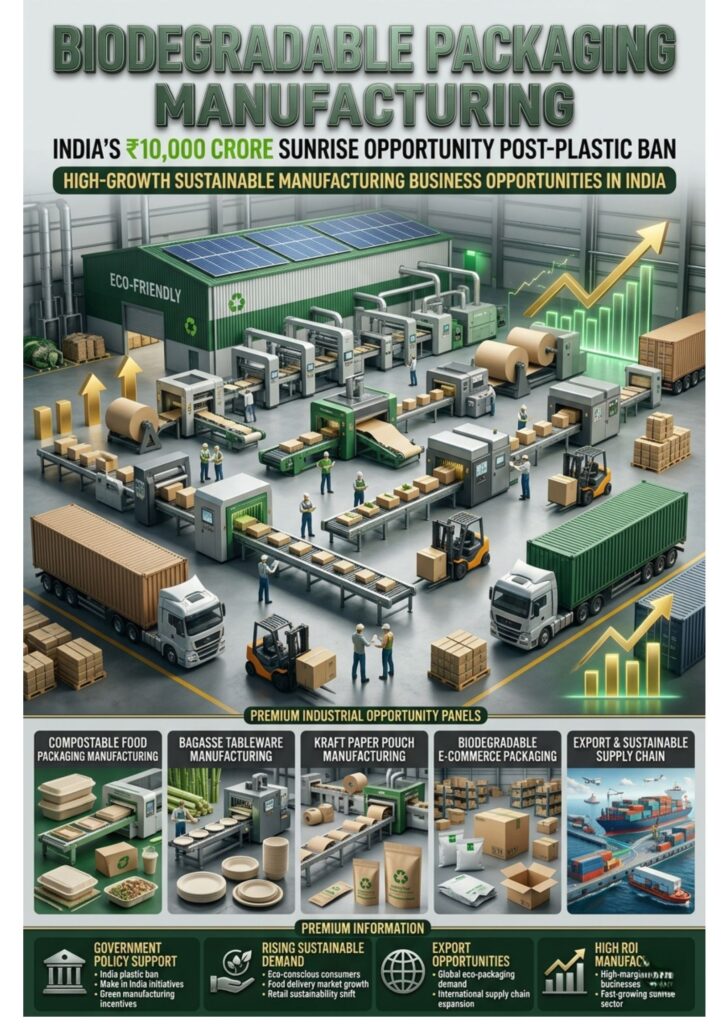
Compostable Food Packaging Manufacturing
This is one of the most lucrative areas of the industry, right now. Restaurants, cloud kitchens, hospitals and catering businesses need packaging supplies daily and have repeat orders.
Popular products include:
- Food trays
- Meal containers
- Cups
- Clamshell boxes
- Disposable cutlery
The investment amount in a small to medium manufacturing unit depends on the machinery used and the production volume, it ranges between ₹40–80 lakh. After production has been stabilized, margins are between 22% and 28%.
Get Detailed Insights from This Book: Food Packaging Technology Handbook (4th Revised Edition)
Bagasse Tableware Manufacturing
Bagasse is derived from the waste of sugarcane and as a substitute for plastic plates and bowls has gained popularity in the events, catering and institutional food service industry.
This segment is appealing due to the low cost of raw material and the high demand for the product.
Key advantages:
- Strong profit margins
- Eco-friendly raw materials
- Growing institutional demand
- Government support for agro-waste industries
Sugarcane waste is easily available in states such as Uttar Pradesh, Maharashtra and Karnataka, making them ideal businesses to pursue.
Kraft Paper Pouch Manufacturing
FMCG brands, spice makers, snack manufacturers and organic product retailers are adopting kraft paper packaging. Now more than ever, many brands desire packaging that appears natural, upscale and eco-friendly.
The products in this segment include:
- Spice pouches
- Snack packaging
- Organic food pouches
- Personal care product packaging
Needs are typically greater for a carry bag investment than for a basic carry bag unit, and customer base is much larger and extensible.
Biodegradable E-Commerce Packaging
As eCommerce becomes more and more popular, the demand for sustainable courier packaging has also been rising. Plastic mailers are no longer acceptable for ecommerce companies as they are going green and making use of biodegradable ones.
Common products include:
- Compostable courier bags
- Paper void-fill systems
- Eco-friendly bubble wrap
- Biodegradable shipping mailers
This type of product has lower margins, but is helped by high volume orders and supply contracts.
Access Complete Business Plan: Bioplastics and Sustainable Packaging Technologies
Investment and Profit Potential
This is one of the areas that is popular among MSME founders because of the size of investments and the growth potential. To start off with a relatively small manufacturing base and gradually build up by introducing product lines.
Common investment amounts are:
- Basic carry bag units: ₹25 – 60 lakh
- Bagasse table ware plant: ₹35-70 lakh
- The cost of food packaging units ranges from ₹40–80 lakh.
- Advanced Film & Pouch Manufacturing: ₹1 crore+.
The majority of the successful businesses concentrate on attracting the institutional buyers first and then begin production. Hospital, airline, restaurant, or corporate food service companies tend to make their break-even sooner than those businesses that rely solely on retail sales.
Professional management can often recover the investment in as short a period as 3 or 4 years.
Major Risks in This Industry
Biodegradable packaging, like all manufacturing companies, is faced with risks during operations. It is essential for entrepreneurs to have a good understanding of these challenges before investing in this sector.
Raw Material Price Volatility
The materials, like PLA and PBAT, still rely on imports. They are subject to world price changes in petrochemicals and shipping.
Inconsistent Plastic Ban Enforcement
In some states, plastic restrictions are quite strict, whereas in others it’s not. It impacts on price power and market demand.
Weak Buyer Commitment
Others advertise as being sustainable, but do not have long-term purchase contracts because biodegradable packaging is more expensive than traditional plastic.
These risks can be minimized by entering into written buyer agreements prior to a large investment in machinery.
Identify high-growth industries before others do
Government Support for Biodegradable Packaging MSMEs
The Indian government is promoting manufacturing and sustainable industries with various schemes.
Key schemes include:
- PMEGP subsidy support
- Collateral-free MSME loans offered by CGTMSE.
- Plastic Parks’ infrastructure support
- State industrial incentives
- MSME Credit Support schemes
These schemes assist in easing the financial burden for the first time entrepreneurs.
Why a Detailed Project Report (DPR) is Important
The fact that many manufacturing businesses fail is due to the lack of planning for an entrepreneur to invest. Before entering the business, one has to carefully consider machinery selection, production economics, working capital and demand of the buyers.
That’s where professional feasibility studies come in very handy.
NPCS (Niir Project Consultancy Services) is among the foremost industrial consultancy firms assisting entrepreneurs to set up manufacturing enterprises in a variety of industries in India.
NPCS prepares:
- Details Project Reports (DPRs)
- Techno-economic feasibility studies
- Market research reports
- Machinery guidance
- Financial projections
- Business setup consultancy
NPCS assists entrepreneurs entering the world of biodegradable packaging manufacturing India to assess the investment needs, machinery options, profitability projections, and the viability of the business in the long run. They can also be helpful in applying for bank loans or approaching investors.
Related Article: Biodegradable Packaging Manufacturing Business in India: Cost, Profit & Project Report
Export Opportunity is Becoming Huge
The demand for eco-friendly packaging is growing at a rapid pace, particularly in Europe and the UK where the regulations are becoming stricter.
Products already exported by Indian manufacturers for which they have proper certifications are:
- Compostable film rolls
- Kraft paper packaging
- Bagasse food containers
- Eco-friendly mailers
Export business could be one of the largest growth areas for this industry in the coming decade as the manufacturing costs in India are still competitive.
Conclusion
Now packaging that is biodegradable is no longer a niche market in the green industry. It is emerging as a significant industrial opportunity backed by the government’s policy, export demand and consumer behaviour.
By doing well to get in early, pay attention to the quality of the products, and find institutional buyers, entrepreneurs can create long-term sustainable manufacturing businesses that can be scaled.
But making a success of this industry requires discipline in planning, correct certifications, good buyer relationships and financial management. It is not a money-making proposition, but for those who wish to create systematically, it provides one of the best manufacturing avenues available in India today.
FAQ
What is the initial capital needed for making biodegradable packaging in India?
The scale of units can begin from around ₹25 lakh, which is dependent on the machinery and category of product.
Which is the most profitable segment in the biodegradable packaging market?
At the moment, the most lucrative market consists of bagasse tableware and compostable plates and cutlery for food packaging.
Are there more ecofriendly packaging exports?
Yes. Europe and UK buyers are looking for Indian suppliers of sustainable packaging.
Is there a government subsidy for this business for MSMEs?
Yes. MSMEs are supported by schemes like PMEGP and CGTMSE.
Why is it important to have a DPR prior to the investment?
A DPR is used to help entrepreneurs with the understanding of the machinery needs, profitability, production planning, and financial feasibility before investing.


