




Public Health Chemical Export Business in India
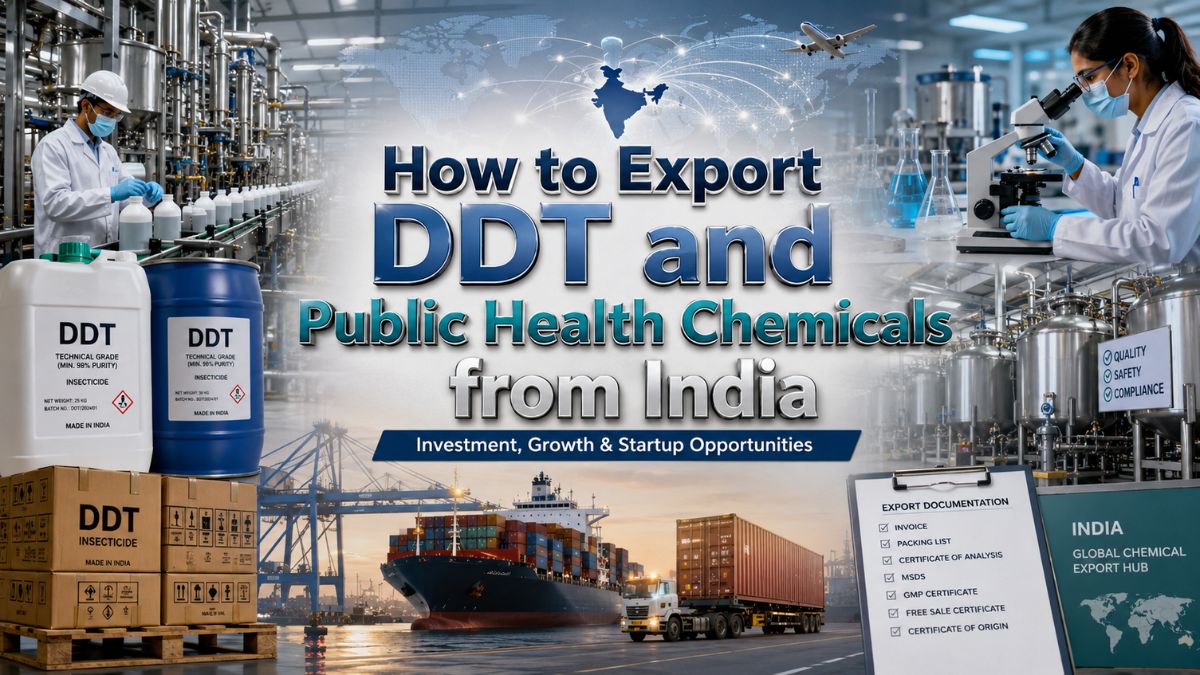
India occupies a special niche in the global chemical industry in the context of public health. India is the only proven source of DDT for WHO supported malaria eradication programmes in Africa, via HIL (India) Limited. Private companies can’t directly produce DDT, but there are huge possibilities in the private sector for WHO approved alternatives such as Long-Lasting Insecticidal Nets (LLINs), pyrethroid formulations, malathion sprays and biological mosquito-control chemicals.
This isn’t a regular chemical export company. It is a specialised health care driven industry supported by WHO, UNICEF, African governments and international donor agencies. Malaria continues to plague millions of people around the world in Africa, and the need for products to control mosquitoes is ongoing and high. To get official regulations and policy update visit Ministry of Chemicals and Fertilizers (mocf.gov.in).
Download the Full Guide: Download the Full Guide
Why This Industry Has Huge Growth Potential
As opposed to normal pesticides exports where the price is competitive and many players from India are competing, the public health chemicals are played in a more regulated and quality driven market. Long-term International procurement programmes funded by global organisations are available to WHO approved suppliers.
The most important thing today is not DDT, but the products which are being substituted for DDT under international environmental agreements.
Key Growth Drivers
- African Governments are increasing investments to control the disease.
- Mosquito prevention programmes supported by WHO
- Change to environmentally friendly vector-control products.
- Good demand for LLINs and pyrethroids
- There are very few suppliers in the world who are qualified by WHO.
Indian businesses already have excellent manufacturing facilities as well as export capabilities, which provides a significant edge.
Get Detailed Insights from This Book: Just For Starters: How To Start Your Own Export Business
Can Private Companies Manufacture DDT in India?
The straightforward answer is, no.
Production of DDT in India continues to be monitored by the government. HIL (India) Limited remains the sole supplier of DDT for WHO supported malaria programmes.
The private sector can, however, still come into the business via other products.
Business Areas Open for Private Companies
- Manufacture of long-lasting insecticide nets (LLINs) for mosquitoes.
- Malathion formulations
- Pyrethroid-based IRS products
- Bti bio-larvicides
- WHO-approved chemical exports
- Chemical trading for public health;
These are the parts where demand is increasing at a strong pace.
Best opportunities in the Public Health Chemical Business.
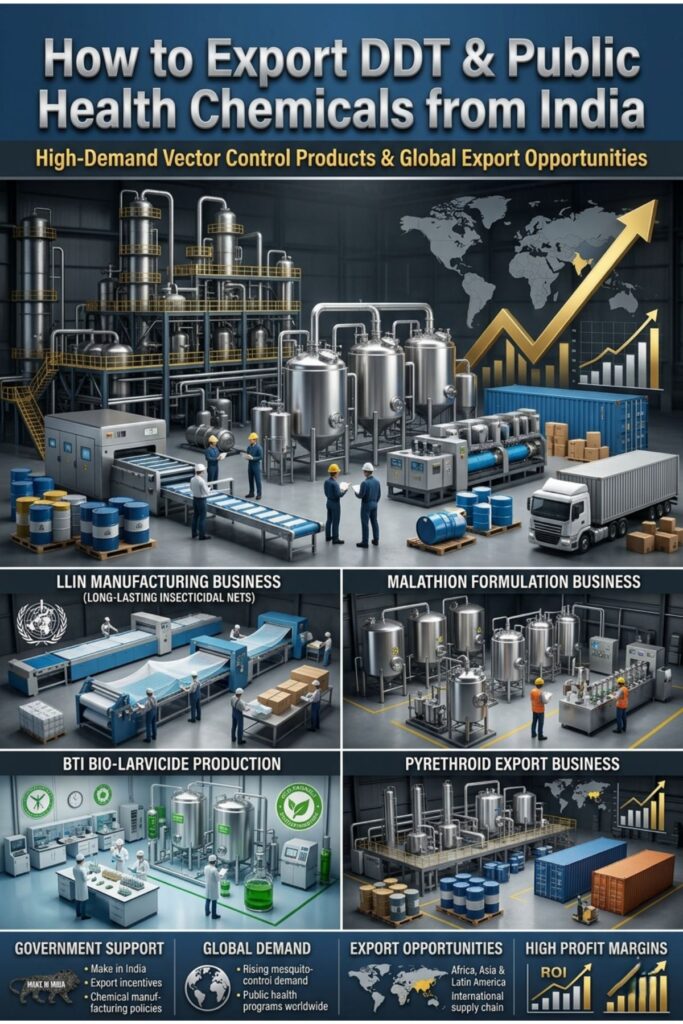
1. LLIN Manufacturing Business
Among the most sought-after products to control malaria are Long Lasting Insecticidal Nets (LLINs). These mosquito nets will last for years and are widely used in malaria programmes in Africa.
In the case of a medium scale manufacturing unit, investments ranging from ₹12-18 crore may be needed for the production as per automation level and scale.
Main Buyers
- WHO procurement agencies
- UNICEF
- Global Fund
- African governments
- Indian health departments
Profit Potential
- EBITDA margins of 20–25%
- Strong export demand
- Large repeat procurement cycles
One of the most scalable opportunities in the industry.
Access Complete Business Plan: Chemicals (Organic, Inorganic, Industrial) Projects
2. Malathion Formulation Business
Malathion is still a commonly used insecticide for the Indoor Residual Spraying (IRS) programme. Industrial formulations such as wettable powder (WP), suspension concentrate (SC) and emulsifiable concentrate (EC) can be formulated by Indian entrepreneurs.
Public health formulations generally have better margins compared to any agricultural pesticide, as procurement agencies are concerned about quality and compliance.
Estimated Investment
- ₹4–7 crore
Major Advantages
- Strong demand in African markets
- Moderate startup cost
- Easier scalability
- Government tender opportunities
There are opportunities for stable export revenue generation in this segment for businesses that are WHO compliant.
3. Bti Bio-Larvicide Production
Bacillus thuringiensis israelensis (Bti) is a biological mosquito-control solution which has no effect on humans or the environment.
Biological mosquito-control products are gaining in significance as environmental regulations become stricter, globally.
Why Bti Has Strong Future Demand
- Eco-friendly alternative to chemicals
- WHO-supported biological control programmes
- Growing urban mosquito-control demand
- No major resistance issues reported
In addition, Indian entrepreneurs can get technical assistance from Institute of Pesticide Formulation Technology for formulation and technology improvements.
4. Pyrethroid Export Business
India already produces large quantities of pyrethroid chemicals like deltamethrin and cypermethrin. These products are commonly used in mosquito-control programmes worldwide.
Investment Requirement
- ₹2–5 crore (mainly working capital)
Business Opportunities
- Technical export
- WHO-approved formulations
- Contract manufacturing
- African government tenders
This segment provides a fairly simple market entry plan for exports, as opposed to establishing large export manufacturing operations.
Choose the right startup backed by real market demand
WHO Tender Opportunities for Indian Exporters
One of the major attractions of this industry is the WHO procurement system. Healthcare budgets and international donors are creating a demand—not market cycles.
Major Procurement Platforms
- WHO procurement portal
- UN Global Marketplace (UNGM)
- Global Fund procurement system
Major African Buyer Countries
- Nigeria
- Ethiopia
- Tanzania
- Mozambique
- DR Congo
Indian exporters should also collaborate with CHEMEXCIL for better export networking and market access.
Why Compliance Is the Biggest Challenge
The most important thing in this industry is not manufacturing technology. It is compliance with regulations and international certifications.
Important Approvals Required
- CIB&RC registration
- IEC code
- WHO Prequalification (PQ)
- GMP certification
- Export documentation
- Destination country approvals
The time period for WHO approval varies and ranges from 18 to 36 months depending on the product category and documentation quality.
Businesses that take a proactive approach to compliance invest more heavily in their compliance infrastructure, which typically means that they perform significantly better in international procurement markets.
Related Article: Specialty Chemicals Business in India: Complete Guide to Investment, Profit Margins, Licenses & Manufacturing Setup
How NPCS Helps Entrepreneurs
NPCS (Niir Project Consultancy Services) assists the entrepreneurs in developing comprehensive techno-economic feasibility reports and project profiles for chemical manufacturing enterprises.
NPCS reports enable investors to gain insight into:
- Manufacturing process Machinery selection
- Raw material sourcing
- Project cost estimation
- Market demand analysis
- Profitability projections
- Break-even calculations
A professional feasibility report can be an excellent way to mitigate business risk for first-generation entrepreneurs entering the public health chemical manufacturing.
Conclusion
DDT is not the only agent of the future for India’s public health chemical industry. Although the direct production of DDT is still not allowed, the world’s move to more environmentally friendly and WHO approved alternatives is generating significant opportunities for Indian companies.
The next major growth areas in malaria-control procurement are likely to be LLIN manufacturing, pyrethroid formulations, malathion sprays and Bti bio-larvicides.
Entrepreneurs who spend money on:
- quality manufacturing,
- WHO compliance,
- export certifications,
- International and and international procurement systems.
will have a good chance to develop long term export enterprises in this specialised industry.
India has already got the factory base, know-how, and institutional strength to be a major player in this transition market.
FAQ
Is it possible to make DDT in India by private companies?
No. DDT production is still allowed by the Government with the authorization from HIL (India) Limited.
Which business opportunity looks like it will be the most successful?
The manufacturing of LLINs and production of bio-larvicide based on Bti have good long-term prospects.
How much money do you need to invest?
The formulation units could begin at ₹3–5 crore and LLIN or biological manufacturing could need ₹10–18 crore.
What is the timeframe of approval for WHO?
Typically, it takes 18-36 months for WHO to prequalify and approve products for export.
What are the countries that import the products from India?
Nigeria, Ethiopia, Tanzania, Mozambique and DR Congo are all key markets in Africa.
What kind of technical support are entrepreneurs looking for?
The Institute of Pesticide Formulation Technology, CIPET and NPCS (Niir Project Consultancy Services) can help entrepreneurs with their support.


