






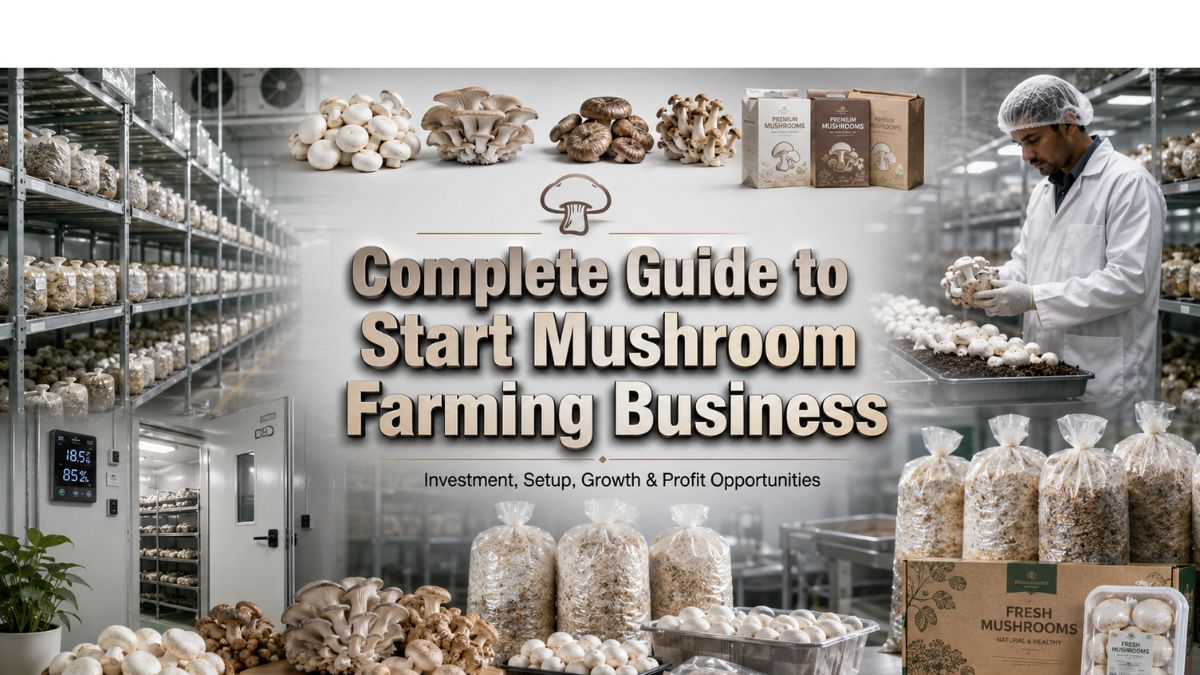
Mushroom Farming Business in India
Mushroom cultivation is one of the rare business ideas that are low-capital, quick-turn and highly in-demand in the Indian farming industry. The sector has been doing extremely well, silently turning into a potential large-scale business venture with several first-time entrepreneurs, agri-investors, and MSME project planners from all over the country by now. From a small mushroom unit in the backyard to an export cultivation facility, mushroom farming can be a viable way to make money — if it’s understood how the market works, how the business is profitable, and how it operates.
Why Mushroom Farming Is a High-Growth Opportunity Right Now
The mushroom sector in India is growing at more than a 10% CAGR, thanks to changing dietary trends, increasing health awareness and robust demand from the mushroom institutional market, comprising hotels, restaurants and food processors. Mushrooms, including oyster and button mushrooms, have begun to be seen more frequently in market chains, QSR menus, packaged foods and other markets, something that was virtually unheard of 20 years ago.
The economics of the new entrants are very compelling. With a proper substrate management system and regular flushing frequencies, the monthly income of a small-scale aquarium, with a capacity of 500 sq. ft., can be maintained between ₹20,000–₹40,000. Mushroom cultivation yields 3–5 times higher than conventional vegetable production per unit area, and the crop to harvest time is very short at 30–45 days per cropping cycle as compared to conventional vegetable production.
Moreover, India is still a net importer of mushroom products processed and dried. It would be a clear arbitrage opportunity for export-oriented entrepreneurs, especially in the dried shiitake and oyster mushroom segments, due to this structural gap.
Factors to drive the key markets are:
- Demand for higher protein plant-based food alternatives in urban areas
- Fast growth of cloud kitchens and health food delivery services
- The Government’s thrust for diversified income generation in agriculture.
- Increasing institutional purchasing by hospitals and nutraceutical manufacturers
- To Southeast Asia, Middle East and Europe to export potential
Mushroom farming is considered as a high priority horticulture activity and is eligible for various subsidy and infrastructure support programs, according to the National Horticulture Board.
Read the Complete Book Here: Handbook on Mushroom Cultivation and Processing (with Dehydration, Preservation and Canning)
Government Policies and Incentives Supporting Mushroom Farmers
The supportive policy environment at central and state levels is another of the best tailwinds in Favor of new entrepreneurs. Finance for mushroom cultivation infrastructure is provided for through several schemes in direct or indirect ways.
Key schemes to explore:
- PMEGP (Prime Minister’s Employment Generation Programme): Provides margin money subsidies of 15–35% for setting up micro-manufacturing and agri-processing units, including mushroom farms and spawn production labs.
- MIDH (Mission for Integrated Development of Horticulture): Offers capital subsidies of up to 50% (limited to ₹5 lakh per beneficiary) for post-harvest management, cold chain logistics, and protected cultivation — all directly applicable to commercial mushroom units.
- NABARD’s RIDF Scheme: Provides rural infrastructure financing including storage and processing units through NABARD-linked banks.
- Mudra Yojana (Tarun) loan of up to ₹10 lakh is offered for agri-business set up and working capital, without requiring collateral.
- State level subsidy: States such as Uttarakhand, Himachal Pradesh, Odisha, Jharkhand etc. give an extra 20-25% subsidy on capital expenditure to mushroom cultivation under tribal and hill development schemes.
Entrepreneurs are required to register themselves on the Udyam Registration Portal for formal MSME registration and access to most of the Government Subsidy schemes and priority sector lending.
Further, it is important for mushroom entrepreneurs to keep an eye on technical guidelines and subsidy notification published by the Ministry of Agriculture & Farmers’ Welfare specific to different crops.
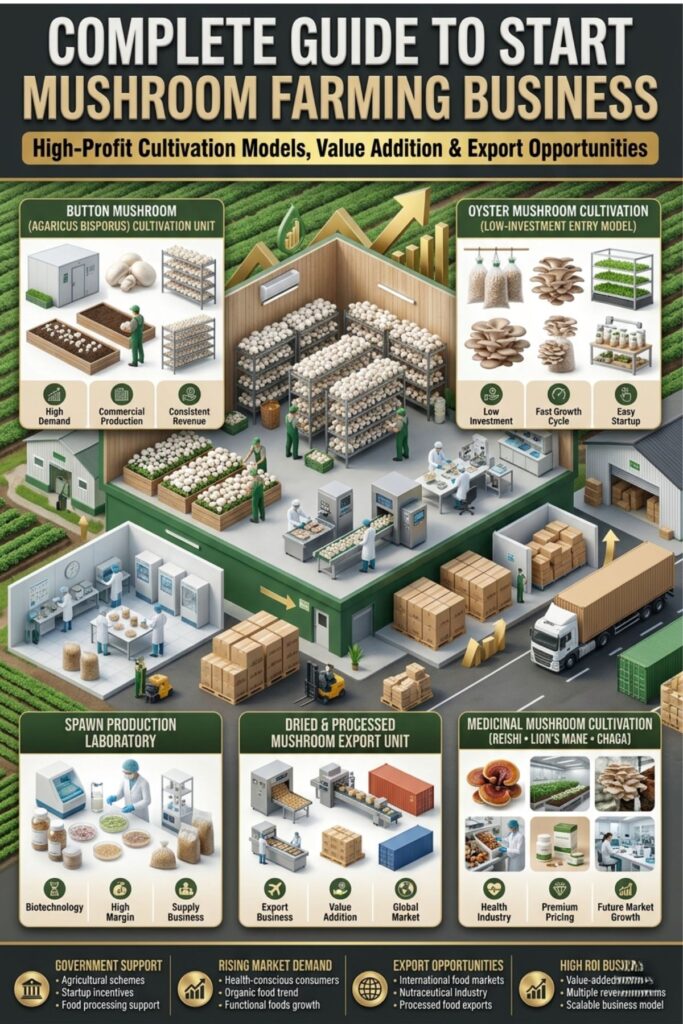
Multiple Mushroom Farming Business Ideas for Startups
1. Button Mushroom (Agaricus bisporus) Cultivation Unit
The button mushroom is still the most commercially significant species of mushrooms in India, contributing more than 70% of the mushroom production. Establishing a button mushroom facility in a controlled environment involves building composting facilities, pasteurization rooms, and temperature-controlled mushroom growing rooms. The yield for a medium scale unit of 1000 sq. ft. growing area is 800–1200 kg/ cycle and a cycle of about 60 days. The expected revenue per cycle is ₹60-₹90 per kg times the average number of cycles, which can be up to ₹48,000 to ₹1,08,000. The main investment problem is the quality of compost, as the poor quality of the substrate directly affects the yield and contamination risks. But entrepreneurs who learn how to make good substrate create a real moat for their business that competitors will not be able to easily overcome.
Access Complete Business Plan: Mushroom Production Process, How to Start Button Mushroom Farming
2. Oyster Mushroom Cultivation (Low-Investment Entry Model)
Oyster mushrooms are perhaps the best start-up for first generation agri-entrepreneurs in India. They can be grown on agricultural wastes, such as paddy straw, wheat straw, sugarcane bagasse, which are low cost, and do not require the additional expense of purchasing substrate. The unit is compact, can be launched for Rs. 1.5 – 3 lakh and commercial yield is possible 15-20 days post spawning. Several flushes per bag (usually 3-4 flushes) increases income per substrate unit. The current retail market price of oyster mushrooms in metro is ₹80-₹120 per kg and farm gate price is ₹50-₹70 per kg. This input cost advantage is unique for the entrepreneurs located in the vicinity of large belts of paddy production in Punjab, Haryana, Uttar Pradesh and West Bengal. Furthermore, used oyster substrate can be composted or sold as organic soil amendment, thus providing a second, secondary source of income.
3. Spawn Production Laboratory
In India most mushroom growers rely on the purchase of spawn and thus the demand for good quality spawn producers is always regular and lucrative. The following equipment is required to establish a spawn production lab: Sterilisation equipment, laminar flow hood, autoclave and culture maintenance. The entry barriers are real, however, and it is necessary to have trained staff and very strict aseptic procedures for contamination control and strain maintenance. The monthly income of a well-managed spawn lab catering to 50–100 mushroom farmers is in the range of ₹2 lakh to ₹5 lakh with a gross margin of more than 50%. In addition, spawn labs can expand their market to provide ready-to-fruit blocks (plug spawn, sawdust spawn) to the growing number of home-growers and hobbyists who are buying spawn through online retail outlets.
4. Dried and Processed Mushroom Export Unit
The dried mushroom export business in India is on steady rise with the highest demand from Gulf countries, Southeast Asian countries and European countries for Shiitake and Oyster varieties respectively. Establishment of post-harvest processing unit including drying equipment (tunnel dryers, tray dryers), cleaning, grading and vacuum packing equipment provides access to a much-increased price realization – dried mushrooms fetch 8–12 times the price that can be realised from fresh at the farm gate. A processing unit, mounted on a medium sized farm, is able to process 200-300 kg of fresh mushrooms and yield 20-30 kg of dried mushrooms daily. The economics are eye-catching with exports fetching ₹800-1,500 per kg, depending on the species and grade. APEDA export facilitation services can be explored for export regulatory information and market linkages to the entrepreneurs. APEDA has provided a list of registered exporters, mushroom certification requirements and market intelligence reports on its APEDA portal for mushroom exporters.
5. Medicinal Mushroom Cultivation (Reishi, Lion’s Mane, Chaga)
There is a premium demand for medicinal mushrooms in the country and world due to the nutraceutical and functional food industry. Reishi (Ganoderma lucidum) and Lion’s Mane (Hericium Erinaceus) are growing in popularity for inclusion in supplement formulas, immunity-boosting products, and Ayurvedic medicines. Having higher technical requirements, these species can get much better price realisation — Reishi dry extract fetches ₹2,000–₹5,000 per kg while the Lion’s Mane fresh mushroom can be sold at ₹300–₹500 per kg at premium quality urban outlets. Those who are entrepreneurs with a biological or pharmaceutical background can enjoy disproportionate margins in this area, or the ones willing to invest in the skills could. Technical cultivation guidelines for the medicinal mushroom species that are reliable starting references have been published by Indian Council of Agricultural Research (ICAR).
Build a profitable business with the right idea
Import–Export Opportunity Analysis
The mushroom industry in India offers a clear structural opportunity to those who wish to venture into entrepreneurship in the mushroom processing sector. Although the volume of fresh mushroom exports is relatively low because mushroom products are perishable, mushroom products with value added such as dried mushrooms, mushroom powder, mushroom extract and mushroom-based seasoning has gained tremendous export market demand growth.
Indian mushroom processors have the most convenient near-term export markets in the Gulf Cooperation Council (GCC) countries, especially the UAE and Saudi Arabia, owing to the presence of trade infrastructure and a demand from the Indian expatriates. The European customers, especially from Germany, Netherlands and the UK, are taking imported dried mushrooms with food safety certification and traceability documentations equivalent to FSSAI.
India imports large quantities of dried shiitakes from China currently, and it is a considerable import commodity. Although potential agro-climatic conditions in the Uttarakhand, Sikkim and Northeast India is suitable for domestic shiitake cultivation, it has not been developed well as yet. There is an opportunity for entrepreneurs to invest in shiitake production infrastructure in order to secure an import substitution opportunity. Entrepreneurs may approach Federation of Indian Export Organisations (FIEO) for export documentation and market access assistance.
Indian MSME Success Stories in Mushroom Farming
Devang Agrofood Pvt. Ltd. — Maharashtra
Devang Agrofood, having Vikram Patil as its promoter, started out as a small scale button mushroom unit near Pune and grew up to a Rs. Integrating spawn production with cultivation to generate 2 crore revenue operation in 4 years. The important lesson Patil learned was that consistency of yields was primarily through quality spawn control and not through enlargement of growing area. Patil had established a hub-and-spoke system by providing spawn to 80+ neighboring farmers, providing farming income and margin in the supply chain.
Srishti Mushroom Farms — Odisha
Srishti Mushroom Farms was established by Sunita Biswal, a former school teacher and agri-entrepreneur, who was given subsidy by the state government under Odisha’s tribal development agricultural scheme. Biswal started his career with a Rs. Within three years, he has built 1.5 Lakh Oyster mushroom unit and 1.5 Lakh milk packets. It has integrated the drying and retail packaging process to 45 lakh revenue operation. The success story shows that access to government schemes coupled with direct access to the retail markets can significantly shorten the mushroom entrepreneurs time-to-scale curve.
Himalayan Mushroom Co. — Uttarakhand
Arjun Negi, a former sales executive in FMCG, Himalayan Mushroom Co. from the outset decided to go for the premium retail segment. Negi established fresh oyster and shiitake brand in urban gourmet grocery chains and online platforms by selling fresh oyster and shiitake mushrooms at 2-3 times farm gate price through direct to consumers packaging. The moral of the lesson is that mushroom cultivation efficiency is not the determining factor to mushroom mushroom profitability ceiling, it is brand and channel strategy.
Related Article: A Detailed Guide To Mushroom Cultivation
How NPCS Can Help You Start Your Mushroom Farming Business
Niir Project Consultancy Services (NPCS) prepare Market Survey cum Detailed Techno-Economic Feasibility Reports (DPRs) for the entrepreneurs who intend to venture into the mushroom cultivation and processing industry. The reports include details on complete manufacturing and cultivation processes, market demand analysis, process flow diagrams, capacity and product mix planning, machinery and substrate sourcing details, and complete project financial with profitability projections. Our goal is to provide a realistic sense of feasibility, real capital needs and data-driven investment decisions, without committing capital.
Mushroom Farming Business – Indicative Project Economics
| Parameter | Oyster Mushroom (Small Unit) | Button Mushroom (Medium Unit) |
| Project Area | 500 sq. ft. | 1,500 sq. ft. |
| Initial Investment | ₹1.5 – ₹3 Lakh | ₹8 – ₹15 Lakh |
| Monthly Yield (kg) | 200 – 350 kg | 800 – 1,200 kg |
| Farm Gate Price (₹/kg) | ₹50 – ₹80 | ₹60 – ₹90 |
| Monthly Revenue | ₹15,000 – ₹28,000 | ₹48,000 – ₹1,08,000 |
| Payback Period | 12 – 18 months | 18 – 30 months |
| Govt. Subsidy Available | PMEGP / MIDH (15–50%) | PMEGP / MIDH (15–50%) |
Source: Field estimates compiled from NHB and ICAR technical publications. Actual figures may vary by region, variety, and operational efficiency.
Frequently Asked Questions (FAQs)
Q1. How much investment is required to set up a simple mushroom farm?
A basic level mushroom unit of oyster mushrooms can be started off with a low cost of around ₹ 50,000 to ₹ 1.5 lakh with an available substrate. The cost of a medium commercial unit with controlled environments ranges from ₹3 lakh to ₹10 lakh, which varies based on the species, location, and infrastructure’s quality.
Q2. Which mushroom is the most successful business in India?
The oyster mushroom is a good choice for new producers because of its low substrate cost, short cultivation period and high market demand. Button mushrooms produce more revenue volume, but more infrastructure. Medicinal varieties such as Reishi provide a better price, but require more technical expertise.
Q3. Are there any mushroom farming startup-friendly government schemes?
The main central schemes which will be applicable are PMEGP, MIDH under the National Horticulture Mission, the funds for rural infrastructure from NABARD and the Mudra Yojana (Tarun). State level schemes differ, and may supplement the figure by 20-30% based on the state and entrepreneurship type.
Q4. Can you farm mushrooms in a small area such as a terrace or in a garage?
Yes. Oyster mushrooms are well-adapted to urban micro farming in small, humid environments. There are dozens of successful micro-entrepreneurs operating profitable businesses in 100–300 sq. ft. premises, mostly in premium local retail and direct consumers in Mumbai, Bengaluru and Hyderabad.
Q5. Where can I get training in mushroom cultivation hands on?
The Institute also provide hands on training programs for mushroom cultivation along with State Agricultural Universities, Krishi Vigyan Kendras (KVK) and other private training centers. All the contact information of KVKs is available on ICAR website, state wise. Further, training programs for farmers are sponsored by NABARD through regional offices.
Q6. What are the risks I should anticipate in mushroom cultivation?
Cross-contamination (usually by competitive moulds, such as Trichoderma) is the greatest operational risk. Temperature/humidity fluctuations, variations in the substrates and the inconsistent quality of spawn represent other risks. These risks are considerably diminished if an entrepreneur is prepared to invest in spawn quality and the pasteurization equipment necessary for substrate production.
Conclusion
This has to be the most rewarding niche within agriculture considering the low capital inputs and robust demand increase coupled with adequate support from the government. If it is an additional source of income for the farm, a self-sufficient agricultural enterprise and manufacturing outfit, or a gateway to exports; then systematic and planned approach, and careful management is key. The entrepreneur most likely to succeed is one who brings to mushrooms the same rigor and analysis he would bring to any industrial MSME project. So before pumping in capital, do yourself a service; study a good feasibility study, conduct an adequate demand analysis and scrutinize the production economics. A bit of that study can save a business in the first round of infection.(Mushroom Farming Business in India
For further data and technical references, entrepreneurs may also consult the Confederation of Indian Industry (CII) Agri-Business Division and the ASSOCHAM Agricultural Council for industry reports and market access facilitation.


