





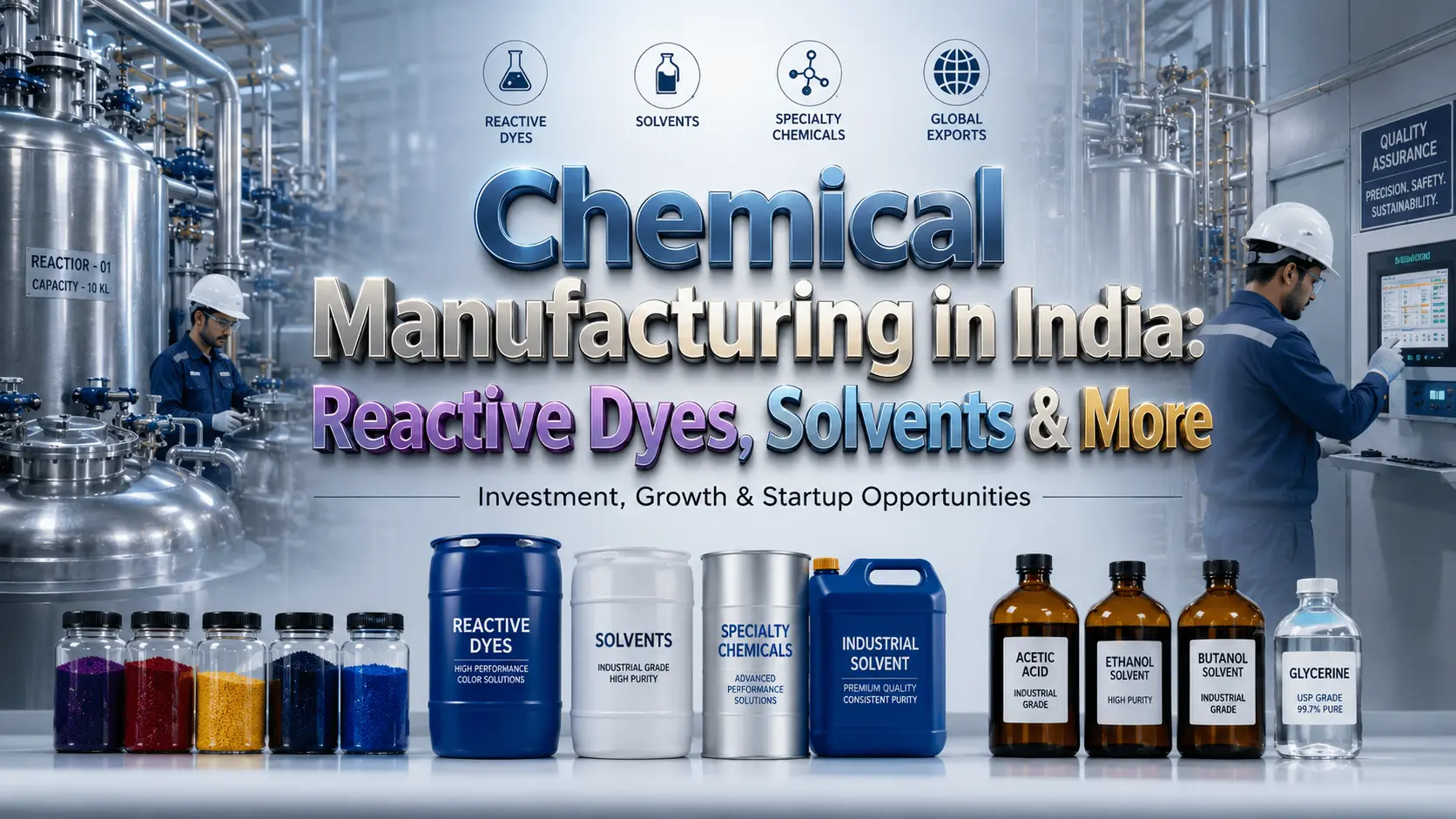
Reactive Dye Manufacturing Business
India Tops the World in Reactive Dye Exports — and Most MSMEs Don’t Know It
India exports more reactive dyes to the world than China, Germany or any other nation. Not second. First. The Observatory of Economic Complexity (OEC) estimates that in one recent year India shipped more than $563 million worth of reactive dyes, more than twice the amount China did. Bangladesh, Turkey, China and Pakistan are in line as purchasers. However, take a stroll through any second-tier town in India and ask ten entrepreneurs what type of chemical business they would choose — none will say reactive dyes.
That is the opportunity where you find yourself in global dominance, but lacking in local awareness.
The dye and chemical industry in India is more than just about fabrics. An equally intriguing facet of this industry consists of solvents for paints, coatings, inks, pharmaceuticals and agrochemicals. Specialty chemicals, which have a combined value of more than 50 per cent of India’s chemical exports, include reactive dyes and industrial solvents, as per US Commercial Service India Guide to Chemicals. Gujarat is the top producer of dyes accounted for by more than 75% of the total production of this country but the demand is national and export market is global.
This is a business that’s worth knowing in depth if you are a first-generation entrepreneur seeking a business in the manufacturing line where you can see a possibility for exporting.
Get Detailed Insights from This Book: Handbook On Chemical Industries (Alcohol Based)
The Market Gap: India Imports What It Should Be Making
The hard reality on India’s Chemical industry. The country exports $3.2 billion worth of dyes per year, and imports large quantities of specialty chemical, solvents, and dye intermediates, which could be manufactured domestically. IBEF’s Chemical Industry Data (FY25) indicates that India’s overall trade in chemicals shows an imbalance in trade in specialty molecules, which is an area with the highest margins.
The market for dye intermediates alone is projected to reach $13.7 billion in the world and growing at more than 8 percent per year, according to market analysis by Apurva Chemicals. The domestic textile industry in India which uses almost 70 per cent of the country’s dyes, is cotton-based. Tiruppur (Tamil Nadu), Surat (Gujarat) and Ludhiana (Punjab) are the major exporters with demand that is high and constant throughout the year.
In the solvent industry, the picture is no different. The pharmaceutical industrial clusters of Hyderabad (Telangana), the paint industry at Hosur (Tamil Nadu) and the agrochemical industry at Pune (Maharashtra) use industrial solvents like methanol, isopropyl alcohol, ethyl acetate, toluene derivatives in large quantities. Although the chemistry for specialty grades is well-understood, a substantial amount of specialty grades is imported, primarily from China.
Fibre2Fashion / Alchempro industry analysis of Indian dyes market finds that it is valued at $5.5 billion and is expected to grow at 8-9 per cent per year. The revenue for reactive dyes was more than 60 percent of the segment’s revenue. The message to entrepreneurs: India’s productivity is high, but it’s lower than it can be.
TABLE 1: Key Indian States — Reactive Dye & Solvent Demand Clusters
| State | Key Industrial Hub | Primary Demand Sector | Dye/Solvent Type | Estimated Annual Demand (MT) |
| Gujarat | Vapi, Ankleshwar, Ahmedabad | Textiles, Pharma, Agrochem | Reactive Dyes, Solvents | 95,000+ |
| Maharashtra | MIDC Tarapur, Pune, Nagpur | Paints, Pharma, Plastics | Specialty Solvents, Pigments | 60,000+ |
| Tamil Nadu | Tiruppur, Hosur, SIPCOT | Textile Export, Auto Coatings | Reactive Dyes, Dispersants | 45,000+ |
| Telangana | Hyderabad, Patancheru | API & Pharma Mfg | Solvents (IPA, Ethyl Acetate) | 38,000+ |
| Rajasthan | RIICO Bhiwadi, Jodhpur | Textile Printing, Handicrafts | Reactive Dyes (Cotton Grade) | 22,000+ |
| Punjab | Ludhiana, Amritsar | Hosiery & Knitwear | Reactive & Direct Dyes | 18,000+ |
Source: Industry estimates compiled from Ministry of Chemicals & Fertilizers data, IBEF, and state industrial development board reports.
The Opportunity: Three Tailwinds Arriving at Once
Reactive dyes and industrial solvents are becoming more desirable as a product of three factors.
The first thing is that there is a China+1 change. Chinese supply chains have been a primary target for European and American textile and paint companies, who are keen to diversify. Many dye manufacturers in India, especially those with REACH compliance for the EU markets, are picking up business formerly done exclusively by Shandong and Zhejiang provinces manufacturers.
Secondly, domestic textile development is still continuing to scale up. The PLI Scheme for Textiles with an allocation of ₹10,683 crore is attracting new garment and fabric factories. For every new unit started up in the textile industry, a dyestuff supplier is needed. The Ministry of Textiles announced certain incentives for dye manufacturers to reduce their environmental impact while expanding production, which is a direct boon for MSMEs that invest in treating effluent upfront, Ken Research noted in its report on the India Dyes and Pigments Market.
Thirdly, there are government support schemes which directly cover this sector. These are the most pertinent:
- PMEGP (Pradhan Mantri Employment Generation Programme): Provides subsidy of 25-35 percent on project costs for manufacturing units, with a limit of ₹50 lakh. Eligible are chemical and specialty product units specifically. Apply at kviconline.gov.in.
- CGTMSE (Credit Guarantee Fund Trust for MSMEs): Offers collateral-free loans of up to ₹2 crore to first-generation entrepreneurs, thereby removing the major obstacle for those, who do not have any property to provide as security.
- Udyam Registration + State Industrial Subsidies: When one registers on the Udyam portal, one becomes eligible for a range of benefits provided by the state such as power tariff subsidies, land subsidies in GIDC (Gujarat), MIDC (Maharashtra) and SIPCOT (Tamil Nadu) estates.
- Make in India / National Chemical Policy – The Government is planning to introduce a PLI Scheme for Chemicals and Petrochemicals, which will structurally drive the production of chemicals from domestic sources and minimize reliance on imports.
Get Detailed Project Report (DPR): Technical Textiles Applications and Projects
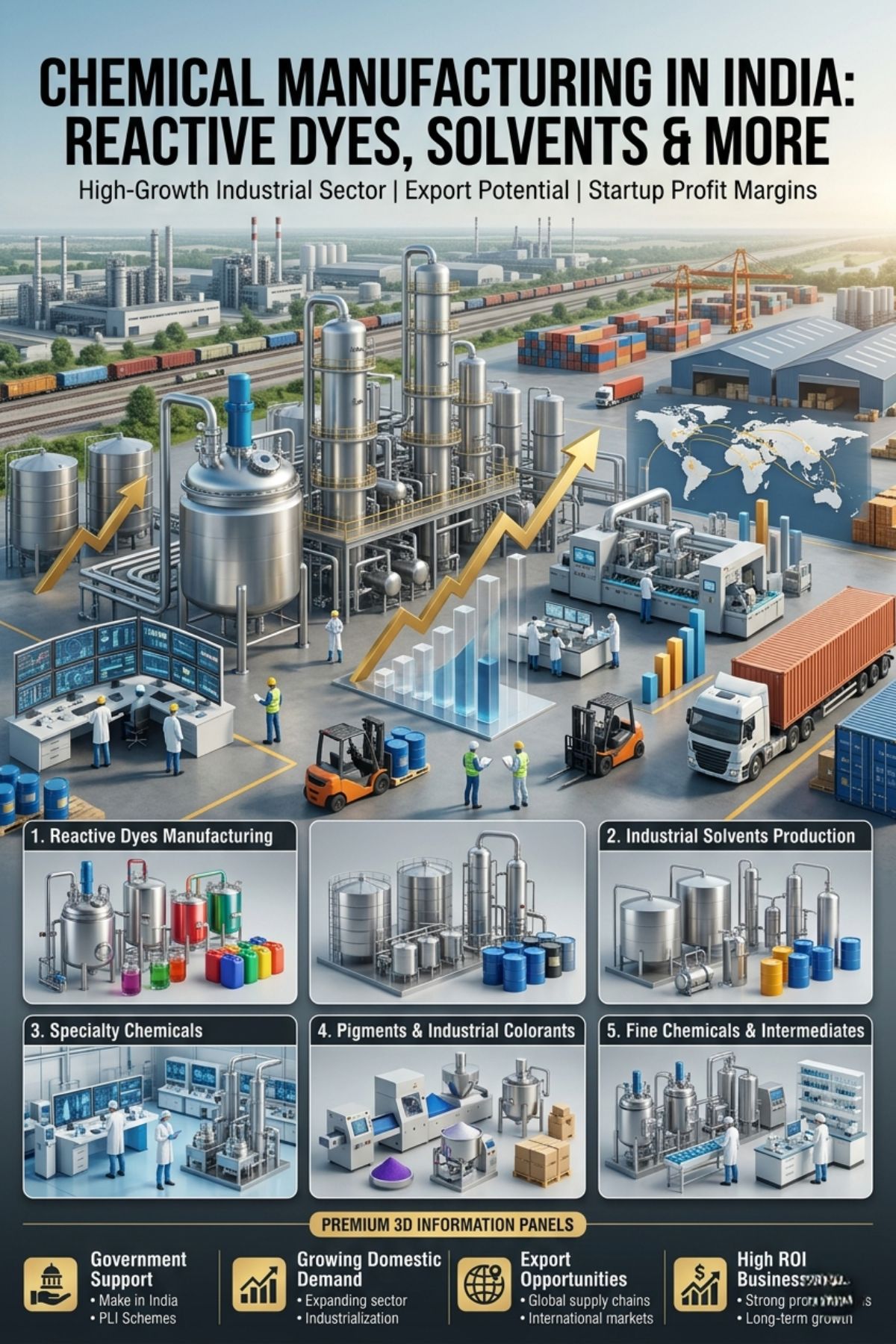
How to Set Up a Reactive Dye or Solvent Manufacturing Unit
Step 1: Choose Your Product and Location
Avoid attempting to make all types of dye. Decide on a niche – cotton reactive dye (the largest segment), disperse dye for polyester (the second largest) or solvents for paints and pharmaceuticals. Be on a well-established chemical industrial estate: The best GIDC estates in Gujarat are Ankleshwar, Vapi and Dahej. You’ll have infrastructure ready, Common Effluent Treatment Plants (CETPs) and a local skilled workforce. MIDC zones in Maharashtra are the second best.
Step 2: Land, Space, and Infrastructure
Built-up Area for a small MSME with an annual capacity of 150-300 MT Reactive dye works is 3,000-5,000 sq ft including Laboratory/Raw Material Store/ETP (Effluent Treatment Plant). Built up shed rentals within a GIDC estate range from ₹18–25 per sq ft per month, and the purchase of a plot in GIDC can be done for ₹800–1,500 per sq ft depending on the zone. Many novices lease instead of purchase in order to maintain their capital.
Step 3: Key Machinery and Equipment
The basic equipment requirements for reactive dyes manufacturing are: stainless steel reaction vessels (2-5 KL), temperature-controlled reactors, centrifuges, spray dryers or tray dryers, grinding and blending units, filtration units and a dedicated ETP. Install distillation columns and condensers, for solvent production units. The total investment of machinery for 150 MT/year unit of reactive dye is ₹ 80 lakh to ₹ 1.2 crore.
Step 4: Raw Material Sourcing
The aromatic amines, sulphonating agents, vinyl sulphone, MCT and coupling components are the primary inputs for the reactive dyes. The largest intermediates producers in Gujarat are suppliers like Bodal Chemicals (Ahmedabad), Atul Ltd. (Valsad) and Kiri Industries (Ahmedabad) who are supplying to the MSMEs. Solvents are made using the basic petrol chemical feedstocks procurable from IOCL, BPCL or from traders in Kandla/ Nhava Sheva.
Step 5: Licences and Regulatory Approvals
This is the longest step. Tie them in sequence:
- Udyam Registration will be first, online and free at the website udyamregistration.gov.in.
- GST Registration — within 30 days of starting operations
- The factory licence issued by state Labour Commissioner’s office under the Factories Act.
- Critical Bottleneck — Consent to Establish + Consent to Operate from GPCB (Gujarat), MPCB (Maharashtra), or relevant State Pollution Control Board; allows 4-6 months to be allotted;
- Authorities to dispose of hazardous waste are required for units that produce chemical wastes.
- Essential before installing machinery: Fire NOC — from local fire brigade
- If storing flammable solvents above threshold quantities use the PESO licence.
Step 6: Timeline and Team
In practice, it takes 12-18 months from registering a company to the first saleable production, mainly due to the fact that pollution clearances are a separate process, and can take from 4-6 months. A lean starting team of 8-12 members includes: one plant chemist (B.Sc./M.Sc. Chemistry), two production operators, one QC analyst, two helpers, one accounts-admin person and a sales/business development member of the trader team.
TABLE 2: Investment Breakdown — Reactive Dye MSME Unit (150 MT/yr Capacity)
| Investment Head | Amount (INR) | Notes |
| Land / Shed (lease deposit + fit-out) | ₹18,00,000 | 3,500 sq ft GIDC leased shed |
| Plant & Machinery (reactors, dryers, centrifuge) | ₹95,00,000 | SS-lined reactors + spray dryer |
| Effluent Treatment Plant (ETP) | ₹20,00,000 | Mandatory; often funded via bank |
| Lab Equipment & QC Infrastructure | ₹8,00,000 | Spectrophotometer, titration sets |
| Electrical & Utility Installation | ₹10,00,000 | 33 KV connection + transformers |
| Licences, Consultancy & Legal Fees | ₹5,00,000 | PCB, Factory Act, PESO |
| Working Capital (3 months raw material) | ₹45,00,000 | Aromatic amines, acids, reactive groups |
| Contingency (10%) | ₹20,00,000 | Cost overruns, delays |
| TOTAL CAPEX + WORKING CAPITAL | ₹2,21,00,000 | ~₹2.2 crore for a small MSME unit |
Source: NPCS project report estimates, NIIR.org industry data, and GIDC estate published rates.
Discover scalable startups tailored to your goals
Financial Snapshot: What the Numbers Actually Look Like
A reactive dye unit of 150 MT/annum capacity with an average realisation of ₹350 per kg would earn a revenue of ₹5.25 crore per annuum at 100 percent capacity utilisation. If the figure is taken conservatively and the utilisation at 60 per cent in the first year, that comes down to ₹3.15 crore.
Operating costs for IMARC Group’s dye production cost benchmarks are 60-70 per cent of raw material costs, which is aligned with the same. If the ratio is maintained at 3.15 crore per plant and the plant makes ₹3.15 crore revenue each year, its annual raw material cost would be about ₹2.1 crore, its annual utilities cost would be ₹30-40 lakhs and its annual labour cost would be ₹18-24 lakhs.
The gross margins for reactive dye industry are in the range of 35-45 percent. After overheads, depreciation and interest on bank loans, net margins are in the 18-25 percent range at scale. If a ₹2.2 crore investment brings in a ₹5.25 crore income, with a turnover of 20 percent, then net income goes up to ₹1.05 crore per year, which translates to a payback period of just over two years.
The realisation of export grade reacting dyes is 15–20 percent higher than domestic grade product. REACH compliant units that are catering to European customers are realizing ₹400-450 per kg, which is closer to 22-28 percent.
TABLE 3: Government Schemes Applicable to Reactive Dye / Solvent MSME Units
| Scheme | Nodal Agency | Key Benefit | Eligibility | Apply At |
| PMEGP | KVIC / MSME Ministry | 25–35% subsidy on project cost up to ₹50L | New MSME unit; 18+ years | kviconline.gov.in |
| CGTMSE | SIDBI / Ministry of MSME | Collateral-free loan up to ₹2 crore | Registered MSMEs | Via scheduled bank |
| MUDRA Loan (Kishore) | MUDRA / RBI regulated banks | ₹5L–₹10L term loan, no collateral | Micro enterprises | Via PSU/private bank |
| PLI Scheme (Textiles) | Ministry of Textiles | 5% incentive on incremental production | Dye mfg suppliers to textile cos | Ministry of Textiles portal |
| Udyam + State Subsidies | State Govts (GIDC / MIDC) | Power tariff subsidy, stamp duty waiver, land at disc. | Udyam-registered MSME | udyamregistration.gov.in |
| SITP (Textile Parks) | Ministry of Textiles | Shared infrastructure for dye/textile clusters | Cluster-based applications | Ministry of Textiles |
Source: Ministry of MSME, KVIC, SIDBI, Ministry of Textiles official scheme guidelines.
ENTREPRENEUR SPOTLIGHT
Dilip Patel | Ankleshwar, Gujarat | Annual Turnover: ₹4.8 Crore
Dilip began working as a production operator in the dye unit at Ankleshwar for 8 years and then started his own dye unit of blending and repackaging reactive dyes by saving ₹28 lakh and taking a loan of ₹40 lakh from CGTMSE. So he decided to go with blending, which was cheaper and would let him get in, and then he would use the cash flow to construct a synthesis reactor two years later. His main principle: formulation before synthesis. I learned more from the market than from any MBA, I learned about buyer specifications before I constructed one reactor. Currently his unit is providing 8 textile exporters of Surat and 2 buyers from Bangladesh.
Related Article: Specialty Chemicals Business in India: ₹1 Lakh Crore Opportunity, Investment & Profit Guide
Planning Your Entry: The Role of Project Feasibility Work
You cannot ‘wing it’ in chemical manufacturing and come up with the setup. The process design for the effluent treatment plants, the size of the reactors, raw material costing and revenue models all need detailed technical and financial inputs before one approach a bank or a state industrial development board.
Niir Project Consultancy Services (NPCS) available at niir.org is a renowned Indian agency that develops DPRs, techno-economic feasibility reports, plant layout designs and raw material studies specifically for chemical and dyes units. They produce well-documented project reports that meet the stringent approval requirements of various Indian banks (including PSU banks under CGTMSE) and state industrial finance corporations. Entrepreneurs can also access detailed and practical business setup guides, organized around manufacturing industries by entrepreneurindia.co (which sources information from NPCS and similar agencies). Preparing a sound DPR reduces your approval times significantly and eliminates the risk of redoing parts of your design, midway through the project.
Your Next Step: Do This Before You Spend a Rupee
India is the world’s number one producer of reactive dyes in terms of volumes exported. It is not an “aspiring to be” statement, it is a statement of facts-the infrastructure is present in industrial estates in Gujarat, government schemes are in operation, and the demand markets abroad are already on the lookout for dependable Indian exporters.
But this opportunity cannot wait. With China+1 sourcing accelerating and European REACH compliance turning a pre-requisite for selling overseas, units that come online early will capture existing buyer relations that late-starters may never breach.
So, what is the single step to be taken right away: Visit the GIDC website (gidc.gov.in) and note down existing sheds available in chemical estates of Ankleshwar or Vapi, while also order for a techno-economic feasibility report from NPCS for your proposed solvent/dye. These two actions will be your sole requirement when you approach a bank and the state pollution control board. All other things are subsequent to this.
Frequently Asked Questions
Q1. What level of investment will be necessary to set up a reactive dye manufacturing facility?
For an MSME scale plant capable of producing 150 MT per year, the total investment needed will likely be around 2-2.5 crores which includes plant, machinery, effluent treatment, working capital and other costs. For a pure blending unit, the capital requirement will be lesser i.e. Between 50-80 Lakh, and later the synthesis plant could be established based on performance of the blending unit.
Q2. What licences do I need to obtain prior to going into production?
The non-negotiables: Udyam Registration, GST number, Factory Licence under the Factories Act, Consent to Establish and Consent to Operate from State Pollution Control Board and Hazardous Waste Authorization. If storage of inflammable solvents exceeding a certain amount is required, a Fire NOC and PESO license will also be needed. State Pollution control board consents will have the longest lead time and so they are best started at the beginning.
Q3. Where can I get the raw materials for reactive dye production?
The primary intermediates (aromatic amines, vinyl sulphone, andreactive groups) are sourced from producers in Gujarat-such as Bodal Chemicals and Atul Ltd, both of which supply directly to MSMEs through authorised agents. Common solvents can be procured from petroleum traders in ports of Kandla and Nhava Sheva. A GIDC or equivalent plot located within a cluster will considerably reduce your procurement costs and lead times.
Q4. What are the profit margins an MSME may realistically anticipate?
The gross margin for reactive dye manufacturing averages 35-45 percent. When net of all expenses it works out to roughly 18-25 percent at scale. Realization for exports where the dyes adhere to REACH regulations will fetch 15-20 percent higher realizations thus pulling the net profit margins up to 22-28 percent. Return on the investment of 2.2 crores will be between 24-28 months at full capacity.
Q5. What governmental schemes are applicable to chemical MSME start-ups?
The most common ones are PMEGP (which can provide a 25-35% subsidy up to 50 lakhs via KVIC), CGTMSE (enables collateral free loans up to 2 crores, offered through commercial banks), MUDRA Kishore loans (up to 10 lakhs unsecured) and subsidies offered by the state industrial bodies, like GIDC, MIDC, or SIPCOT. Udyam registration acts as the gateway to all state level benefits-they must be acquired before approaching for any scheme.
Q6. How does NPCS benefit start-up entrepreneurs in the chemical field?
Niir Project Consultancy Services (NPCS), accessible through niir.org, produces detailed project reports and techno-economic feasibility studies for chemical production facilities including solvent and reactive dye plants. These reports include machinery specifications, plant layout, sourcing of materials, financial calculations and required regulatory clearances. They also serve as part of the loan documentation which speeds up bank approval in the case of new entrepreneurs.


