





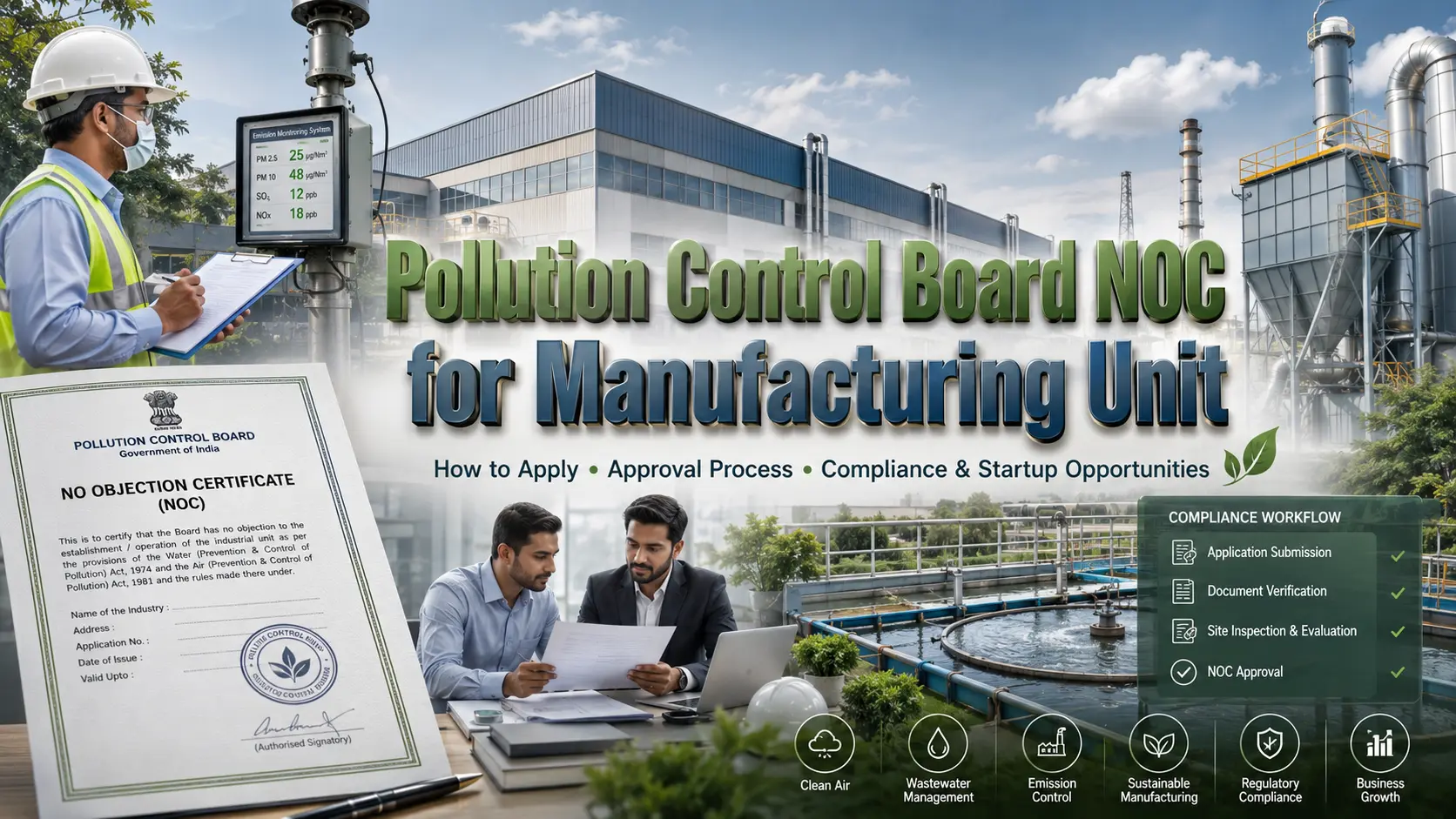
Why Your Factory Can’t Open Without a Green Tick
Last year, more than a thousand industrial units in India were sealed, closed or issued closure notices for one simple reason: they didn’t have the Pollution Control Board NOC. It is not because of bad manufacturing. Not for financial fraud. For not obtaining regulatory approval for operating the machines.
Many of them were small or medium sized units – dyeing units in Surat, food processing units in Ludhiana, chemical blending units in Vapi, all having valid GST registration, Udyam registration and bank sanctioned loans. They were blocked by a concept which most first-time entrepreneurs would never have heard of, until the district magistrate knocked at their door.
Pollution Control Board NOC (Consent to Establish (CTE) and Consent to Operate (CTO)) is a mandatory clearance granted by the State Pollution Control Boards (SPCBs) under the Water (Prevention and Control of Pollution) Act, 1974 and Air Act, 1981. If not, your plant is illegal. Period.
The good news? If you know it, it is navigable. This guide explains each step from classification to the documentation, application process, timelines, and what inspectors will see when you’re on site.
Get Detailed Insights from This Book: The Complete Guide on Industrial Pollution Control
The Compliance Gap That’s Killing New Ventures
The Central Pollution Control Board (CPCB) has registered more than 3.6 lakh industrial units in India which are under the control of environment. However, there is a considerable number of new MSMEs that start their businesses even before filing a consent application in the relevant segments such as plastic processing, textile dyeing, electroplating, food and beverages, chemical manufacturing, etc.
So what’s going on here? A host of factors is always given by the MSME consultants and officials from the state SPCB, three of these are always mentioned:
- Entrepreneurs assume Udyam Registration or Factory License covers environmental clearance. It does not.
- Many state portals are confusing with out-of-date fee schedules, and lack guidance on classification of categories.
- Founders often start construction or trial production with a fear of delay, hoping to ‘regularise later’, which is a harsh approach taken by courts.
The repercussions are dire. SPCBs have immediate closure powers under Sections 33A of the Water Act and 31A of the Air Act. If the environmental compliance is a doubt, banks can freeze term loan accounts, a clear risk for PMEGPs and those that took loans under the CGTMSE.
Gujarat, Maharashtra, Tamil Nadu, Uttar Pradesh and Haryana are the most active states in terms of SPCB enforcement activities in India, accounting for about 55–60% of the country’s active MSME manufacturing base. The growing tempo of industrial park development in states such as Rajasthan, Telangana and Odisha, is also resulting in a rise in the rate of inspections.
Based on the pollution potential, industries are categorized as Red, Orange and Green by MoEFCC. This classification will directly impact the documentation requirements, costs and frequency of inspections you will encounter.
Table 1: Industry Category Classification Under CPCB Guidelines and Typical Consent Timeline
| Category | Examples of Industries | Pollution Index Score | Typical CTE Timeline | Typical Annual CTO Fee (INR) |
| Red (High) | Electroplating, Textile Dyeing, Distilleries, Cement, Chemical Mfg. | ≥ 60 | 60–90 days | ₹20,000–₹2,00,000 |
| Orange (Medium) | Food Processing, Plastic Products, Soap & Detergent, Rubber | 41–59 | 30–60 days | ₹10,000–₹75,000 |
| Green (Low) | Assembly Units, Light Engineering, Garments, Handloom | 21–40 | 15–30 days | ₹2,500–₹20,000 |
| White (Negligible) | Software, Education, Tailoring, Certain Handicrafts | ≤ 20 | Exempted / Self-declaration | Nil |
| Specific Hazardous | Common Effluent Treatment Plants, Waste-to-Energy, Lead Smelting | Variable | 90–180 days + EIA | Case-by-case |
The Compliance Window Is Actually Shrinking — Here’s Why You Must Act Now
There has been a significant transformation in the enforcement landscape in India in the last five years. Three forces are changing the compliance timeframe for new manufacturers:
For one, the National Green Tribunal (NGT) has put in place standing orders for the SPCBs that they carry out at least two surprise inspections for a red category unit and one for an orange category unit every year. States are required to abide by it or be held in contempt. This has significantly diminished the previous practice and informal ‘tolerance’ of units that operate without permission.
Second, the Ease of Doing Business (EoDB) reforms promoted by DPIIT have indeed expedited online consent systems in 22 states. This is a double-edged sword as faster approval is possible, but also faster detection of non-compliance, as digital databases are now cross-referencing GSTN registrations with consent records.
Thirdly, the availability of government funding schemes has now become dependent on environmental clearance. Pollution Control Board clearance is required for the disbursement checklist of the PMEGP (Prime Minister’s Employment Generation Programme) which gives subsidies of 15–35% on project cost for new manufacturing units. Likewise, for CGTMSE (Credit Guarantee Fund Trust for Micro & Small Enterprises), there is a need for the environmental NOC documentation before issuing the final sanction letters for the collateral-free loan.
According to the SIDBI MSME Pulse report, compliance-ready units get 18-22% quicker loan processing time when compared to non-compliant units. The process of preparing the PCB NOC is not just a legal obligation, it’s a financial catalyst.
The Parivesh portal (parivesh.nic.in) – the one-window clearance system of MoEFCC – now incorporates the state-level SPCB applications for various industries. This is your gateway to the national project for projects more than ₹5 crore.
Get Detailed Project Report (DPR): Project Reports & Profiles
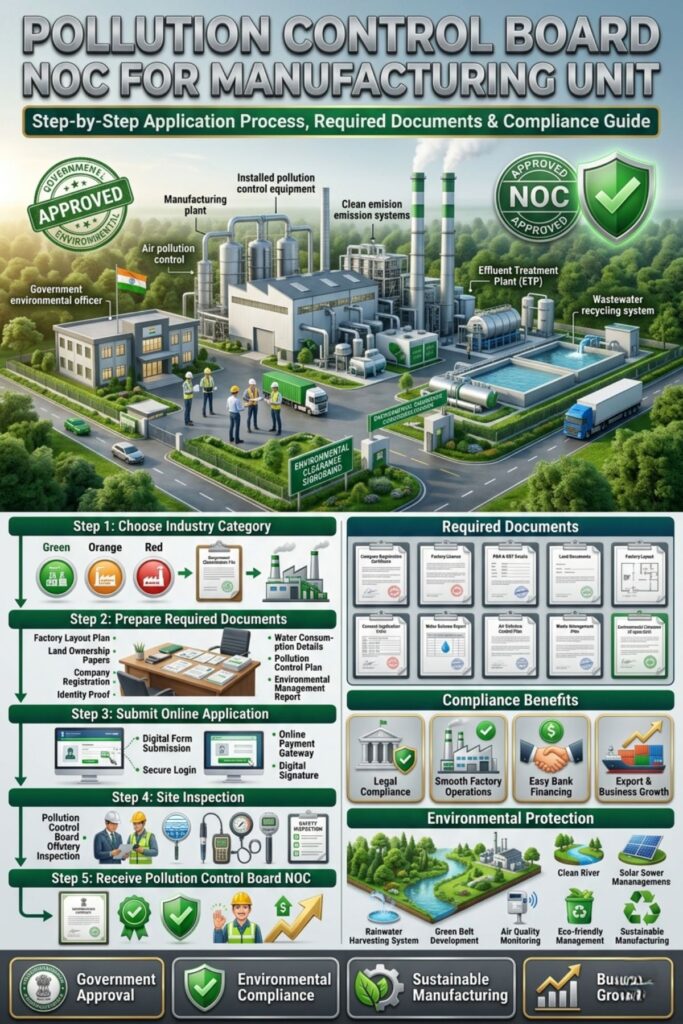
Step-by-Step: How to Apply for a Pollution Control Board NOC
Step 1 — Determine Your Industry Category
Check the CPCs categorisation list before you contact a form. Everything depends on your category (Red / Orange / Green / White): documentation, fees, requirements for inspection and issuing authority. A pickle manufacturing plant is Green. Red: An electroplating unit. A soap plant is orange. Soap plant is orange. Even if you’re mistaken, it can result in a withdrawal of consent in the future.
Step 2 — Identify Your State Portal and Nodal Authority
SPCBs are found in each state and have their own independent website. For example:
- MPCB Online Portal (mpcb.gov.in): Maharashtra
- Gujarat: GPCB (gpcb.gujarat.gov.in)
- Tamil Nadu: TNPCB (tnpcb.gov.in)
- Assam: DISHA (dishaweb.gov.in)
- Rajasthan: RPCB (environment.rajasthan.gov.in)
In case the investment is more than Rs. 5 crores, please verify if your project is also requiring Environmental Clearance (EC) from MoEFCC on Parivesh portal. Generally, however, green category small units do not.
Step 3 — Gather Your Documents (CTE Application)
Consent to Establish (CTE) is applied for prior to construction. Common forms used in most states:
- Site plan and layout drawing (to scale)
- Ownership documents or lease agreement for the land.
- Explain the manufacturing process and a flow chart of manufacturing process.
- List of raw materials showing daily/monthly quantities.
- The proposed effluent treatment, stack detail, and dust suppression measures are all considered to be pollution controls.
- The details of the water sources and water use is provided.
- Facilitation of MSME Registration / Udyam Certificate.
- GST Registration Certificate
- Affidavit of compliance (format varies by state)
- Prescribed fee payment receipt
Typical additional documentation for Red-category units is a detailed Effluent Treatment Plant (ETP) design report, emission calculations for the stack and a Solid/Hazardous Waste Management Plan.
Step 4 — Apply Online and Track Your Application
The majority of states have online applications only. Set up an account, upload all documents in proper formats (usually pdf with max file size of 5MB each), and online fee payment. Make sure you have your application reference number and it’s important for follow-up work.
Time of processing for full applications:
- Green category: 15 – 21 working days.
- Orange category: 30-45 working days
- Yellow category: 75–100 working days
- Red category (for site inspection) – 90-120 working days
Step 5: Prepare for the Site Inspection
An SPCB inspector will physically inspect your site before CTE is awarded, for Orange and Red units. They confirm that your proposed plant layout is consistent with what was submitted, the plant is designed appropriately for pollution control systems and the water discharge and air emission points are identified. Have your technical consultant or environmental engineer present during the inspection.
Step 6 — Obtain CTE, Construct, Then Apply for CTO
CTE (Consent to Establish) is a permission to construct the facility. CO (Consent to Operate) is applied for once construction is complete and equipment is installed. The CTO application will need the basic documents along with the evidence of pollution control equipment installed, record of trial runs and environmental laboratory test results for effluent/emission samples. The CTO fees are normally 1.5 to 2 times that of CTE fees.
The CTO needs to be renewed on an annual or 5-year basis depending on the state and category. If a person does not renew the consent on the renewal date, it is the same as if they had not consented at all.
Build a profitable business with the right idea
Total Investment in Compliance
The price of a PCB NOC for a medium-sized – Orange or Red category – unit usually varies from ₹40,000 to ₹3,50,000 covering the fees of government, consultant and pollution control equipment document. The total cost of small Green category units is in the range of ₹8,000 – ₹40,000.
Table 2: Pollution Control Board NOC — Document Checklist and Compliance Cost Breakdown by Category
| Item / Expense Head | Green Category | Orange Category | Red Category | Notes |
| CTE Government Fee | ₹2,500–₹10,000 | ₹15,000–₹50,000 | ₹30,000–₹2,00,000 | Varies by state and investment scale |
| CTO Government Fee | ₹3,000–₹15,000 | ₹20,000–₹75,000 | ₹40,000–₹2,50,000 | Renewal required annually / 5 years |
| Environmental Consultant Charges | ₹5,000–₹15,000 | ₹20,000–₹50,000 | ₹50,000–₹1,50,000 | Document prep, liaison, site report |
| ETP/STP Design Report | Not required | ₹15,000–₹40,000 | ₹40,000–₹1,50,000 | Mandatory for liquid discharge units |
| Lab Testing (Effluent/Emission) | Not required | ₹5,000–₹15,000 | ₹15,000–₹40,000 | NABL-accredited lab sample analysis |
| Total Estimated Compliance Cost | ₹8,000–₹40,000 | ₹75,000–₹2,30,000 | ₹1,75,000–₹5,40,000 | Excludes pollution control infrastructure CAPEX |
Financial Snapshot: Cost of Compliance vs. Cost of Non-Compliance
Many new founders consider the PCB NOC to be a “sunk cost. It is not. It is a risk-adjusted investment that has a definite return.
For a mid-scale food processing unit (Orange category) with a project cost of ₹1.2 crore:
- CTE + CTO compliance cost: ₹1,10,000–₹1,80,000 (0.9–1.5% of project cost)
- Under Environment Protection Act (EPA): Fine for the first violation is minimum of ₹5 lakh and criminal liability will be imposed on the second violation onwards.
- Emergency Closure & Re-opening Cost: ₹8 to 15 lakhs (Legal, Reconstruction, Loss of Revenue, Bank Penalties, etc.)
- If not compliant, impact on PMEGP subsidy disbursement is Full subsidy hold ₹18–42 lakh.
In the case of the red category units (electroplating, dyeing, solvent extraction), the arithmetic is more pointed:
- Annual CTO compliance cost: ₹3,00,000–₹6,00,000 (fees + ETP maintenance + lab testing)
- At 60% utilisation, the typical revenue for a dyeing factory of ₹3 crore is ₹1.8-2.2 crore per year.
- Net margin with full compliance: 14 – 18 %
- In the immediate aftermath of the closure order and forced remediation: Negative in 6–18 months
Compliance investment is effectively a pay-as-you-go investment: compliance is the cost for staying open. If a factory is not legal, then it has an infinite payback period.
Table 3: Government Schemes Linked to Environmental Compliance — Eligibility and Benefits
| Scheme Name | Administering Body | Relevant Support | PCB NOC Required? | Max Benefit |
| PMEGP | KVIC / State DICs | 15–35% capital subsidy for new mfg. units | Yes – mandatory | ₹25 lakh (SC/ST) / ₹12.5 lakh (General) |
| CGTMSE | SIDBI / MoMSME | Collateral-free loan guarantee up to ₹5 crore | Yes – for disbursement | 100% guarantee cover for loans up to ₹20 lakh |
| MSME Technology Upgradation Scheme (CLCS-TUS) | DC-MSME | 15% subsidy on machinery for micro units | Yes | ₹15 lakh per unit |
| Common Effluent Treatment Plant (CETP) Scheme | MoEFCC / State Govts. | 50–75% grant for ETP setup in industrial clusters | Supports obtaining NOC | Case-by-case |
| Zero Defect Zero Effect (ZED) | QCI / MoMSME | Certification + subsidy for compliant MSMEs | Mandatory for rating | ₹5 lakh reimbursement |
| PLI (Sector-specific) | Ministry of Industry / DPIIT | Production-linked incentives | Yes – prerequisites | 4–20% on incremental sales |
Related Article: The Rise of Carbon-Negative Materials: Can We Build a Pollution-Free Future?
Entrepreneur Spotlight
Ramesh Goswami is the Founder of Goswami Rubber Products — Vapi, Gujarat.
Ramesh Goswami set up a rubber compound manufacturing facility in Vapi GIDC at Vapi, Gujarat, which is one of India’s most monitored industrial areas as it is located in the catchment area of Vapi Common Effluent Treatment Plant. He first worked four months with a local environmental consultant to obtain his red category CTE before laying the first foundation stone. In 75 days after his unit was commissioned, they were awarded the CTO. From day one, our compliance file was clean, and the better terms we got from the banks. His unit is now running at 78% capacity and has annual revenue of ₹3.4 crore.
The takeaway: Hire your environmental consultant prior to hiring your civil contractor.
Expert Guidance for New Manufacturing Units
For the first-time entrepreneur applying for CTE-CTO, NIIR Project Consultancy Services (NPCS) has the specific project reports covering environmental compliance checklists, pollution control plant layout, ETP design data, and specific state-level guidelines. Having experience in over 8,000+ project reports across almost all manufacturing sectors for over 45 years, NPCS has developed a techno-economic feasibility study that inherently includes the NOC in the schedule and financial project from start-avoiding underestimation of environmental costs common in entrepreneur project plans. Pre-application founders may refer to niir.org and entrepreneurindia.co for sector-specific project reports, feasibility study, and compliance procedures that may be used as working documents throughout the consent process.
The One Thing You Should Do This Week
You have the blueprint. The only question is will you act upon it before the machinery begins to churn and the inspector shows up at your doorstep.
This week, do just this one thing. Google your industry under the CPCB categorisation list and decide whether you are Red, Orange, or Green. That one category determines your entire time and money investment for the consent process- whether it is a fullblown ETP, environmental consultant and planning or simply a filling of the online forms.
If you are yet to commence construction, apply for a CTE immediately. If you are currently running your business without a CTO, please stop reading this article and immediately contact an environmental consultant. There is a list of empanelled consultants readily available with the SPCB of your state. NPCS is there to aid you in embedding compliance requirements into your comprehensive project report and financial planning. To do it right, at the outset, has a nominal cost. To get it wrong, however, is fatal.
FAQs
1.What is the cost of obtaining PCB NOC in India?
Cost varies by industry category & state. For a green category small unit it ranges from Rs. 8,000 – 40,000 (Govt fees + consultant fees); for orange category, it can range from Rs. 75,000 – 2,30,000. For red category the cost may be from Rs. 1,75,000 – 5,40,000 (excluding the investment made on pollution control equipment like ETP).
2.What is the difference between CTE & CTO?
Consent to Establish (CTE) is granted by state PCB before establishing the manufacturing plant and gives permission to build the premises. Consent to Operate (CTO) is granted after establishing and running of manufacturing plant, after fulfilling all norms required. You require CTE first, then CTO before starting commercial operations. No product can be manufactured without CTO.
3. Which industries are exempt from PCB NOC?
White Category industries by CPCB include some software firms, some food retails, tailoring and certain handicraft industries are exempted from getting the PCB NOC. The list is too small and limited. Most of the manufacturing activities including assembly, molding, light chemical, Food processing would definitely require a green or orange category NOC. Please check the category for the activity code.
4. How much time is taken by PCB NOC process?
Green category will have around 15-21 days on the respective state portal upon submission of proper application documents and information. For orange categories, there is a general limit of 30-60 days. The red category takes 60-90 days as they require physical inspection and approval by committee; this time may extend up to 120-180 days if an EC clearance under EIA Notification is also required. The biggest delay is incomplete applications.
5.Can I apply for a bank loan without obtaining PCB NOC?
A bank can issue an in-principal sanction letter before obtaining the NOC but final disbursal of term loan for the specific venture would require environment clearance certificate in PMEGP, CGTMSE back products, and PSU Bank loan schemes. Private banks and NBFC’s may disbursal in the absence of the NOC but at the risk of borrower in terms of legal liabilities. SIDBI regulations also mention need for environmental compliance documents for loans to manufacturing units above Rs. 25 Lakh.
6. Where can I find an expert for a project report that includes environmental compliance?
NIIR Project Consultancy Services (NPCS) prepares detailed project report that also includes compliance requirements, ETP costs, and the SPCB application documents list as part of the scope of the service for more than 8,000 project reports that cover all the manufacturing industries available with one of the best project report databases available across India. You can see industry specific reports, compliance guide at niir.org or at entrepreneurindia.co to reach the NPCS team.


