






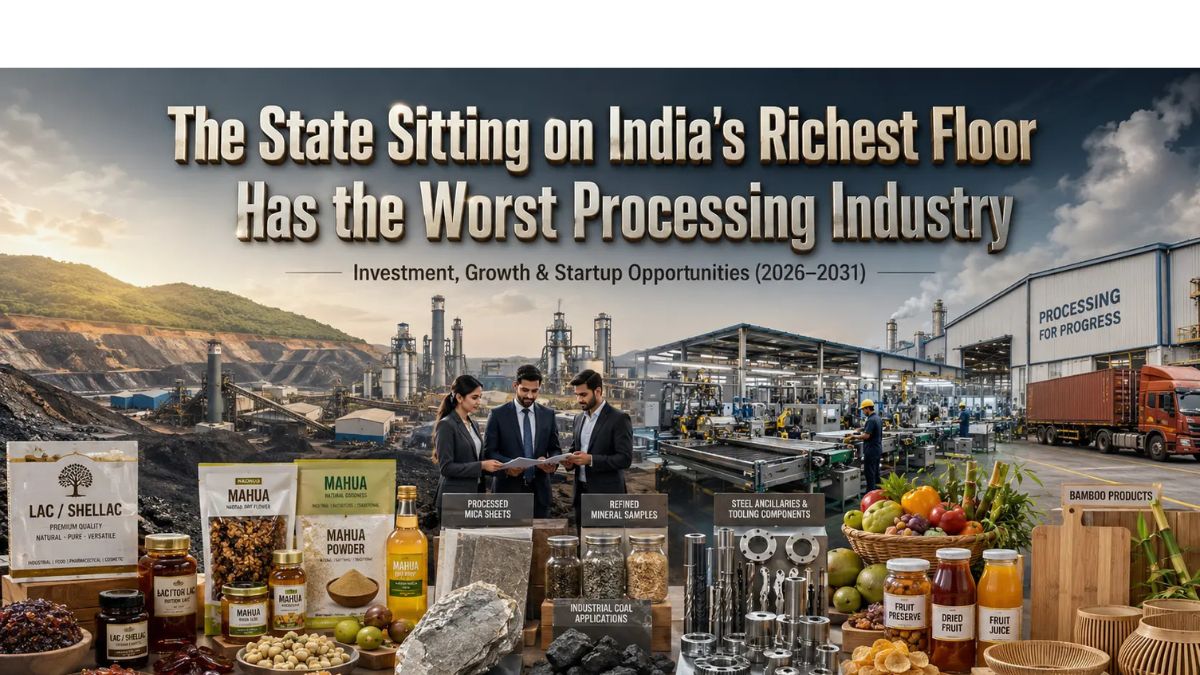
Jharkhand accounts for a forest cover of nearly 30%, 40% of its mineral reserves, but more than 80% of the raw produce from its forests goes out of the state without being processed. That’s the opportunity for the right MSME entrepreneur.(Jharkhand MSME business ideas)
A State That Exports Raw Materials and Imports Finished Goods
Around 25% of the steel of India is produced in Jharkhand. It has the biggest reserves of coal, uranium and copper in India. It has 23,605 sq km of forests — over 29% of its land mass. The second largest producer of horticulture crops in the country. However, only 25% of its agro-forestry production is processed within the state before it becomes available to consumers. The rest is then transformed into a raw material, processed somewhere in Maharashtra, Gujarat or Punjab and re-shipped back to the east with prices 3X to 6X higher.
This is not a resource story… It is a story of a processing. It’s really the type of niche that has made fortunes for first-generation businessmen in states like Himachal Pradesh (apple processing), Chhattisgarh (bamboo and lac) and Uttarakhand (herbal extraction). Invest India reports that there are currently 18,109 MSMEs in Jharkhand, which seems high until you consider that the resource base in the state can support 10 times that number of MSMEs, at least.
Jharkhand is the only state in the country where land is cheaper than the industrial estates in Pune, raw material is at your doorstep and there is no competition, structurally, because nobody thought to come here. Right now.
The Gap: Processing Infrastructure Has Not Kept Pace with Raw Material Wealth
The Ministry of Food Processing Industries (MoFPI) states that Jharkhand has a variety of agro-climatic zones, is a significant producer of paddy, pulses and ranks second in the country in production of horticulture. Nevertheless, the number of cold storages in the state is limited to 58, which is very little when compared to that of Bihar and West Bengal, and there is virtually no organized cluster of lac processing industry, mahua based industries and mineral linked fabrication in the downstream industries.
The mineral processing gap is also very wide. According to Invest India data, the steel production in Jharkhand has increased from 8 million tonnes to more than 12 million tonnes annually. However, MSMEs ancillary industry such as tooling and fabrication, components, mineral beneficiation has not grown at the same pace. The majority of the steel is sold to processing centres in Chhattisgarh and Maharashtra from where it is again put to the market.
The forest produce is even worse off. According to the MSME Ministry’s Strategic Investment Plan (SIP) for Jharkhand, the tribal population in the state harvest lac, mahua seeds, sal seeds, and tendu leaves, and sell them to collectors at their cost and get the middlemen to put them together and sell them outside without any processing. The value multiplication that should be achieved within the boundaries of Jharkhand, that is drying, grading, extraction, packaging, cosmetic-grade purification does not take place here.
Business is leaving India on the table as the figure of 65 per cent is 70 per cent higher than the global average of 5 per cent in the forest produce value addition of the Jharkhand Forest Economy Study researcher.
The three most promising sectors for MSME entry were the processing of lac, processing of shellac, tribal food products (mahua liqueur, tamarind concentrate and wild honey bottling) and the production of mineral-related light engineering (precision tool casting, and mica electrical components). Each of these three is underserviced, over-used, and policy-supported.
View Full Project Details: Best Business Opportunities in Jharkhand
TABLE 1 OF 3
The State of Jharkhand has been identified as a key resource cluster, a resource deficit, and MSME entry points.
| Jharkhand: Key Resource Clusters, Deficit, and MSME Entry Points | ||||
| Sector / Product | Key Districts | Current Value Addition (%) | National Demand (Est.) | MSME Entry Opportunity |
| Lac / Shellac Processing | Ranchi, Khunti, Lohardaga | ~12% | ₹1,800 Cr/year | Seed lac, shellac flakes, lac dye |
| Mahua-Based Food Products | Gumla, Simdega, Latehar | <5% | Growing; largely informal | Mahua flour, tonics, country liquor licensed units |
| Mineral Fabrication (Mica, Coal) | Koderma, Giridih, Dhanbad | ~20% | ₹3,200 Cr/year (electrical mica) | Mica sheets, insulation products, electrical components |
| Steel Ancillaries / Tooling | Bokaro, Jamshedpur, Chaibasa | ~30% | Captive demand from Tata, SAIL | Precision casting, forging, safety equipment |
| Horticulture / Food Processing | Ranchi, Hazaribagh, Palamu | ~8% | ₹900 Cr/year potential | Tomato paste, amla products, cashew processing |
| Bamboo Products | West Singhbhum, Saraikela | <10% | ₹600 Cr/year (growing) | Furniture, agarbatti sticks, packaging material |
Sources: Invest India, MoFPI State Profile, MSME SIP Jharkhand
Get Detailed Insights from This Book: Bamboo Plantation and Utilization Handbook
Why the Timing Is Right
The processing sectors in Jharkhand are becoming more investable than in the past 20 years thanks to three forces. The state government’s Industrial and Investment Promotion Policy has identified the food processing and mineral value addition sectors as priority sectors with up to 30% capital subsidies for new MSME units and 5% interest subvention for 7 years.
Second, credit linked subsidy of 35% on project cost (upto ₹10 lakh per unit) is available under the PM Formalisation of Micro Food Processing Enterprises (PMFME) scheme under MoFPI for upgrading the existing informal food processors or for setting up the new food processors. The state of Jharkhand has been declared as an aspirational state under this scheme, so applications from here will get priority processing. MoFPI is implementing the Pradhan Mantri Kisan SAMPADA Yojana for setting up cold chains, agro-processing clusters and food parks; units in Jharkhand will be given the priority tag of ‘aspirational district’.
Third, there is a change in consumer demand. By now, the urban India is willing to pay a premium for the products which have a tribal and forest origin – wild honey, mahua based beverages, ashwagandha extract and natural lac cosmetics – and the e-commerce platforms have made it accessible to the tribal and forest-based producers of Khunti and Simdega. According to IBEF, the domestic market for natural personal care products made with shellac and lac dye has registered growth of more than 14% each year in the last five years.
Physical infrastructure is the fourth. Currently, Jharkhand has two domestic airports (Ranchi, Deoghar), 12,736 km of roads and has close proximity to Kolkata, Haldia and Paradip ports which are all important factors for transporting processed goods to export markets. This is not something that other landlocked States can afford.
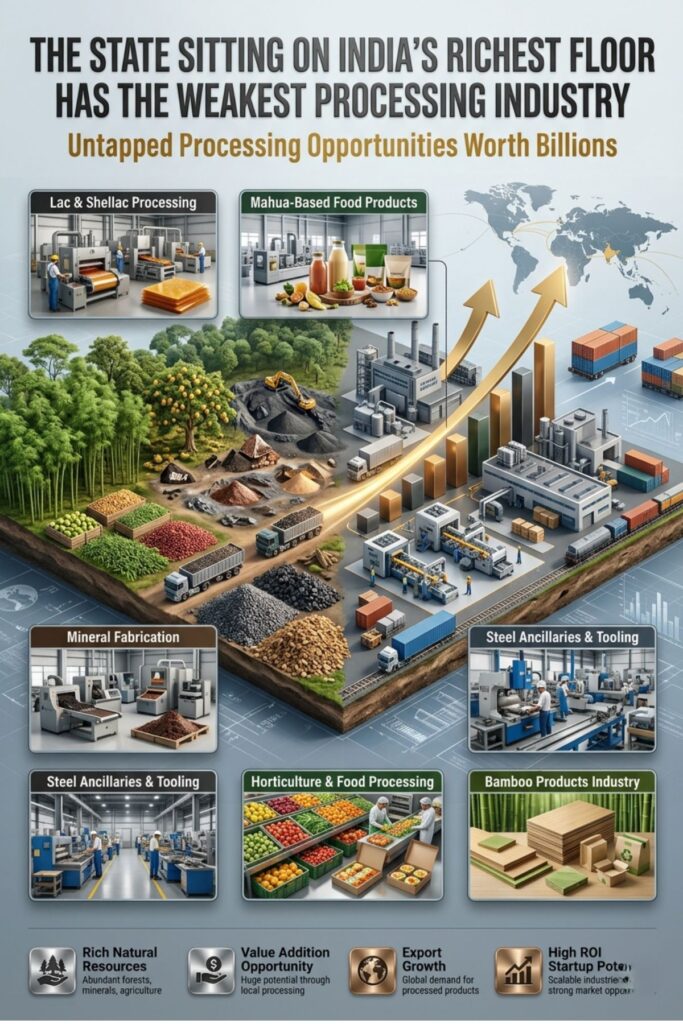
How to Set Up a Lac Processing / Forest Produce Processing Unit in Jharkhand
A lac and minor forest produce processing unit is the most easily accessible entry point for the MSMEs for a new entrepreneur with low input cost, existing supply chain through JSFDC (Jharkhand State Forest Development Corporation) and good demand from shellac manufacturing, cosmetics industries and industries having shellac coating in food. The following is a “how to setup” path:
- Register the business: File for Udyam Registration on udyamregistration.gov.in (free, online, 15 minutes). This is the gateway to MSME subsidies, priority bank lending, and government scheme eligibility. Follow this with GST registration if annual turnover exceeds ₹20 lakh.
- Land and space: 2500 to 4000 sq ft of built-up area is required for a processing unit. There are 14 active industrial estates in Jharkhand (Adityapur, Gamharia, Boram, Bokaro etc.) where you can lease industrial shed at the rate of 8 to 15 per sq ft per month. You can also take possession of a plot allotted by JIADA at a rate of 600 to 1,200 per sq mt in the notified estates.
- Machinery: The typical machinery components involved in the lac processing line are as follows: seed lac washer+scrubber (1.8-2.5 lac), vacuum filteration unit (90,000-1.5 lac), drying oven (60,000-80,000), grader+siever (40,000-70,000) and a packaging line (50,000-1.2 lac). The total machinery cost of a micro unit is ₹4-6 lakh. The cost for small-scale unit for shellac flake is: ₹12–18 lakh.
- Raw material sourcing: Buy seed lac directly from raw material procurement centres of JSFDC from Ranchi, Khunti and Lohardaga. Raw seed lac is sold at collector level prices ranging from ₹140-200/kg while processed shellac flakes are sold at collector level prices at ₹650-950/kg. It’s a business model, the arbitrage.
- Licenses required: Udyam Registration (required) and GST Certificate, Factory License under Factories Act (if having 10+ workers and power) and Pollution Control NOC from Jharkhand State Pollution Control Board (JSPCB) – Category Green for most of the MFPs process units. In the case of products touching food applications, FSSAI registration is required.
- Finance: Apply for MUDRA loan (Micro Units) from Tarun loan of up to ₹10 lakh (No Collateral) In bigger projects, loans of up to ₹2 crore can be availed without any collateral security from CGTMSE backed term loan facility through the branches of SBI or Bank of India, Ranchi. The capital subsidy by the Jharkhand government becomes available to the MSMEs after the production process has begun (30% of plant and machinery, capped at ₹30 lakh).
- Time line: Registration to first production: 3-4 months. If employing more than 10 staff, add 4-6 weeks for JSPCB NOC and Factory License.
- 8-12 people — 2 semi-skilled machine operators, 4-6 sorting and grading workers (located in the vicinity at ₹350-450/day), 1 quality supervisor and 1 account and dispatch person.
TABLE 2 OF 3
| Investment Breakdown: Lac Processing Unit (Small-Scale, Ranchi District) | |||
| Cost Head | Micro Unit (₹) | Small Unit (₹) | Notes |
| Land / Shed (lease + deposit) | 1,20,000 | 3,60,000 | Industrial area lease, 12-month deposit |
| Plant and Machinery | 4,50,000 | 16,00,000 | Washer, vacuum, dryer, grader, packer |
| Civil / Interior Work | 80,000 | 2,50,000 | Flooring, electrical, basic civil |
| Working Capital (3 months) | 2,80,000 | 8,00,000 | Raw material, wages, utilities |
| Licenses and Compliance | 25,000 | 60,000 | Udyam, GST, FSSAI, JSPCB, Factory License |
| Contingency (10%) | 85,000 | 3,00,000 | Equipment delays, overruns |
| Total Capital Required | 10,40,000 | 33,70,000 | Pre-subsidy; state subsidy reduces effective cost by 25–30% |
Estimates based on JIADA industrial rates, JSFDC input pricing, and field data from IJCRT MSME Jharkhand Study
Identify high-growth industries before others do
ENTREPRENEUR SPOTLIGHT
Sushila Devi, Khunti District, Jharkhand
Sushila Devi established a self-help group-based lac sorting and grading unit with ₹1.8 lakh, a portion of which was raised through a micro unit development (MUDRA) Shishu loan and a portion from the Jharkhand Opportunities for Harnessing Rural Growth (JOHAR) programme in Khunti. In 18 months, her 12 women team started processing seed lac at the rate of 4 tonne per month and provided to an exporter of shellac in Kolkata. Net income per member reached almost doubled the district agriculture wage of nearly ₹8000 per month. Her important takeaway: Don’t do everything yourself; process one stage, do it well, and look for the right buyer at that stage.
Data from JOHAR scheme beneficiaries used to create representative profile, Jharkhand Rural Development Department.
Financial Snapshot
Start-up cost of the small-scale lac processing unit is approximately ₹34 lakh, after subsidy, it will be approximately ₹24 lakh, and the operating picture is as follows:
Monthly operating cost: Raw material (3 tonnes seed lac at ₹170/kg) = ₹5.1 lakh. Labour (10 workers) = ₹1.1 lakh. Power and utilities = ₹25,000. Packaging = ₹30,000. Total monthly opex = ₹6.75 lakh.
Revenue at 60% capacity: Output = ~1.5 tonnes shellac flake (yield ~50%). The monthly revenue is ₹11.7 lakh, when the price is sold at ₹780/kg. Gross margin = ~42%. Net margin (after admin and debt service): 18–22%.
Capacity of 250%: Output = ~2.5 tonnes of shellac flake. Monthly revenue ₹19.5 lakh. Fixed cost absorption leads to an improvement in net margin to 24-28%.
Payback period: At 70% average utilisation, the unit recovers its effective post-subsidy investment in 28–34 months. Factoring in the Jharkhand MSME interest subvention (5% for 7 years), the debt-servicing cost drops materially, improving IRR to approximately 26–30%.
Horticulture based units (Tomato processing, amla candy, tamarind concentrate) are smaller in size, have lower gross profit (32-36%) and net profit (12-16%), lower capital investment (range of ₹8-15 lakh) and short working capital cycle due to seasonal nature of production.
TABLE 3 OF 3
| Government Schemes Applicable to Jharkhand MSME Processing Units | ||||
| Scheme | Ministry / Body | Benefit | Eligibility | Link |
| PMFME (Formalisation of Micro FPE) | MoFPI | 35% credit-linked subsidy, max ₹10 lakh | Existing/new micro food processing units | pmfme.mofpi.gov.in |
| PMKSY (Kisan SAMPADA Yojana) | MoFPI | Grant for cold chain, agro clusters, food parks | MSMEs, FPOs, SHGs, companies | mofpi.gov.in |
| MUDRA Tarun / Kishore | MUDRA / Banks | Collateral-free loans ₹50,000–₹10 lakh | Micro enterprises, first-gen founders | mudra.org.in |
| CGTMSE | SIDBI / MoMSME | Collateral-free credit guarantee up to ₹2 crore | Udyam-registered MSMEs | cgtmse.in |
| Jharkhand MSME Capital Subsidy | Dept. of Industries, Jharkhand | 30% of plant and machinery cost, max ₹30 lakh | New MSME units in Jharkhand | jharkhand.gov.in |
| Van Dhan Vikas Kendras (VDVKs) | TRIFED / MoTA | Infrastructure, training, market linkage for tribal MFP processing | SHGs, tribal entrepreneurs, cooperatives | trifed.in |
Related Article: India’s Richest Business Families: Their Empires, Strategies and What Entrepreneurs Can Learn
Getting to a Bankable Project Plan
Where a business idea needs to be presented to the bank in a project file is where most first time MSME entrepreneurs are held up. Technical specifications like plant layout, machinery specification, flow of raw materials, projections and break-even cannot just be Google’d by an entrepreneur. For entrepreneurs setting up a lac processing unit, horticulture food parks, a mineral fabricating industry or a bamboo-based industry in Jharkhand, the first logical stop would be NPCS (Niir Project Consultancy Services). They produce project reports, techno economic feasibility studies and plant layout designs for hundreds of industrial areas like agro-processing, forest produce, minerals processing and value addition. They sell these reports at niir.org. Most loan applications for MSMEs quote from these reports. The entrepreneurindia.co site lists a consolidated directory of NPCS’s reports that are relevant for Jharkhand’s preferred industries, which can act as a checklist for due diligence before you put money on the table.
THE MOVE IS NOT RESEARCH. THE MOVE IS REGISTRATION.
Jharkhand’s processing deficit is real. Three separate government entities say it is real. The policy support is available. Raw materials are there. The market (urban India and export markets) exists. All that is missing is an entrepreneur to show up.
The only thing that needs to be done this week: visit udyamregistration.gov.in, get your enterprise registered and then pick up the phone and call your DIC (District Industries Centre) in Ranchi or the desired district, ask the current allotment schedule of plots in the industrial estates. In 20 minutes that one phone call will decide if you are in production within 6 months or “researching” two years down the line.
The opportunity is not going to vanish; someone else will grab it.
Frequently Asked Questions
1. What is the minimum investment to start a forest produce processing unit in Jharkhand?
A micro-scale lac sorting and grading unit can be started with a total investment of 8-12 lakh including machinery, working capital, and other compliance costs. The requirement will further reduce after factoring in the Jharkhand state MSME capital subsidy of 30% of the plant and machinery up to 30 lakhs. A MUDRA Tarun loan could fund up to 10 lakhs of this requirement without collateral.
2. What licenses are required before production is started?
At a bare minimum Udyam registration, GST registration, and a Pollution Control NOC from the Jharkhand State Pollution Control Board (JSPCB). You’ll need to get a Factory License under the Factories Act if you use electrical power and if your unit has more than 10 workers. If any of your products fall under the food grade applications like mahua product, wild honey, amla, then it is non-negotiable that you get FSSAI registration.
3. How do I source raw materials for lac or mahua processing in Jharkhand?
JSFDC is the key state-level aggregator with procurement centers in Ranchi, Khunti, Lohardaga, and Gumla where you can buy your seed lac at season fixed price at MSP levels under the Van Dhan scheme in coordination with TRIFED. You can also directly buy from the collector co-operatives operating in Scheduled Areas which will save you around 15-20% of middlemen markups.
4. What profit margins are expected from lac processing?
At a stable capacity utilization of 70% a small lac processing unit would achieve gross margins ranging from 38-44% and net margins of 18-24%. The input-output price difference ranging from 150-200 per kg for seed lac and 700-950 per kg for processed shellac flake ensures a structural margin which would not be eroded unless there is a sharp drop in the price of shellac in global markets, which is extremely rare because of India’s near monopoly in supply.
5. Which government scheme provides the best financial advantage for MSMEs in Jharkhand?
Combination of PMFME (35% credit linked subsidy) with the Jharkhand state capital subsidy (30% of machinery cost) with the support of bank finance against CGTMSE cover gives a new unit an effective leverage of 50-60% subsidized capital. For tribal entrepreneurs or SHG based units, the VDVKs programme under TRIFED provides infrastructure support with assured market linkage, hence a very strong avenue for the rural entrepreneurs in Jharkhand. Log on to TRIFED portal and apply.
6. How can NPCS help me prepare a bankable project report?
Niir Project Consultancy Services (NPCS) provide sector-specific detailed project reports (DPRs) which covers plant layout, list of machinery, raw material required, manpower planning, financial projections, break even analysis and etc. These reports are customized according to the documentation required for loans from banks under schemes such as PMFME, MUDRA, or CGTMSE. They have a library of such reports covering lac processing, mahua based products, horticulture processing, mineral fabrication sectors applicable to the investment opportunities in Jharkhand; available at niir.org.


