





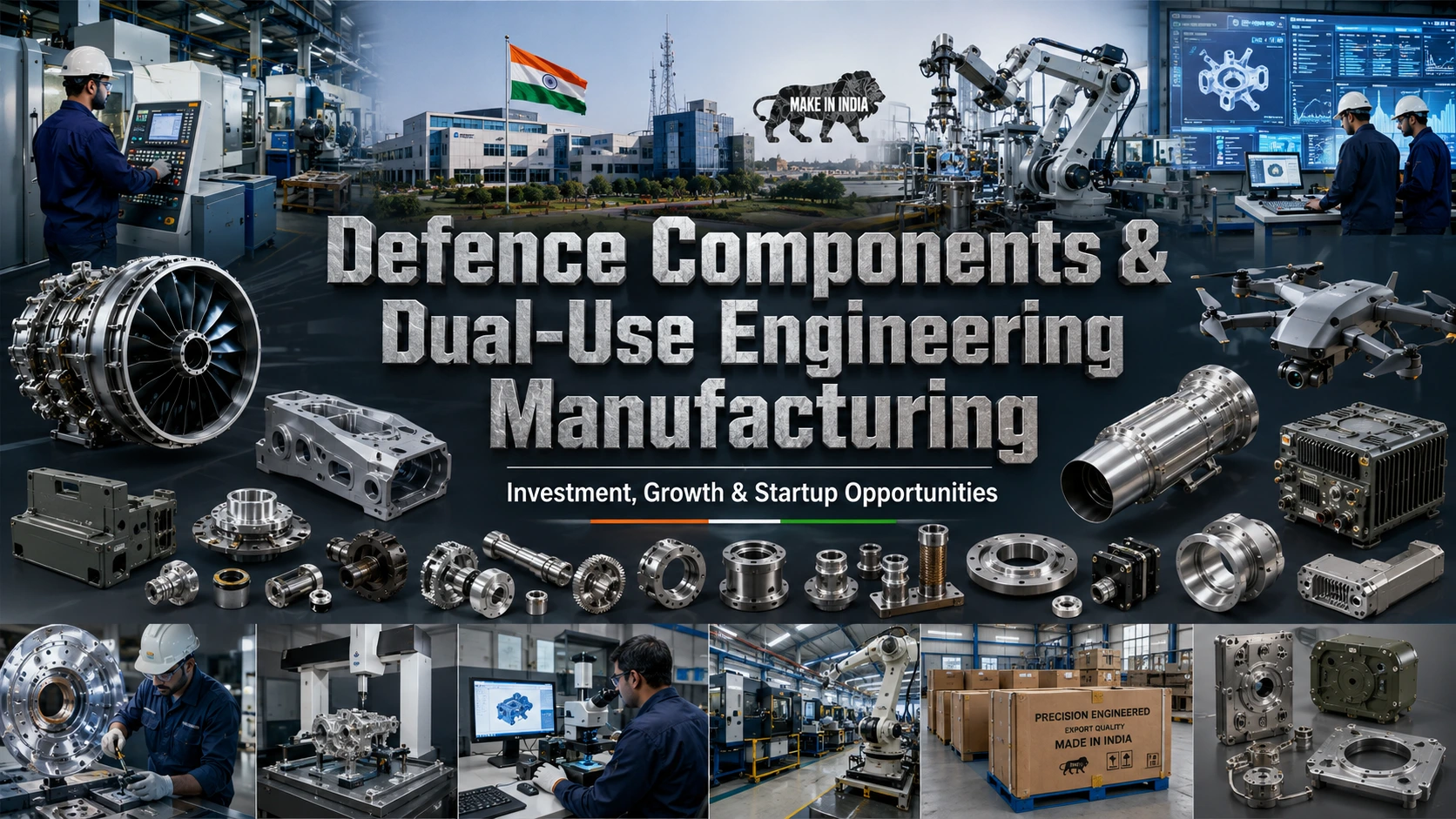
Defence Components Manufacturing
Defence components and dual use engineering manufacturing is one of the most strategically critical and commercial engineering enterprise enterprise concepts in India. The Indian government has established an ambitious target of ₹50,000 crore in defence exports, and promotes MSMEs to engage in defence manufacturing through the iDEX programme and dedicated MSME development efforts. The Engineering Equipment’s Export Promotion Council, India is assisting the defence related engineering component manufacturers and the Department of Defence Production, Ministry of Defence is formulating policy to engage MSMEs in the defence industry.
The Positive Indigenisation Lists (PIL) have been laid down to ensure Indian sourcing for hundreds of defence items, which is a boon to those manufacturers who are required to acquire technical capability and at the same time export to the world market.
Related Article: India’s Defence Manufacturing Boom: A $15 Billion Opportunity for MSMEs and Startups
EEPC and Government Policy Support
The MSME defence manufacturing development is managed by Department of Defence Production (DDP, Ministry of Defence) via the iDEX programme (Development Contracts for Technology Capable MSMEs for Defence Innovation Projects); up to ₹1.5 crore of Government grant support for each project. Precision Engineering & Electronics companies are specifically targeted for Defence Supply Chains by DDP’s MSME initiatives.
The DRDO (Defence Research and Development Organisation) has also been supporting the private manufacturers with technology transfer for the production of Defence system and components, which enables the MSME manufacturers to produce Defence Grade components as per military requirement. DRDO vendor registration is the way to technology transfer partnerships.
Business Ideas
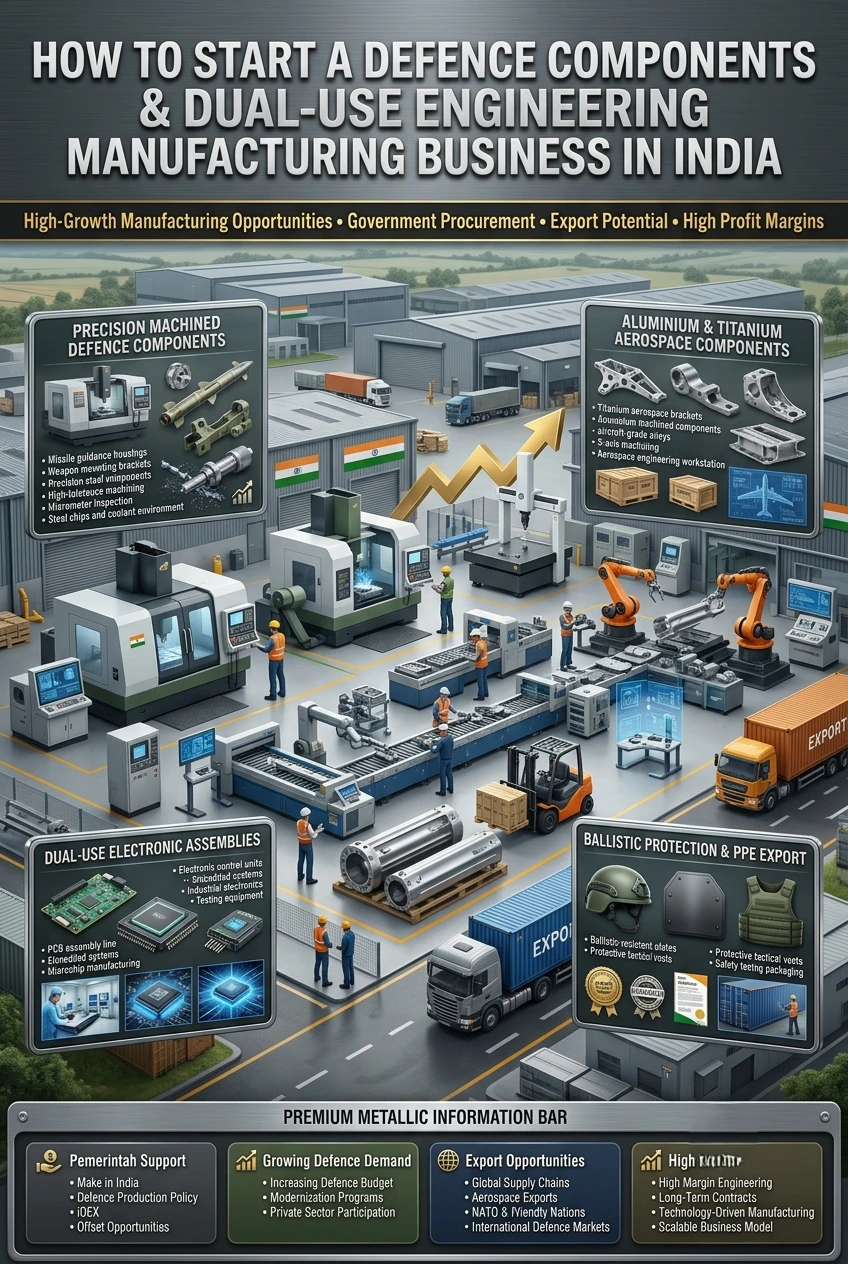
1. Precision Machined Defence Components
High value machined component opportunities include artillery shell casing, missile body parts, fuse housing, weapon sight parts, and precision mechanical parts for military applications. The investments are in the range of ₹2 crore to ₹8 crore in high precision CNC Machining, Quality Measurement Systems and Clean Room Assembly. The precision defence parts generally have margins between 35% and 60% which are far higher than the margins for commercially manufactured precision parts.
2. Aluminium and Titanium Aerospace Components
Aluminium and titanium alloys are used in many parts of the aircraft including structural aerospace components such as brackets, housings, access panels and avionics enclosures, which are a high-value manufacturing category. Qualifications are DGCA approval, AS9100D quality management certification and aerospace process approvals from NADCAP. Rs. 3 crores to 10 crore is being invested in the infrastructure for 5 axis CNC, Non-Destructive Testing and Quality Inspection.
Explore This Book: The Complete Technology Book on Aluminium and Aluminium Products
3. Dual-Use Electronic Assemblies
Electronic systems, both commercial and military, particularly in the power supply, communications, sensor and ruggedised computing sectors, are an approachable start for electronics manufacturers looking to break into the defence arena. The quality requirements are to IPC-A-610 workmanship standards, MIL-SPEC component specifications and MIL-STD-810 environmental testing. Investment amounts are from ₹80 lakh to ₹3 crore.
4. Ballistic Protection and PPE Export
MSME scale defence manufacturing opportunities in terms of ballistic helmet, body armour, combat clothing, and PPE include a strong prospect of demand for exports. The price of investment in a body armour or ballistic helmet unit is between ₹1 crore and ₹4 crore. Defence procurement in the United States and most countries overseas is subject to NIJ ballistic standard certification. Military sales to African countries, police forces in Southeast Asia, and security services in the Middle East are among the export markets.
Start with clarity—choose the best business idea
Import-Export Opportunity Analysis
India’s defence export performance has improved considerably towards achieving the target of ₹50,000 crore. The key geographies for Indian defence exports are friendly countries in Africa, Southeast Asia and Latin America. The Positive Indigenisation Lists are a mechanism of creation of an indigenous market, which is of immense importance — the procurement of all the listed items of the defence sector ensures captive market for those manufacturers who are developing capability in the identified product categories. MSME manufacturers that acquire capacity to manufacture PIL listed components not only get assured domestic demand, but also get opportunities for export market.
Indian MSME Success Stories
Data Patterns, a Chennai based defence electronics company, developed a substantial defence business by specialising in ruggedised electronics and avionics systems for HAL, DRDO and export customers. They are already a part of iDEX and are a model for how MSME electronics companies can enter into the defence industry.
One local company, MKU Limited of Kanpur, is one of the top ballistic protection companies in the country, and also exports ballistic helmets and body armour to the defence and security forces of 100+ countries worldwide, with a very high level of global scale that has been achieved with investment in NIJ certification.
A few of those precision machining MSME’s in Pune and Hyderabad have made a successful entry in the DRDO and HAL supply chain as precision component manufacturers, and have established quality credentials for supplying in the international aerospace defence supply chain.
Get Detailed Project Report (DPR)
How NPCS Supports This Business
Niir Project Consultancy Services (NPCS) offers professional Services for preparation of Market Survey cum Detailed Project Technical & Economical Feasibility Report (DPRs) for establishment of fresh manufacturing as well as export businesses in this area. In our reports, detailed manufacturing processes, market research and demand analysis, process flow diagrams, product mix and capacity planning, machinery details, raw material details and complete project financials with profitability analysis. Our goal is to aid entrepreneurs to assess feasibility, profitability and scalability over the long run before investing.
Key Data Overview
| Defence Category | Investment Range | Key Certification | Market Channel | Typical Margin |
| Precision Machined Defence Parts | ₹2 Cr – ₹8 Cr | NADCAP + DDP Vendor | HAL, OFB, DRDO | 35–60% |
| Aerospace Al/Ti Components | ₹3 Cr – ₹10 Cr | AS9100D + NADCAP | HAL, Aerospace Tier-1 | 30–55% |
| Dual-Use Electronics | ₹80L – ₹3 Cr | IPC-A-610 + MIL-STD | iDEX, DDP, Export | 30–50% |
| Ballistic Protection | ₹1 Cr – ₹4 Cr | NIJ Standards + BIS | Export + Domestic Security | 35–60% |
| Military Footwear and Gear | ₹50L – ₹1.5 Cr | MIL-SPEC + BIS | Export Security Forces | 25–45% |
Frequently Asked Questions (FAQ)
1. What is the iDEX programme?
iDEX (Innovations for Defence Excellence) provides development contracts and grant funding up to ₹1.5 crore per project to MSME innovators developing defence technology solutions. Successful iDEX participants receive both funding and a pathway to production contracts with the Indian defence establishment.
2. What is the Positive Indigenisation List?
The Ministry of Defence publishes PILs specifying defence items that cannot be imported after a notified date and must be sourced from Indian manufacturers. Over 500 items are on current PILs. MSME manufacturers who develop capability in PIL-listed items gain captive domestic procurement demand from Indian defence forces.
3. What is NADCAP certification?
NADCAP (National Aerospace and Defence Contractors Accreditation Programme) is a global accreditation for special processes in aerospace manufacturing — covering heat treatment, welding, non-destructive testing, and chemical processing. Required by major aerospace OEMs and increasingly by Indian aerospace supply chain requirements.
4. Can an MSME enter defence without prior defence experience?
Yes — through dual-use component manufacturing where commercial precision machining capability is applied to defence components, through iDEX innovative product development, or through DDP MSME development initiatives. Starting with components using existing commercial capability provides the experience base for progressive defence sector qualification.
5. What security clearance is required for defence manufacturing?
Security clearance requirements depend on the security classification of the product. Unclassified commercial-grade components supplied to defence programmes do not require clearances. Most MSME defence component manufacturing does not involve classified systems.
6. How do I register as a vendor for DRDO or HAL?
DRDO vendor registration is through the DRDO procurement portal — requiring company registration, ISO certification, facility capabilities documentation, and product sample evaluation. HAL registration requires similar documentation plus factory audit. Both processes take 3 to 9 months. Engaging a defence procurement consultant familiar with these processes significantly accelerates registration.
Conclusion
Defence components and Dual-use engineering manufacturing is one of the most strategically important and commercially promising engineering business ideas — it is a blend of national security, government ensured domestic demand with the help of Positive Indigenisation Lists and increasing export opportunities to friendly countries. The trade fair support provided by EEPC, the iDEX development funding by DDP, technology transfer by DRDO and specialised financing by SIDBI provides an all-round support system for the MSME manufacturers who wish to enter into this segment. Those who invest in making their businesses precision manufacturing, pertinent quality certification and patient defence programme qualified, create businesses of long-term contracted revenue, premium margins and strategic national importance.


