






Market Insight
The PUF sandwich panel industry in India is seeing a structural demand acceleration which has not been witnessed in the last 10 years. There is also an existing huge cold chain infrastructure deficit, a rapidly growing pre-engineered building (PEB) industry and a wide-spread Government policy to support food processing and pharmaceuticals logistics, which are all coming together to cause a supply gap that domestic manufacturers still have to overcome. Entrepreneurs and MSME investors considering investing in the manufacturing sector for high growth prospects are looking at PUF sandwich panel manufacturing as an opportunity that is bankable, scalable and supported by policy.
What Are PUF Sandwich Panels and Why Does India Need Them Urgently?
A PUF (Polyurethane Foam) sandwich panel is a composite structural building element built by bonding a rigid polyurethane foam between two pre-coated galvanised steel sheets. This creates a low weight load-bearing panel that is highly thermally insulating, fireproof, sound dampening and moisture resistant. A well specified PUF sandwich panel has a thermal conductivity of as low as 0.022 W/mK, making it, in all applications requiring absolute temperature integrity, the material of choice over expanded polystyrene which has a thermal conductivity of 0.035 W/mK.
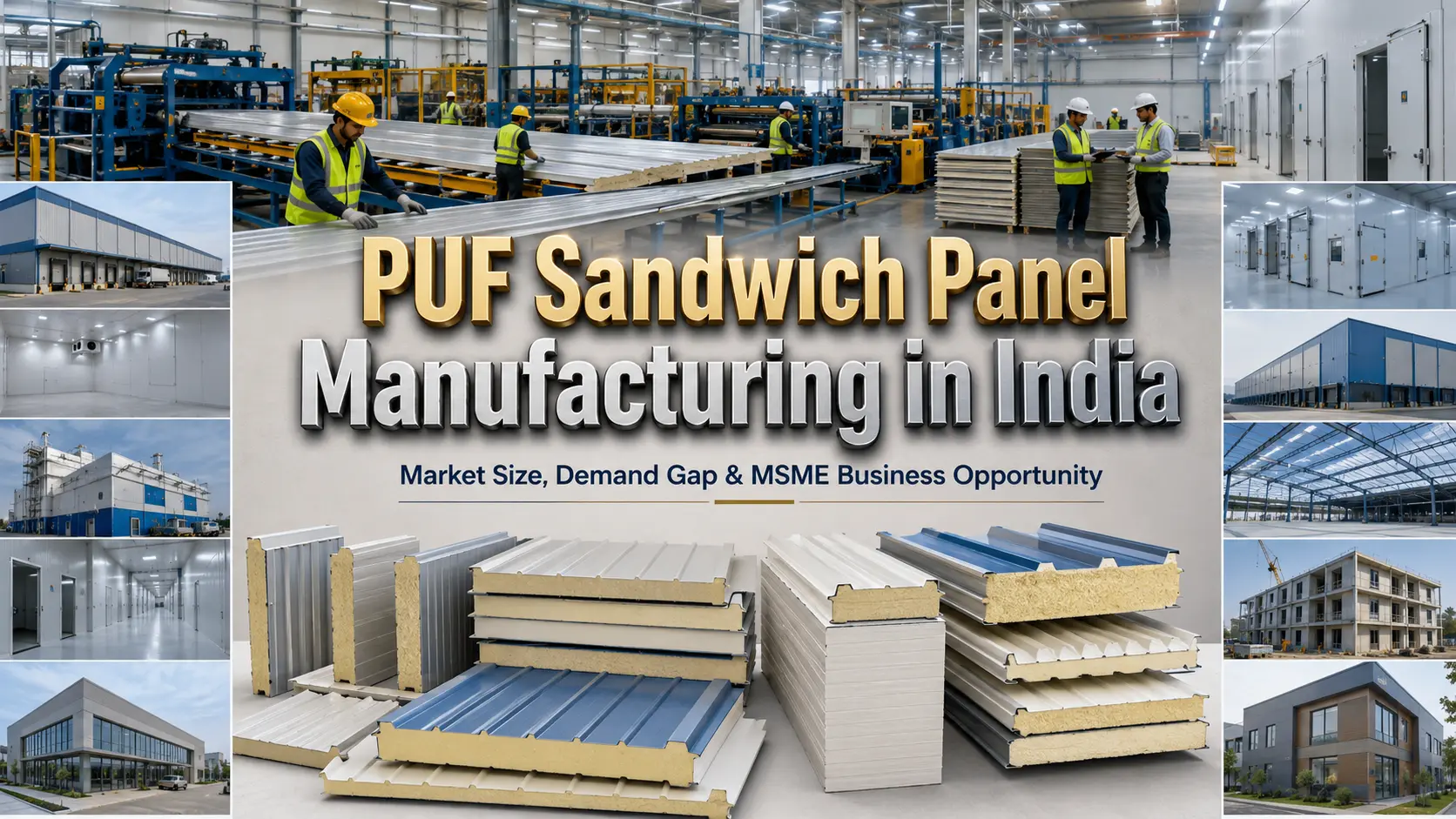
These panels are used in practical applications in cold storage rooms, pharmaceutical manufacturing clean rooms, food processing plants, industrial warehouses, data centers, modular hospitals, prefabricated offices, and large span industrial sheds. The technology is so applicable for temperature sensitive and conventional applications that it’s an attractive manufacturing proposition; demand is not tied to any particular end-use sector, but spread throughout the size and scope of India’s growing industrial economy.
The magnitude and urgency of this need have dramatically changed in the past few years. India’s construction industry, which accounts for roughly 9% of the country’s Gross Domestic Product (GDP), is poised to become the third largest industry in the world in terms of size. The introduction of 100 smart cities, the National Logistics Policy, industrial corridor development under PM Gati Shakti National Master Plan and the aggressive growth of the pharmaceutical and food processing industry have all given them a demand vector that existing domestic panel manufacturers can’t meet in terms of volume or quality specification.
Get Detailed Project Report (DPR): Discontinuous Sandwich Panel
The Demand–Supply Gap: Where the Opportunity Actually Lives
The single most powerful reason to do any analysis of the PUF sandwich panel market is the cold chain infrastructure deficit. India has an immediate need of an extra 35 million metric tons of cold storage to cater to the needs of the horticulture, dairy, pharmaceutical and seafood industries, says the National Centre for Cold-chain Development (NCCD) set up by the Ministry of Agriculture and Farmers’ Welfare. The current installed capacity is about 32 million MT and experts estimate the total requirement at 67/70 million MT. This is NOT a marginal gap. It is equivalent to nearly doubling our infrastructure and all of each square foot needs insulated PUF or PIR panels.
It is not just a difference in terms of quantity, but in terms of structure. The current cold storage infrastructure in India is disproportionately concentrated on potato storage, primarily in Uttar Pradesh, West Bengal and Punjab, which have a large proportion of the installed stock. There is a critical lack of modern multi-commodity storage, pharma grade temperature-controlled facilities, blast-freeze rooms and controlled-atmosphere chambers, especially in the eastern and north-eastern states. The demand for high specification PUF panel systems is accelerating faster than the growth in manufacturing capacity, as India expands pharmaceutical plant exports (India is the world’s leading exporter and supplier of generic medicines) and investments pour in into the food processing PLI (Production Linked Incentive) sector for greenfield units.
The data centre industry is becoming an important new demand generator beyond cold chain. New data centre facilities (with precision insulated building envelopes) are on the rise in Tier-1 and Tier-2 Cities with 100% FDI allowed under automatic route and investments in the sector are expected to cross US$ 5 billion per year. The required material for the construction of the data centre envelope is PUF and PIR sandwich panels for their high thermal performance and structural reliability.
Demand–Supply Gap at a Glance
| Parameter | Current Status | Gap / Opportunity |
| India Cold Storage Requirement | ~67–70 Million MT | ~35 Million MT deficit |
| Cold Storage PUF Panel Market (Industrial Segment) | 55% of total panel market | Growing at 11.4% CAGR |
| PUF Panel Volume (2024) | 125,109 Thousand sq ft | To reach 231,835 Thousand sq ft by 2031 |
| India Market Value (2024) | US$ 0.2 Billion | US$ 0.4 Billion projected by 2031 |
| PUF Panel Price Range (India) | ₹95–₹380 per sq ft | Premium certified variants command 40–60% higher price |
Key Application Sectors Driving Demand
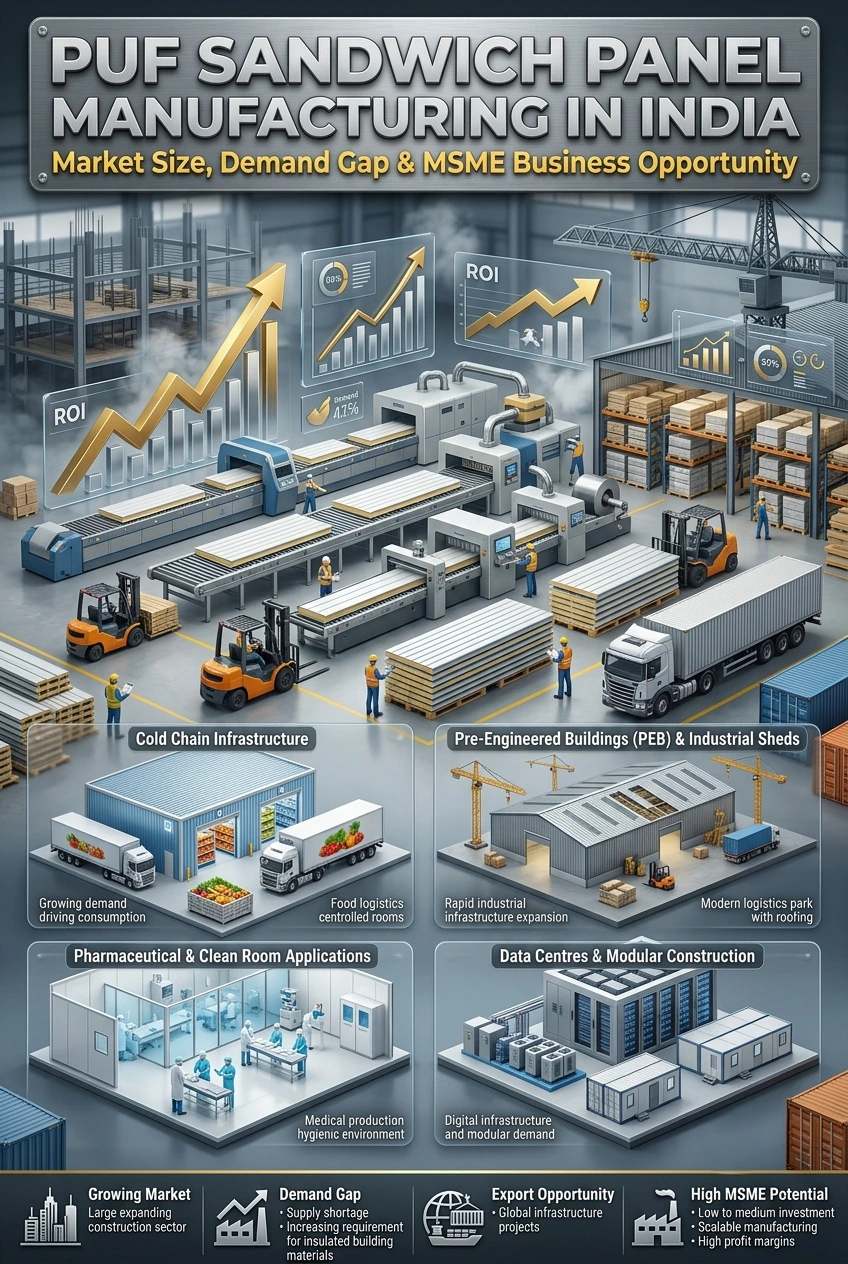
1. Cold Chain Infrastructure
Food Processing, FMCG Logistic and Pharma are expected to be the key market drivers for the Indian cold chain industry growing at more than 12% CAGR. New construction of cold storage is one of the most subsidized infrastructure sectors in India with the PM Kisan SAMPADA Yojana and National Horticulture Board (NHB) schemes providing 35-50 per cent capital subsidy. Cold chain is the largest demand driver for PUF panels, since each cold room constructed requires panels for walls, roof, floor deck and partition systems.
Related Article: How Cold Chains Can Boost India’s Food Exports
2. Pre-Engineered Buildings (PEB) and Industrial Sheds
India’s PEB industry is changing the face of the industrial construction industry. Under Make in India and PM Gati Shakti, a number of new industrial parks, logistics hubs and manufacturing clusters are being established within dedicated freight corridors. PEB structures are used for walls and roofing with PUF sandwich panels due to the dramatically reduced construction time (up to 40% less time than a conventional RCC structure) and energy efficiency benefits for the long-term. As the government aims to boost industrial’s contribution to GDP to 25%, the construction of industrial sheds will be a secular growth trend that will continue to drive the demand for PUF panels in the next ten years.
3. Pharmaceutical and Clean Room Applications
The Indian pharmaceutical industry is expanding its manufacturing capabilities fast, especially in biologics, vaccines and WHO-GMP compliant API manufacturing units. Smooth-surface, non-porous, hygiene-grade PUF panel systems are the only systems that can meet clean room specifications required by the Central Drugs Standard Control Organisation (CDSCO) for the manufacturing of pharmaceuticals. Premium PUF panel manufacturers are among the fastest growing niche markets in the pharmaceutical industry.
Get Detailed Insights from This Book: Business Ideas for Startup in Drugs & Pharmaceutical Industry with Project Profiles
4. Data Centres and Modular Construction
Government initiatives to invest in infrastructure for Digital India, along with the increased penetration of internet, cloud and similar applications are creating a fresh and higher demand for PUF panels in Tier-2 and Tier-3 cities. PUF sandwich panels are the material of choice for the new data centre industry, for the precision insulation and structural integrity needed for cold storage.
Raw Material Ecosystem and Manufacturing Process
The key raw materials used in PUF sandwich panel manufacturing are polyols, isocyanates (MDI – methylene diphenyl diisocyanate), pre-painted galvanised steel coils (PPGI) and other chemicals, such as blowing agents, catalysts and fire-resistant chemicals. The polyols react with MDI to create the rigid foam core along a continuous lamination line, creating polyurethane foam. The foam core is injected/foamed in place between two moving steel face sheets that are chemically bonded.
Under IS 12436, the Bureau of Indian Standards (BIS) specifies quality requirements for rigid polyurethane foam and under the relevant product standards, the standards for sandwich panels are specified. Compliance with BIS standards is fast becoming an essential requirement for government-funded cold chain projects and building projects, which thus far had been a significant way in which the organised manufacturers had differentiated themselves from the unorganised local fabricators.
The average manufacturing cost of a mid-scale PUF sandwich panel production line is around ₹4-8 crore for equipment, whereas, the land, civil works and working capital would cost around ₹10-18 crore depending upon the location and installed capacity. Continuous foaming lines are the best method of production, and discontinuous press-moulded lines are a more affordable option for MSMEs catering to the local market.
PUF Panel Production Parameters (Indicative)
| Parameter | Typical Range / Specification |
| Core Material | Rigid Polyurethane Foam (PUF) |
| Core Density | 38–42 kg/m³ (cold storage); 32–38 kg/m³ (industrial sheds) |
| Thermal Conductivity | 0.020–0.024 W/mK |
| Face Sheet | Pre-painted Galvanised Steel (PPGI), 0.40–0.60 mm |
| Available Thickness | 30 mm, 40 mm, 50 mm, 60 mm, 80 mm, 100 mm, 120 mm, 150 mm |
| Standard Width | 1000 mm / 1100 mm |
| Standard Length | Up to 12 m (customisable) |
| Fire Rating | B2 (standard); B1 / FM 4880 Class 1 (fire-rated variants) |
| Service Life | 20–25 years (properly specified and installed) |
| Market Price Range (Ex-Works) | ₹95 to ₹380 per sq ft |
Major Indian Players in the PUF Sandwich Panel Sector
Industry is well organised for PUFs with a relatively small number of technically advanced players and a large population of regional and semi organised manufacturers catering to localised demand. The market opportunity between organised and unorganised capacity is also a market opportunity for the new entrants who agree to quality specifications and certifications.
Nest-In (Mumbai) is a division of Tata Steel which is one of the most technically advanced PUF and PIR sandwich panel manufacturers in India. The company creates panels for thermal insulation, roofing and wall cladding for cold chain, industrial and commercial applications. The technical support and infrastructure advantage of Tata Steel over its competitors makes it a credible deal for institutional buyers and government-funded projects for material sourcing.
Part of the Jindal group ecosystem, Jindal Mectec is specialised in the manufacture of insulated sandwich panels in the field of cold chain logistics, clean rooms and pharmaceutical applications. The firm has established its identity in the niche market with high specification products, and is extending its reach in Tier-II and Tier-III cities, which is indicative of the widening geography of demand.
Alfa PEB Limited: Alfa PEB is one of the leading PUF panels and pre-engineered building systems manufacturers in India. The company has allocated over 25% of its annual capacity to cold storage and modular construction work, according to industry data. Alfa PEB’s PEB and panel package is a competitive edge in turnkey industrial building projects.
Kingspan Jindal Pvt. Ltd: A joint venture to introduce the panel technology of Kingspan into the Indian market, Kingspan Jindal is looking to be strong in the premium segment by offering technologically advanced systems as panel variants like high performance PIR core for pharmaceutical and data centre applications.
EPACK Polymers (P) Ltd. and Rinac India Limited: Both are big names in the cold chain and modular construction industry, with Rinac having a strong manufacturing presence in Bangalore and Murbad (Maharashtra) and having completed 10000+ projects in 23 countries. These companies are the epitome of quality certification in the panel manufacturing industry in India.
These organised players don’t take up the entire market, though. The market share of North India is around 28.2% due to the industrial and cold chain demand in NCR and West India (Mumbai, Maharashtra and Gujarat) accounts for around 26.7%. There is a huge demand from Tier-II and Tier-III markets being met by local fabricators without any formal quality certification which is a competitive entry opportunity for fresh MSME manufacturers.
Choose the right startup backed by real market demand
Import Dependency and Export Potential
The dependence on imports for India PUF sandwich panels is skewed towards high specification panels — especially panels with superior fire ratings (FM 4880 or Euroclass B) and advanced hybrid core technologies. Historically, premium panel systems from European manufacturers (Kingspan, Isopan, Metecno) have been used in the pharmaceutical and data centre segments where Indian manufacturing has not been certified with the required standards. Data from DGFT trade and industry tracking indicates that a significant flow of specification grade panels is still being imported from manufacturers in the European and Middle Eastern markets, notably for LEED certified and WHO-GMP projects.
On the export front, the Indian PUF panels are being marketed in the South Asian, Southeast Asian and African markets, where India’s cost competitiveness and manufacturing scale is providing an edge to the panels. Indian PUF panels are imported to the Maldives, Sri Lanka, Bangladesh and various markets in Africa for construction and cold chain operations. Indian manufacturers are making investments in quality certification (ISO, BIS, FM 4880), and the addressable export market is growing significantly — especially in the Middle East where the construction boom associated with Vision 2030 is driving an ever-increasing demand for insulated building systems.
Pre-engineered Building components and Construction materials are identified as priority export verticals by the Engineering Export Promotion Council of India (EEPC India) and domestic PUF panel manufacturers can avail export incentives through Remission of Duties and Taxes on Exported Products (RoDTEP) scheme.
Government Policy Tailwinds: Building the Demand Foundation
The production of PUF sandwich panels is one of the most government-supported manufacturing industries. Convergence of many schemes and infrastructure creates a demand pull which is not cyclical but structural. The capital subsidy provided by the Ministry of Food Processing Industries (MoFPI)’s PM Kisan SAMPADA Yojana is directly encouraging demand for PUF panels, every time the government subsidises a cold room constructor. Greenfield food processing, pharmaceutical, and advanced textiles opportunity P.L.I. schemes are creating investments in new production and storage facilities that will need insulated panel systems throughout the systems.
The project of PUF panel manufacturing is a financeable project for first generation entrepreneurs as subsidy for manufacturing enterprises is available under the PMEGP scheme of the Ministry of MSMEs on margin money basis where the subsidy is up to 15% for the manufacturing enterprises in general and special categories. MSME classification for panel manufacturing units translates to getting priority sector lending, technology support under CLCSS, and credit support under CGTMSE.
The National Logistics Policy is all about creating a world-class integrated logistics infrastructure, meaning modern and cold chain warehouses are in high demand, both of which require PUF panels to cover their thermal envelope. Further, the government’s green building policy and the Energy Conservation Building Code (ECBC) which mandates energy efficient buildings are driving institutional buyers, which include government hospitals, defence establishments, public sector undertakings, to include insulated panel systems in their building specifications.
Startup Opportunity: Why This Is the Right Time to Enter PUF Panel Manufacturing
The characteristics of the PUF sandwich panel sector that are hard to find in other industrial sectors when it comes to structural demand growth, policy support, low import substitution threat, accessible raw material supply and good unit economics at the mid-scale level are attractive from an entrepreneur’s perspective evaluating a manufacturing investment.
Demand Visibility: There will be a 15–20-year demand runway due to cold chain deficit. Any and every cold storage project, pharmaceutical factory, industrial shed or modular building being built in the foreseeable future in India is a sign of demand for panels. It is infrastructure-based demand, which is closely tied to growth in industrial investment and GDP, as opposed to demand for discretionary consumer goods.
Entry Scale Flexibility: The manufacture of PUF panels can be set up at various entry levels. The investment required to set up a discontinuous (batch) production line for catering to the regional industrial shed and warehouse markets ranges between ₹3 – 6 crores. The cost to set up a continuous lamination line for cold chain and pharma with higher quality specification is ₹10 to ₹18 crore. Both the models have proven their feasibility in various Indian states for MSME level.
The high demand in central, eastern and north-eastern parts of India, compared to the concentration of quality PUF panel manufacturing in Gujarat, Maharashtra and Delhi NCR, is a challenging factor that needs to be addressed. Freight cost advantage and reduced local competition, especially in the vicinity of emerging industrial areas, are the benefits to a new manufacturing unit in Madhya Pradesh, Odisha, Bihar and in the Northeast.
Quality certifications are becoming more widespread for institutional procurement, and include BIS, FM 4880, and ISO 9001. Entrepreneurs of MSMEs who invest for compliance readiness in early stages can create a defensible competitive position when compared to unorganised local suppliers who are unable to become compliant.
Value-added project partners and not commodity suppliers; Government Subsidy Leverage: A panel-footing manufacturer with turnkey cold storages would also be able to help the customer avail Government subsidy such as PM Kisan SAMPADA or NHB’s that would help the customer in cost reduction. This integrated model can enhance revenue per project and client stickiness to a great degree.
How NPCS Supports PUF Sandwich Panel Manufacturing Projects
Niir Project Consultancy Services (NPCS) is a leading Industrial Consultancy organization having more than 45 years of experience in preparing Market Survey cum Detailed Techno-Economic Feasibility Reports (DPRs) for Manufacturing/Processing Projects in India and abroad. NPCS supports the entrepreneurs, MSMEs and investors throughout the project evaluation and execution process.
NPCS offers all-inclusive DPRs for PUF sandwich panel manufacturing projects, including:
- Manufacturing process and technologies (continuous lamination vs discontinuous press-moulding)
- Market study and demand analysis by sector with forecasts of consumption.
- Process Flow Diagrams (PFD/BFD) of panel production lines
- Optimising product mix and installed capacity as per requirement.
- Details of the machines and their vendors.
- Raw material (polyol, MDI, PPGI coil) procurement and pricing analysis
- Understanding the components of import/export dependence analysis and the interpretation of trade data.
- Provide the project finance details such as capital cost, working capital, profitability of the project and the payback period.
- The CSO documents consist of the following:
The goal of NPCS is to help the entrepreneur assess the technical feasibility, financial viability, market demand and scalability of every industrial project objectivity before investing money. NPCS’ database of 8,000+ DPRs distils the most comprehensive consulting expertise to emerging manufacturing opportunities in 50+ countries.
Frequently Asked Questions (FAQ)
Q1. What is the minimum capital required to start a PUF sandwich panel manufacturing unit?
A PUF panel manufacturing unit can be set up with a total project cost ranging from approximately ₹5 crore (small-scale, batch/discontinuous process targeting regional shed and warehouse market) to ₹15 to ₹20 crore (continuous lamination line with cold chain-grade specifications). The exact capital requirement depends on production capacity, technology choice, land availability, and geographic location.
Q2. What are the key raw materials and where are they sourced in India?
The key raw materials are polyols and MDI (methylene diphenyl diisocyanate) – available from Indian suppliers such as BASF India and Covestro India – as well as pre-painted galvanized steel (PPGI) coils available from Indian steel makers, such as Tata Steel, JSW Steel, and Uttam Galva. Specialty chemical distributors supply the blowing agents, catalysts, and fire retardants. There is no raw material sourcing challenge for new entrants of the MSME size.
Q3. What certifications are required for PUF panel manufacturing in India?
The BIS certification in India based on the respective Indian Standards is applicable for the panels to be used in government projects. ISO 9001:2015 quality management certification is often a must have for institutional customers. For the pharma and cold chain market panels producers may want to look into FM 4880 fire rating for export as well as premium domestic market applications and keep available test reports of core density, thermal conductivity and compressive strength.
Q4. Are government subsidies available for setting up a PUF panel manufacturing unit?
Yes, PUF Panel production is recognized as an industrial manufacturing enterprise in MSME category and therefore eligible for PMEGP margin money subsidy (15-35%), CGTMSE credit guarantee cover, CLCSS capital subsidy for technology upgradation and various State Govt. Benefits like allotment of land, tariff concessions on power and concessions in stamp duty etc as per state industrial policy.
Q5. What is the typical payback period for a PUF panel manufacturing project?
For a well-planned mid-scale PUF panel unit achieving 70-75% capacity utilisation by Year 2, the payback period is typically 4 to 6 years. Projects with backward integration (in-house polyurethane foam production) or forward integration (turnkey cold storage installation services) can achieve better margins and correspondingly shorter payback periods.
Q6. What are the key quality parameters that differentiate premium PUF panels from commodity products?
Core density (38-42 kg/m³ for cold storage vs. 32-36 kg/m³ for standard industrial), thermal conductivity (lower is better — target 0.020-0.022 W/mK), PPGI skin thickness (0.50 mm for long-life vs. 0.40 mm for economy), edge sealing quality, vapour barrier integrity, and documented fire rating test reports. Premium certified panels command a price premium of 40-60% over unspecified commodity panels.


