





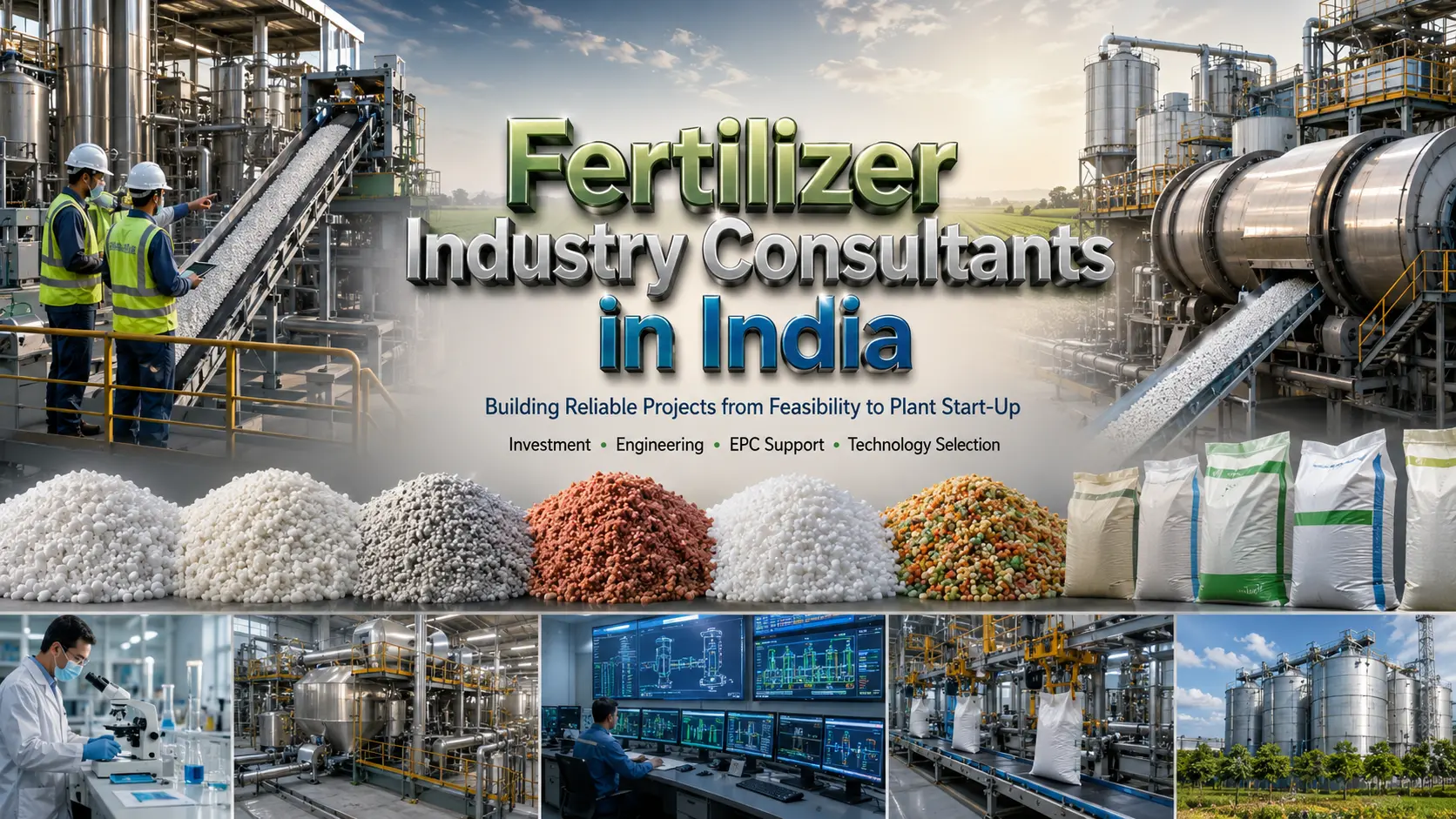
Why Fertilizer Industry Consultants Matter in India Today
In India, the agricultural sector depends on a continuous source of good quality nutrients and hence it has become an actual necessity for the business of the fertilizer industry. The new entrant is not able to just purchase machines and begin production. The location, procurement of raw materials, product portfolio and product approval must all align before the first bag of fertiliser has left the plant.
Without a good feasibility study, banks and financial institutions are unlikely to finance a fertilizer project. Investors, too, want independent confirmation before putting money into the investment. That’s where the consultants come in and develop a business concept into a viable and viable project. Furthermore, shifting towards self-sustainability in nutrient production has provided an opportunity for fresh manufacturers, especially in the specialty and organic fertilizer sectors, in India.
Due to this, there has been a huge surge in demand for skilled process plant consultants, feasibility experts and EPC partners in states like Gujarat, Rajasthan, Madhya Pradesh and Andhra Pradesh where the fertilizer manufacturing clusters are still growing.
Get Detailed Insights from This Book: Fertilizers Manufacturing Handbook
What Fertilizer Plant and Process Consultants Actually Do
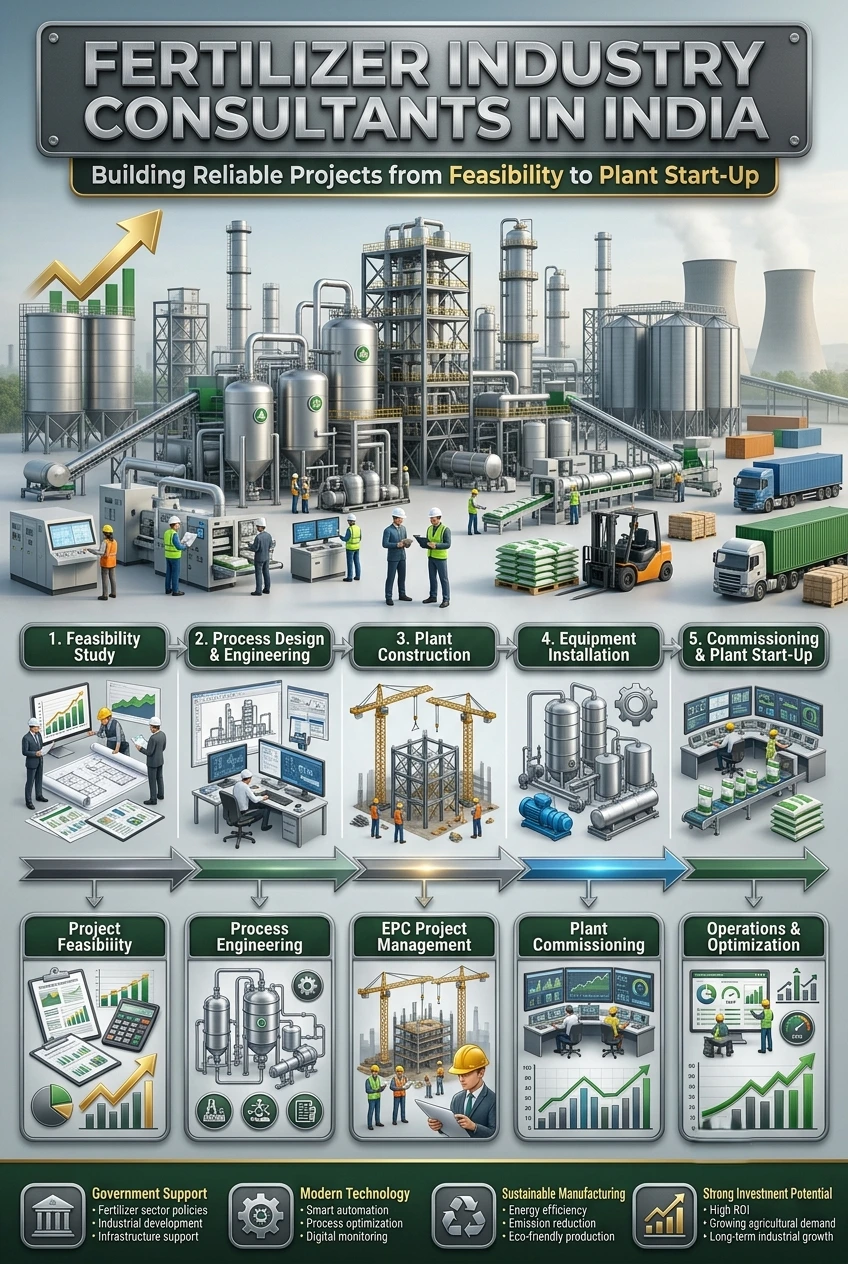
A consultant is much more than a writer of a report. Typically, they begin with a feasibility study: What market is there for the proposed capacity, and is the raw material supply chain viable? The scope often then moves onto detailed project reporting, process engineering, plant layout planning and regulatory guidance.
Feasibility Studies and DPR Preparation
The Detailed Project Report is the lifeline of any fertilizer business. It includes process selection in manufacturing, specification of the machines, raw materials and utilities required, manpower planning, and a full financial model including cost of project, profitability and break-even analysis. This document is examined closely by lenders and is not all about being polished and polished up but rather about being accurate with realistic assumptions.
Process Engineering and Plant Layout
The DPR is then converted by consultants, who have experience in Fertilizer Technology or chemical engineering, to a working plant design. These involve process flow diagrams, equipment sizing, material handling systems, and layout drawings which will optimise space and comply with safety standards. In the case of units based on NPK or SSP or DAP, this stage is often the key to whether the plant will obtain its rated capacity in practice.
EPC Support and Regulatory Compliance
If the entrepreneur prefers to have a turnkey solution, the EPC consultant will take care of the procurement and construction process as well as the process design. In the meanwhile, all the fertilizer units need to obtain clearances from the Fertilizer (Control) Order, 1985, issued by the Department of Fertilizers, and consent from the State Pollution Control Board & Factory Act registration. Approach approval pathways understanding by consultants reduces the promoter’s downtime by months.
Get Detailed Project Report (DPR): Fertilizers and NPK: Complete Guide
Why India Has Become a Hotspot for Fertilizer Consulting
India is the second largest consumer of fertilizers and domestic production has been on an upward trend due to the government’s import substitution policy. Together with the support and activity of the policy, this scale has created a real hub for boutique management consultancies and specialised engineering practices focused on the sector.
This change is being fuelled by a number of drivers. For one, Production-Linked Incentive schemes across the broader chemicals sector are promoting indigenous manufacturing of intermediates for various fertilizer manufacturing plants. Secondly, there are niche opportunities in the rising demand for nanotech and specialty fertilizers that are not being fully exploited by existing companies. Third, export potential to neighbouring agricultural economies is driving Indian promoters to consider markets outside the domestic market from the beginning.
Demand for fertilizer is on a clear upward trajectory as the agriculture and allied sectors are compelling the government and private investors in the country to invest heavily in the sector, says IBEF. Thus, new players have some breathing room, if they design their projects and work them out adequately at the beginning.
How to Evaluate and Shortlist the Best Fertilizer Industry Consultants in India
The mis-selection of consultant can be much more expensive than the consulting fee, as a poorly done feasibility study or a small plant layout doesn’t usually become obvious until after construction. This means that a structured evaluation is a worthwhile investment of one additional week.
Domain Expertise and Track Record
Search for a firm that has experience in preparing DPRs for fertilizer or allied agro-chemical projects and not a generalist consultancy shop that dabbles in the industry. Request sample sections, capacity ranges they have operated and any observations regarding the success/failure of their financial models based on plant performance.
Build a profitable business with the right idea
Engineering and EPC Capability
The feasibility of a concept is just half the battle. Ideally the best fertilizer plant consultants will have their own process engineering expertise or have reliable working relationships with EPC contractors who can be on hand to confirm that the plant is built correctly.
Regulatory and Compliance Know-How
A consultant who is not aware of the provisions of the Fertilizer Control Order, State Pollution Control Board norms and the provisions of the Factory Act will not accelerate the project but will rather delay it. Inquire directly how they have gone about obtaining these approvals.
Client Base and Geographic Reach
Consultants that have worked for several states or overseas tend to have more information on other costs, equipment suppliers and market trends. This is very useful for MSME promoters as well as NRI investors while assessing projects from outside India.
Role of NPCS in Fertilizer Project Consultancy
Since 1994, Niir Project Consultancy Services (NPCS) — niir.org — is one of the well-established entities in the industrial consultancy market of India based in New Delhi. With 30+ years of consulting experience, NPCS has a proven track record in over 85 countries with over 150,000 successful project reports across manufacturing sectors.
In the Fertilizer and Allied Agro-input Sector, NPCS prepares Detailed Project Reports and Techno-economic feasibility reports, which include details about the manufacturing process selection, specification of machines, raw materials, market and demand analysis, process flow diagrams, product mix and capacity planning, complete project financials with profitability projections. Given that some entrepreneurs are in the early stages of considering whether a product line, like SSP, NPK complexes, or organic and bio-fertilizers, is worth the investment, this type of independent research can determine the investment decision.
Those readers who want to explore several ideas of a project can check the fertilizer project profiles and reports catalog here provided by NPCS, which encompasses project ideas based on capacities and product types. This type of resource is a useful first step for promoters considering whether a particular plant size and product combination is feasible.
This is a very common feature in Indian industrial consulting, where a seasoned company with decades of experience in a particular sector usually has a strong research base and is experienced in preparing DPRs – both of which are essential when a promoter approaches a bank or an investor for the first time.
Related Article: Organic Fertilizer & Bio-Stimulant Manufacturing Business in India: Cost, Profit & Market Opportunity
Best Fertilizer Industry Consultants in Delhi and the Broader India Consultancy Landscape
The fact that the headquarter of the Department of Fertilizers, important associations along with some public fertilizer companies are in or near the capital makes it a natural base for consultancy for fertilizer projects. This closeness to the policy, licensing, and sector data, allows consultants based in Delhi to be more up to date with the policy than their counterparts in smaller cities.
However, this is not a consultancy sector that is limited to one city in India. There has been an increase in feasibility and in expertise of EPCs in the state of Gujarat, Rajasthan where some big fertilizer complexes are located, Maharashtra and Tamil Nadu. While selecting the best fertilizer industry consultant in Delhi, entrepreneurs need to consider much more than location—especially if a consultant is registered in Delhi, but the project is located elsewhere, a lot of the work on the DPR and process engineering can be done remotely.
Comparing Fertilizer Consulting Service Types
| Consulting Service Type | Core Focus | Typical Deliverable | Best-Fit Client |
| Techno-Economic Feasibility & DPR | Market demand, plant capacity, financial viability | Detailed Project Report with cost, revenue and ROI projections | First-time entrepreneurs, bank loan applicants |
| Process & Plant Engineering | Process flow, machinery selection, plant layout | Process flow diagrams, equipment list, layout drawings | Investors setting up greenfield fertilizer units |
| EPC (Engineering, Procurement, Construction) | End-to-end execution of the plant | Turnkey commissioning of the fertilizer facility | Large-scale or export-oriented manufacturers |
| Regulatory & Compliance Advisory | FCO licensing, Pollution Control Board clearances, Factory Act norms | Licence applications, compliance checklists, audit support | Units needing statutory approvals before commissioning |
| Market Research & Business Planning | Demand-supply gaps, pricing, distribution strategy | Market study reports, go-to-market plans | Entrepreneurs deciding between fertilizer product lines |
Frequently Asked Questions
What is the cost of DPR of a Fertilizer Plant in India?
The cost is dependent on plant size, complexity of the product and depth of financial modelling needed. The cost of a basic feasibility report for a small SSP or NPK blending plant is much less than that of a full scale DPR for a large ammonia-based complex as the latter requires much detailed engineering and market analysis.
What is the difference between Process Consultant and EPC Consultant?
A process consultant’s job involves designing the manufacturing process, choosing the machinery, and drawing the layout. An EPC consultant carries the responsibility to procure and construct, too, and thus provides the client with a turnkey plant instead of just the design.
Which is the best fertilizer plant consultant in India?
Review their previous DPR portfolio in the fertilizer/agro-chemical field, verify they are aware of the requirements of the Fertilizer Control Order and if their financial forecasts have been correlated to actual plant performance in similar capacity ranges.
Is a separate feasibility consultant and plant engineer needed?
Not necessarily. A number of the well-known consultancies provide both sides in one contract, minimising the coordination time between the financial model and the real plant design. Sometimes smaller or very specialised projects can still benefit from the inclusion of a specialist process engineering company in addition to the feasibility consultant.
Which kind of licences are required for a new fertilizer manufacturing unit in India?
The minimum requirement for a promoter is to register under the Fertilizer (Control) Order, 1985 and to obtain the consent from State Pollution Control Board and to register under the Factory Act. Other approvals such as the local industries department may also apply, depending on the product and state.
Can one of the poorest farmers be a fertilizer manufacturer?
Yes, especially in segments of organic fertilizer, specialty nutrient and low capital requirement segments of large nitrogenous fertilizer complexes like SSP. The chances of securing bank finance for such ventures typically depend on a well-prepared DPR.
Conclusion: Practical Next Steps for Fertilizer Entrepreneurs
Few promoters can afford to enter into the fermenter business without a validated feasibility study, for the production of fertilisers is a capital-intensive business with many layers of regulatory requirement. A practical approach is a realistic techno-economic assessment and then process engineering to match the selection of capacity and product mix.
From that point forward, the selection of the consultant boils down to fact – not marketing. Request sector-specific DPR samples, validate their knowledge of Department of Fertilizers licensing requirements and ensure that they are able to help the project through to plant commissioning, rather than handing over a DPR and walking away.
Entrepreneurs can use the resources like Fertiliser Association of India, Government portals under Invest India for having an insight into the sector before finalising a project and a capacity or product line before converting that into a bankable report on the same site by a reputed DPR consultancy firm.


