





AI Agents in the Workplace
A silent revolution is underway in offices, warehouses, call centres and boardrooms around the world. It doesn’t come with a big announcement or a big press conference. It appears on a Monday morning when an employee checks their laptop, and the report they spent three hours on is ready—coded up overnight by an AI agent. It appears in a manufacturing plant when alert is detected, diagnosed, and forwarded to an appropriate technician prior to the awareness of a human being. This is the scenario of 2026, and it’s transforming the nature of going to work.
Google Cloud 2026 AI Agent Trends Report says that it’s no longer about “what might happen with AI” in the future—it’s about what happens now. The technology now exists, it’s already in use, and those businesses getting ahead of the curve are doing so. In the world of professionals and entrepreneurs, it is as crucial as knowing how to use a spreadsheet to understand AI agents: what they are, how they operate, and the direction they are going.
What Exactly Is an AI Agent? (And Why It’s Different From a Chatbot)
A lot of people are acquainted with a chat bot. You ask a question and the Bot answers. It is reactive, one task at a time, and typically confined to conversation window. AI agents are not the same thing.
MIT Technology Review defined “AI agent”: an AI agent “can perceives its environment, has goals it wants to achieve, divides those goals into sub-problems and takes action over time-some portion of that action without explicit input from humans”. The analogy of a chatbot would be a vending machine, you press a button then something happens and you get the response. An AI agent could resemble a bright and new employee you give a task and he’ll manage it.
The Numbers That Tell the Real Story
The proof of enterprise deployments is in the pudding. Over 57,000 people at Telus, one of Canada’s largest telecommunications companies, are now using AI regularly and, according to the Google Cloud AI case study database, they are saving an average of 40 minutes every time they interact with AI. It is not just an efficiency boost; it is literally tens of thousands of work hours saved each day by modifying the way organisation’s function.
Another data point: Suzano, the world’s largest pulp maker, is providing. They used an AI agent to generate SQL database queries from natural language, cutting query times for 50,000 staffers in half, or 95%. The complete details can be found in the news release from the Suzano–Google Cloud partnership.
How AI Agents Are Changing the Nature of Work
McKinsey Global Institute’s studies on workforce automation have found repeatedly that AI agents can take over tasks that are purely execution, rule-based and require repetitive work – work that can be done without creativity, therefore more time for employees to think strategically, solve problems, build relationships, and innovate. Not one of the employees is sitting idle because they are saving 40 minutes a day. They are devoting those minutes to more valuable work that does require human judgment.
Which Industries Are Moving Fastest?
Financial Services
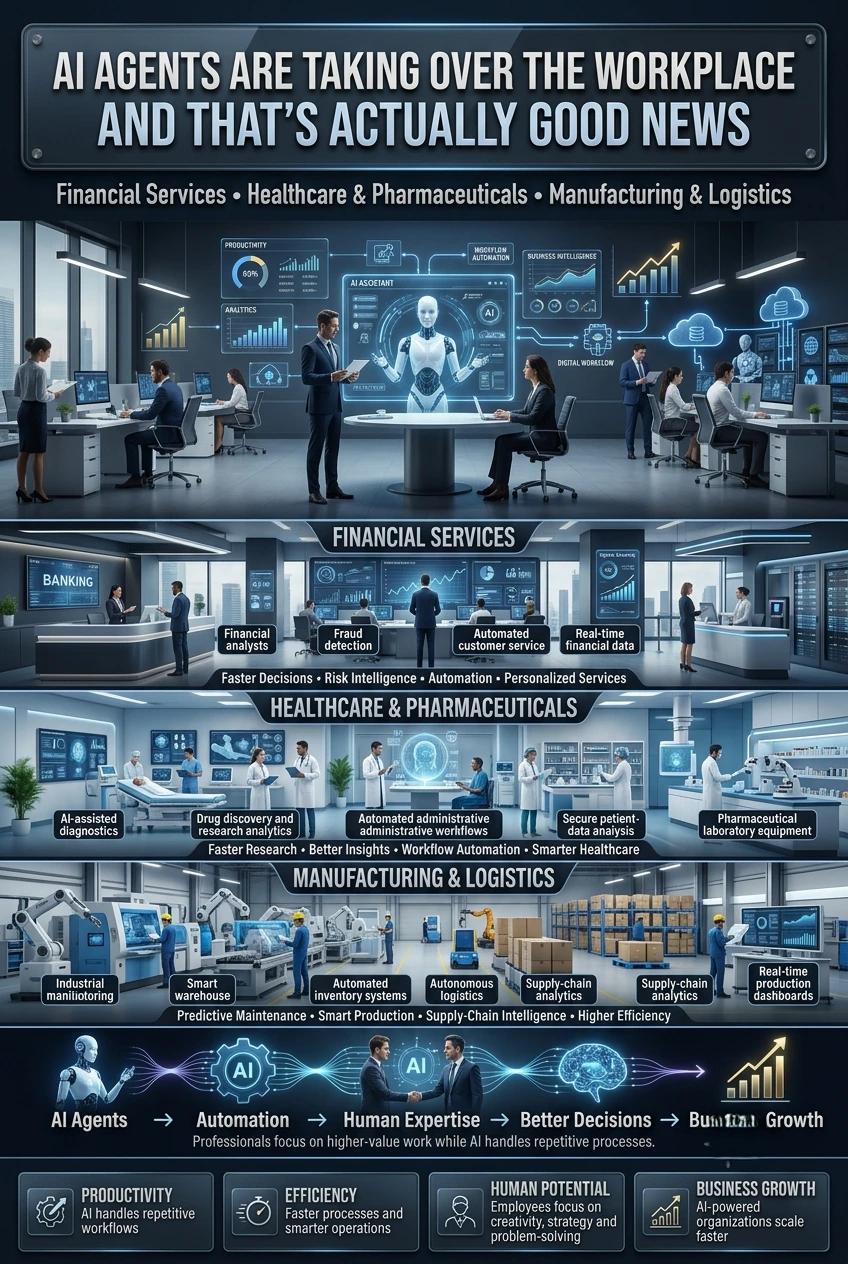
AI agents are being scaled throughout the insurance and banking industries. Insurance companies and banks are putting AI agents to work in large numbers. A report by Deloitte titled “AI in financial services” says agents are changing the way that customers’ queries are resolved, fraud is prevented, loans are processed and regulatory compliance is monitored. AI has taken care of tier 1 issues, leaving customer service agents to focus on answering more complex queries five times the number of cases.
Related Article: Financial Advisory Services for Indian Businesses: Why Professional Guidance Is Essential for Growth
Healthcare and Pharmaceuticals
From appointment scheduling to clinical trial data analysis, AI agents are making tasks seem like a breeze that were once excruciatingly slow. AI agents have significantly reduced the time spent on analysing molecular data and identifying promising compound combinations, especially in the field of drug discovery.
Explore This Book: Biotech & Pharmaceutical Handbook
Manufacturing and Logistics
Predictive maintenance agents track equipment in real time and alert for anomalies that become failures. Transfer agents monitor stocks, forecast shortages and make automatic orders. This equates to reduced downtime, waste minimisation and improved margins.
The Human Challenge Nobody Talks About Enough
The tech press tends to gloss over this fact: Getting to the stage where AI agents can be deployed isn’t the technical problem. It is human.
In a groundbreaking study by Stanford HAI, workers reported resistance to using AI, miscommunication about job duties, and low confidence in AI-generated content when their employers rush to adopt agents without any changes in workflow. If workers are threatened by agents, they withdraw. Poor teams don’t know what agents can and cannot do, and therefore make poor choices on when to trust their outputs.
What Small and Mid-Sized Businesses Need to Know
AI agent tools have become democratised quickly. Platforms such as Google’s Workspace, Microsoft’s Copilot and Salesforce’s Agentforce have democratized agents, making them accessible to businesses of 5 to 500 users, according to Gartner’s Magic Quadrant for AI Platforms. Most of these tools do not involve any coding ability to establish and use.
In a small e-commerce company, an AI agent could manage customer support requests, track inventory, and even assist with return management, all of which were previously undertaken by part-time employees. An agent at a marketing agency could track brand mentions, create a response that’s suitable, and compile performance reports. Agents can analyze contracts, identify unusual terms, and provide a summary of case documents for a law firm.
View Full Project Details: DPR Consultant in India – Detailed Project Report Consultants & Consultancy Services
The Ethical Considerations Worth Taking Seriously
Data privacy is chief among the ethical challenges. The EU AI Act framework for AI systems with high risks has clear requirements for organisations which use AI agents in significant contexts. No matter what the jurisdiction, security of data, the scope of access, and updating the governance policies for the agent era are not negotiables.
Bias – The NIST AI Risk Management Framework gives you a working structure that will enable you to identify, analyze and deal with bias risks when AI systems are used within high-risk environments, such as lending, hiring and customer service and support functions.
What to Expect in the Next 12 to 18 Months
Multiagent cooperation is advancing swiftly now. We’re moving away from the one agent, one job model to that of a system of specialized agents – one agent explores, another writes, another proofreads, another submits, but all working together, making the entire process much quicker and less prone to error than a single agent working all alone.
Agent-to-agent negotiation of routine B2B transactions between systems from two different organizations without human involvement is not far off and is considered likely to address activities such as procurement, scheduling and coordinating logistics.
Your investment deserves the right opportunity
Getting Started: A Practical Roadmap
Business owners who are prepared to get to work can do so by going small as IBM Institute for Business Value guide to AI adoption suggests: find the single task that is the most tedious in your company process – time spent on one’s routine – locate an AI tool designed to perform this task on your behalf, implement it, measure time savings and scale up. It is Steep the Learning Curve in the Beginning but You Get Paid Fast.
- Audit your time: Spend one week tracking where your team’s hours actually go. Look for recurring, rule-based tasks that consume disproportionate time.
- Pick one use case: Do not try to automate everything at once. Select the single task with the best ratio of time consumed to business value created.
- Choose the right tool: Research agent platforms purpose-built for your use case. Look for strong security practices, good user reviews, and clear data handling policies.
- Run a pilot: Deploy the agent with a small group for four to six weeks. Measure time saved, error rate, and user satisfaction.
- Iterate based on feedback: Adjust the agent’s instructions, scope, and integrations based on what the pilot reveals. Then scale.
Final Thoughts: This Is the Shift, Not the Hype
The World Economic Forum’s Future of Jobs Report 2025 confirms what enterprise deployments are already demonstrating: AI agents are not replacing workers at scale, they are augmenting them. The 40 minutes saved per interaction at Telus. The 95% query time reduction at Suzano. These are operational outcomes from real deployments, in real organisations — a preview of what becomes table stakes for competitive businesses in the years ahead.
The good news is that the path forward is clear. The technology is ready. The playbook is forming. The only thing left is the decision to begin.
References & Further Reading
- MIT Technology Review — What Is an AI Agent?
- Google Cloud Customer Case Studies
- McKinsey Global Institute — A New Future of Work
- Deloitte — Banking Industry AI Outlook
- Gartner Magic Quadrant for AI Platforms
- European Commission — EU AI Act Regulatory Framework
- NIST AI Risk Management Framework
- World Economic Forum — Future of Jobs Report 2025


