




Profitable Chemical Manufacturing Businesses
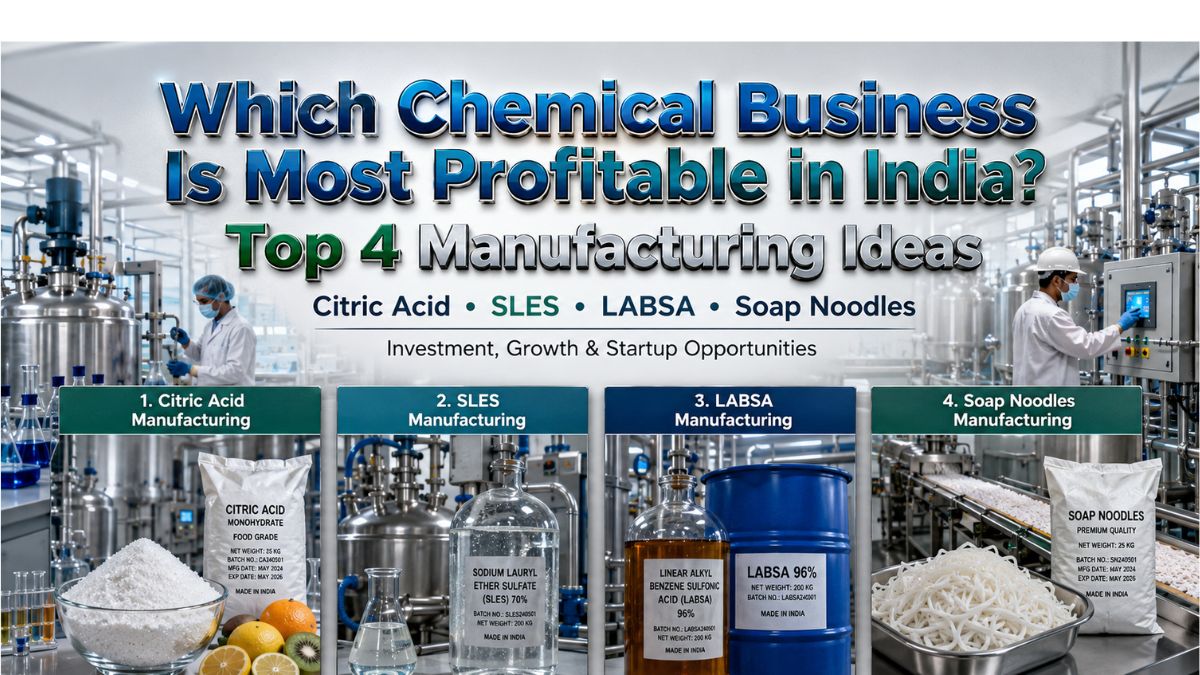
The specialty chemicals and surfactant industry provide some of the most interesting business ideas to first-generation entrepreneurs today in India. Four products—Citric Acid, Linear Alkyl Benzene Sulfonic Acid (LABSA), Sodium Lauryl Ether Sulfate (SLES), and Soap Noodles—are caught between the rapidly rising domestic demand, robust export demand, and relatively low manufacturing cost. They are not special materials. They are basic ingredients of food and drinks, cosmetics, washing and cleaning products, and pharmaceuticals; industries which account for hundreds of thousands of crores of production annually.
If an entrepreneur is ready to venture beyond the obvious and invest in industrial chemistry where there are strong demand fundamentals, then these four products can be some of the best protection, scalable and capital efficient entry points available in Indian manufacturing.
Get Detailed Insights from This Book: Handbook On Chemical Industries (Alcohol Based)
Why This Sector: Demand Logic and Market Fundamentals
The situation of India in the specialty chemicals market has changed significantly over the years. The home and personal care segment is the main consumer of SLES, LABSA and Soap Noodles and the sector has been growing at a steady pace as a result of increasing incomes, urbanisation and the growing middle-class whose purchasing power has been proven for hygiene and grooming. Opportunity is direct for premium detergent manufacturers, FMCG manufacturers and contract manufacturers as all of them require uniformity in raw material supply and India’s own production has always been unable to meet this demand, which has been met by imports.
The growth case for Citric Acid is also highly favourable. It is a versatile raw material which is utilized in all areas of food processing, pharmaceuticals and industrial sectors and its demand is in line with the growth of the consumption economy. India has already been receiving huge shipments from China and the world is rather in favour of diversifying supply chains, especially for those multinationals which are in the country, which has opened the real door for domestic manufacturers offering the requisite quality parameters.
Government Policies and Incentives
The policy framework is truly enabling. Under the CGTMSE scheme, entrepreneurs can avail of a loan of up to ₹5 crore without providing any collateral, which is vital for plant setup and working capital. PMEGP scheme offers capital subsidy facility of 25-35% and is one of the most accessible funding options to start small scale chemical manufacturing. Start-up India provides income tax benefits for three years and expedient registration processing to eligible manufacturers under DPIIT.
Import duties on various raw materials used to make surfactants have been progressively reduced by the Ministry of Chemicals and Petrochemicals to promote value addition and make in India industrial estates provide plug and play infrastructure with reduced time-tomarket. Entrepreneurs definitely get better loan terms and quicker loan disbursal when they approach any scheme under the MUDRA Yojana with a well-prepared Detailed Project Report, as the maximum amount for collateral-free loan under Tarun category is ₹10 lakh.
Four Manufacturing Business Ideas in Detail
1. Citric Acid Manufacturing
Citric acid is the most widely traded commodity chemical in the world, and is the most resilient of all the organic acids due to its dominance in food, pharma and industrial applications. It is found in carbonated drinks, jams, milk and all processed foods where pH control is essential. In pharmaceuticals, it is used as an excipient and effervescent base.
It is used in the cosmetics industry as a pH adjuster in shampoos and creams; it is also used in the industrial sector for metal cleaning, water treatment, and other purposes. The fermentation is submerged culture, on molasses or corn steep liquor, which is a raw material produced in abundance in India from sugar industry. This is a fermentation, filtration, calcium hydroxide precipitation, sulfuric acid acidulation and crystallisation process.
Fermentation vessel capacity, filtration equipment and quality assurance infrastructure to satisfy food-grade and pharma-grade specifications are key investments for entrepreneurs entering this field. India’s reliance on the Chinese for citric acid is an opportunity in disguise: Domestic manufacturers with recalling ability to ensure purity and consistency can tap the import substitution market, and as per reports, the Indian country is home to more than 100 such manufacturers.
APEDA, processed food exports — a big consumer for the downstream — remain on the rise and that’s enough justification for the demand of the upstream – acidulants.
Get Detailed Project Report (DPR): Citric Acid Manufacturing Plant Project Report
2. Sodium Lauryl Ether Sulfate (SLES) Manufacturing
The anionic surfactant responsible for the foaming and cleaning action of shampoos, body washes, dishwashing liquids and industrial degreasers is SLES. It is the most popular surfactant used in all types of personal care products worldwide and is one of the top volume specialty chemicals in Indian domestic trade. Other areas of application for SLES include personal care, textiles, leather tanning and oilfield chemicals. Because of its relatively mild skin profile, it’s been chosen as the surfactant for high quality and mid-range personal care brands. Production includes ethoxylation of lauryl alcohol, sulfation and neutralisation; the more capital-intensive process is the ethoxylation, which is achieved under pressure in reactors at controlled temperatures.
The manufacturing of SLES is within reach of investment in the mid-tier MSME range at 10-25 tonnes per day. The most distinguishing factor of the competition is the consistency of quality in the active content, pH, and viscosity — with the investment in laboratory testing infrastructure, entrepreneurs can create credibility with the buyer in less time. India’s personal care market continues to grow, local SLES capacity is not gaining pace with the market demand, and there are active opportunities in the personal care segment in the Southeast Asian, Middle East and East African markets for well-managed Indian manufacturers.
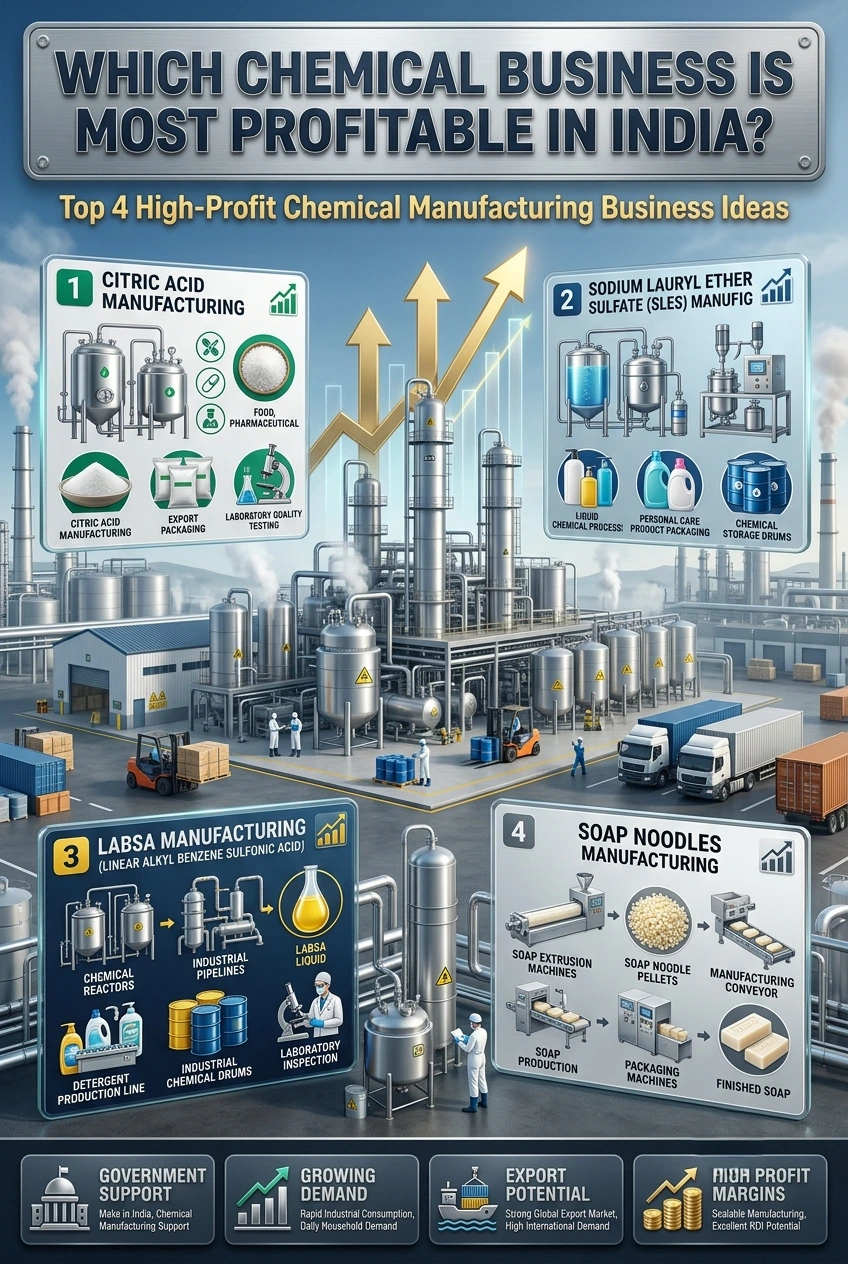
3. LABSA (Linear Alkyl Benzene Sulfonic Acid) Manufacturing
The main component of powder and liquid laundry detergents, industrial cleaners, and agricultural emulsifiers is called LABSA. All the big detergent companies, whether multinational FMCG companies or even local powder manufacturers rely on a steady supply of LABSA. India is witnessing robust growth in the demand for detergents and the penetration into rural areas by branded products makes this a definite trend. In the production process, Linear Alkyl Benzene is sulfonated with Sulfur Trioxide or oleum in a falling film reactor. The chemistry is fairly simple, but requires careful control of temperature, the safety of acid handling, and uniformity of active matter content (usually not less than 96%).
The main raw material is “LAB” which is mainly provided by domestic petrochemical manufacturers. The reactors can be scaled up modularly, and MSME reactors are available at 5–15 tonnes per day scale. Surfactants are one of the fastest growing segments of Indian chemical exports, according to Chemicals Export Promotion Council (CHEMEXCIL). For entrepreneurs with good LAB sourcing, CPCB compliant pollution control system and relationship with detergent formulators, they can create a business which is resilient, cash generating and cash flow positive in this segment.
Related Article: High-Growth Industrial Opportunities in Linear Alkyl Benzene Sulphonic Acid, Biogas Plants, Soya Lecithin & Sodium Silicate from Rice Husk Ash
4. Soap Noodles Manufacturing
They are the semi-finished product that is used to create all bar soaps, including toilet base, laundry base and medicinal soap base. They are the basic raw material for soap industry and they are prepared by saponification of fatty acids (palm oil, coconut oil or tallow) with caustic soda, dried and extruded.
This intermediate position lends manufacturers a significant and stable customer base of large and multi-national FMCG brands, regional soap manufacturers and contract manufacturers. The most important quality specification is the TFM content, which is usually 78–80% for toilet grade. Buyers are most critical of the quality of the soap from the suppliers in these areas: moisture control, free caustic soda levels, and fat blend management, which directly impact soap quality downstream.
The major raw material sources are palm oil through Mundra and Kandla ports and coconut oil from Kerala and Tamil Nadu; handling price volatility of raw material is a common practice and new entrants should do so from day one by signing forward contracts. With input cost discipline, solid EBITDA margins are achieved at a plant size of 20 – 50 tonnes per day with effluent treatment. Indian manufacturers of Coconut noodles have plenty of export opportunities, especially to the African and Middle East markets.
Import–Export Opportunity Analysis
India has multiple entry points in the trade in these four products. However, the country continues to be a net importer of citric acid, which is a first point of intervention for local producers for food-grade and pharma-grade citric acid. Cost and logistics benefits over European and Chinese suppliers have enabled India to establish important export footprint in South Asia, Southeast Asia and Middle East for SLES and LABSA. Soap noodles are involved in an active two-way trade with Malaysia and Indonesia, exporting palm-based noodles and importing coconut-based noodles into India. Surfactants and organic acids are among the consistently growing export items, according to the DGFT.
Those entrepreneurs who invest in ISO 9001 certified plants, REACH certified plants for European buyers and Halal certified plants for Middle Eastern markets, can enjoy premium export pricing while minimizing the risk of concentration in the domestic market. The China +1 sourcing of global FMCG and pharma buyers is a structural tailwind for Indian manufacturers with proven quality systems.
Indian MSME Success Stories: Lessons from the Field
Nirma Ltd — Karsanbhai Patel
The story of Karsanbhai Patel from one-man detergent shop in Ahmedabad to a national brand “Nirma” is the ultimate MSME to industry parable in the surfactant industry of India. The competitive advantage was backward integration, that is, he produced LABSA and other key input materials in-house, without relying on third parties, thus obtaining a cost structure that was hard for any cost sensitive competitor to reproduce. The Nirma entrepreneurs have revealed that the margin maximisation at the beginning is less important than the volume discipline, control of raw materials and distribution width for the entrepreneurs entering into LABSA or SLES manufacturing today.
Jyothy Laboratories — M.P. Ramachandran
M.P. Ramachandran started Jyothy Laboratories expanding its operations from Kerala to a multi-category household products company with Ujala fabric whitener. On the successful acquisition of Henkel India’s brands, he proved the quality of his manufacturing capabilities as well as distribution network. The MSMEs that learn this one key lesson: volume consistency, and customer stickiness trumps premium brand building, will create more sustainable businesses.
Regional Soap Manufacturer Ecosystem
Dozens of MSME soap noodle processors and contract soap manufacturers have been able to create sustainable businesses across Gujarat, Maharashtra, Tamil Nadu and Uttar Pradesh by filling niche positions in the supply chain such as manufacturing for brands by paying tolls, supplying value tier soap to local retail outlets, and supplying to institutional buyers. The business logic is straightforward: keep spending low, keep quality high, and keep the relationships with buyers in a strong position, with volume predictability. This is the practical approach for new players in either soap noodles or LABSA to achieve sustainable profits.
Discover business ideas that actually make money
How NPCS Can Help You Evaluate Your Manufacturing Project
While the market may be ready for a manufacturing investment in citric acid, SLES, LABSA or soap noodles, a thorough techno-economic evaluation is required. We at Niir Project Consultancy Services (NPCS) are preparing Market Survey cum Detailed Techno-Economic Feasibility Reports, which provide entrepreneurs a complete bankable project framework before making any investments. Our reports include detailed manufacturing processes, raw material and machinery identification, demand analysis, process flow diagrams, capacity planning and complete project financials with profitability projections. Entrepreneurs who start a DPR with a good structure are more likely to obtain funding, get the best machinery terms and will not find costly course corrections after they invest, due to lack of pre-investment analysis.
Market Snapshot: Key Parameters for Four Chemical Manufacturing Opportunities
| Product | Entry Capacity | Key Raw Materials | Primary End-Use | Export Potential |
| Citric Acid | 1–5 TPD | Molasses, A. niger culture | Food, pharma, cosmetics | High — import substitution + export |
| SLES (28–70% active) | 5–25 TPD | Lauryl alcohol, ethylene oxide | Personal care, home care | Moderate–high (SE Asia, Middle East) |
| LABSA (96% active) | 5–15 TPD | Linear Alkyl Benzene, SO₃/oleum | Detergents, industrial cleaning | Moderate (South Asia, Middle East) |
| Soap Noodles (78% TFM) | 20–50 TPD | Palm/coconut oil, caustic soda | Bar soap manufacturing | High (Africa, Middle East, S. Asia) |
Frequently Asked Questions
Q1. What is the minimum investment needed for a SLES or LABSA plant?
For a SLES plant of 10 TPD, a total project investment can range from Rs 80 lakh to Rs 1.5 crore, considering land, building, plant & machinery and working capital. Similarly, for a LABSA plant of 10 TPD, a similar investment is involved with additional costs for safety on acid handling and pollution control setup. Entrepreneurs going for CGTMSE or PMEGP loans will also have to have a properly drawn DPR – this is the most critical thing the banks expect for a chemical manufacturing project.
Q2. Is citric acid manufacturing viable for a small MSME entrepreneur?
1-2 TPD molasses-based citric acid fermentation can be explored by entrepreneurs if they have steady supply of molasses, ideally from molasses belt states like Maharashtra, Uttar Pradesh and Karnataka. Getting high consistency in quality and fulfilling buyer specifications is the main thing here. For pharmaceutical grade, one will need GMP certification, thus, more investment on compliance but also more realisation.
Q3. Which government schemes are most useful for soap noodles or chemical manufacturing?
Direct benefits include PMEGP for capital subsidy, CGTMSE for loans without collateral and Tarun segment of MUDRA Yojana. For entrepreneurs who wish to set up their businesses in specified industrial areas, state incentives can be taken up as well – for instance, stamp duty concession, discount on electricity tariff and GST related benefits. The better the DPR, quicker is the loan sanction by commercial banks and NBFCs.
Q4. What are the pollution compliance requirements for LABSA or soap noodles manufacturing?
These activities typically fall under the orange or red category under CPCB pollution classification. Entrepreneurs must obtain Consent to Establish and Consent to Operate from the State Pollution Control Board, set up effluent treatment plants meeting prescribed norms, and maintain stack emission records. Compliance is entirely achievable and should be planned into the project from day one — it is not a cost to minimise but an operating licence requirement.
Q5. Are there real export opportunities for SLES and LABSA from India?
Yes — Indian surfactant manufacturers supply Bangladesh, Sri Lanka, Nepal, the UAE, Saudi Arabia, and East African markets. Competitiveness of price, continuity of supply and quality consistency – that’s the top three priority points identified by buyers in the international market. For a new exporter interested in developing rapport with the international buyer, gaining the ISO 9001 certification and exhibiting at CHEMEXCIL trade fairs can be the first step.
Q6. How long does it take to commission a LABSA or soap noodles plant?
Most well-conceived projects go from land acquisition to first production in about 12-18 months. The biggest factors in time depend on the timing of local government approvals and equipment lead times for reactors and extruders. Even before civils are complete, projects that have already developed a full DPR (which address such things as approvals required, who the contractor will be and who will supply utilities) will always be shorter timeframes than reactive plans.


