





Silicon Carbon Battery Business
The energy storage revolution is taking place worldwide, and Silicon Carbon batteries are at its heart. This technology is one of the most exciting investment opportunities of the decade for forward-looking entrepreneurs that are interested in advanced manufacturing business ideas. In contrast to traditional lithium-ion batteries, Silicon Carbon (Si/C) batteries have significantly greater energy density, rapid charge times and extended cycle life. Such benefits are fueling the strong demand in the electric vehicles sector, consumer electronics, grid storage, and defence.
This opportunity is on the rise in India. The government’s policies for promoting electric mobility, clean energy transition and domestic battery production such as the Production Linked Incentive (PLI) scheme have provided fertile land for new players. As a small business entrepreneur, MSME business planner, or an investor in manufacturing, knowing about this sector may be the key that shapes your next decade. It explains the largest business ideas, policy support, trade dynamics and real market statistics – giving you the level of rigor needed to make this a business worth evaluating.
Why Silicon Carbon Batteries Are Transforming the Energy Storage Industry
The Demand Logic Is Undeniable
The uptake of EVs is happening at a much quicker rate than ever before, and battery performance remains the biggest hurdle. The theoretically maximum energy density of conventional graphite anode lithium-ion cells is approaching. To overcome this issue, silicon Carbon anodes incorporate silicon, which can hold ten times more lithium ions than graphite, and carbon matrices that promote structural stability within the electrode.
What comes out is a battery that is 20-40% more energy dense than a typical lithium-ion battery. This means that it provides EV manufacturers with a longer driving range for the same weight. For consumer electronics companies, it’s about reduced device thicknesses and longer battery life. It translates to cheaper per kWh storage for grid storage operators.
The World Bank Energy Sector is closely watching the demand for the Silicon Carbon anode materials globally, which it has repeatedly recognised as the key enabler for clean energy transitions in emerging economies such as India.
India’s Battery Market Is Expanding at an Extraordinary Pace
India is on one of the fastest growth markets for energy storage globally. The EV value chain is in full swing in the country, with all 2-, 3- and commercial vehicles undergoing electrification. In the meantime, the industrial energy storage and telecom back-up power applications are driving continuous demand for high-performance cells.
Domestic production of batteries is very reliant on imports, especially from China, Japan and South Korea. This opens up a structural opportunity for Indian manufacturers that can manufacture Silicon Carbon cells or components here. The IBEF Electric Vehicle Sector Report has highlighted this dependency in detail and it is clear that there is a significant gap in the domestic manufacturing sector that can be addressed by entrepreneurs.
Government Policies and Incentives Supporting Silicon Carbon Battery Manufacturing
PLI Scheme for Advanced Chemistry Cell (ACC) Batteries
The most prominent policy is the PLI scheme for Advanced Chemistry Cell (ACC) batteries by the Ministry of Heavy Industries. This scheme provides production linked financial incentives to the manufacturers to set-up battery manufacturing plants in India. Silicon Carbon anode technology is in the advanced chemistry category, and therefore is eligible for significant funding.
The scheme aims for 50GWh of domestic battery manufacturing capacity to be achieved as a national target. This policy framework is a strong signal for Silicon Carbon battery entrepreneurs, as it not only offers a financial incentive, but it also signals that the government is actively creating a market for locally made advanced batteries.
MSME Support and DPIIT Recognition
Under the Udyam Registration Portal, MSMEs will be able to get collateral-free credit under CGTMSE, subsidised testing facility services at government laboratories, and preference for Government procurement. Further, the startups registered under the DPIIT with a battery technology background get tax exemption, relaxed compliance norms & Fund of Funds capital with SIDBI.
The Government of India has identified energy storage as a thrust area for manufacturing. The Make in India Electronics & IT sector brief provides entrepreneurs with scheme specific guidance, including advanced electronics manufacturing, such as battery systems.
FAME India and EV Ecosystem Linkages
The Faster Adoption of Electric Vehicles (FAME) India scheme focuses on the demand side and directly impacts battery manufacturers. OEMs begin to ramp up EV production in response to the consumer demand for these cars incentivised by FAME, thus generating a growing order pipeline for battery suppliers. Entrepreneurs must make sure that they know the scope and eligibility of the scheme, as explained in a PIB press release on FAME India Phase II, in order to plan their supply agreements with EV OEMs.
Top Business Ideas in Silicon Carbon Battery Manufacturing and Technology
1. Silicon Carbon Anode Material Manufacturing
The Silicon Carbon technology distinguishes itself most markedly in the anode sector, which is a high-margin, technology intensive business opportunity with Silicon Carbon technology. The process of preparing silicon carbon composite anode materials is a controllable synthesis of nano silicon particles in carbon matrix. The carbon component (usually graphene, carbon nanotubes or pyrolytic carbon) softens the expansion of silicon during charge/discharge cycles.
It’s also a technical challenge that creates the value: those that can solve it at commercial scale, can charge premium prices. Indian entrepreneurs who have drawn inspiration from materials science, chemical engineering or electrochemistry have an edge to enter into this niche. First production can be aimed at research institutes, battery assembly plants, and academic labs and then commercial battery manufacturers. Invest India’s materials arm, which is monitored through the Invest India – Electronics & IT Sector Page, has seen a rise in institutional interest in the battery material manufacturing in the domestic market.
Get Detailed Project Report (DPR): Lead Battery Recycling
2. Silicon Carbon Battery Cell Assembly Unit
For manufacturing entrepreneurs who are new to the business, the most directly scalable business idea is cell assembly. A cell assembly unit receives the procured anode materials (silicon carbon), the cathode materials (usually NMC or LFP), electrolyte and separator films and packs them into completed battery cells in cylindrical, prismatic or pouch format. The integration of Silicon Carbon anode by the Indian battery manufacturers will enable them to provide OEMs with a performance boost over conventional Lithium-ion.
The business model is capital-intensive at large scale but can begin at a pilot level with semi-automated assembly lines. The key success driver is quality control — cell consistency, electrolyte filling precision, and formation cycling all determine product reliability. Entrepreneurs should plan for robust testing infrastructure from day one.
3. Battery Module and Pack Integration for EVs
In addition to the manufacturing level, battery module and battery pack integration is a relatively simple application that is suitable for startups having electronics and mechanical engineering backgrounds. A module is a grouping of cells, which is housed together in a thermally controlled and mechanically protected unit. A pack is a combination of modules and a battery management system (BMS) and enclosure.
Differentiated performance, especially in fast charging and low temperature, makes Silicon Carbon-based packs a true selling point to EV OEMs and fleet owners. This business can be initiated at MSME level with custom pack design for niche areas like e-rickshaws, cargo cycle, solar storage etc. and can be scaled with the growth of market.
Related Article: EV Battery Materials & Critical Minerals: Startup Opportunities in India
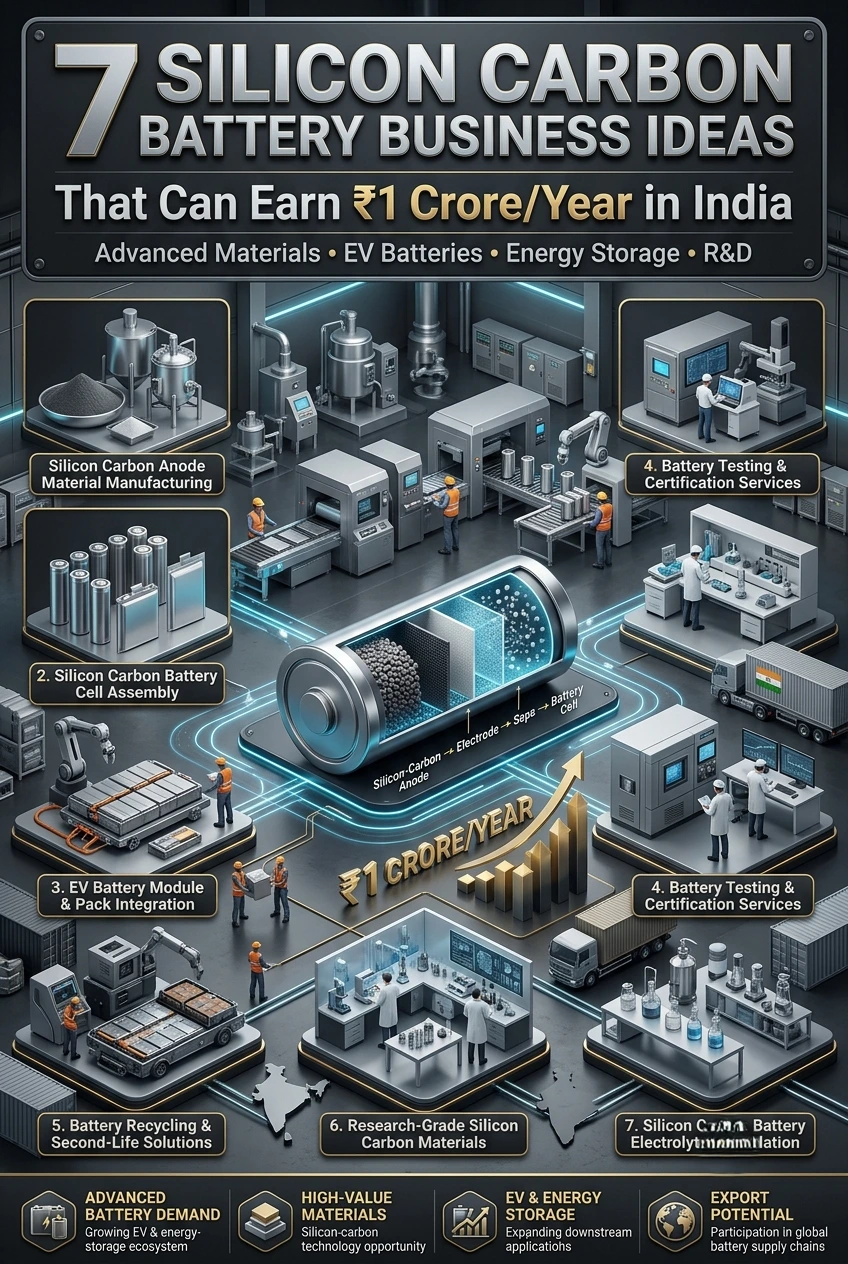
4. Battery Testing, Characterisation, and Third-Party Certification Services
An independent testing and certification lab is crucial infrastructure, and a viable business, as India’s battery manufacturing ecosystem expands. The electrochemical characterization, cycle life testing, thermal runaway testing, Indian and international safety certification of Silicon Carbon cells is a specialized process. Advanced electrochemical characterisation is available for Silicon Carbon chemistries in very few private testing labs in India.
A NABL accredited lab with cell testing facilities can cater to the cell manufacturing industry, pack integrators and OEMs in the country. It’s a services business, one that has a lot of recurring revenue, which, in terms of capital, is not as intense as manufacturing, and which has a high strategic value, in a developing ecosystem. The CII – Confederation of Indian Industry Battery & EV Sector has identified the lack of testing infrastructure as one of the challenges hindering the growth of the sector.
5. Recycling and Second-Life Battery Solutions
This end-of-life issue is crucial as Silicon Carbon batteries go into commercial use on a large scale. As a rapidly expanding manufacturing industry, battery recycling can recover valuable materials such as lithium, cobalt, nickel and silicon from spent batteries. A Silicon Carbon battery recycling unit can recover the silicon in the anode for use, recover the metals in the cathode by hydrometallurgical or pyrometallurgical processes, and process the electrolyte materials safely.
The company enjoys positive regulatory momentum. As per the Battery Waste Management Rules (BWM), India, the brand is also responsible to provide Extended Producer Responsibility (EPR) and has created an institutional framework for battery brands. Early entrepreneurs will have first mover advantages in an under-occupied market.
Get Detailed Insights from This Book: E-Waste Recycling: PCB, LCD, Mobile & Battery Processing
6. Research-Grade Silicon Carbon Material Supply for Academic and R&D Institutions
India has also a large number of IITs, NITs, CSIR research labs and electrochemical research groups at various universities which have a need of reliable, high purity of Silicon Carbon composite materials for their research and development activities. These materials are now mostly being imported from abroad in expensive and lengthy lead times from the most of these institutions. A domestic-based supplier with high expertise in research grade Silicon Carbon anode materials, nano-silicon powders and custom composition formulation can establish a sustainable business that can be tailored to the needs of this institutional market.
The volume of sales is less than industrial supply but margins are somewhat higher and there are definite requirements. Having established relationships with leading research institutions can also be a valuable platform for future commercial-scale supply. APEDA – Chemical & Allied Products Export Data offers useful benchmarking data on specialty chemical trade flows as inputs to the planning for material procurement and export strategy.
7. Silicon Carbon Battery Electrolyte Formulation and Supply
Silicon Carbon battery electrolyte needs to be specially formulated to address the unique surface chemistry of silicon, especially to create a stable solid electrolyte interphase (SEI) that prevents cracking during the volume changes that silicon experiences. With a graphite-anode cell, standard electrolytes are not ideal for a Silicon Carbon system.
Chemistry graduates who want to get into formulation and supply business of customised electrolytes, such as fluorinated solvents, ionic liquid additives and solid-state electrolyte precursors, can do so if they are compatible with Silicon Carbon. It is a specialty chemicals niche product company showing a high margin growth rate directly related to the volume of Silicon Carbon cell production. The DPIIT – Chemicals & Petrochemicals Sector Policy provides a comprehensive outline of the regulatory framework in India for specialty chemical manufacturing.
Import–Export Opportunity Analysis for Silicon Carbon Battery Businesses
India’s Import Dependence Creates a Built-In Market for Domestic Producers
Today, almost all the battery cells, anode materials and electrolyte chemicals are imported to India. China is the biggest supplier of battery grade graphite and silicon materials, posing a geopolitical concentration risk that Indian policymakers are trying to tackle. This import dependence is a structural opening that is vital for the domestic manufacturers. Silicon Carbon anode materials are still not commercially available in India, and in case an Indian manufacturer can supply a qualified and consistent anode material, they will have pricing power and OEM good will.
Export Markets Are Opening Up Across Southeast Asia and Africa
With the improvement in battery manufacturing quality and an increase in production, export opportunities are becoming available, especially to Southeast Asian countries like Vietnam, Indonesia and Thailand, and to Africa, such as Kenya, Nigeria and South Africa. India’s trading ties, low production expenses and increasing brand reputation are all advantages to Indian Silicon Carbon battery module exporters. The ILO – Skills and Manufacturing in Asia Pacific Report further underscores the manufacturing capability gap in the emerging markets in Asia, further strengthening India’s export opportunity.
Indian MSME Success Stories in Battery Technology
Exicom Tele-Systems – Building India’s EV Charging and Battery Ecosystem
Exicom Tele-Systems, which is headquartered in Gurugram and is led by promoter Anant Nahata, started its operations as a power electronics company that provided products to telecom customers. The company was quick to seize the opportunity of EVs, shifting its focus to advanced lithium-ion battery packs and EV chargers for the Indian market. They chose to invest in expertise in deep battery management system, not just in importing batteries, which meant they had a more sustainable competitive edge.
In the Exicom story, the long term defensibility in the electronics side of the cell can be created with enough technical depth and depth of expertise, even if cell chemistry changes. In this sector, a proven method of scaling is starting from a system-level expertise and working up to a material-level capability.
Log9 Materials – Silicon-Graphene Battery Technology from Indian Research
Log9 Materials, co-founded by Akshay Singhal from Bangalore, is a startup from the IIT Roorkee research on graphene-based battery technologies. It evolved aluminium air battery systems, as well as fast-charging graphene systems, and then established itself as a technology-driven substitute for traditional lithium-ion batteries for certain applications. Log9’s story has been the proof that Indian start-ups can create an offering that is credible globally by beginning the journey in the research lab and then moving into commercial products.
For Silicon Carbon battery entrepreneurs, the Log9 model — technology first, commercialisation second — offers a replicable playbook. Academic partnerships, early pilot customers, and clear IP ownership are the building blocks.
Amara Raja Energy & Mobility – MSME Roots to Industry Leadership
The Amara Raja Group, with roots in Andhra Pradesh and founded by Ramachandra Naidu Galla, grew from a mid-sized industrial battery manufacturer to one of India’s largest energy storage companies. Today, through Amara Raja Energy & Mobility, the group is actively investing in advanced cell chemistry research — including Silicon Carbon and lithium-iron-phosphate technologies — through partnerships with global technology licensors. The lesson for MSME entrepreneurs: starting in adjacent battery segments and building operational excellence in manufacturing is a viable path to eventually entering advanced chemistry production.
Discover business ideas that actually make money
How NPCS Helps Entrepreneurs Enter the Silicon Carbon Battery Sector
We at Niir Project Consultancy Services (NPCS) provide professional consulting for the preparation of Market Survey cum Detailed Techno-Economic Feasibility Reports (DPRs) for setting up new industries or businesses. For entrepreneurs evaluating entry into Silicon Carbon battery manufacturing or related value-chain businesses, our reports include detailed manufacturing processes, market research and demand analysis, process flow diagrams, product mix and capacity planning, machinery and raw material details, and complete project financials with profitability analysis.
The Silicon Carbon battery sector involves complex technology choices, rapidly evolving supply chains, and significant capital planning considerations. Our objective is to help entrepreneurs evaluate feasibility, profitability, and long-term scalability before investing — so that business decisions are grounded in rigorous analysis rather than market hype. Whether you are considering anode material manufacturing, cell assembly, or battery testing services, a professional DPR is the most reliable foundation for your investment decision.
Silicon Carbon Battery Market at a Glance – Key Data Table
| Parameter | Detail |
| Global Si/C Battery Market Growth Rate | ~25–30% CAGR (high-growth phase) |
| Primary Applications | EVs, Consumer Electronics, Grid Storage, Defence |
| India Battery Import Dependence | ~80–85% of cells imported |
| ACC-PLI Scheme Incentive Pool | ₹18,100 Crore (Govt of India) |
| Key Raw Material – Silicon | Abundant in India (quartzite reserves) |
| Energy Density Advantage vs Graphite | 20–40% higher |
| Key Export Destinations | Southeast Asia, Middle East, Africa |
| Domestic Manufacturing Gap | Significant – anode materials & electrolytes under-produced |
| Recycling Opportunity Trigger | Battery Waste Management Rules (EPR mandate active) |
Conclusion – The Silicon Carbon Battery Business Opportunity Is Real and Ready
The Silicon Carbon battery sector sits at the intersection of India’s energy transition, its manufacturing ambitions, and its technology future. This is not a speculative bet — it is a sector backed by hard policy commitments, measurable import substitution opportunity, and growing commercial demand from EV manufacturers and electronics brands.
For entrepreneurs, the timing is right. The technology is maturing from laboratory to commercial production. Government policy through PLI, MSME support, and EV demand incentives is fully aligned. Import dependence remains high, which means domestic manufacturers enter a market with structural demand and limited domestic competition.
The seven business ideas outlined in this article — from anode material manufacturing to testing services, recycling, and electrolyte formulation — represent entry points at different levels of capital intensity and technical complexity. The right choice depends on your background, resources, and risk appetite.
Before you commit capital, commission a professional feasibility study. Understanding the full cost structure, technology requirements, market dynamics, and regulatory landscape is the most important step any serious entrepreneur can take. The opportunity is real — but so is the complexity. The entrepreneurs who succeed in Silicon Carbon batteries will be those who combine genuine technical understanding with rigorous business planning. Start with the right research. Build on solid foundations. The Silicon Carbon battery business could be your most consequential manufacturing decision yet.


