
• Latest
  • Trending
  • All
Sustainable Business: Why Green Is the New Business

Green Is the New Black: How Sustainability Has Become the Business Imperative of the Decade

September 8, 2026
गांव में Business Ideas और ग्रामीण उद्यमिता के अवसर

गांव में शुरू करें ये 7 Business Ideas और हर महीने कमाएं ₹50,000 — कम निवेश, ज़्यादा मुनाफा

September 19, 2026
Solar Business Ideas in India: 5 Profitable Manufacturing

5 Solar Business Ideas: Profitable Manufacturing and Service Units in India

September 19, 2026
Project & Profile
Food Processing Business Ideas: 5 Profitable Units

Food Processing Business Ideas: 5 Profitable Manufacturing Units to Start in India

September 19, 2026
Chemical Business Ideas in India: 5 High Manufacturing Units

5 Chemical Business Ideas: High-Margin Manufacturing Units to Start in India

September 19, 2026
Ferro Alloy Manufacturing Business in India: Opportunities

India’s Steel Surge Is Creating a New Wave of Opportunities for the Ferro Alloy Sector

September 18, 2026
बिना किसी गारंटी के सरकार दे रही ₹50 लाख

बिना किसी गारंटी के सरकार दे रही ₹50 लाख तक का बिज़नेस लोन, जानिए कैसे करें क्लेम?

September 18, 2026
2027 में कभी न बंद होने वाले 5 बिज़नेस आइडियाज

2027 में कभी न बंद होने वाले 5 बिज़नेस आइडियाज: कम लागत में शुरू करके बनाएं बड़ी कंपनी

September 18, 2026
Compressed Biogas CBG Plant in India: Government Schemes

India’s Compressed Biogas Revolution: Why Animal and Agricultural Waste Could Fuel the Next Wave of Rural Manufacturing Opportunities

September 17, 2026
Goat Farming Business Loan Detail

बकरी पालन बिज़नेस लोन कैसे ले | Goat Farming Business Loan Detail

September 15, 2026
Biomass Gasification Business in India: Syngas, Methanol

Business Ideas in Biomass-Derived Syngas, Methanol, Hydrogen & DME: From Farm Waste to Clean Fuel

September 13, 2026
OFC Copper Rod Manufacturing: Business Ideas & Investment

OFC Copper Rod (Oxygen-Free Copper Grade): Business Ideas, Manufacturing Opportunity & Investment Guide for Indian Entrepreneurs

September 13, 2026
Shea Butter Business in India: Organic Shea Butter Manufacturing

Shea Butter (Organic Unrefined Grade): Business Ideas, Market Opportunity & Manufacturing Potential in India

September 12, 2026
  • About
  • Advertise
  • Privacy & Policy
  • Contact
Sunday, September 20, 2026
  • Login
Entrepreneur India Blog
  • Home
  • About
  • Books
  • Business Ideas
  • Contact
No Result
View All Result
Entrepreneur India Blog
No Result
View All Result
Home Eco Friendly Sustainable Business

Green Is the New Black: How Sustainability Has Become the Business Imperative of the Decade

by Diksha Garg
September 8, 2026
in Eco Friendly Sustainable Business, Renewable Energy Startups, Waste Management & Recycling Business
0
Sustainable Business: Why Green Is the New Business

Sustainable business practices are becoming essential for growth, resilience and competitive advantage in 2026.

502
SHARES
1.4k
VIEWS
Share on FacebookShare on Twitter

Why sustainability is no longer just about values — it is about survival, competitive advantage, and the future of your business model

By 2026, sustainability has become the heart of business decisions. Not just because of pressure from regulations – although there is, and it is growing. Not only because consumers want it – that is true and it is increasing. However, as business leaders with vision have realised sustainable business models are just more robust, more desirable for talent, more investable, and more aligned with the trajectory of the global economy.

In its recently released Annual Letter to CEOs on Sustainability and Investment, BlackRock argues that the investment case is clear, citing a number of companies that consistently outperform the market in terms of long-term financial results, cost of capital, and economic cycles’ resilience. This has gone beyond a values argument and is a financial argument.

Table of Contents

Toggle
    • Related Article: Top 20 High-Growth Renewable Energy Startups to Launch in India
  • The Business Case for Sustainability: Beyond the Ethics Argument
    • Access to Capital
    • Talent Attraction and retention
    • Regulatory Environment
    • Consumer Demand
  • What Sustainability Actually Means in Practice
    • Environmental Sustainability
    • View Full Project Details: Renewable Energy Projects & Green Power
    • Social Sustainability
  • The Supply Chain Challenge: Where Most of the Impact Lies
    • Green Energy: The Opportunity Inside the Transition
    • Get Detailed Insights from This Book: Solar PV Power and Solar Products Handbook
    • Circular Economy: Rethinking the Take-Make-Dispose Model
    • Greenwashing: The Risk That Can Destroy What Sustainability Builds
    • Discover business ideas that actually make money
  • The Competitive Landscape Is Shifting — Now
  • References & Further Reading
    • Frequently Asked Questions

Related Article: Top 20 High-Growth Renewable Energy Startups to Launch in India

The Business Case for Sustainability: Beyond the Ethics Argument

Access to Capital

ESG has come from the margins to the mainstream as a criterion for capital allocation. According to the Global Sustainable Investment Alliance biennial report, global sustainable investment assets now exceed 5 trillion. Green bonds and sustainability-linked loans (SLLs), which reward lenders with lower interest rates for meeting sustainability goals, have become trillion-dollar markets.

Talent Attraction and retention

Compared to other areas of current business research, there is no stronger link between organisational sustainability and talent. Genuine employer commitment to sustainability is a tangible competitive advantage because younger employees have consistently indicated in Deloitte’s Global Millennial and Gen Z Survey that they consider them to be an important factor in determining which jobs to pursue and which to pursue away.

Regulatory Environment

The path of the regulation on sustainability is so clearly and irrefutably in one direction. The official documentation of the EU Corporate Sustainability Reporting Directive (CSRD) is the most comprehensive mandatory sustainability reporting framework ever adopted, impacting a large number of companies in European markets and their global value chains.

Consumer Demand

Sustainable products are no longer a trend but a market reality, with consumers preferring them. A Nielsen IQ Annual Sustainability Report on Consumer Behaviour reveals that sustainably marketed products are increasing at twice the rate of conventional products in key consumer product categories.

What Sustainability Actually Means in Practice

Environmental Sustainability

The Science Based Targets initiative (SBTi) framework is the most credible benchmark for companies beginning their emissions measurement journey to establish corporate emissions reduction targets based on climate science. More than 7,000 companies have pledged themselves to SBTi-compliant targets, offering a distinct clue as to where the sustainable standard is taking a firm stand.

  • Measurement and reduction of carbon footprint along value chains and operations.
  • Energy transition towards renewable energy and energy efficiency.
  • Waste reduction and circular economy practices to remove waste and value of material.
  • Water stewardship (especially in water stressed areas).

View Full Project Details: Renewable Energy Projects & Green Power

Social Sustainability

Social sustainability is about how a business affects people – the people who work for the business, people in its supply chain, people who buy from the business, and people in its communities. The main dimensions are fair labour practices, diversity and inclusion, community impact and product responsibility.
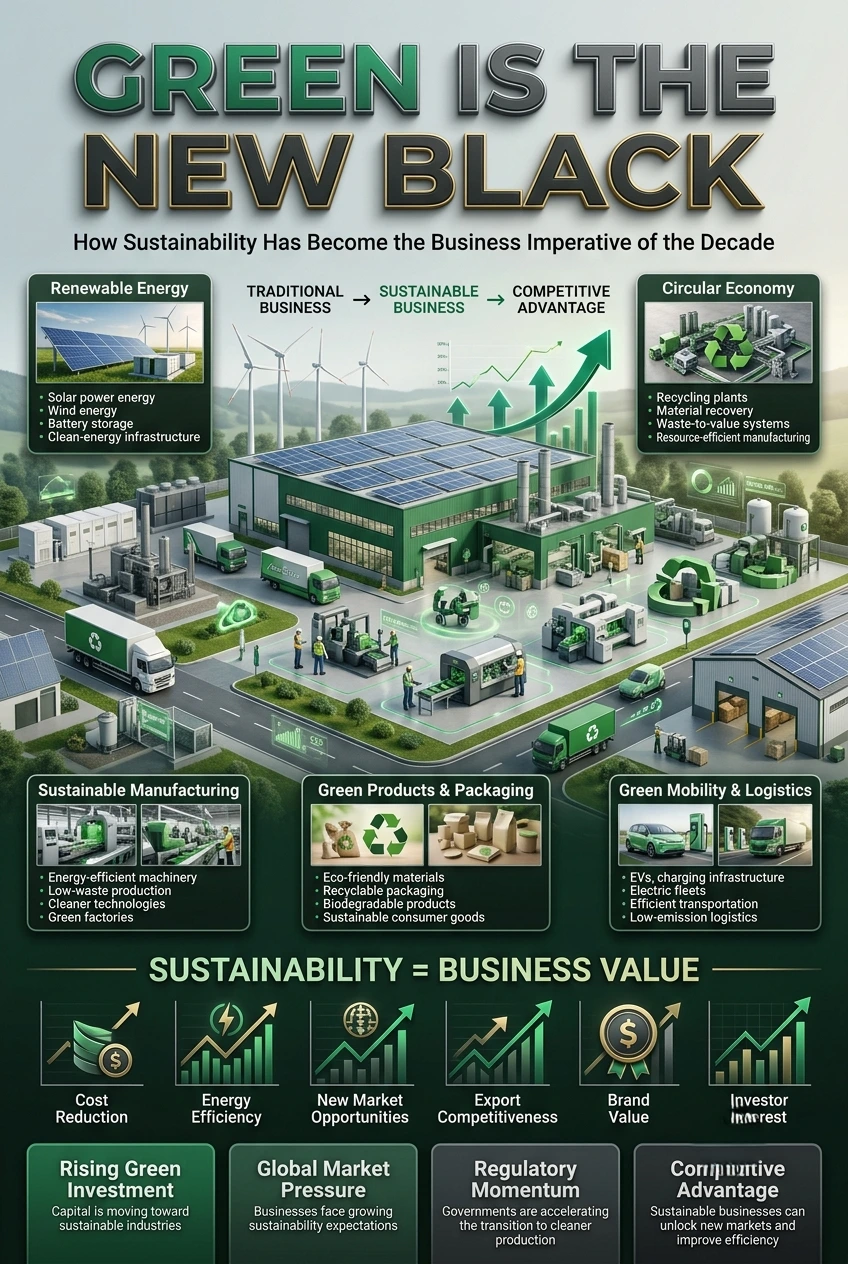
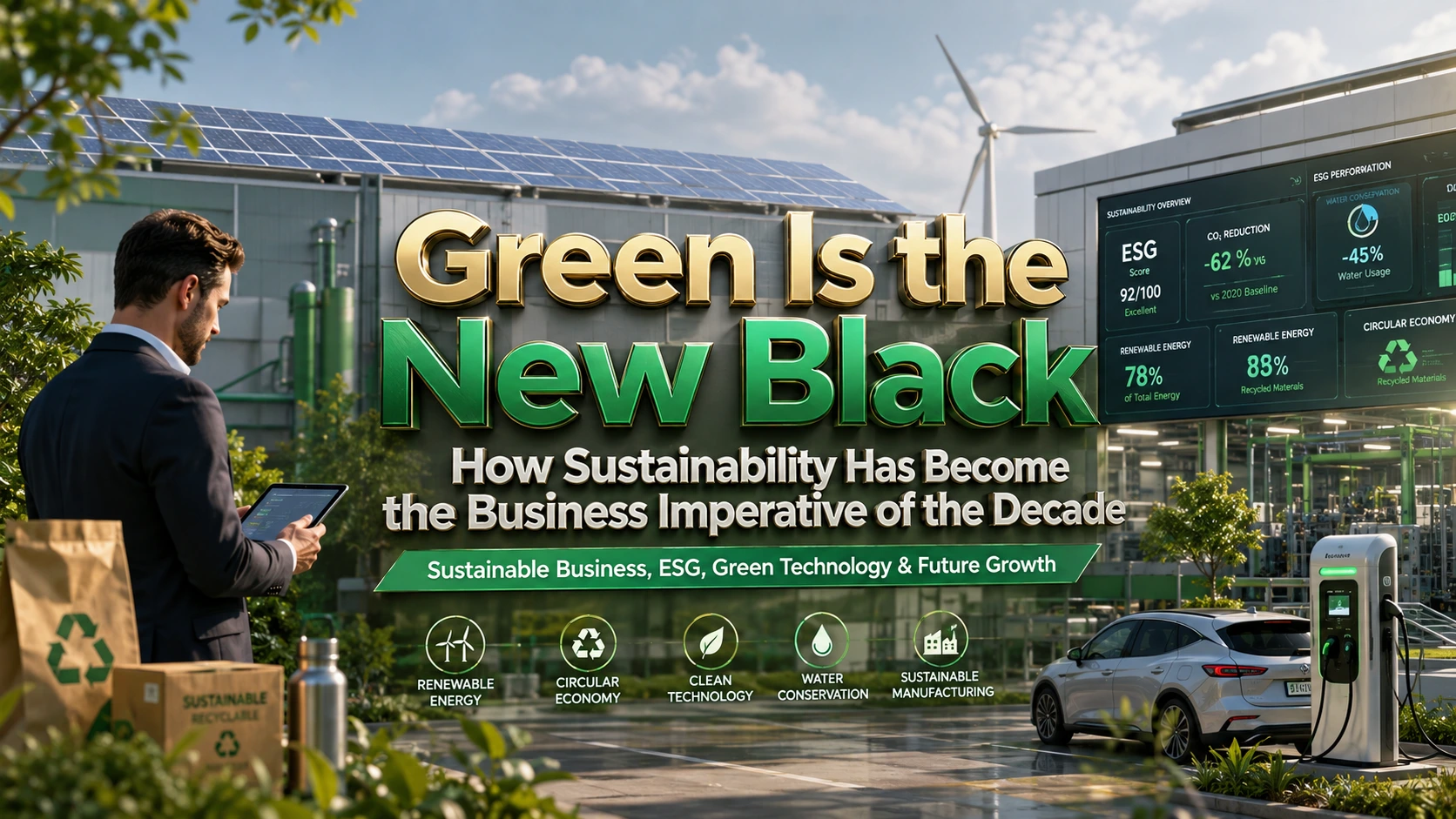
Sustainable business and green sustainability practices in 2026
Sustainable business practices are becoming essential for growth, resilience and competitive advantage in 2026.

The Supply Chain Challenge: Where Most of the Impact Lies

Far more of the environmental and social footprint lies on the business’s supply chain than its own operations. According to the CDP Supply Chain Report on Scope 3 Emissions, supply chain emissions are 5 to 10 times greater than direct emissions from most industries, hence supply chain sustainability is the top opportunity for most companies to reduce emissions.

Green Energy: The Opportunity Inside the Transition

Now renewable energy is economically attractive regardless of the environmental reasons for using it. The cost of renewables is now the lowest available for a new power generation facility in most global markets, with the cost of utility scale solar PV has dropped by more than 90% in the last ten years, according to IRENA’s Renewable Power Generation Costs Annual Report.

Get Detailed Insights from This Book: Solar PV Power and Solar Products Handbook

Circular Economy: Rethinking the Take-Make-Dispose Model

The circular economy has taken a step from theory to business implementation, both in industry and across industries. The Ellen MacArthur Foundation’s Circular Economy Research calculates that circular economy strategies could have an economic impact of .5 trillion by 2030, through improved resource productivity, new business models and innovation.

Greenwashing: The Risk That Can Destroy What Sustainability Builds

Greenwashing is no zero-sum game. It’s a time bomb to reputation and regulation. Over the past two decades, there has been a significant increase in the level of scrutiny regulatory bodies are applying to environmental claims, while high-profile exposes have sparked consumer distrust of the sustainability claims of any company.

Discover business ideas that actually make money

The Competitive Landscape Is Shifting — Now

Businesses that are actually going down the path of sustainable development are not the ones that are purely doing it for the good of others. They are making the decision to do so because they can clearly see the future of the business environment. There is a trend of capital going to sustainable companies. Talent likes to work for sustainable companies. Regulation is tightening. The times they are changing. Sustainability is a business approach. Those businesses that do are creating a product that has a long shelf life.

References & Further Reading

  1. Deloitte — Global Millennial and Gen Z Survey
  2. European Commission — Corporate Sustainability Reporting Directive
  3. Science Based Targets Initiative (SBTi)
  4. Ellen MacArthur Foundation — Circular Economy Overview
  5. PwC — ESG Business Strategy Report

Frequently Asked Questions

Why has sustainability become important for businesses in 2026? +
Sustainability has become important because it can improve business resilience, attract investment and talent, meet regulatory requirements, reduce operating costs, and respond to changing consumer expectations.
How does sustainability provide a competitive advantage to businesses? +
Sustainable business practices can help companies reduce resource and energy costs, strengthen their brand reputation, attract customers and employees, improve supply-chain resilience, and access sustainability-focused capital.
What is ESG and why is it important for businesses? +
ESG stands for Environmental, Social, and Governance. It provides a framework for evaluating how a business manages environmental impacts, social responsibilities, and corporate governance. Strong ESG practices can influence investor decisions and long-term business performance.
How can businesses reduce their carbon footprint? +
Businesses can reduce their carbon footprint by improving energy efficiency, using renewable energy, reducing waste, optimising transportation and logistics, and measuring emissions across their operations and supply chains.
What is supply chain sustainability? +
Supply chain sustainability means managing the environmental and social impacts associated with suppliers, manufacturing, transportation, sourcing, and other supply-chain activities. It is important because a significant share of a company's overall environmental impact can occur outside its direct operations.
What role does renewable energy play in sustainable business? +
Renewable energy can help businesses reduce dependence on fossil fuels, lower long-term energy costs, reduce emissions, and improve energy resilience. Solar and other renewable energy solutions are increasingly becoming strategic business investments.
What is the circular economy in business? +
The circular economy is a business approach that aims to keep products and materials in use for as long as possible. It focuses on reducing waste through reuse, repair, refurbishment, recycling, resource recovery, and innovative product and service models.
What is greenwashing and why is it a risk? +
Greenwashing occurs when a company makes environmental or sustainability claims that are misleading, exaggerated, or unsupported by evidence. It can damage customer trust, create reputational problems, and increase regulatory and legal risks.
How can sustainability help businesses attract investors and employees? +
A credible sustainability strategy can make businesses more attractive to investors who consider ESG factors and to employees who value responsible employers. Transparent sustainability goals and measurable progress can strengthen both investor and employer appeal.
How can a business start implementing a sustainability strategy? +
A business can start by measuring its environmental and social impacts, identifying its highest-impact areas, setting measurable sustainability goals, improving energy and resource efficiency, engaging suppliers, and regularly tracking and reporting progress.
Tags: Business SustainabilityCorporate SustainabilityGreen Business OpportunitiesGreen FinanceRenewable EnergySustainabilitySustainable BusinessSustainable Business PracticesSustainable Investment
Share201Tweet126
Previous Post

The E-Commerce Gold Rush Is Still On — If You Know Where to Dig

Next Post

The SEO Game Has Changed Permanently — Here’s How to Win in 2026

Diksha Garg

Diksha Garg

Diksha Garg is a marketing strategist and business growth enthusiast with over 7 years of experience driving impact through data-driven insights and strategic storytelling. She writes for entrepreneurs and startups, breaking down complex business challenges into actionable ideas that help founders scale smarter, market better, and build sustainable growth.

Next Post
SEO Trends 2026 for Google Search and AI SEO

The SEO Game Has Changed Permanently — Here's How to Win in 2026

Leave a Reply Cancel reply

Your email address will not be published. Required fields are marked *

Contact Us

    Categories

    • Agri Business Opportunities
    • Business Ideas
    • Chemical Industry Business Opportunities
    • Cosmetics and Personal Care Business
    • Eco Friendly Sustainable Business
    • Entrepreneurship Leadership and Startup Growth
    • FMCG Consumer Products Business
    • Food Processing Business Industry
    • Future & Emerging Industries
    • Government Schemes Policies for Business
    • Import Export Business Opportunities
    • Industrial Project Reports Business Guide
    • Investment Funding for Startups
    • Manufacturing Business Ideas for Startups
    • Market Research Trends for Business
    • MSME & Small-Scale Industries
    • Paper Pulp Industry Business
    • Pharmaceutical Industry Business
    • Plastic & Packaging Business
    • Renewable Energy Startups
    • Startup Business Opportunities
    • Startup Business Planning and Strategy
    • Technology & Automation Business
    • Textile Industry Business
    • Uncategorized
    • Waste Management & Recycling Business
    • Water & Environmental Business
    Entrepreneur India Blog

    Copyright © 2026 Entrepreneur India

    Navigate Site

    • About
    • Advertise
    • Privacy & Policy
    • Contact

    Follow Us

    Welcome Back!

    Login to your account below

    Forgotten Password?

    Retrieve your password

    Please enter your username or email address to reset your password.

    Log In
    No Result
    View All Result
    • Home

    Copyright © 2026 Entrepreneur India

    Not enough quota to unlock this post
    Unlock left : 0
    Are you sure want to cancel subscription?