





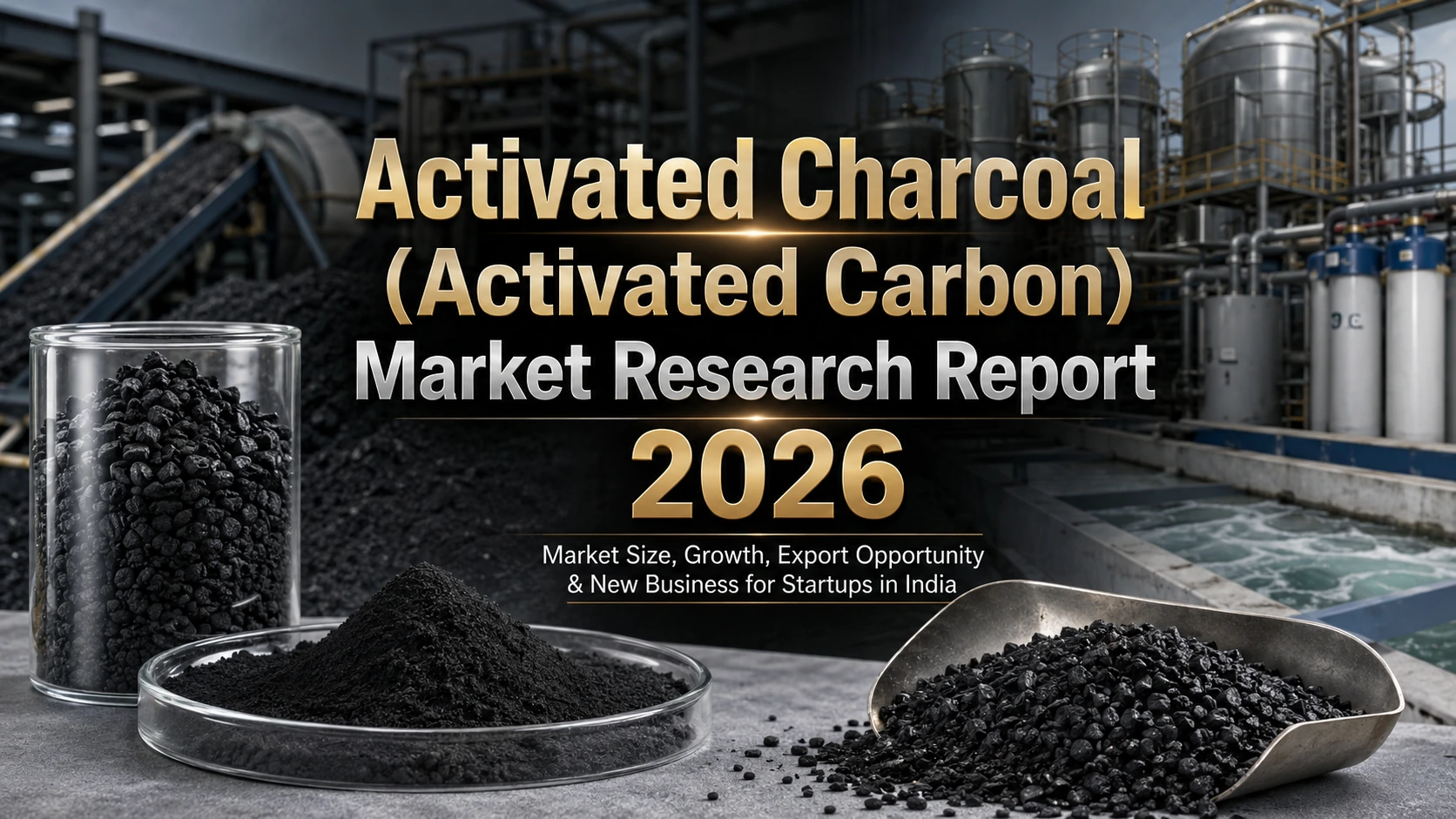
Activated Charcoal Manufacturing Business
In the rare case of manufacturing, India is not playing catch-up with activated charcoal; it is the world’s second largest producer, enjoying a home-grown advantage in raw materials, namely the coconut shell. Yet, the demand for water treatment, pharmaceuticals, and gold recovery is still strong, as is the opportunity for new Indian capacity – especially for exports – despite tight global feedstock supply and a rising international price.
What Is Activated Charcoal?
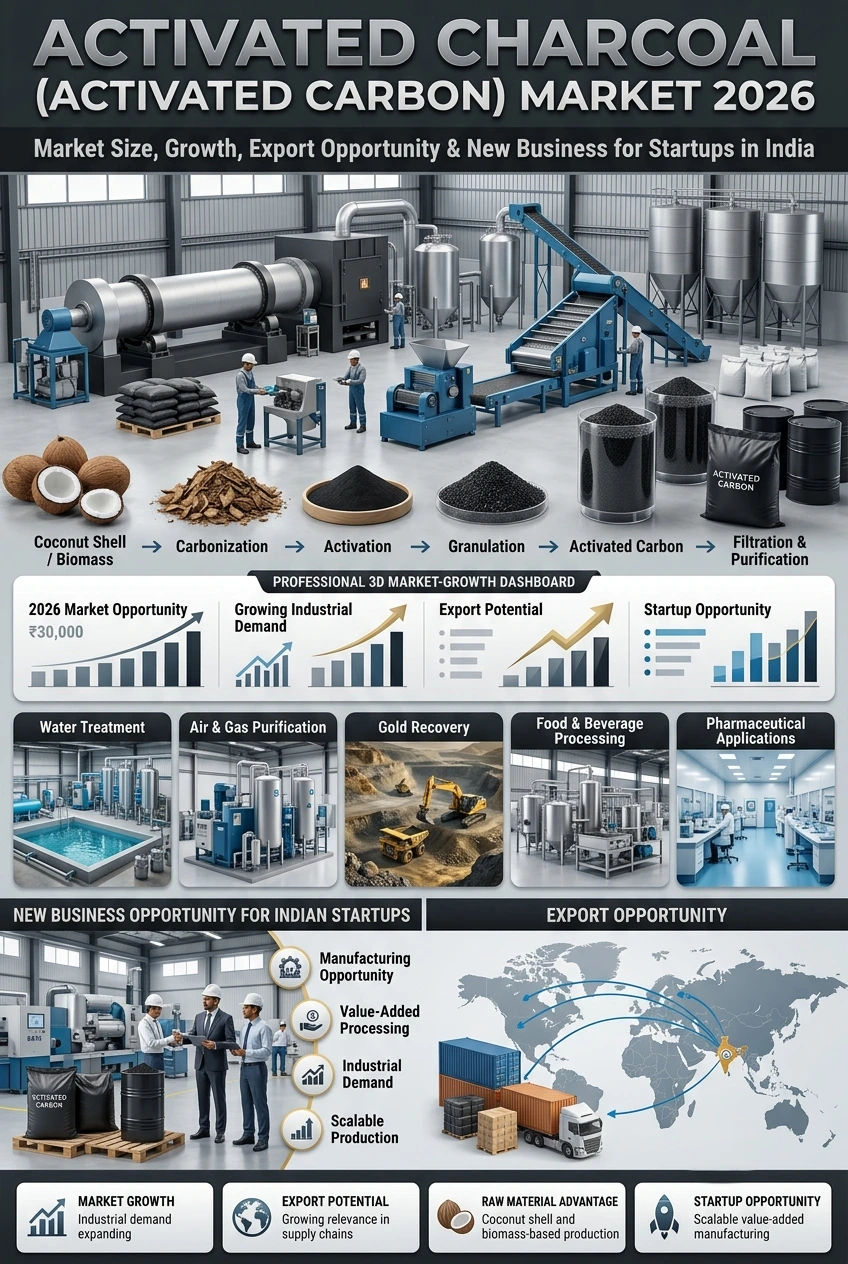
Activated charcoal, also known as activated carbon, is a highly porous form of carbon which has been treated to have an extremely high internal surface area with extremely strong adsorption properties. It is produced by carbonizing a carbon source raw material (coconut shell, wood, coal or other biomass) and then chemically activating or steam activation to create a lot of fine pores.
There are three main physical forms of activated carbon:
- Powdered Activated Carbon (PAC) – the finest form, which is used in water treatment, decolorization of food and beverages, and purification of pharmaceutical products, the largest product segment by revenue share in the world.
- Granular Activated Carbon (GAC) – Larger particles applied in fixed-bed filtration systems to municipal water treatment, gold recovery, and industrial gas-phase applications; the fastest-growing with municipal reactivation economics
- Extruded/Pelletized Activated Carbon – Extruded or pelletized from powdered carbon and a binder and typically found in gas-phase applications, such as automotive cabin filters and VOC recovery systems.
In the specific category of raw materials, coconut shell activated carbon is more valued than coal or wood activated carbon for its high hardness, porous structure and adsorption ability, which is the area where India enjoys a structural raw material advantage.
Access Complete Business Plan: Activated Charcoal Manufacturing Business
Global and India Activated Carbon Market Size and Growth
The estimates of market size by Global differ based on scope and methodology and range from approximately USD 4.1 – 9.3 billion in the base year of 2025 – 26 with projections of growth varying between USD 5.5 billion and USD 15.7 billion by the early 2030s, and at generally 4% – 14% CAGR.
India’s domestic market is relatively small in terms of value but its importance to this industry can be gauged by the number of products produced and exported, rather than their consumption value.In terms of value, India’s domestic market is estimated to be $254-376 million between 2024 and 2033, but in terms of numbers of products produced and exported, India’s importance to this industry is not justifiable by the value of the domestic market.
For the figures, note that, like most specialty materials categories, there are potentially significant variations in the values available in the literature, largely due to the scope of the studies (some analyses include activated carbon with a wider range of adsorbent materials). NPCS can provide an investor-grade number of a custom feasibility study for your target raw material (coconut shells vs. wood/coal) and product form (PAC vs. GAC).
India’s Distinctive Position: Net Exporter, Not Net Importer
In contrast, India’s production surplus in the segment of activated carbon is structural as opposed to most other segments in this series, where India is import dependent. The production of activated carbon in India is estimated to be about 436,000 tonnes per annum, while consumption is about 283,000 tonnes per annum, which makes India the second largest producer as well as a significant net exporter of activated carbon after China.
India’s exports of activated carbon and coconut-shell derived charcoal have also shown strong growth; this category’s coconut shell derived charcoal exports increased by 10.7% YoY to 117,368 MT and the export value increased by 22.5% to USD 225.7 million. Based on various reports, total activated carbon exports from India are estimated to be in excess of USD 240 – 330 million, making India the third largest exporter of activated carbon after China and the United States/Sri Lanka in various rankings.
Get Detailed Insights from This Book: Book
Policy Tailwinds
- Jal Jeevan Mission and expansion of municipal water treatment infrastructure: It is India’s massive water infrastructure programme for rural and urban areas, which is a significant domestic demand driver for activated carbon use in drinking water treatment to remove organics and pesticides.
- Coconut Development Board support: Coconut Development Board is a promotion body for value addition in coconut industry and supports the shift in export of raw coconut shell to the production of valuable activated carbon.
- Export promotion infrastructure: The port infrastructure in Mangalore, Tuticorin and Kochi have been made active to facilitate the export of activated carbon to the global market.
- BS-VI emission norms: India implementation of BS-VI vehicle emission norms has raised the demand for the pelletized activated carbon in automotive cabin air filter and fuel vapor emission control canister.
- Benefits eligible to manufacturing units producing activated carbon: The manufacturing of activated carbon is done using agro-residues, and is export oriented in nature, so various benefits are available for MSME and export promotion schemes.
India Demand-Supply Position: Activated Carbon
| Parameter | Current Position |
| Domestic production | ~436,000 tonnes annually |
| Domestic consumption | ~283,000 tonnes annually |
| Production surplus | ~153,000 tonnes — largely absorbed by exports |
| Global rank | World’s second-largest manufacturer (after China); third-largest exporter by value |
| Nature of the “gap” | Unlike most categories, this is a surplus, export-oriented position — the opportunity is capacity expansion for export and higher-value-added product grades, not import substitution |
| Raw material constraint | Coconut shell feedstock is the binding constraint — prices in India rose from roughly USD 551/MT to USD 983/MT between December 2024 and July 2025 amid regional supply tightness across India, Indonesia, Sri Lanka, and the Philippines |
Reading the position: The Indian situation is not the one of replacing imports; it is a need of having more capacity to tap the increasing global market which is structurally deprived of high-grade coconut shell activated carbon. The limiting factor is not demand or technology, it’s the availability and reliability of coconut shells in Tamil Nadu, Kerala and Karnataka in terms of long-term supply chains, or the ability of entrepreneurs to diversify into wood/agro-waste feedstock to overcome that challenge.
Major Indian Activated Carbon Manufacturers
| Company | Base/Region | Raw Material Focus | Notes |
| Boyce Carbon | India, Sri Lanka, and Southeast Asia (multi-site) | Coconut shell | Vertically integrated operations across water treatment, air purification, gold recovery, food & beverage, and pharmaceutical-grade carbon; strong export network across Asia Pacific, Middle East, and Africa |
| Indcarb Activated Carbon Pvt. Ltd. | India | Coconut shell | Recognised manufacturer; launched coconut-shell-based inline water filters in 2024 |
| Suneeta Carbons | India (South India) | Coconut shell | One of India’s largest activated carbon exporters |
| Raj Carbon | India | Coconut shell | Recognised Indian manufacturer specialising in high-quality coconut shell-based carbon |
| Active Char Products | India | Coconut shell | Recognised Indian manufacturer in the export-oriented coconut shell activated carbon segment |
| A large base of regional South Indian manufacturers | Tamil Nadu, Kerala, Karnataka | Coconut shell | Numerous small-to-mid-scale batch-kiln operations forming the long tail of India’s production base, closest to the entrepreneurial entry-point opportunity |
Major International Activated Carbon Players
| Company | Country | Notes |
| Kuraray Co. (Calgon Carbon) | Japan/United States | Major global activated carbon and specialty chemicals manufacturer |
| Osaka Gas Chemicals (Jacobi Carbons Group) | Japan (acquired Jacobi Carbons, Sweden) | Major global producer with strong coconut shell and coal-based carbon portfolios |
| Cabot Corporation (Norit brand) | United States | Global specialty chemicals company with a leading activated carbon brand |
| Haycarb (Pvt) Ltd. | Sri Lanka | Leading South Asian coconut shell-based activated carbon manufacturer and India’s closest regional competitor |
| Carbon Activated Corporation | United States | Recognised global activated carbon manufacturer and distributor |
| Evoqua Water Technologies | United States | Major water and wastewater treatment technology company with activated carbon applications |
| TIGG LLC | United States | Specialised activated carbon systems and reactivation services provider |
| Freeman Carbon Indonesia | Indonesia | Regional Southeast Asian coconut shell activated carbon producer, competing directly with India for global feedstock and export share |
Market Segmentation
By Raw Material
- Coconut shell (India’s core strength; premium hardness and pore structure)
- Coal (dominant in China; high-ash Indian coal is less suited to premium coal-based GAC)
- Wood
- Other agro-waste/biomass (emerging category)
By Product Form
- Powdered Activated Carbon (PAC) — largest segment by revenue share
- Granular Activated Carbon (GAC) — fastest-growing segment, especially for municipal reactivation systems
- Extruded/pelletized carbon — gas-phase and automotive applications
By Application
- Water treatment (municipal and industrial) — dominant application globally and in India
- Air and gas purification (including automotive cabin filters and VOC recovery)
- Food and beverage processing (decolorization, purification)
- Pharmaceutical and medical (activated charcoal capsules, wound dressings, dialysis)
- Gold and precious metal recovery (mining industry)
- Industrial process purification (textile dye effluent, sugar refining)
By End-Use Industry
- Municipal water utilities and Jal Jeevan Mission-linked infrastructure
- Automotive (emission control, cabin air filtration)
- Pharmaceuticals and healthcare
- Food and beverage manufacturing
- Mining (gold recovery)
- Textile and industrial effluent treatment
Key Growth Drivers
- Global feedstock scarcity favouring established coconut-growing regions. India, Indonesia, and the Philippines together contribute over 70% of global coconut production — with global demand for coconut shell activated carbon consistently outpacing supply, well-positioned Indian producers are structurally advantaged versus buyers relying on imported feedstock.
- Tightening water quality regulations globally. PFAS remediation programmes, mercury-removal mandates at coal-fired plants, and stricter drinking water standards in the US, EU, and domestically are driving sustained granular activated carbon demand.
- Jal Jeevan Mission and India’s own municipal water treatment buildout. The domestic market of India’s drinking water infrastructure development is a significant and increasing source of India’s domestic demand, apart from the export market.
- Emission norms for BS-VI and demand for automobiles. The use of pelletized activated carbon for vehicle emission canister keeps increasing as the number of vehicles being manufactured in India increases.
- Increasing demand for pharmaceutical and food grade. Domestic and export demand for food-safe and pharmaceutical-grade activated charcoal (capsules, medical-grade purification) have premium prices over regular industrial grade.
- Global price increases benefiting established Indian exporters. Coconut shell charcoal and activated carbon prices have risen sharply worldwide amid supply tightness — a dynamic that favours producers with secured feedstock supply chains and existing export relationships.
Related Article: Top 4 Manufacturing Opportunities in Drinking Water, Bamboo Charcoal, Aluminium Recycling & Rice Husk Biomass Pellets
Challenges and Restraints
- Feedstock price volatility and scarcity. Coconut shell prices in India have nearly doubled within a single year amid regional supply tightness — the single largest margin risk for manufacturers.
- Batch-to-batch quality consistency. Many Indian producers use small batch type of kiln instead of big computer-controlled kiln, resulting in an iodine number and hardness variance with potential competitive disadvantage against the bulk buyers from abroad who are looking for guaranteed specifications.
- Energy-intensive activation process. The high temperature activation step consumes a large amount of energy and is a major, fluctuating operating expense.
- Temporary raw material supply. The supply of coconut shell is dependent on the harvest schedule of the agriculture industry; with storage facilities or a wide variety of feedstock sources, this supply can be maintained.
- Competition of big scale Chinese processing. Despite the fact that the demand for coconut shell activated carbon is increasing, China is currently a major coconut shell activated carbon processor with minimal domestic coconut supply and importations of premium coconut shell feedstock for consistency of production on an industrial scale.
Competitive Landscape
The Indian industry of activated carbon is comprised of a handful of larger exporters who have a vertical integration (Boyce Carbon, Suneeta Carbons) and long tail of small-to-mid-scale regional manufacturers in Tamil Nadu, Kerala and Karnataka – states that are rich in coconut shell feedstock. This is because the Asian Pacific competitive environment is evolving in a manner similar to that of the Sri Lanka (Haycarb) and Indonesia (Haycarb) market, where both are competing with India for the same coconut shell feed and market, but China is industrially utilizing the imported shell feedstock to compete on consistency without having a domestic coconut source.
Activated Carbon Manufacturing: Business Opportunity for Startups and MSMEs
- Coconut shell activated carbon unit with secured feedstock contract. In fact, there is a structural advantage in the business if the entrepreneur can secure long-term coconut shell supply contracts in Tamilnadu, Kerala or Karnataka as it is a constraint that is binding across the industry.
- Exported, high consistency GAC production. Installing the more automated and computer-controlled activation technology (as opposed to batch kilns) can enable the delivery of premium export contracts with municipal water plants and gold mining companies that demand consistent hardness and iodine number specifications.
- Pharmaceutical/food-grade activated carbon. A specialised product line for pharmaceutical and food industry which is required to be higher margin and has different purity requirements compared to regular industrial grade production.
- Diversification of feedstocks using wood/agro-waste based activated carbon. Manufacturing capacity using alternative source of agro-waste feedstock (wood, agricultural residues) can offer a cushion and cater to customer segments that are not as premium with coconut.
- Reactivation/regeneration services. In recent years, municipal utilities have been more inclined to use GAC than PAC, and a regional reactivation service business will be a complementary, lower capital intensity opportunity to primary manufacturing.
Assumption flag: carbon manufacturing investment and margin figures are significantly different depending on the type of carbon activation (batch kiln versus continuous rotary furnace), raw material used and level of product grade. NPCS drafts Project Reports covering every detail which includes machinery list, feedstock sourcing strategy, financial projections for export market with technology specific to the target capacity and product grade.
How NPCS Supports Entrepreneurs Entering This Space
The first step for any businessman planning to start a business in the field of activated carbon manufacturing is to draw a Detailed Project Report (DPR), which should include aspects such as plant capacity, selection of activation technology, raw material sourcing strategy, manpower planning, project cost, and financial viability based on the product grade and target market (Domestic or Export).
About NPCS (Niir Project Consultancy Services)
Founded in 1994, NPCS is a techno-economic and project consultancy organization based in New Delhi, which is certified as an ISO 9001:2015 organisation and has more than 30 years of experience in the field of techno-economic and project consultancy. NPCS has been able to provide over 150,000 project reports and profiles to 85 countries over the past 33 years, representing almost every manufacturing and process industry, agro-based specialty carbon products and export-oriented manufacturing.
NPCS has three integrated platforms:
- niir.org — the primary repository of industry-specific Detailed Project Reports, business plans, and techno-economic feasibility studies
- entrepreneurindia.co — market research, project profiles, and manufacturing business opportunity content aimed at entrepreneurs and MSMEs
- npcsblog.com — industry insight, trend analysis, and manufacturing sector commentary
Relevant core deliverables of a carbon-activation project of NPCS are:
- Detailed Project Reports (DPRs) including plant capacity, machinery specifications and layouts.
- Feedstock sourcing studies and export-market guidance (techno-economic feasibility studies)
- Financial modelling – project cost, profitability analysis, ROI, break-even calculations
- Raw material and market evaluation related to the coconut producing areas and export markets
- Support documentation such as loan application documents for MSMEs, subsidy schemes, export promotion assistance, etc.
Entrepreneurs interested in this sector can download the pertinent activated carbon manufacturing profiles directly from niir.org and entrepreneurindia.co or can get a customized feasibility study for a particular raw material and product grade by calling us.
Discover business ideas that actually make money
Government and Institutional Reference Links
- Coconut Development Board, Ministry of Agriculture & Farmers Welfare
- Ministry of Micro, Small and Medium Enterprises (MSME)
- Development Commissioner, MSME (DCMSME)
- Directorate General of Foreign Trade (DGFT)
- Agricultural and Processed Food Products Export Development Authority (APEDA)
- Bureau of Indian Standards (BIS)
- Central Pollution Control Board (CPCB)
- Press Information Bureau (PIB), Government of India
- Startup India
- Invest India (National Investment Promotion and Facilitation Agency)
Entrepreneurs are advised to verify the latest Coconut Development Board schemes, export promotion norms, and MSME subsidy guidelines directly on these portals, as programme provisions are periodically revised.
Conclusion
Activated charcoal is an exception to most manufacturing opportunities that are highlighted in this series: India has already become a global leader in production and exports and has the real advantage of the local raw material. The opportunity for new entrants is not the elimination of an import dependency but the ability to capture more of a structural growth market of coconut shell activated carbon which is structurally limited by the ability to provide a consistent high-quality feedstock.
For entrepreneurs and MSMEs considering the investment in specialty carbon, the demand from water treatment, pharmaceuticals and worldwide industrial purification markets is an increasing opportunity given the activated charcoal’s unique export potential on the back of a genuine resource advantage for India, growing global prices and demand.


