

• Latest
  • Trending
  • All
Setting Up a Successful Vermiculture and Vermicompost Business

Setting Up a Successful Vermiculture and Vermicompost Business

April 24, 2025
Millet Processing Business in India

Millet Processing Business in India: Opportunities & Startups Guide

March 2, 2026
Polymer manufacturing business

How to Start a Profitable Synthetic Fibre & Polymer Manufacturing Business in India

March 2, 2026
Project & Profile
Maize processing plant in India producing starch, glucose and maize derivatives

Maize Processing Business in India: Investment, Profit & Startup Opportunities

March 2, 2026
High demand chemical manufacturing

High-Demand Chemical Manufacturing Projects for Automotive & Textile Industry (India)

March 2, 2026
Turmeric Processing Business India Plant Setup

How Profitable Is Turmeric Processing Business in India? Cost, Profit & Export Guide

March 2, 2026
petrochemical import substitution manufacturing plant in India

Top Petrochemical Products India Still Imports: MSME Import-Substitution Opportunities You Can Profit From

February 27, 2026
Why India Imports Sorbitol Despite High Maize Production – A Golden MSME Manufacturing Opportunity

Why India Imports Sorbitol Despite High Maize Production – A Golden MSME Manufacturing Opportunity

February 27, 2026
container manufacturing business in India factory under Budget 2026 scheme

Container Manufacturing Business in India: Budget 2026 ₹10,000 Cr Opportunity

February 27, 2026
Zinc Sulphate Manufacturing plant setup and production process

Zinc Sulphate Manufacturing Business in India: Heptahydrate vs Monohydrate, Market & Profit

February 27, 2026
EV Battery Materials Startup

EV Battery Materials & Critical Minerals: Startup Opportunities in India

February 27, 2026
Linear Alkyl Benzene LAB manufacturing plant used for detergent chemical production in India

LAB Manufacturing Business in India: ₹20,000 Crore Import Substitution Opportunity

February 26, 2026
downstream petrochemical manufacturing plant in India for MSME business

Top Investment-Ready Petrochemical Manufacturing Projects for MSMEs in India

February 26, 2026
  • About
  • Advertise
  • Privacy & Policy
  • Contact
Tuesday, March 3, 2026
  • Login
Entrepreneur India Blog
  • Home
  • About
  • Books
  • Business Ideas
  • Contact
No Result
View All Result
Entrepreneur India Blog
No Result
View All Result
Home Waste Management and Recycling Organic Waste Composting

Setting Up a Successful Vermiculture and Vermicompost Business

by admin
in Organic Waste Composting
0
Setting Up a Successful Vermiculture and Vermicompost Business
601
SHARES
1.7k
VIEWS
Share on FacebookShare on Twitter

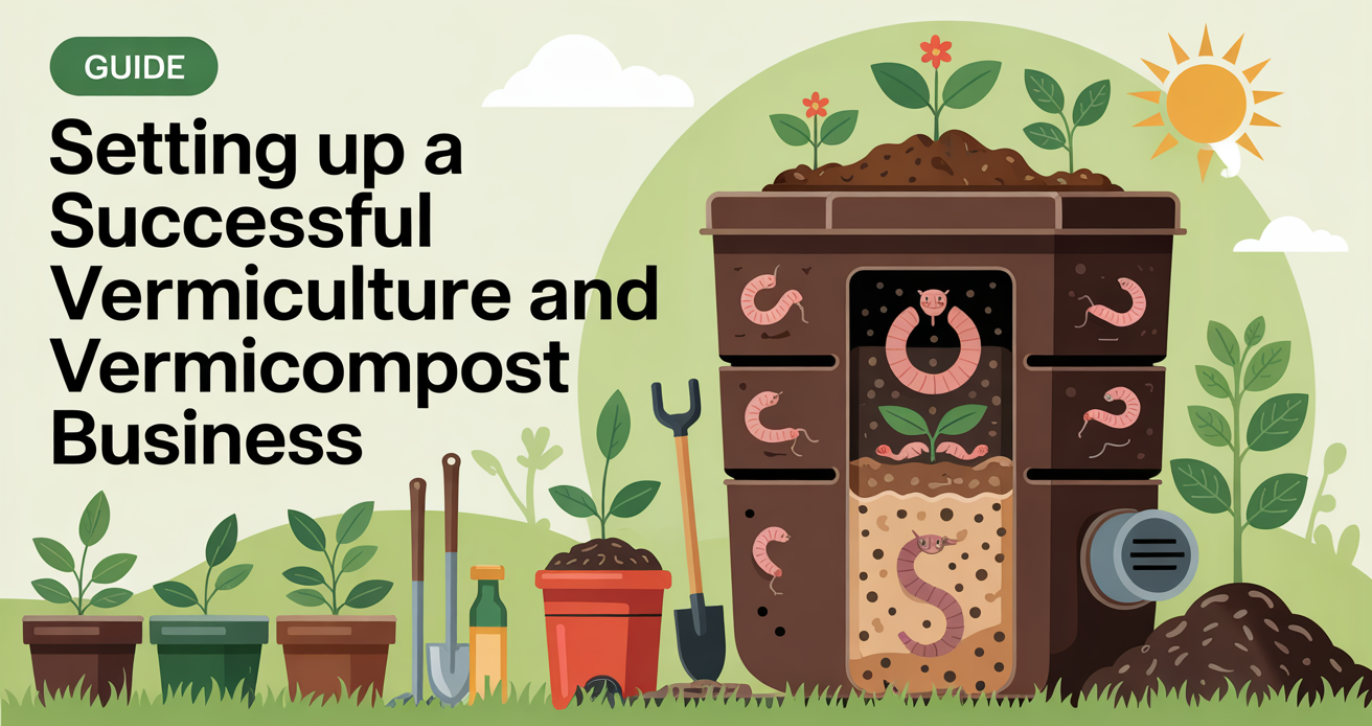
Starting a Vermiculture and vermicompost business is a safe and environmentally friendly way. It turns organic waste into good compost. Since it works on the needs and awareness of sustainable farming and organic gardening principles, the demand for vermicompost is large. The opening of a vermiculture business will also be a profitable and eco-friendly venture. The following guide will explore everything you need to successfully start your vermiculture and vermicompost business. 

Table of Contents

Toggle
  • Vermiculture and Vermicompost Business : Understanding
  • Beneficial Aspects of Vermiculture and Vermicompost Business
  • Step-by-Step Guide to Starting Your Business
  • Here is how to harvest
  • Packaging and Selling Your Vermicompost 
  • Expanding Your Business 
  • Challenges and Solutions
  • Concluding Thought

Vermiculture and Vermicompost Business : Understanding

Breeding farmed earthworms for composting or other agricultural uses is termed “vermiculture. 

Vermicomposting describes the process by which worms degrade organic matter into compost enriched with various nutrients. 

The product, called vermicompost, is quite valuable. It is an excellent enrichment and growth medium for both soil and plants. 

Beneficial Aspects of Vermiculture and Vermicompost Business

1. This practice reduces waste and improves the quality of soil health.

2. The minimum setup costs needed compared to other agricultural businesses.

3. Vermicompost is in high demand among organic farmers, gardeners, and plant nurseries.

4. The Quick reproduction of worms will always ensure continued production.

5. Very little space and work are required once properly set up.

6. Improved soil microorganisms and plant health. 

7. Move to synthetic fertilizer-free using chemicals for farmers and gardeners.

Step-by-Step Guide to Starting Your Business

Step 1: Choosing the Right Worms

There is more than one worm that can be utilized in vermicomposting. The most common species include the following:

Eisenia fetida (Red Wigglers) period.

Lumbricus rubellus

Mostly popular in tropical regions.

Step 2: Make the Vermiculture Bed

An excellent worm bed will be necessary for maintaining the health of your worms and the compost they produce. Follow the steps provided below:

1. Sensitization of the location – This should be an ideal shaded and moisture-controlled place.

2. Bins or pits—Glass, plastic, wooden crates, or ground pits are used, but they should have proper drainage.

3. Prepare bedding materials for the worms. Use shredded newspapers or coconut coir, dry leaves, or composted manure.

Step 3: Feed the Worms

Worms feed on organic waste, through which they survive and produce compost. Suitable food includes:

1. Scrapings of fruits and vegetables

2. Coffee grounds and tea leaves

3. Eggshells-crushed

4. Garden waste (leaves, grass clippings)

5. Paper products such as unbleached cardboard and shredded newspaper

Avoid feeding dairy products, oils, meats, and citrus peels, as they are harmful to worms.

Step 4: Feed the Worm Bed

1. Moisten it to make it moist: spray regularly to keep the moisture level right.

2. Aerate properly—Always turn the compost occasionally, or else it will smell foul and overheat.

3. Worm health check—See how they are doing in terms of distress signals: escaping worms or slow composting.

4. Protect from pests: Cover with fabric that allows breathability from flies and rodents.

5. Constant temperature—Keep in a narrow range between 15 degrees to 25 degrees Celsius for possible activity.

Step 5: Harvesting Vermicompost 

Your worms will be able to change the waste into rich black compost after about 2-3 months. 

Here is how to harvest

1. Stop feeding for 1 week – this way they will not take more time in finishing the present consumption.

2. Separate worms from compost – Place fresh food in one corner; worms will migrate, making collection easier.

3. Sieve the compost – Remove any large, undigested particles.

4. Store properly – Keep in a dry, breathable bag or container for packaging and sale. 

Packaging and Selling Your Vermicompost 

To make your vermicompost business successful, you need effective marketing strategies. Below are a few ways to sell your products:

1. Local Farmers and Gardeners – Give some samples for free to farmers or gardening enthusiasts. 

2. Nurseries and Plant Shops – Approach nurseries in your area to carry your products together with theirs. 

3. Online Platforms – Sell via e-commerce sites like Amazon, Etsy, and Facebook Marketplace. 

4. Agricultural Exhibitions and Farmers’ Markets – Join events where your compost will be showcased. 

5. Direct to Consumers – Start an organic gardener subscription service to provide regular supplies of compost. 

6. Collaborate with Government Programs – Many local governments are proponents of sustainable farming, and some may even want to offer grants or buy in bulk. 

7. Branding and Labelling – Beautifully packaged with clear instructions on using vermicompost will propel branding. 

Expanding Your Business 

After establishing your business in vermiculture, consider expanding in the following ways: 

  • Live worms for sale: A lot of people look around for composting worms to set up their home vermicomposting systems. 
  • Workshops – Setting up their vermicomposting systems by farmers and gardeners will be taught at these workshops. 
  • Compost-based products – Make liquid fertilizers, compost tea, and mixes for organic soil. 
  • Work with waste management services – Organic waste collected from households or restaurants and converted into compost. 
  • Organic farming: Grow vegetables and herbs organically for sale in the future with this compost. 
  • Export opportunities – Look for international markets in which organic compost is in high demand.

Challenges and Solutions

Like all enterprises, vermiculture has its share of challenges. Below are the most common problems in vermiculture and their possible solutions: 

1. Overfeeding and Odor Problems

Solution: Feed worms only what they can consume in a few days without adding too much wet waste. 

2. Worm Disappearance

Solution: Maintain moisture and create a comfortable living environment. 

3. Slow Decomposition

Solution: Balance each component in terms of food, moisture, and aeration. 

4. Seasonal Demand

Solution: Proper storage of compost while focusing on pre-selling bulk orders. 

5. Lack of Awareness

Solution: Educate potential buyers via blogs, social media, and local workshops. 

6. Countering Synthetic Fertilizers

Solution: Educate farmers regarding the sustenance and improvement of soil structure in the long term. 

Read our Blog: Sustainable Raw Material Sourcing for Manufacturing Entrepreneurs: Strategies and Supplier Networks

Concluding Thought

Commencing a business in vermiculture and vermicomposting is not only lucrative but also friendly to the environment. Knowing the right worms, setting them up properly, and marketing wisely will equip you with the ingredients for a viable and sustainable venture. By following the steps mentioned above, you are on the road to producing the high-quality vermicompost already in demand among farmers, gardeners, and agribusiness firms. Gradual business expansion and educating the customers on the benefits of vermicomposting will help you in building a brand in the organic farming landscape.

Tags: Agricultural SectorVermiculture and Vermicompost Business
Share240Tweet150
Previous Post

Key Infrastructure Projects That Are Transforming India’s Economy

Next Post

Challenges and Opportunities of Incorporating Natural Fibers in Textile Manufacture

admin

admin

Next Post
Challenges and Opportunities of Incorporating Natural Fibers in Textile Manufacture

Challenges and Opportunities of Incorporating Natural Fibers in Textile Manufacture

Leave a Reply Cancel reply

Your email address will not be published. Required fields are marked *

Contact Us

    Categories

    • AAC (Autoclaved Aerated Concrete) Blocks
    • Adhesives
    • agriculture
    • Agriculture & Agribusiness
    • Agrochemicals (Pesticides, Fungicides)
    • Alcoholic and Non-Alcoholic Beverages
    • Aluminium wire
    • animal food
    • API (Active Pharmaceutical Ingredients)
    • Automobiles
    • Automotive Coatings
    • Ayurvedic and Herbal Drugs
    • Ayurvedic Medicines
    • Bakery and Confectionery Products
    • Bee farming
    • Beer and Wine
    • Biodegradable Plastic Bags
    • Biodegradable Plates and Cutlery
    • Biodegradable Products
    • Biodegradable Straws
    • Bioethanol and Biodiesel Production
    • Biofertilizers and Biopesticides
    • Biomass Briquettes
    • Biotechnology
    • BOPP Fabric Roll
    • Bread and Buns
    • business
    • Business Ideas
    • Business Model
    • Butter and Ghee
    • Cakes and Pastries
    • candle business
    • Carton Boxes and Corrugated Sheets
    • Cement and Concrete Blocks
    • Chemical Industry
    • chemical packaging
    • Chemical Projects
    • cloud kitchen
    • CNG Industry
    • Cold Storage and Warehouse
    • Cold Storage for Fruits and Vegetables
    • Compostable Packaging
    • Construction & Building Materials
    • Cosmetic and Beauty Products
    • Cotton and Synthetic Fabrics
    • Dairy Farming
    • Disposable Products
    • Dry vegetable
    • Dyeing and Printing Units
    • E-Waste Recycling
    • Eco-Friendly Food Containers
    • Edible Cooking Oils (Soybean, Palm, Mustard)
    • Electronic Industries
    • Electronic Toy
    • Enzymes and Fermentation Products
    • Epoxy Resins & Adhesives
    • Essential Oils
    • Essential Oils
    • Ferroalloys
    • fine chemicals
    • Fish and Seafood Processing
    • Fish Farming
    • flour mill
    • food processing
    • Food Processing Industry
    • Franchise
    • Fruit Juices and Concentrates
    • Glass FIber Reinforced Polymers
    • Glass Industry
    • Green Energy
    • HDPE Barrels
    • Herbal and Natural Cosmetics
    • Herbal Powders
    • Herbs and Herbal-Based Products
    • Hospitality Sector
    • Ice Cream and Flavored Milk
    • Ice Cream Cones and Mixes
    • Industrial Chemicals
    • Industrial Wastewater Treatment
    • Iron and Steel industry
    • Khadi Manufacturing
    • LED Bulbs and Lighting
    • Liquid Milk Processing
    • Lithium-Ion Battery Manufacturing
    • Livestock Farming
    • Manufacturing
    • Manufacturing Business Ideas
    • market forecast
    • MDF (Medium Density Fiberboard)
    • Medical Sector
    • metal alloy
    • Milk & Dairy Products
    • News
    • Nutraceuticals and Dietary Supplements
    • Oils and Fats
    • Organic Waste Composting
    • Packaged Drinking Water
    • Packaging and Printing Industry
    • Paints Industry
    • Paper Industry
    • Perfumes and Deodorants
    • Plastic & Packaging Industry
    • Plastic Container
    • Plastic Packaging Materials
    • Plastic Waste Recycling
    • Plastics Projects
    • PMFME Scheme
    • Polyurethane Adhesives
    • Poultry Farming
    • Pre insulated pipes
    • PV Cell Industry
    • PVC Pipes and Fittings
    • Railway manufacturing
    • rare earth magnet
    • Ready-to-Drink (RTD) Beverages
    • Renewable Energy
    • Renewable Energy Sector
    • Rice husk
    • rice noodles
    • Rubber Products
    • Schemes
    • Skin Care Products (Creams, Lotions)
    • Solar Panel Manufacturing
    • Specialty Chemicals
    • spice
    • Spice business
    • Stained Glass
    • startups
    • Sugarcane
    • Synthetic Rubber Adhesives
    • Tata Chemicals
    • Textile Industry
    • Tiles and Ceramic Products
    • TMT Bars
    • Tyre Manufacturing
    • Uncategorized
    • Warehousing for E-commerce
    • Waste Management and Recycling
    • Water Industry
    • Water Purifiers and Filters
    • Wood and Wood Products
    • Wooden Furniture
    Entrepreneur India Blog

    Copyright © 2025 Entrepreneur India

    Navigate Site

    • About
    • Advertise
    • Privacy & Policy
    • Contact

    Follow Us

    Welcome Back!

    Login to your account below

    Forgotten Password?

    Retrieve your password

    Please enter your username or email address to reset your password.

    Log In
    No Result
    View All Result
    • Home

    Copyright © 2025 Entrepreneur India

    Are you sure want to unlock this post?
    Unlock left : 0
    Are you sure want to cancel subscription?
    No Result
    View All Result
    • Home

    Copyright © 2025 Entrepreneur India

    Are you sure want to unlock this post?
    Unlock left : 0
    Are you sure want to cancel subscription?
    Call Us
    Whatsapp