





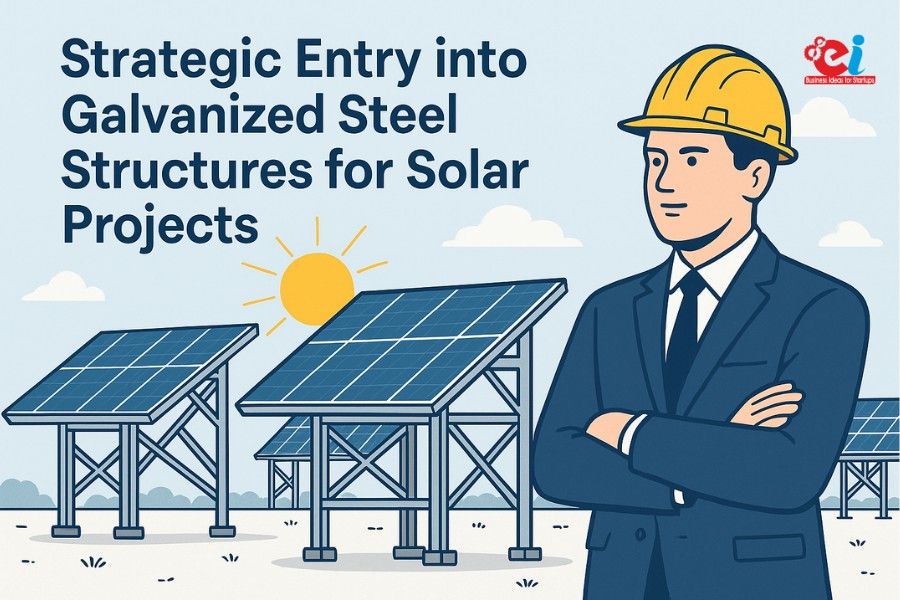
With the shift towards cleaner sources of energy, there is an unprecedented growth in the solar power industry. Globally, countries are adopting aggressive policies for expansion of renewable energy capacity, and as solar energy emerges as the most rapidly deployable and scalable source of energy, it is now the most preferred choice. Within that innovative ecosystem however, one area that is often ignored is Galvanized Steel Structures for Solar panel design and fabrication which could prove to be a goldmine.
These steel structures serve as the skeletal framework for any kind of solar installation, whether it is rooftop, ground mounted or floating systems. The demand for mounts that can withstand harsh weather, corrosion, and can stand the test of time fiercely is growing as solar farms continue to sprawl across rooftops, deserts, and agricultural lands. This provides a strategic opportunity for traditional metal fabricating units to diversify their operations and invest in a high growth, high margin business spring.
In this detailed article, we examine the complete value chain of Galvanized Steel Structures for Solar panel frameworks. We detail all aspects including raw materials, production processes, capturing demand dynamics, market growth potential, investment strategies, dealing with NPCS, and how these steps will help you transform this opportunity into a successful venture.
The Contribution of Galvanized Steel Structures for Solar panel
Wind loads, rainfall, UV radiation, and extreme temperature differences pose challenges for a solar power system’s support structure. Therefore, it requires something reliable and durable. Galvanized steel structures are the most commonly used support limbs because of their ability to combat corrosion, their durable structural strength and require little maintenance over time.
These structures are used as the substructure for solar PV modules while optimizing their sunlight exposure. For example, they are used in:
- Ground mounted utility scale solar farms
- Rooftop solar for residential, commercial and industrial users
- Grid off hybrid solar systems as well as other remotely located solar plants
- Agricultural solar fencing and floating solar arrays
Hot dip galvanization treats galvanized steel where the steel parts are dipped in molten zinc forming a protective rust proof layer. This treatment is ideal for solar projects that require more than 25 years of lifespan because it dramatically increases the life of steel under outdoor conditions.

Fabrication Businesses’ Case for Diversifying into Solar Infrastructure
For existing steel fabricators servicing the railways, telecom, industrial sheds, or construction, the diversification opportunity that comes with the fabrication of Galvanized Steel Structures for Solar panel mountings comes with minimal investment barriers and enormous potential returns.
The solar energy industry, in contrast to traditional markets, benefits from sustained government commitments as well as international climate obligations. India, for instance, aims to achieve 500 GW of non-fossil fuel energy capacity by 2030, with solar power alone accounting for over 280 GW. There is a perpetual demand from large infrastructure companies, EPC contractors, and renewable energy developers for dependable suppliers of galvanized structures that can meet tight deadlines, have large production capacities, and possess competitive pricing.
This allows fabricators to achieve better margins than what is offered through industrial standard fabrication. In addition, having exposure to this sector allows fabricators to broaden their market base, ensuring that they make continuous sales no matter the economic climate. With the added benefit of solar infrastructure being lightweight and modular, it requires lower levels of raw materials per unit value, enhancing material efficiency and profitability.
Specifications and Requirements of Raw Materials
The primary component of solar mounting structure fabrication is mild steel (MS) or structural steel, which is further protected by hot dip galvanization. Commonly referred to as IS 2062 or ASTM A36, these grades are used regionally or locally.
Main constituents are:
- Steel angle, channel or tube per design
- Cutting and welding supplies
- Maintaining Steel Trusses Galvanizing Baths, Pre-Treatment Plants, Pickling Tanks, and Flux Tanks are some of the other components needed for installation
It is also important to note that every part should adhere to standards such as IS 4759 and IS 2629 or ASTM A123 for international equivalence.
Galvanized Steel Structures for Solar panel Fabrication
Installation of solar panels is preceded by the fabrication of Galvanized Steel Structures for Solar panel, a process which allows for maximized scalability. The general steps for the same include:
Designing and Engineering
Determining the prerequisites such as kind of solar installation either ground mounted, carport or rooftop determines the primary components. CAD tools are extensively utilized for optimized detailing and parting.
Material Procurement and Cutting
Steel raw material in the form of long sections (angles, channels or hollow tubes) is procured and cut to the required sizes using band saws, plasma cutters or CNC machines.
Welding and Assembly
Components are, where necessary, welded using MIG or TIG processes. In batch production, Jigs and fixtures are used to maintain repeatability.
Drilling and Punching
Precision holes are drilled or punched to enable the use of bolts, nuts, or interlocking joints as specified by the structural design. Accurate onsite assembly requires precision.
Surface Treatment and Galvanization
Pickling (acid treatment) is used to clean the fabricating parts to remove impurities and rust. After pickling, the parts are galvanized by dipping them into zinc and afterwards quenched, cooled, then inspected for coating thickness, surface finish, and rust. Mild steel components are treated after undergoing hot-dip galvanization.
Quality Inspection and Packaging
Inspection of each lot is done to test the physical strength, adhesion test, measuring the coating thickness with magnetic gauges, and testing for dimensional accuracy. Certified parts are then prepared and packed for dispatching to the site of installation.
Modular and Pre-assembled strategies aid in offsite pre-fabrication of structures, therefore a larger focus on ease of site labor and installation time allows some fabricators to offer pre punched bolt on solutions.
Related: Profitable Hot Dip Galvanizing Business: A Lucrative Startup Opportunity
Establishing A Galvanized Steel Fabrication Unit: Overview of Investments
Setting up a unit for Galvanized Steel Structures for Solar panel requires an appropriate plant, availability of skilled manpower, and reliable suppliers for raw materials.
NPCS as they are popularly known mentioned that the two medium scale units needs an investment of ₹6 crore to ₹12 crore depending on land costs and plant automation in a NPCS feasibility report. This range is for a galvanizing and fabrication unit capable of 2000 to 3000 MT per year.
As NPCS of Niir Project Consultancy Services has provided each radius of investment is bound to have some specific goals to be achieved.
- CNC punch and cut machine
- Fabrication yard and galvanizing area of at least 2 acres
- Taps and drills for welding, assembly tools, and galvanizing plant equipment
- Zinc bath accompanied hot dip galvanizing furnace, pickling tanks
- Cranes and Trolleys for easier material transportation
- Power connection along with ETP, lighting infrastructure, and plant for effluent treatment
NPCS project reports include detailed breakdowns of costs, estimating five years of return on investment including valuable cost-benefit analysis.
Market Demand, Clients, Growth Trends
By 2030, the Asia Pacific region will be leading global growth in the solar mounting systems market, which is projected to exceed USD 20 billion. India alone will require over 6 million metric tonnes of mounting structures to attain its solar power goals by 2030. The demand can be attributed to:
- Farmers’ solar scheme under PM-KUSUM and government solar park tenders
- Commercial and industrial C&I rooftop solar installations
- Urban development plans mandating solar rooftops on public buildings
- Foreign solar projects looking to outsource to Indian suppliers due to competitive pricing
Potential clients encompass:
- Renewable energy EPC contractors
- Solar modules manufacturers
- Govt. agencies and PSUs
- Infrastructure companies
- Export clients particularly in the Middle East and Africa
Possessing ISO certification, galvanization quality reports, and experience in solar structure fabrication improves chances of vendor registration with these clients.
Financials, Profit Margins
Cost management, material utilization, and project timelines are critical factors that influence profitability for a business. Furthermore, well run units with a clear order pipeline stand to set EBITDA margins of 12–20%.
For a plant with a capacity of 3,000 MT per year, sample financials are as follows:
- Total Revenue Potential: ₹35–₹40 crore/year
- Net Profit: ₹4–₹6 crore/year
- ROI: 18%–24%
- Breakeven Point: Within 3–4 Years
NPCS project reports detail financial modeling including cost heads of raw material, labor, power, consumables, depreciation, and marketing. This allows businesses to effectively plan working capital and funding requirements.
Government Assistance and Support
The Indian government offers several incentives as well as specific schemes for the aid of the steel fabrication and renewable energy sectors. The MSMEs in this segment will benefit from:
- Subsidized Loans from CGTMSE and PMEGP
- Capital Subsidies for Solar Manufacturing from the MNRE
- Export Subsidies like RoDTEP
- GST exemption privileges and preferential lending from the bank
Along with these, compliance with PCB, Factory Act, Zinc effluent limits, and BIS norms are compulsory. NPCS aids with licensing, scheme documentation, ETP setup, salt purification plants, and statutory licensing.
Branding, Marketing, and Growth Strategy
Investment in professional branding (case studies, brochures, catalogs) and a digital footprint (Wikipedia, B2B portals, and LinkedIn) is critical in helping propel businesses forward in solar fabrication.
Exposure through solar expos such as Intersolar and REI India can further help with bolstering recognition. Public as well as Private water EPC vendors require vendor registration too.
NPCS offers new entrants not only DPRs but also consulting services in marketing strategy and buyer linkage. NPCS DPRs are inclusive of competition mapping, export entry strategizing, planning for emerging markets, and SWOT analysis.
Final Thoughts: Shaping the Solar Future with Steel Inclusive of Strategic Diversification
Expanding into Galvanized Steel Structures for Solar panel Projects is a strategic goldmine for fabrication companies. As industry experts predict Galvanized Steel Structures for Solar panel will be the dominant investment in the power sector over the next two decades, developing capabilities in this area ensures sustainable growth, relevance, and profitability.
The high degree of modularity due to changes in technology, design evolution, persistent market demand, and business modularity makes it a formidable addition to any steel fabrication portfolio. Fab industry optimizing this booming sector need the expertise of Niir Project Consultancy Services to navigate the entry and excel with confidence.
Niir Project Consultancy Services – Waiting to Partner with you from Project Planning to Execution, Operational Efficiency and Profitability.


