




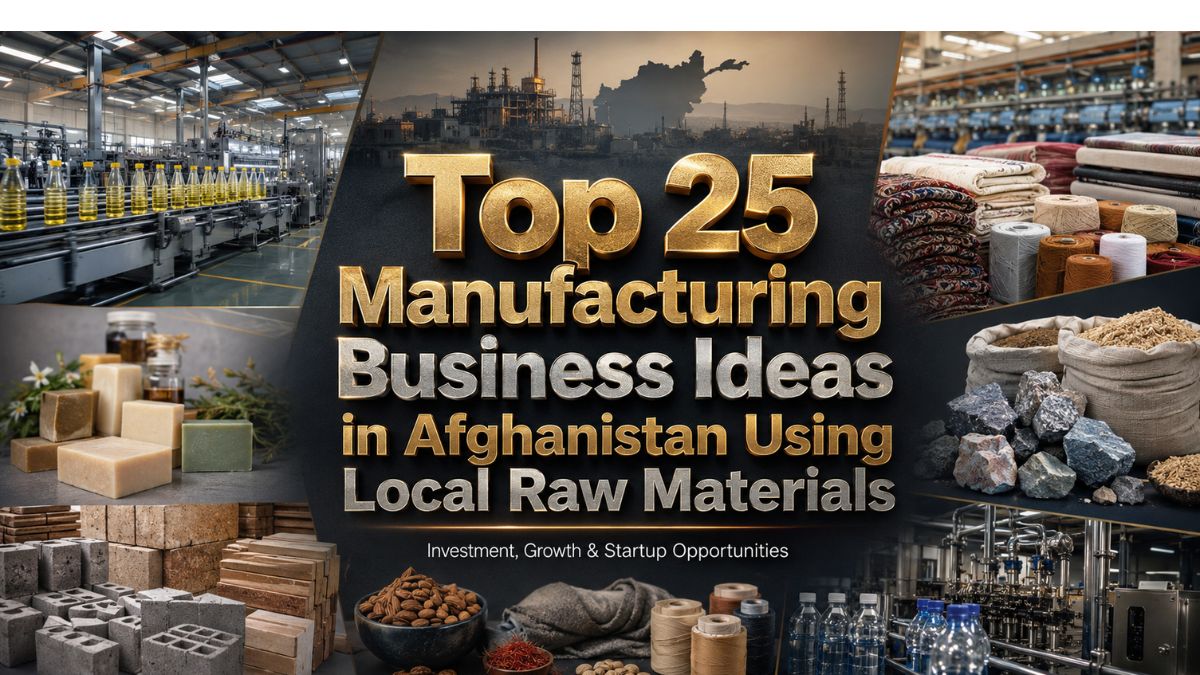
Manufacturing Business Ideas in Afghanistan
The United States Geological Survey (USGS) estimates that Afghanistan has mineral resources worth more than USD 1 trillion. The country has the world’s biggest untapped lithium reserves, the metal at the heart of all batteries, all electric vehicles, all grid-scale energy projects on earth. It also contains copper, iron ore, rare earth elements, chromite and an abundance of marble to cover half of the buildings in Asia. Then there’s saffron — Afghan saffron, which consistently ranks at the top in international quality tests, and fetches ₹3 to ₹5 lakh per kg in good markets.
However, the nation imports processed products which it has the right to make at home. The dried fruits are sold in the raw. Marble is not polished but it is quarried. Saffron is exported in bulk from the country, not as retail packs. The export of Cashmere is in the form of fleece, not in the form of yarn.
It’s not a tale of a nation in conflict. It is a tale of raw material surpluses that come into balance with manufacturing deficits. The business opportunity is this gap between what is in the ground and what is sold as finished goods. It is real, it is specific and it is measurable.
The 25 business ideas presented in this article are based on Afghanistan’s real possibilities and potential. They can all be initiated using local raw materials and most are able to be converted into export quality operations in 3-4 years after production.
A Market Gap the Size of a Mountain Range
According to the Afghanistan Central Business Registry (ACBR), the import expenditure for Afghanistan is around USD 2.5 to 3 billion each year. Much of this consists of processed food, fabrics, building materials, chemicals and packaging, which the nation can make on its own. The raw materials are at hand. There is adequate labour, and it is not too expensive. The missing link is the manufacturing infrastructure to transform inputs into finished sale-ready products.
Take dried fruits as one example, for instance. The Food and Agriculture Organization (FAO) of the United Nations ranks Afghanistan as one of the five largest producers of raisins, apricots, and almonds in the world. However, processing facilities, such as sorting lines, grading equipment and food-grade packaging are still very limited. The outcome: Bulk export price of Afghan raisins is USD 0.80 to USD 1.20 per kg and in international retail market the same raisins in cleaned, graded and packed form are USD 3.50 to USD 5.00 per kg. This is a 3-4x value uplift on a sorting table.
The story of cashmere is very similar. The fleece of Changthangi and Khorasan goats from Afghanistan is of raw quality similar to Mongolian cashmere. The fleece is traded with traders at rates lower than market rates before they are sent to Pakistan, China or Iran for processing. Finally, the completed product of yarn and fabric would be imported back to the Afghan market.
The increased demand for bricks, marble tiles, stone blocks in the reconstruction process is beyond the capabilities of local producers. The urban centres are growing rapidly, such as Kabul, Mazar-i-Sharif and Kandahar. Cement and stone (marble, structural bricks) are being loaded-in from Pakistan and Iran, if local deposits are available.
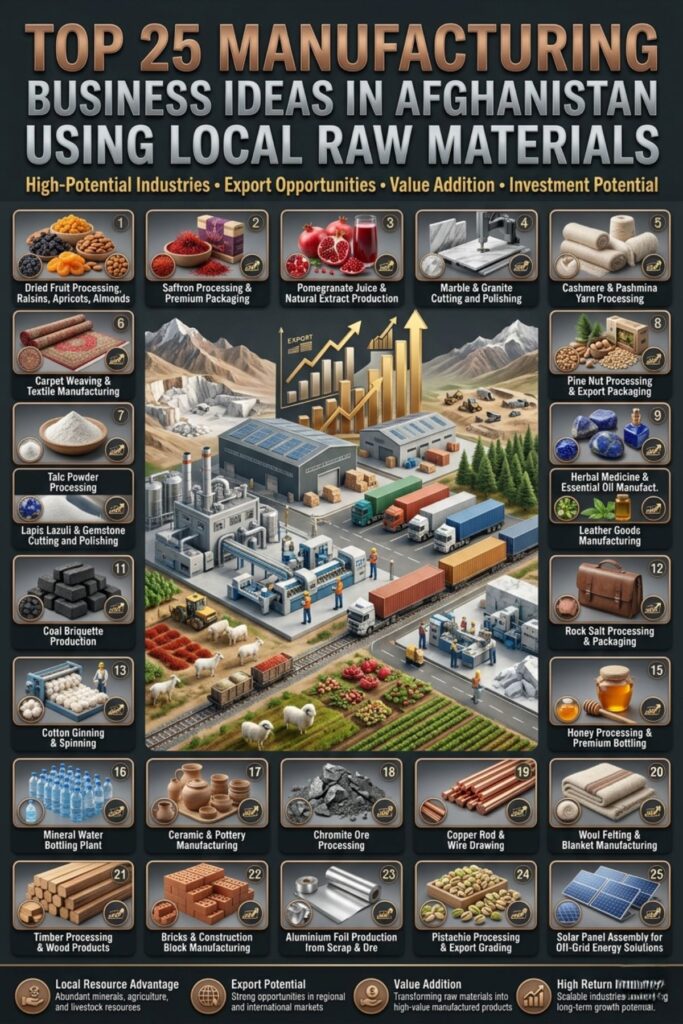
This is repeated for minerals, food, textiles, and energy. The gap is not one business idea – it’s twenty-five – and the table below correlates each idea with its raw material, its investment and the margins it can reasonably expect to earn.
Related Article: Best Import Substitution Industries in Afghanistan
Table 1: Top 25 Manufacturing Business Ideas in Afghanistan — Overview
| # | Business Idea | Primary Raw Material | Min. Investment (INR) | Gross Margin | Market Demand |
| 1 | Dried Fruit Processing (Raisins, Apricots, Almonds) | Grapes, apricots, almonds (local) | ₹25–50 lakh | 28–35% | Very High (global export) |
| 2 | Saffron Processing & Packaging | Raw saffron (Herat, Balkh region) | ₹15–30 lakh | 35–50% | Very High (premium export) |
| 3 | Pomegranate Juice & Extract | Fresh pomegranates (Kandahar region) | ₹30–60 lakh | 25–32% | High (health food segment) |
| 4 | Marble & Granite Cutting / Polishing | Raw marble & granite (Helmand, Kunar) | ₹80 lakh–1.8 cr | 22–30% | High (construction boom) |
| 5 | Cashmere / Pashmina Yarn Processing | Raw goat fleece (northern highlands) | ₹50 lakh–1.2 cr | 30–40% | Very High (luxury textiles) |
| 6 | Carpet Weaving & Textile Mfg. | Wool, silk (local flocks) | ₹20–45 lakh | 25–35% | High (traditional export) |
| 7 | Talc Powder Processing | Raw talc ore (Laghman, Nangarhar) | ₹40–90 lakh | 20–28% | High (pharma, cosmetics) |
| 8 | Pine Nut Processing & Packaging | Wild pine nuts (Nuristan, Paktia) | ₹20–40 lakh | 30–42% | Very High (premium snack) |
| 9 | Lapis Lazuli & Gemstone Polishing | Raw lapis (Badakhshan), emeralds | ₹15–35 lakh | 40–60% | High (jewellery market) |
| 10 | Herbal Medicine & Essential Oil | Fennel, liquorice, senna, cumin (wild) | ₹25–55 lakh | 28–38% | High (Ayurveda, pharma) |
| 11 | Coal Briquette Manufacturing | Raw coal (Samangan, Baghlan region) | ₹35–70 lakh | 18–25% | High (domestic energy) |
| 12 | Leather Goods Manufacturing | Animal hides (local slaughterhouses) | ₹30–65 lakh | 22–30% | Moderate–High |
| 13 | Cotton Ginning & Spinning | Raw cotton (Kunduz, Baghlan region) | ₹1–3 cr | 15–22% | High (textile supply chain) |
| 14 | Rock Salt Processing & Packaging | Rock salt (Badakhshan, Takhar) | ₹10–25 lakh | 25–35% | Moderate–High |
| 15 | Honey Processing & Packaging | Raw honey (mountain apiaries) | ₹10–20 lakh | 30–45% | High (health + export) |
| 16 | Mineral Water Bottling | Underground spring water | ₹40–80 lakh | 20–28% | High (urban centres) |
| 17 | Ceramic & Pottery Products | Local clay deposits (Istalif, Ghazni) | ₹25–50 lakh | 22–30% | Moderate |
| 18 | Chromite Ore Processing | Raw chromite (Logar, Wardak region) | ₹1.5–3.5 cr | 18–26% | High (steel industry) |
| 19 | Copper Rod & Wire Drawing | Raw copper ore (Aynak deposit, Logar) | ₹2–5 cr | 14–20% | Very High (electrification) |
| 20 | Wool Felting & Blanket Mfg. | Raw sheep wool (local flocks) | ₹15–35 lakh | 20–28% | High (domestic + export) |
| 21 | Timber Processing / Wood Products | Walnut, cedar timber (Nuristan) | ₹50 lakh–1.2 cr | 18–25% | Moderate–High |
| 22 | Bricks & Construction Blocks | Clay soil, limestone (widespread) | ₹20–50 lakh | 18–24% | Very High (reconstruction) |
| 23 | Aluminium Foil from Scrap + Ore | Bauxite deposits + scrap metal | ₹1.5–3 cr | 15–22% | High (packaging sector) |
| 24 | Pistachio Processing & Grading | Wild pistachios (Badghis, Faryab) | ₹20–45 lakh | 28–38% | Very High (premium nut export) |
| 25 | Solar Panel Assembly (Off-Grid) | Locally sourced aluminium frames | ₹1–2.5 cr | 16–24% | Very High (energy deficit) |
Note: Investment figures are in INR and represent small-to-medium scale start-up capital. Gross margin ranges assume 60–80% capacity utilization. Figures are indicative.
Eight Ideas Worth Studying Closely
This is just a summary of the possibilities and can be extensive. However, eight ideas have been identified that show potential for a combination of raw materials, export opportunities, and relatively short payback periods.
1. Saffron Processing & Packaging
Afghanistan is one of the biggest producers of saffron with more than 20 tonnes of production annually, mainly in Herat province, according to the International Trade Centre (ITC). Flower is collected in October once a year. The price of raw saffron is ₹2-3 lakh per kilogram. The same kilogram is worth of ₹4-6 lakh when it is dried, tested and packed under a brand. The processing unit needs little investment – between ₹15 lakh and ₹30 lakh – and lots of accuracy – ISO 3632 graduation standards, moisture test, vacuum-sealed packing. Margins of 35-50% can be achieved on a scale.
2. Dried Fruit Processing
This is the biggest volume opportunity of this list. Afghanistan’s primary agriculture export by weight is a combination of raisins, apricots, figs and almonds. A medium scale processing unit (grading lines, solar dryers, food grade storage and automated packages) can be set up at a cost of ₹35–55 lakh and it can process 800 to 1,200 kg of finished product per day. Gulf, European and Indian export markets are well-developed.
Get Detailed Insights from This Book: Handbook on Fruits, Vegetables & Food Processing with Canning & Preservation (3rd Edition)
3. Marble & Granite Cutting and Polishing
The estimated deposit of Afghanistan is over 1 billion tonnes of marble. There is virtually no processing done on the marble, and it is sold to the Pakistani traders who cut and polish it and then re-export as finished slabs and tiles. The cost of a diamond wire cutting plant with polishing heads and edge trimming machine ranges from ₹80 lakh to ₹1.8 crore. Final product is sold 2.5x to 4x the price of raw block. This is a business that can be profitable within 4-6 years due to construction demand within Afghanistan and export to the Gulf markets.
4. Cashmere / Pashmina Yarn Processing
The region of Wakhan Corridor and the highlands of the Hazara are natural cashmere belts. The fibre of Afghanistan goats has tested at 15-17 microns which is the luxury grade range. The cost range of a dehairing and spinning unit is from ₹50 lakh to ₹1.2 crore depending on the capacity. When there is a consistent quality certification, export to luxury textile companies in Europe and Japan is possible. It is a reasonable expectation to achieve net margins of 30–40% per kilogram of finished product in yarn.
5. Pine Nut Processing & Packaging
Wild pistachio and pine nut trees grow at the best known in the forests of Afghanistan, mostly in Nuristan, Paktia and Khost, yielding nuts of superior quality and size. The current production is sold out on informal trader network without much value adding. The cost of a basic shelling, roasting and grading facility is from ₹20 to 40 lakh. The packaged pine nut is sold at ₹2,500 to ₹4,000 per kg in international markets. The gross margin on a finished, packaged product is 30–42%.
6. Talc Powder Processing
Talc deposits are present in Laghman and Nangarhar province of Afghanistan. Talc powder is employed in pharmaceuticals, cosmetics, ceramics and plastics. It is imported to South Asian markets in high volumes. Crushing, milling and micronizing plant for production of Talc for pharmaceutical grade depends on the mesh fineness required and is priced around ₹40–90 lakh. An investor should anticipate a large premium for pharmaceutical talc over the industrial grade as revealed in Indian Minerals Yearbook data from the Indian Bureau of Mines.
7. Gemstone Polishing — Lapis Lazuli
Badakhshan’s lapis lazuli is one of the best in the world and has been extracted for more than 6000 years. Currently, exports are predominantly in raw or rough-cut products. A lapidary shop equipped with lapidary cutting, polishing and grading machine ranges from ₹15–35 lakh. The difference in value between rough lapis and set of graded, polished and certified stones can be as much as 400-600%. These unit economics are peculiar: low volume, high margins per piece, and high collector demand in the world.
8. Herbal Extracts & Essential Oils
The wild plants of Afghanistan are liquorice, one of the largest natural reserves of the world, fennel, senna, valerian and cumin. The cost of steam distillation plants and solvent extraction plants for essential oil and standardised herbal extracts are from ₹25–55 lakh. Indian, European and Middle Eastern markets for Ayurveda, nutraceutical and aromatherapy products are active buyers of authenticated and traceable Afghan botanical extracts. The Spices Board India offers market development and export facilitation assistance to Indian and overseas buyers of botanical extracts manufacturers.
Access Complete Business Plan: Cosmetics, Perfumery Compounds, Flavours & Essential Oils
How to Set Up a Manufacturing Unit in Afghanistan: A Step-by-Step Guide
The following is a list of agro-processing and light manufacturing enterprises that may use the set-up pathway described here.
- Choose your sector and confirm raw material supply: Before any capital is deployed, spend 4–6 weeks mapping your raw material supply chain.
- Register your business: Register your business with the Ministry of Commerce and Industry at the Afghanistan Central Business Registry (ACBR). The time it takes to register a limited liability company (LLC) is usually 5–10 working days. Commercial Registration (Trade Licence) is also necessary from the Ministry of Commerce. Apply for a Tax Identification Number (TIN) with Afghanistan Revenue Department.
- Availability of land and infrastructure: Lease of industrial land in the industrial and special economic zones (SEZs) around Kabul, Jalalabad and Mazar-i-Sharif. A small processing unit requires 1,500-3,000 sq. ft of covered space.
- Source machinery: For most agro-processing units, Indian-manufactured machinery from clusters in Coimbatore, Pune, and Rajkot is both cost-effective and serviceable from India.
- Obtain required clearances: Food processing units need clearance from the National Standards Authority of Afghanistan (ANSA). Mineral processing units need a processing licence from the Ministry of Mines and Petroleum.
- Train and hire workers: It takes 8–15 workers to get a small processing unit going.
- Timeline to first production: If you’re a well-funded and well-planned unit, you’ll be at first production in 5-8 months.
Table 2: Investment Breakdown — Dried Fruit Processing Unit (Representative Example)
| Cost Head | Small Scale (₹) | Medium Scale (₹) | % of Total (Med.) |
| Land & Civil Construction / Shed | 3,00,000 – 5,00,000 | 8,00,000 – 12,00,000 | 18–22% |
| Sorting, Grading & Drying Machinery | 4,00,000 – 7,00,000 | 12,00,000 – 18,00,000 | 28–32% |
| Packaging Line & Sealing Equipment | 1,50,000 – 3,00,000 | 4,00,000 – 6,00,000 | 9–11% |
| Cold Storage Unit (optional at small scale) | — | 6,00,000 – 9,00,000 | 12–16% |
| Raw Material (First Purchase, 3-Month Stock) | 2,50,000 – 4,00,000 | 6,00,000 – 8,00,000 | 12–15% |
| Working Capital (Wages, Power, Consumables) | 2,00,000 – 3,00,000 | 5,00,000 – 7,00,000 | 10–13% |
| Contingency & Pre-operative Expenses | 1,00,000 – 1,50,000 | 2,50,000 – 3,00,000 | 5% |
| TOTAL ESTIMATED INVESTMENT | ₹14–23 lakh | ₹43–63 lakh | 100% |
Note: All figures in INR. Small scale = 200 kg/day output; Medium scale = 800 kg/day output. Figures assume leased land.
Financial Snapshot: What the Numbers Actually Look Like
Monthly operating cost: ₹4.5-6.5 lakh of which raw material is 50%, power is 20%, labour (12-15 workers) is 15%, packaging material is 10% and transport is 5%.
Revenue at 60% capacity: About ₹28-35 lakh/month on the basis of 480 kg/day finished packaged raisins and almonds with an average export price of ₹200-250/kg.
Revenue at 100% capacity: ₹48-60 lakh per month.
Gross margin: 28–35% at 60% utilisation; 33–40% at full capacity.
Net margin: 18-24% at full capacity with all operating cost, depreciation and working capital charges.
Average capacity: 70% Payback period: 3.5 – 5 years. Per-unit margins for saffron or gemstone are higher and thus can be recovered in 2.5-3.5 years.
Discover business ideas that actually make money
Table 3: International & Government Support Programmes for Afghanistan Manufacturing Units
| Scheme / Programme | Administering Body | Key Benefit | Eligible Sectors |
| AREDP (Afghan Rural Enterprise Dev. Programme) | MRRD / UNDP | Grants up to USD 15,000 + business training for rural SMEs | Agro-processing, handicrafts, food |
| AISA Investment Support | Afghanistan Investment Support Agency | One-window licensing, tax holidays up to 7 years | All manufacturing sectors |
| WFP-LIFT Agri Value Chain | World Food Programme / Govt. | Equipment grants + market linkages for food processors | Dried fruit, nuts, dairy, cereals |
| IFC SME Financing (MSME Window) | IFC / World Bank Group | Low-interest loans up to USD 500,000 | Export-ready SMEs, agri-business |
| USAID ASAP (Agriculture) | USAID / DAI | Technical assistance, certification support, equipment grants | Horticulture, value addition |
| UNCTAD EMPRETEC Programme | UNCTAD / Local Chamber | Entrepreneur capacity building; international trade networks | All export-oriented sectors |
| National Solidarity Programme (NSP) CDCs | Ministry of Rural Rehab. | Community Development Council grants for local production units | Handicrafts, construction material, food |
Note: Scheme availability and grant sizes are subject to programme funding cycles. Always verify current status with the relevant administering body.
Need a Detailed Project Report Before You Invest?
Any of the manufacturing units listed here would be a good starting point for any entrepreneur who is currently considering doing business in that area. With 45 years of experience, NIIR Project Consultancy Services (NPCS) is one of the most well-established industrial consultancy firms in India that specialize in creating detailed project reports (DPRs) and techno-economic feasibility studies for manufacturing industries such as agro-processing, mineral beneficiation, textiles, and construction materials, as well as plant layout designs. Their reports include estimates of capital costs, specifications of machines, raw material sourcing plans, financial forecasts, and regulatory road maps. A list of resources can be found at niir.org and entrepreneurindia.co.
What You Should Do Next
The window of manufacturing in Afghanistan cannot remain open indefinitely. The pioneers – who build processing facilities in the present period – will have material contracts, supplier relationships and export markets established long before the next set of investors will. Country data for Afghanistan from the World Bank repeatedly states that the manufacturing gap is perhaps the easiest structural weakness of the Afghan economy to solve. Choose a single sector. Commission a solid feasibility study. Lock down your raw material supply chain before you buy one machine. Then execute.
The opportunity does not need a pitch. It needs a decision.
Frequently Asked Questions
Q1. What is the minimum investment required to set up a manufacturing unit in Afghanistan?
The minimum practical starting capital required varies hugely depending on the sector. A saffron packaging unit or honey processing unit may be set up for 10-20 Lakh. A marble cutting plant or cotton ginning unit will demand 80 Lakh to 2 Crore. Specific investment ranges are included for all 25 manufacturing concepts on this list in Section 2 below.
Q2. What kind of licenses are required for a manufacturing setup in Afghanistan?
A basic requirement for any business is an ACBR company registration, a Trade License issued by the Ministry of Commerce, and a Tax Identification Number. Any food processing unit requires additional approval from the ANSA. Any mining related processing unit will additionally require a separate processing license from the Ministry of Mines and Petroleum.
Q3. Are there government or international funding available?
Several schemes are currently in operation, including the AREDP grants of up to USD 15,000 for rural businesses, USAID’s ASAP program to support the horticulture value chain with technical assistance and equipment, and the IFC’s SME financing window which supports export-ready manufacturers. A table of seven schemes currently in operation can be found in Section 3 of this document with respective eligibility criteria.
Q4. What services can NPCS offer for a manufacturing venture in Afghanistan?
NIIR Project Consultancy Services (NPCS) can assist in preparing the relevant project reports or techno-economic feasibility studies needed for manufacturing units. The project reports can guide with information on machinery, cost model of raw materials, financial viability etc. You can look for readily available reports or custom make one for you from niir.org or entrepreneurindia.co.


