






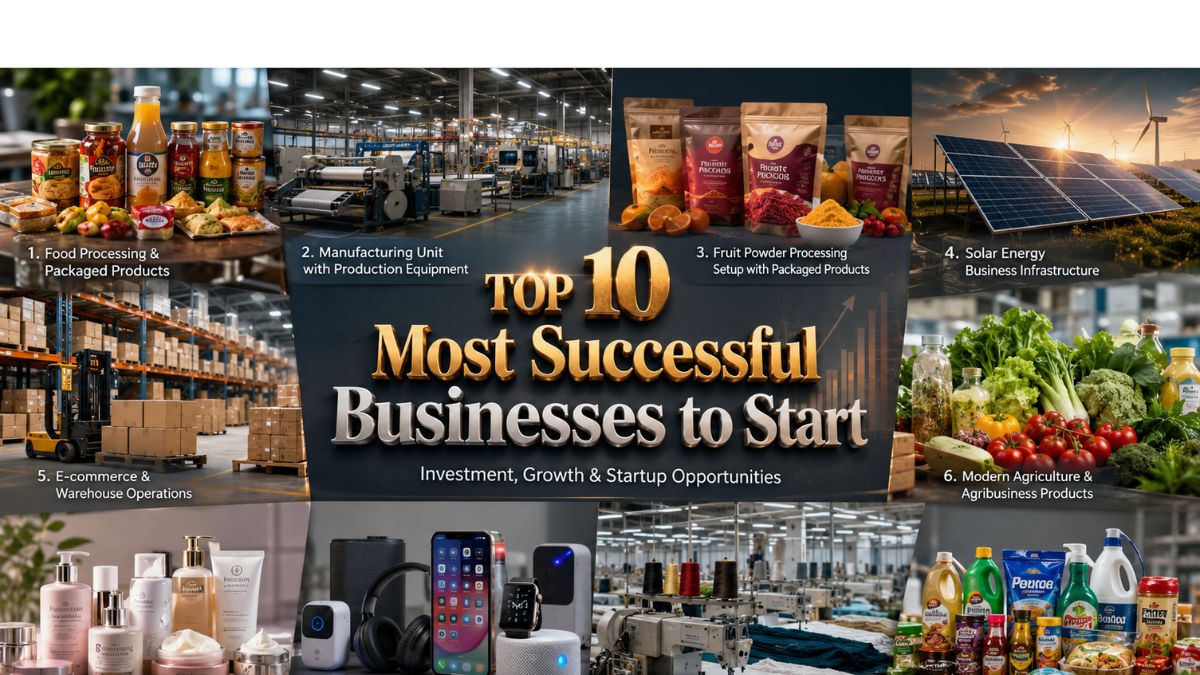
Most Successful Businesses to Start in India
The entrepreneurial environment in India is more dynamic — and demanding — than ever. The rapid growth of business concepts in a variety of sectors from agri-tech to the fintech, advanced manufacturing to D2C consumer brands, is not only a testament to the high level of enthusiasm but also a change in the value creation dynamics in the Indian economy. So, if you are a first-time entrepreneur or an experienced MSME investor, you might not even be asking ‘what to start’ but you might be asking ‘what will work and sustain and scale.’ The business units discussed in this analysis are not hypothetical. They are opportunities which are market validated, policy supported, demand-driven and are ones that a well-informed entrepreneur can assess, capitalize and profitably operate within a relatively short planning period. Here, it’s about inspiration, but it’s also about actionable intelligence.
Why This Is the Right Time to Enter — Market Rationale
There is a favourable environment for new enterprise in India because of the country’s rapidly growing GDP, the booming digital infrastructure and changing consumption patterns among the middle class. Spending by consumers in health, education, mobility and food has been revised continually and in all directions over the past 12 years, even during periods of macroeconomic uncertainty. Export demand of Indian MSMEs (textiles, chemicals, processed foods and engineering goods) continues to build up momentum. The government’s focus on the promotion of domestic manufacturing has led to a significant reduction in structural risk for the new players by introducing various initiatives such as PLI schemes, MSME credit guarantees, and infrastructure investments. For the entrepreneur, it is easy to understand: competition has been reduced, market size increased, and the institutional support structure made stronger than it ever has been before.
As per the data from the Ministry of MSME, there are more than 6.3 crore MSMEs across India that account for around 30% of the GDP and nearly 48% of the total exports. This ecosystem, the digital enablement of supply chains, payments, and distribution, has significantly reduced the amount of capital needed for a well-structured business to become a scale business today. This context is the basis for the evaluation of the ten businesses below.
Government Policies & Incentives Shaping the Opportunity
Indian businesses today cannot be seriously assessed without paying adequate attention to the policy architecture. The Production Linked Incentive (PLI) Scheme, which is implemented in 14 industries such as food processing, textiles, pharmaceuticals and electronics, provides direct monetary incentives based on incremental manufacturing. The Production Linked Incentive (PLI) Scheme provides direct monetary incentives to manufacturing ventures based on incremental manufacturing, across 14 key industries such as food processing, textiles, pharmaceuticals and electronics. In the PM Vishwakarma Yojana, the artisans who belong to a micro-enterprise are supported through subsidised credit and linkages with skill development. As per Credit Guarantee Fund Trust for Micro and Small Enterprises (CGTMSE), loans up to ₹5 crore can be availed without providing any security – a tool particularly suited for businesses that do not have much in terms of assets, such as asset-light service businesses and early-stage manufacturing units.
Startup India initiative under DPIIT provides registered startups a range of advantages, such as 80IC tax benefits for the initial three profitable years, quick patent processes and flexible public procurement regulations. The National Green Hydrogen Mission and state renewable energy policies are establishing new investable corridors in the green and clean-tech sector. Additionally, MSMEs should also check out the Udyam Registration portal, as it is the initial step towards gaining access to most government subsidy and credit assistance schemes.
10 Businesses with Proven Scalability and Demand Strength
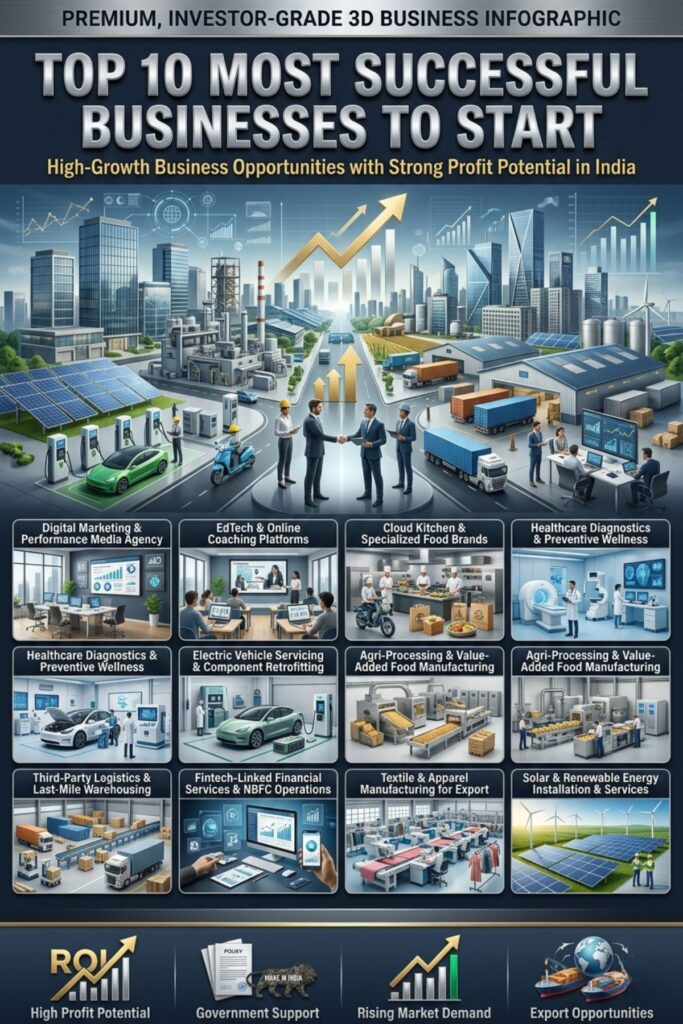
1. Digital Marketing & Performance Media Agency
With the swift pace of the ecommerce boom in India, ranging from retail, healthcare, real estate to education, the demand for capable digital marketing partners has surged. There is a special kind of performance media agency that focuses on paid search, social commerce, and content strategy power via analytics that can start with very little investment and earn high-end retainers from mid-market brands. The challenge isn’t about the capital, it’s about the skills — entrepreneurs with hands-on experience in platforms like Meta Ads Manager, Google Performance Max, or programmatic platforms are well equipped to establish an agency with a revenue ranging from ₹50–75 lakh annually in 18–24 months of diligent client acquisition. The key to differentiation is verticalization: agencies who focus on real-estate, D2C beauty, ed-tech niches and so on are proven to outperform their generalist peers when it comes to client retention and pricing power, over and over.
2. EdTech and Online Coaching Platforms
Education is one of the most structurally under-served sectors in India – and hybrid and digital learning has created an unprecedented opportunity for targeted knowledge entrepreneurs. Irrespective of the model, whether it be live-instruction coaching for competitive exam preparation, a subscription service for recorded content for professional upskilling, or a B2B offering for corporates, the unit economics of EdTech are very attractive: near-zero marginal cost of content delivery, high potential for recurring revenue and scalable teacher-to-student ratios. Even in the K-12 supplemental education market alone, it is estimated that several billion dollars are spent on this market annually, and tier 2 and tier 3 cities are expected to be the highest growth corridors. An entrepreneur having related subject matter knowledge and a disciplined process of creating contents can build a credible platform with an investment of under ₹10 lakh.
3. Cloud Kitchen and Specialised Food Brands
With the real estate costs and labor overheads as the biggest challenges in the traditional restaurant business model, the “Cloud Kitchen” business model has become one of the most cost-effective food business models. Unlike the traditional ristorante, a cloud kitchen does not have a front of house, doesn’t need to be in the prime, and doesn’t need to have dine-in staff.A cloud kitchen offers no front of house, no prime location and no dine-in personnel, but can take multiple delivery platforms at once within a certain radius. When brands are based on a core message and values; such as being local, healthy or specialising in hyperlocal cuisine, they always outperform the generic fast food brand. Platforms such as Zomato and Swiggy come with their own demand discovery, and the only limitation is the quality of kitchens and consistency of ordering, not the cost of acquiring customers.
4. Healthcare Diagnostics and Preventive Wellness
Structural underpenetrating of the healthcare ecosystem, especially diagnostics and preventive, is observed in India as compared to demand. With the consumer behaviour shift in the post-pandemic era, in the direction of proactively monitoring health, the use of diagnostic packages has come under the spotlight, as has the use of laboratory services and tele-health. Even a single diagnostic centre, a node of an existing network of laboratories, can make a profit within 24–36 months in an average-sized city or big town. If you are a health entrepreneur who has a clinical or pharma background, you can create a health enterprise with high margin and recurring revenue by incorporating diagnostics services, tele-consultation, and nutraceutical retailing within a multi-specialty wellness clinic.
5. Electric Vehicle Servicing and Component Retrofitting
The EV movement in India, which is gaining momentum in the 2-wheelers and 3-wheelers segments, is causing a secondary need for skilled service infrastructure. A mismatch exists between EV-trained mechanics and service centres and the rate of EV adoption — an opportunity for service entrepreneurs who invest early in training themselves and their staffs in EV technical training, diagnostic tools and battery management skills. The market of retrofitting, which is about the conversion of ICE vehicles to electric platforms as per the ARAI approved process, is not only technically challenging but also high value business opportunity as well. The governments of Gujarat, Maharashtra, and Tamil Nadu have also developed EV specific MSME incentive packages to explore.
Related Article: EV Revolution in India: Market Size, Battery Manufacturing & Business Opportunities
6. Agri-Processing and Value-Added Food Manufacturing
The food processing industry is a highly underdeveloped industry in India and suffers from tremendous post-harvest losses every year. Being in the middle of the food value chain, in the production of spice mixes, fruit pulps, dried vegetables and cold-pressed oils, this agri-processing unit plays a high value chain. Both the Food Safety and Standards Authority of India (FSSAI) licensing and PLI for food processing complement each other and provide a conducive regulatory and financial framework. Geographically, there is a ready availability of agricultural produce advantage, whether it is from the Deccan for pulses, Punjab-Haryana for wheat or Maharashtra for fruits.
Get Detailed Insights from This Book: Handbook on Fruits, Vegetables & Food Processing with Canning & Preservation (3rd Edition)
7. Third-Party Logistics and Last-Mile Warehousing
The surging growth in e-commerce, pharma distribution and the region’s FMCG expansion has resulted in a structural logistics deficit in India. The third-party logistics (3PL) operator or a specialised last-mile delivery firm operating in a distinct geographic area, or a commodity vertical, such as cold-chain logistics for dairy, pharma distribution for rural areas or fulfilment services for regional D2C brands can develop defensible and scalable business with good repeat revenue profile. The capital cost is fairly predictable (vehicles, warehouse space, WMS software) and the pricing model is easy to model and present to institutional clients – per-unit fulfilment or per-kilometre delivery, or a monthly retainer.
8. Fintech-Linked Financial Services and NBFC Operations
In India, the financial services sector shows tremendous gaps of inclusion, especially in MSME lending, rural credit, and insurance penetration. A banker, banker-to-banker, or banker-banking distribution expert is likely to be a good fit to launch a network of DSAs for institutional lenders or, at a higher capitalisation criterion, as an NBFC under RBI regulations and develop a niche lending book on the underserved segments such as street vendors, SHG groups, or agriculture input financing. The technology layer, including the co-lending platforms, AA framework integrations and digital KYC, has significantly lowered the cost of doing business when it comes to being compliant with the fintech.
9. Textile and Apparel Manufacturing for Export
In premium cotton, India’s structural advantage is further enhanced by the presence of Bangladesh and Vietnam, and skilled artisan labour and design heritage still continue to be appreciated by global sourcing teams. With a well-designed production line, focusing on EU sustainable fashion, the US mid-market basics or the domestic market of branded athleisure, a focused apparel manufacturing unit can have a viable export business. The capital cost to start a new textile manufacturing unit is reduced by a combination of PLI scheme, TUFS (Technology Upgradation Fund Scheme) and cluster development under the Ministry of Textiles. Sourcing/compliance professionals have an unusually strong advantage as entrepreneurs when it comes to the relationship with buyers and compliance.
Access Complete Business Plan: Technical Textiles Projects
10. Solar and Renewable Energy Installation and Services
A steady demand for EPC solar contractors, O&M service providers, and energy auditors has emerged in India due to the government’s renewable energy capacity addition programmes, aimed at achieving 500 GW of non-fossil-based electricity generation. A company that installs solar panels as part of the commercial and industrial solar market (C&I solar) or a rooftop solar solution provider for government institutions, schools and hospitals under PM Surya Ghar Muft Bijli Yojana has a market where both the clients are known to the government and there are sustainability requirements. Solar policies at the state level and DISCOM tie-ups mitigate demand side risk for well-structured enterprises.
Import–Export Opportunity Analysis for New Startups
The external trade environment is a multi-layered opportunity for the above-mentioned businesses. Demand for organic and sustainably sourced food ingredients, particularly spices, pulses, and functional food ingredients, is continuing to be strong, supported by important export markets in the USA, EU and GCC countries in the agri-processing segment. Government’s Agricultural export policy is proactive in providing market development assistance and providing subsidy for quality certification to APEDA registered exporters.
In the case of textiles and apparel, India enjoys pricing benefits from preferential access to trade under various bilateral regimes compared to other manufacturing countries. The software export market, under the STPI and SEZ framework, provides considerable tax incentives and is an excellent option for those exporting software services to global clients without the hassle of having to deal with physical trade logistics. The market in East African and South-East Asian countries is witnessing a surge in cross-border business opportunities for entrepreneurs in diagnostics and healthcare equipment repair, thanks to local market ecosystems that offer highly competitive pricing and Indian skilled technicians. As the local content rules are becoming more stringent within India, the importers of EV components from China can look for anti-dumping and indigenization provisions to create a more secured supply chain.
Indian MSME Leaders Worth Studying
Kiran Mazumdar-Shaw – Biocon Limited
Biocon’s journey from a small business operating from a garage in Bangalore to a listed biopharmaceutical firm, is a great case study of an Indian entrepreneurship success. Kiran Mazumdar-Shaw’s genius was his understanding that Indian scientific talent, coupled with a process quality focus, could enter into global generics biologic markets at a much lower cost than westerners. In essence, the take from MSME entrepreneurs is that of the importance of niche selection: Biocon did not try to fight in all segments of pharma, instead it played a niche that was technically challenging and had intellectual discipline and long-term capital patience.
Harsh Mariwala – Marico Limited
The rise of Marico from a commodity edible oil distribution business to a branded FMCG behemoth under Harsh Mariwala shows how branding can turn a non-differentiated supply chain into a power center. The product, Parachute coconut oil, was not a different product; it was a commoditized one. The insight Mariwala displayed was that packaging, distribution discipline, and consistent quality messaging, even in a price sensitive category, can disproportionately win consumer preference. For entrepreneurs starting up in commodity adjacent businesses, agri-processing, food processing, commodity FMCG distribution, etc., this is still the blueprint for value creation to aspire to.
Ritesh Agarwal-OYO Rooms
Despite the chaotic operational trajectory of OYO, Agarwal’s premise (huge, unorganized, and unreliable supply) was sharp and lucratively validated. OYO, initially, provided proof of the ability of an asset-light, standardization, and technology-backed demand-distribution business to rapidly grab market share in fragmented service businesses. Entrepreneur’s seeking scale in logistics, food delivery or healthcare should look at the aggregation-and-standardization framework.
How Feasibility Analysis Reduces Investment Risk
We know at NPCS that almost every business idea with the right value proposition fails, or makes money, based on the strength of the pre-investment analysis. NPCS offers professional consulting and preparation of market survey cum detailed techno economic feasibility reports (DPR) to assist entrepreneurs and investors thoroughly assess the potential of any business idea prior to investing funds. This includes the details of manufacturing processes, analysis of the market and demand, process flow diagrams, product mix and capacity analysis, machinery details and specifications, raw material sources, and complete project economics, including profits and payback models. Whether you are looking at an agri-processing unit, a diagnostic centre, a solar EPC venture, or a manufacturing business, a professionally drafted feasibility report will ensure your investment decisions are driven by facts, and not assumptions.
Discover business ideas that actually make money
Market Snapshot: Investment and Return Benchmarks by Sector
Indicative entry investment, gross margins, and growth trajectories across the ten business categories discussed in this analysis.
| Business Sector | Approx. Entry Investment | Expected Gross Margin | Market Growth Trend |
| Digital Marketing Agency | ₹2–5 Lakh | 55–70% | High |
| EdTech / Online Coaching | ₹3–8 Lakh | 60–75% | Very High |
| Cloud Kitchen / F&B | ₹8–15 Lakh | 35–50% | High |
| Healthcare / Diagnostics | ₹15–30 Lakh | 45–65% | Very High |
| EV / Green Tech | ₹20–50 Lakh | 40–55% | Emerging |
| Agri-Processing | ₹10–25 Lakh | 30–45% | Moderate-High |
| Logistics & Warehousing | ₹15–40 Lakh | 25–38% | High |
| Fintech / NBFC Services | ₹10–20 Lakh | 50–65% | Very High |
| Textile / Apparel Mfg. | ₹12–30 Lakh | 28–42% | Moderate |
| Renewable Energy | ₹25–75 Lakh | 35–50% | High |
Note: Investment figures are indicative estimates for startup-scale operations. Actual figures will vary by city tier, operational model, and capacity.
Frequently Asked Questions
Q1. Which business requires the minimum capital from the below listed businesses?
Digital marketing agency or an online coaching business can be setup with an investment less than 5 lakh where primarily the expenditure is software tool, initial marketing expenses, workspace cost. It relies more on the skills and relations than capital itself.
Q2. Which business is eligible for government grants/ subsidies in the below listed businesses?
PLI schemes covers Agri-processing, solar energy, textile manufacturing, EV related businesses. CGTMSE provides collateral-free credit guarantee to startups in cloud kitchens and Fintech business if registered as a startup. MSME registration on Udyam portal provides the entry for majority of these instruments.
Q3. Which business is feasible in tier-2 and tier-3 cities?
Multiple – healthcare diagnostics, Agri-processing, Logistics and warehousing, Solar installations, even digital/Ed-Tech ventures as a backend, are more suitable in tier-2 and tier-3 markets due to low competition and reasonable rentals/real estate costs and higher growth potential as compared to metros.
Q4. When would I expect to break even in these businesses?
The break-even period differs greatly from business to business depending upon the sector and the business model. Digital businesses, Ed-Tech businesses with planned client acquisition can break even in 12-18 months. Manufacturing, healthcare ventures generally require 24-48 months. This depends on the first-year capacity utilization which can be best predicted in a professionally drawn DPR.
Q5. Do these businesses have any export potential?
Agri-processing, textile, digital services, and diagnostic equipment maintenance has substantial scope in exports. There are schemes in APEDA, FIEO, and Ministry of Commerce which can assist in market development. The first step is to register in the concerned export promotion council.
Q6. How crucial is the feasibility report before embarking on any of these business activities?
Feasibility report professionally prepared is not a routine but a very high-value investment an entrepreneur makes prior to putting capital into a venture. It validates demand assumption, tests the costs and identifies the operational and regulatory risk before incurring a high cost for doing so. A majority of entrepreneurs jumping the DPR process regret at the operational cost for the value that a DPR would have provided at fractional cost.


