





Food Processing Business in India:
India has the potential to produce sufficient food to meet the nutritional needs of its population two times over. It is the second largest producer of vegetables and fruits, the largest milk producer and the second largest wheat producer in the world. Despite this, just 10% of its agriculture products are processed before they reach the consumer, while the UK processes between 65 and 70%, and the USA processes almost 80%.
The impact of this one number is mind-boggling: about ₹92,000 crore of the farm output goes bad or becomes worthless each year, without anyone being able to do anything with it to make it shelf-stable, package it or prepare it for export.
₹92,000 crore of farm produce loses value every year. Food processing is not a niche opportunity — it is an infrastructure gap waiting to be filled.
It is not a problem that can be solved exclusively by the government. It’s the most concrete and quantifiable opportunity a first-generation entrepreneur or MSME can have at their fingertips now. No need for a PhD in food science. There is no need to have a factory from day one in an industrial estate. Three-four essential licences, sourcing tie-ups with the local farmers/mandis, precise product category, and appropriate machinery.
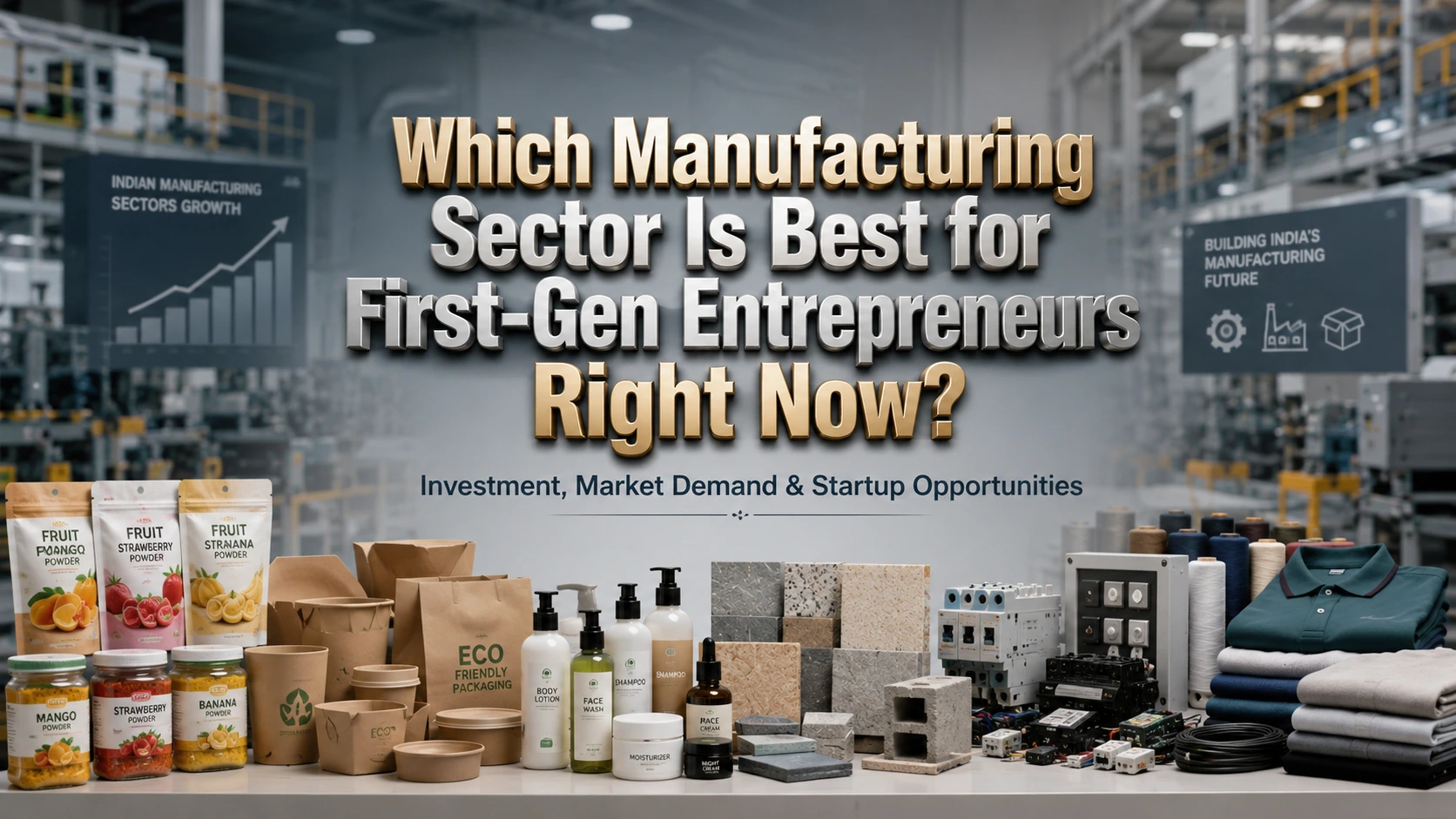
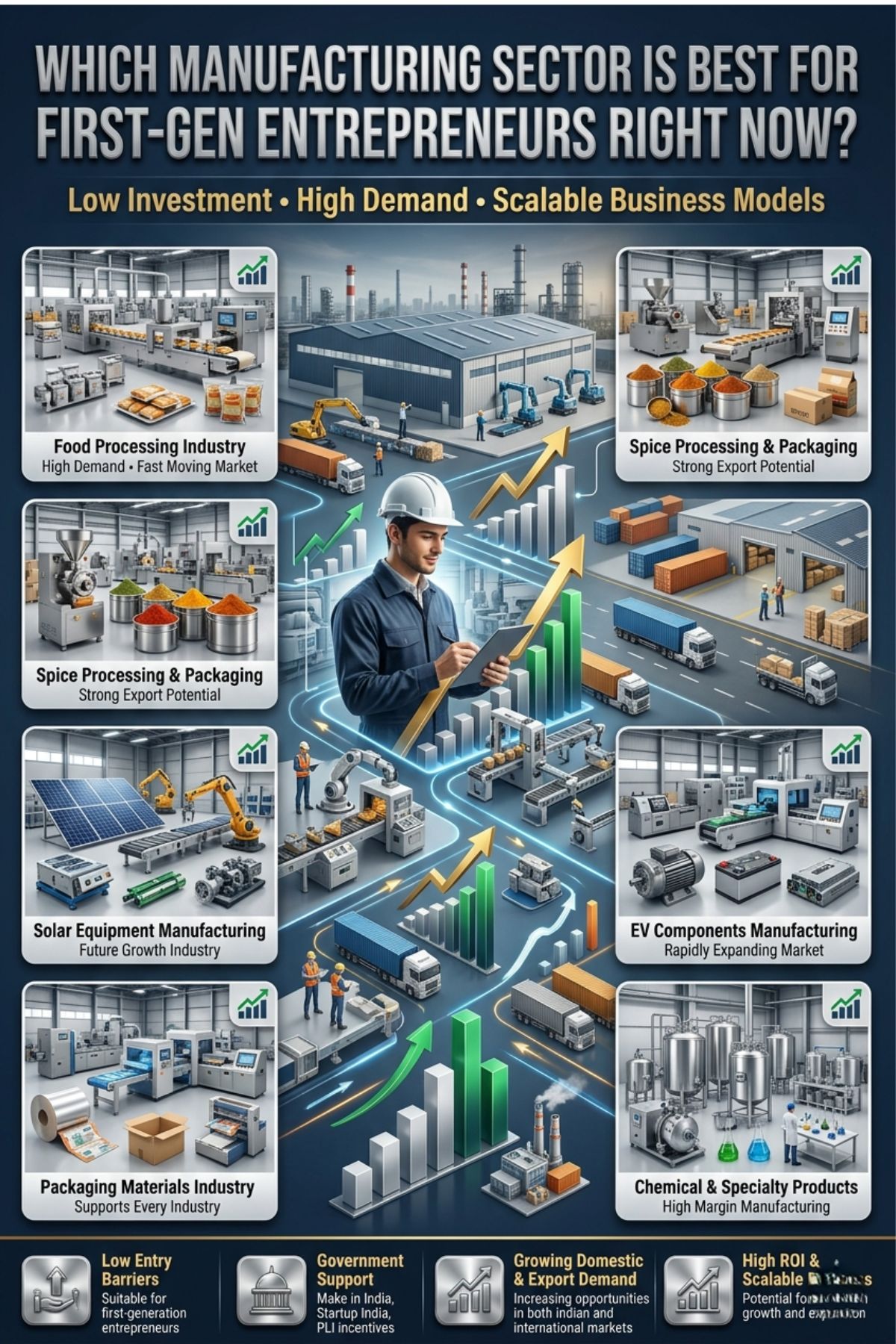
The answer to the question on the cover of this article is food processing. So, why — and how — to get in.
Related Article: How to Choose the Right Business Idea in India: A Complete Guide for New Entrepreneurs
SECTION 2 — THE PROBLEM / MARKET GAP
A ₹535 Billion Industry Running at a Fraction of Its Capacity
Data published by the Ministry of Food Processing Industries (MoFPI) shows that food processing industry accounts for 8.80 per cent of manufacturing GVA and 8.39 per cent of agriculture GVA of India. It makes 13% of Indian total export and 6% industrial investment. Over the last seven years the sector has increased by 7.3% per year on average. But it is far less than it should be based upon its agricultural base.
The big challenge: Food processing is highly fragmented, informal and low-invested in India, especially small & medium scale. According to Brickwork Ratings Report on Food Processing (Jan 2025), the industry share of the Indian food market is 32%, indicating that 68% of Indian food market is still comprised of unprocessed or less processed food products. capital expenditure expenditure is 0.5-1.5% of revenue, indicating the lack of investment in industry modernisation.
The region disparity is significant. There are states, such as Uttar Pradesh, Bihar, Jharkhand and Madhya Pradesh, which generate huge quantity of grains, pulses and horticulture crops and lack adequate number of processing facilities as compared to the production. Though 302 cold chain projects are underway, only 25 Mega Food Parks are operational across the country under PMKSY. This is not a challenge for Tier 2 and Tier 3 cities as it is a first mover’s advantage.
The MoFPI data indicates that the processed food component of India’s agri-food exports has increased from 13.7% in FY 2014-15 to 23.4% in FY 2023-24. However, India’s share of processed food trade is less than 2% of the global trade volume, even though it ranks among the top three leading producers of food in the world. The market won’t wait around.
TABLE 1: State-Wise Food Processing Demand, Clusters & Policy Support
| State | Key Product Categories | Industrial Clusters | Market Size (Approx.) | Key Policy Support |
| Uttar Pradesh | Cereals, Spices, Dairy | Agra, Lucknow, Varanasi | ₹42,000 Cr (est.) | ODOP scheme, MSME clusters |
| Maharashtra | Fruits & Vegetables, Beverages | Nashik, Pune, Nagpur | ₹67,000 Cr (est.) | Mega Food Parks (3 operational) |
| Punjab & Haryana | Wheat, Rice, Dairy | Ludhiana, Amritsar, Karnal | ₹38,000 Cr (est.) | Grain processing corridor |
| Andhra Pradesh | Aqua, Spices, Rice | Vijayawada, Kakinada | ₹29,000 Cr (est.) | Marine exports, AP Food Park |
| Gujarat | Snacks, Dairy, Edible Oil | Rajkot, Anand, Ahmedabad | ₹51,000 Cr (est.) | AMUL supply chain, GIDC parks |
| Tamil Nadu | Ready-to-Eat, Beverages | Coimbatore, Hosur, Chennai | ₹33,000 Cr (est.) | Export processing zones |
Sources: MoFPI Annual Report, IBEF Industry Report, Udyam Portal State Data
SECTION 3 — THE OPPORTUNITY
Four Tailwinds Hitting the Same Target at the Same Time
One trend, is not the opportunity in food processing. It is the place where four forces act at the same time.
Consumer Demand Is Shifting Fast
65% of the Indian population is below 35 years of age and packaged, branded, ready-to-cook or ready-to-eat food is becoming in demand among the urban consumers. The per capita consumption of packaged food has increased by 11-13 per cent annually in Tier 1 and Tier 2 cities. Since 2021, more than 400 new brands have been launched in the D2C packaged food channel, within a four-year period. There has to be manufacturing to support that demand.
PLI Scheme Is Pumping Real Capital
MoFPI has the Production Linked Incentive (PLI) Scheme for Food Processing Industry (PLISFPI) with a total outlay of ₹10,900 crore for six years. Till December 2025, the cumulative investment under PLI exceeded its committed investment of ₹7,000 crore and reached ₹9,207 crore — industry had more than breached its investment commitment. As of February 2026, the scheme has generated more than 3.39 lakh jobs (both direct and indirect) against the targeted 2.5 lakh. Most importantly, 69 out of 168 approved were applicants who were MSMEs.
Export Momentum Is Building
The PLISFPI exports of agricultural processed food have been expanding at a CAGR of 13.23% since FY2019-20. From April 2021 to September 2025, the cumulative PLISFPI beneficiary export sales amounted to ₹89,053 crore. APEDA actively assists food exporters from India in terms of financial aid, Quality infrastructure and market development. Indian snacks, RTC meals, spices and dairy are in demand in the UAE, Saudi Arabia, Southeast Asia and the US.
Government Schemes Cover Startup Risk
This is the highest level of subsidies and credit support in any other manufacturing sector at the start-up stage:
- PMEGP (Prime Minister Employment Generation Programme): Provides 25–35% capital subsidy (35% for rural entrepreneurs). Maximum project cost of ₹50 lakh for manufacturing units. Run by KVIC under Ministry of MSME.
- PM FME Scheme: Grants of 35% (max ₹10 lakh per unit) with credit linkage for micro food processing units. Identifies informal units to be brought into the formal sector.
- MKSY: Provides common infrastructure facilities such as Mega Food Parks, cold chain projects, agro-processing clusters to the small units but does not provide ownership of the infra.
- MUDRA Tarun Loan: Working capital loans up to ₹10 lakh without any collateral and can be availed from any scheduled bank.
Get Detailed Insights from This Book: Handbook on Fruits, Vegetables & Food Processing with Canning & Preservation (3rd Edition)
SECTION 4 — HOW TO SET IT UP
How to Set Up a Food Processing Unit: A Step-by-Step Guide
This is a guide for a medium scale food processing unit that can be used for spice grinding, packaged pulses, cold pressed oil or RTC snacks with capacity of 500-800 kg/day. This is the place of sweetness for the first-generation entrepreneur – capital efficient, scalable and eligible to all major government schemes.
Step 1 — Choose Your Product Category
Choose a sub-category first. The gross margin in spice grinding (chilli, turmeric, coriander) is 18-22% and entry barriers are very low. In packaged pulses and flour, though the margins are 12-16%, the demand has been steady. The premium margin of cold-pressed oil (mustard, groundnut, coconut) is 24–28%. The margins of RTC snacks (namkeen, poha, chivda) are from 20-26% with high repeat purchase. Your best bet depends on your geography, select what grows within 100km of your unit.
Step 2 — Space and Location
The required covered production area is 1,200 to 2,000 sq ft and storage space is 400-600 sq ft. Being in close proximity to an agricultural mandi at Morena (MP), Unjha (Gujarat), Guntur (AP) or Nizamabad (Telangana) can reduce raw material costs by 8–12%. In many state MSME departments shed allotments are available in industrial estates at discounted prices.
Step 3 — Key Machinery
The main equipment for a spice/flour unit consists of a pulveriser/grinder (₹2.5–4 lakh), sifting machine (₹80,000–1.5 lakh), mixing drum (₱ 60,000–1 lakh), semi-automatic packaging and sealing machine (₱ 2–3.5 lakh), and a pouch/sachet printer with barcode (₱ 1–1.8 lakh). In case of cold pressed oil, invest in a cold pressed expeller for ₹3.5–6 lakh. Purchase trusted Coimbatore (Tamil Nadu), Rajkot (Gujarat) or Ludhiana (Punjab) suppliers, not just the lowest price you can find online.
Step 4 — Raw Material Sourcing
Institute a direct linkage with the farmer producer organizations (FPO) or commission agents at the nearest APMC mandi. UP, MP and Rajasthan FPOs provide spices and grains at 6-9% discounts at open market rate. In the case of oilseeds, your basic belts are Rajasthan (mustard), Gujarat (groundnut) and Tamandu (coconut). Secure buying price before the harvest season — the most important leverage of food processing is to secure the purchase price before the harvest.
Step 5 — Licences and Regulatory Approvals
You need to have everything in place before your first production run:
- FSSAI State or Central Licence: All food businesses need to have FSSAI State or Central Licence. If the turnover is above ₹20 crore or if manufactured packaged food items are sold in more than one state, then central license is required. Apply at fssai.gov.in
- Udyam Registration: Register as an MSME unit at gov.in – it is mandatory for scheme eligibility.
- GST Registration: To be done when the turnover is above ₹20 lakh (₹10 lakh in northeastern states).
- Factory Licence: Necessary if over 10 persons are working in your unit with power. Submit a job application to your state’s Labour Department.
- Pollution NOC (Consent to Establish): Pollution Control Board of your state. Category A (Green) for food units – relatively simple clearance.
- BIS Certification: Mandatory only for certain categories like packaged drinking water and some dairy products. Not required for most spice and grain processing.
Step 6 — Timeline
It will take 4 to 6 months from the time of Udyam registration till the first production: 3-4 weeks for FSSAI and GST registration, 4-8 weeks for procurement and installation of machinery, and 2-3 weeks for trial production and product testing. In case of PMEGP subsidy applications, give an additional 60-90 days for bank appraisal.
Step 7 — Team Size
A 500-800kg/day unit needs: 1 Production supervisor, 4-6 Machine operators and labourers, 1 Quality/Packaging checker, 1 part-time (Accounts/compliance). Emphasis: 6-9 players should begin. You, the founder, do sourcing, sales, and compliance up to ₹80 lakh of monthly revenue.You are the founder and do sourcing, sales and compliance till you reach monthly revenue of ₹80 lakh.
TABLE 2: Capital Expenditure Breakdown for a Medium-Scale Food Processing Unit
| Cost Head | INR Range | Central Estimate | Notes |
| Land (1,500–2,000 sq ft, leased) | ₹0 (own) / ₹1.5–3L/yr lease | ₹0–3,00,000/yr | Ownership ideal in rural MSME zones |
| Processing Machinery (grinders, pasteurisers, sealers) | ₹12,00,000–22,00,000 | ₹12–22 lakhs | PMEGP subsidy covers up to 35% |
| Packaging Line & Labelling Equipment | ₹4,00,000–7,00,000 | ₹4–7 lakhs | Semi-auto lines for smaller units |
| Cold Storage / Refrigeration Unit | ₹3,00,000–5,00,000 | ₹3–5 lakhs | PMKSY provides infrastructure grant |
| Initial Raw Material Stock (1 month) | ₹6,00,000–9,00,000 | ₹6–9 lakhs | Local mandis or FPO tie-ups |
| Working Capital (salaries, utilities, misc.) | ₹5,00,000–8,00,000 | ₹5–8 lakhs | MUDRA Tarun loan up to ₹10 lakh |
| Licences, Testing, Contingency (10%) | ₹2,00,000–3,00,000 | ₹2–3 lakhs | FSSAI, GST, Udyam, Pollution NOC |
| TOTAL (Medium-Scale Unit) | ₹32,00,000–54,00,000 | ₹32–54 lakhs | — |
Sources: NIIR Project Consultancy Services (niir.org), MoFPI PMEGP Guidelines, Industry Estimates
Get Detailed Project Report (DPR): Complete Guide to Food Processing and Agro-Based Projects
SECTION 5 — FINANCIAL SNAPSHOT
The Numbers: What to Expect at 60% and 100% Capacity
The figures are for a medium scale spice grinding and packaged grain mill, with an investment of Rs 42 lakh and with a capacity of 600 kg per day of production at full scale.
- Capital Expenditure: ₹38–46 lakh (which includes machinery, basic fitout, raw material for the first month and licensing)
- Monthly Operating Cost: ₹5.8-7.2 lakh (raw material 68%, labour 16%, power and packaging 11%, overheads 5%)
- Revenue at 60% Capacity: ₹9.5–11.5 lakh/month (≈ 360 kg/day × avg. ₹120/kg selling price × 26 working days)
- Revenue at 100% Capacity: ₹15.5–19 lakh/month
- The gross margins vary between 28–34% for spice products and 18–22% for packaged grains and pulses.
- Net Margin (at full capacity): 14–20% for spice and 10–14% for packaged grain.
- Payback Period: 26–36 months after the first production at 70–80% capacity utilisation
Things are not very glamorous in Year 1. Compelling after Year 2 when procurement of raw materials is optimised, and brand recognition in local and online channels begins to generate repeat orders. The IBEF’s Food Processing Report found that export-oriented units (in particular those under APEDA schemes) achieve net realisation of 12–18% higher when compared to units purely engaged in domestic food processing.
SECTION 6 — RESOURCE REFERENCE
Where to Get Reliable Project Data Before You Commit Capital
One of the resources which have been proved to be useful to the food processing entrepreneurs is NIIR Project Consultancy Services (NPCS), one of the oldest industrial consultancy organizations in India with more than 45 years of experience in the development of MSME Projects. NPCS provides detailed project reports for more than 400 food and agri-processing industries which include plant layout, machinery specifications, raw material sourcing, financial projections and payback analysis. In most banks including PSU and cooperative banks, their techno-economic feasibility studies are bankable papers for PMEGP and MUDRA loan applications. If an entrepreneur does not want to create his/her data packages from scratch, he or she can access their reports at niir.org and associated editorial content at entrepreneurindia.co. The first step is to spend ₹5,000 on a validated project report, before you shell out ₹40 lakh.
SECTION 7 — CONCLUSION
One Decision. Then Move.
Nobody gets it right when to get into manufacturing. There is only a window — in food processing there is a wider window. Cover of the Government subsidy is available. Export orders are on the rise. Input supply chains are available. The willingness of consumers to pay for branded, packaged food is genuine and is increasing.
Avoid spending 6 months researching. Choose one product appropriate to the geography and raw material availability: spice grinding, cold pressed oil or packaged pulses. Register Udyam by this week at udyamregistration.gov.in. Then apply for PMEGP. It’s the order. All the rest is detail.
Choose the right startup backed by real market demand
TABLE 3: Government Schemes for Food Processing Entrepreneurs — Eligibility and Benefits
| Scheme | Nodal Agency | Who Can Apply | Key Benefit | Notes |
| PMEGP | KVIC / MoMSME | All new food processing units | 25–35% capital subsidy (rural 35%) | Max project: ₹50 lakh (manufacturing) |
| PM FME Scheme | MoFPI | Micro food processing enterprises | 35% credit-linked grant, max ₹10 lakh | Existing units or new micro units |
| PMKSY (PMKSY) | MoFPI | Agri-linked processors | ₹10,000–50,000 Cr infra fund | Mega Food Parks, Cold Chain grants |
| PLI – Food Processing | MoFPI | Medium+ scale, turnover-linked | 4–10% incentive on incremental sales | MSME category: 69 beneficiaries approved |
| MUDRA (Tarun) | SIDBI / Banks | MSMEs, working capital | Collateral-free loan up to ₹10 lakh | No collateral required |
| CGTMSE | MoMSME / SIDBI | Micro & Small Enterprises | Credit guarantee up to ₹5 crore | 75–85% guarantee cover on bank loans |
Sources: MoMSME (msme.gov.in), MoFPI (mofpi.gov.in), KVIC, SIDBI, PIB
ENTREPRENEUR SPOTLIGHT
Ramesh Gupta | Founder, SunGrain Foods | Morena, Madhya Pradesh
Annual Turnover: ₹3.8 crore | Product: Cold-pressed mustard oil and packaged atta
It all began with one cold-press expeller in a 1200 sq ft shed in Morena MP-one of the biggest mustard growing belts in India. He bought raw mustard from FPOs for `52/kg, cold-pressed and packaged it under his own label and initially started selling it on WhatsApp commerce groups before listing it on Flipkart. Within 3 years, his unit works in two shifts, has 11 employees and exports 12 percent of its output to UAE and Oman. His key learning is: “Purchase raw materials before it gets expensive due to season. Profit margin lives and dies on the purchase, not on the sale.”
Frequently Asked Questions
Q1. What is the minimum amount of capital that will be needed for a food processing unit?
It will range between 14-22 lakh to set up a small-scale unit (150-200 kg/day), say a spice grinding or packaged atta operation, which includes the cost of machinery, raw material and licenses. It will range between 32-54 lakh for medium-scale (500-800 kg/day). Under PMEGP scheme a maximum of 35% of the project cost (rural) is covered as a non- repayable subsidy making your investment in cash low. You can apply for PMEGP scheme from kviconline.gov.in.
Q2. Which all are the mandatory licenses required before I can start production?
Must-haves: FSSAI license (from foscos.fssai.gov.in), Udyam registration, GST registration and Pollution Control Board Consent to Establish are non-negotiable. If you are employing 10 or more workers with power then a factory license is required from the state Labour Department. FSSAI and Udyam can be obtained in 15-20 working days with proper document.
Q3. How do I source raw materials cheaply?
Approach farmers producers’ organizations (FPO’s) or mandis within 100-150 kms from your unit. Origination belts for spices, like Guntur for chillies, Unjha for cumin, Sangli for turmeric and Kota for coriander, will provide the basic raw material. Signing forward purchase contracts with the farmers and FPOs before the harvest season can ensure the purchase price. Most FPO tie-ups result in lowering the raw material price by 6-9% in comparison to the open mandis.
Q4. What are the real profit margins?
Gross margins of 18-22% for processed grains and pulses, 28-34% for spice powders and 24-28% for cold pressed oils can be expected at full scale. Net profit margins at full scale and branding premium may stand between 12-20%. Exporting through APEDA tied-up channels may lead to 12-18% more net revenue in comparison. Once your brand establishes repeat orders, profit grows sharply – Year 2 is significantly better than Year 1.
Q5. What government schemes support this industry?
Food processing sector gets the most support from government policy schemes of any MSME manufacturing sector. PMEGP provides capital subsidies. PM FME provide grants for micro units. PMKSY funds shared infrastructure. PLISFPI provides incentives for scalability and performance. MUDRA and CGTMSE offer collateral free financing. Refer mofpi.gov.in and msme.gov.in.
Q6. Can NPCS help with the planning of this project?
NIIR Project Consultancy Services (NPCS) offer 400+ food processing-specific project reports covering plant design, machinery selection, raw materials analysis, market demand forecasts, financial projections, and funding support plans at niir.org. They are prepared to be bankable and useful for loan applications to banks or for presentations at DIC offices for the PMEGP scheme or MUDRA scheme. Entrepreneurs planning this sector must consider their services as a valuable initial source of data prior to making significant investment decisions. Additional relevant information is also available at entrepreneurindia.co.
DATA SOURCES & CITATIONS
Primary Sources Used in This Article:
- Ministry of Food Processing Industries (MoFPI) — PLI scheme data, PMKSY, sectoral GVA
- IBEF — India’s Food Processing Industry Report — GVA share, export data, FDI figures
- APEDA (Agricultural and Processed Food Products Export Development Authority) — Export promotion, processed food trade data
- Udyam Registration Portal — MoMSME — MSME registration data by state
- FSSAI (Food Safety and Standards Authority of India) — Licensing framework, food business regulations
- PIB — PLI Scheme Performance (pib.gov.in) — Investment, production, employment data
- Brickwork Ratings — Food & Food Processing Industry Report, Jan 2025 — Sector structure, consumer demand analysis
- NIIR Project Consultancy Services (niir.org) — Project cost benchmarks, industry feasibility data


