





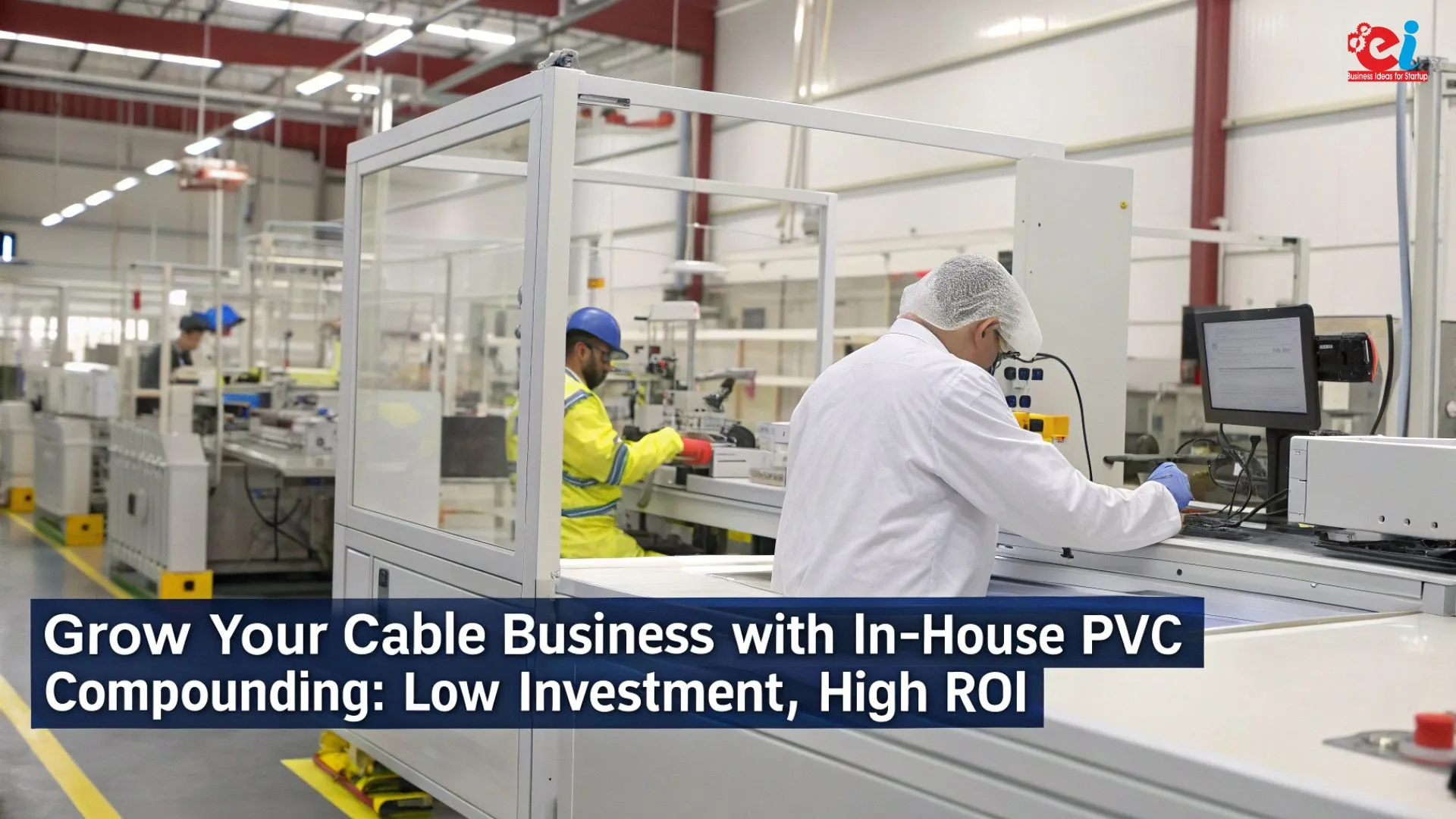
One of the most important supply sectors that supports the infrastructure of the PVC wires and cables industry, industrial automation, domestic electrification, automobile manufacturing, and integrating renewable energy is the wires and cables industry. There is a high demand for cost-effective, high quality cables that adhere to industry standards due to the rapid growth in construction, telecommunication, and power distribution.
Profitability and competitiveness within this segment hinges on the quality, availability, and cost containment measures of polyvinyl chloride (PVC), one of the most essential materials. The insulation and sheathing of the majority of low and medium voltage cables utilize PVC. The protective jacket that enables electrical performance, mechanical strength, chemical resistance, and safety is a PVC Compounding.
The Need for In-House PVC Compounding
Usually, manufacturers buy ready-made PVC compounds from third-party suppliers. However, this model is increasingly becoming susceptible due to changes in the pricing of the raw materials, quality differences, long lead times, and supply chain interruptions. To enhance production stability, value chain control, cost effectiveness, and supply chain disruptions, many innovative firms are adopting backward integration and installing their own PVC compounding units.
Reasons Why Cable Contains a Core Element of PVC Compounding
As with all wires and cables, their use require particular PVC compounds that are a blend of several ingredients with custom defined attributes such as flexibility, tensile strength, managing flame, enduring thermal, ultra violet radiation, and color retention. A basic PVC resin is brittle and has poor thermal stability. A compound composed of polymer, plasticizers – softened to enable easier blending (thermally unstable), thermal stabilizers (to prevent rot from occurring), fillers – to decrease costs (usually calcium carbonate) and some lubricants whole aid in processing and pigment is blended to give excess properties is rather better.
Whether it’s control cables, power cables, proprietary class general wiring, telecom wires, automotive harnesses, flexible cords, and many more. Each wire application has grades of compound in which form they come in. Formulations must comply with several national standards: including IS 694, IS 1554, BS 6004, IEC 60227, or simply environmental standards as RoHS compliant (Restriction of Hazardous Substances).
The PVC outer sheath and insulation layer of the cables must provide not only electrical but also physical protection against moisture, abrasion, chemicals, and temperature changes. A compound’s lack of uniformity can lead to failure of insulation resistance testing, dielectric strength, testing elongation at break, flame retardancy and lead to rejected batches or potential safety risks.
Related: Navigating the Wire and Cable Manufacturing Industry
Backward Integration as a Strategic Business Decision
With backward integration into PVC compounding, cable manufacturers vertical integrate to take on the role of formulators and controllers of their main raw material, thus ensuring supply security while improving customization flexibility and cost control, and responsiveness to their customers.
Manufacturers are able to achieve these goals by establishing their own compounding unit which allows them to create customized formulations such as:
- FRLS and zero halogen cables for metros, airports, and hospitals
- Heat resistant cables for Solar PV systems and EVs
- Water tight cables for submersible pumps and irrigation systems
- Oil and chemical resistant cables for factories and refineries
This degree of product differentiation allows entry into high margin, performance critical cable segments. Additionally, companies can eliminate dependency and control the volatility of compound prices and quality issues arising from out sourced vendors.
Having a compounding facility improves internal coordination. It causes no interruptions in the flow of supply, lowers inventory expenses, and guarantees precise timing for material delivery into the extrusion lines. Quality control is built into the system with laboratory testing which actively checks for defects and increases consistency by ensuring that control checks are ongoing.
Explained Setup of PVC Compounding
PVC compounding consists of the accurate combination of raw PVC resin and copious chemical additives to make a homogeneous mixture suitable for wire coating. Setting up such a unit includes several stages, each requiring specific machinery, technical expertise, and space planning.
Supplementary Resources Needed
- Suspension Grade PVC Resin (K value of ~67)
- Plasticisers (DOP, DBP, DOTP, or phthalate free)
- Thermal Stabilizers (Calcium/Zinc, Tin-based, or Lead-based)
- Fillers (Calcium carbonate, Talc)
- Lubricants (Paraffin Wax, Stearic Acid)
- Alumina Trihydrate, Antimony Trioxide (Flame Retardants)
- UV Stabilizers and Pigments
Primary Tools and Machines
- High-speed Mixer (for dry blending ingredients)
- Mixing Heater-Coolers (for consistent temperature)
- Twin-screw Extruder or Kneader (for melt compounding)
- Vibrating Screen and Cooling Conveyor
- Batch weighing and dosing system
- Dust collector and fume extraction units
- Laboratory Equipment (MFI tester, tensile tester, hot air oven, volume resistivity meter)
The best arrangement for the plant is to permit seamless progress from receiving raw materials, batching, compounding, cooling, pelletizing, quality testing, and packaging. Environmental control requirements such as dust free areas, anti-static floors, ventilation, and others are crucial for safe and streamlined operations.
Related: Feasibility and Techno Economic Viability Study on PVC Wire and Cable
Investment and CapEx Analysis
Establishing a mid-sized PVC compounding unit (capacity of 1–2 tonnes/hour) incurs capital expenditure of approximately ₹3 crore to ₹10 crore based on the level of automation, imported versus domestic machinery, construction, and other factors. Operating expenses include electric, raw materials, labor, maintenance, and consumables.
The ROI is contingent on in-house consumption compared to selling to third parties. For your own cable manufacturing lines, if the compound is fully consumed, is sold at savings of ₹7-15/kg against market-purchased composites, the savings are in lakhs per month. Further selling partial capacity to external cable producers enhances returns through additional external sales.
Considering the material savings from reduced rejections, added product quality, and new revenue streams, such a unit’s return on investment is 24-36 months when considering market outreach and capacity utilization.
Exporting and Third-Party Opportunities
Once consistency and quality have spooled, excess amounts of softened PVC compounds can be marketed towards wire manufacturers lacking a compounding facility expanding sales to centrally utilize the plant else expanding sales to secondary strengthen plant usage.
There is an increasing demand overseas for specially formulated RoHS compliant compounds which have no heavy metals included. In Africa, the Middle East, South Asia, and Latin American countries lack the ability to domestically manufacture PVC compounds for local cable manufacture. Thus there is opportunity to export premium grade pre-tested PVC compounds with Indian export incentive schemes and preferential trade treaties.
Adding another compound to the portfolio also enhances B2B networking. Most OEMs prefer buying cables or compounds from integrated suppliers who have in-house formulation and R&D champs because of the in-house capabilities. This often leads to customers granting them long-standing contracts with command over premium market positioning.
Various Challenges to Take into Account and Their Solutions
Setting up a PVC compounding unit has its perks, but it comes with its own challenges. The first one is lack of expertise. The formulation of PVC is very sensitive to the ratios of the ingredients, processing temperature, and the speed of mixing. Any small deviation might result in a lot of problems such as blooming, porosity, discoloration, or even becoming brittle. In the formulating stage, hiring a skilled formulator or a technical consultant is of utmost importance.
The use of lead based stabilizers and phthalate plasticizers brings ever increasing environmental restriction. Manufactures must plan to switch over to eco-friendly additives much earlier and design plant processes to lessen emissions and hazardous waste.
Managing the inventory of chemicals and ensuring the safety measures for workers exposed to dust and vapors falls under the operational model. Compliance with periodic audits and training for operational safety as well as regulatory framework certifications like ISO 9001, ISO 14001 amongst others are sustaining prerequisites.
Conclusion: Future-Proofing Your Cable Business with Backward Integration
In the dynamic landscape of PVC wires and cables, success hinges on more than just extrusion speed or copper purity. It lies in the ability to control every input, ensure product consistency, meet evolving customer demands, and innovate for specialized applications.
Backward integration through a PVC compounding unit enables manufacturers to take full control of their value chain—transforming their role from passive buyers to active innovators. It reduces costs, secures supply, enhances brand reliability, and unlocks new business verticals.
As India emerges as a global hub for electrical infrastructure, telecom, renewable energy, and smart city development, the need for high-quality, customized, and regulation-compliant wires is only going to grow. The time is right for strategic manufacturers to integrate backward—and lead forward.Niir Project Consultancy Services (NPCS) offers end-to-end guidance—from feasibility reports and equipment sourcing to formulation development and market expansion strategies—for businesses entering the PVC compound manufacturing space.


