





Semiconductor Manufacturing Business Opportunities in India
Cranes are soaring over the site of India’s first advanced silicon fabric plant in an open sea of salt in a flat area near Dholera, Gujarat. Tata Electronics is collaborating with Powerchip Semiconductor Manufacturing Corporation (PCSMC) of Taiwan to construct a
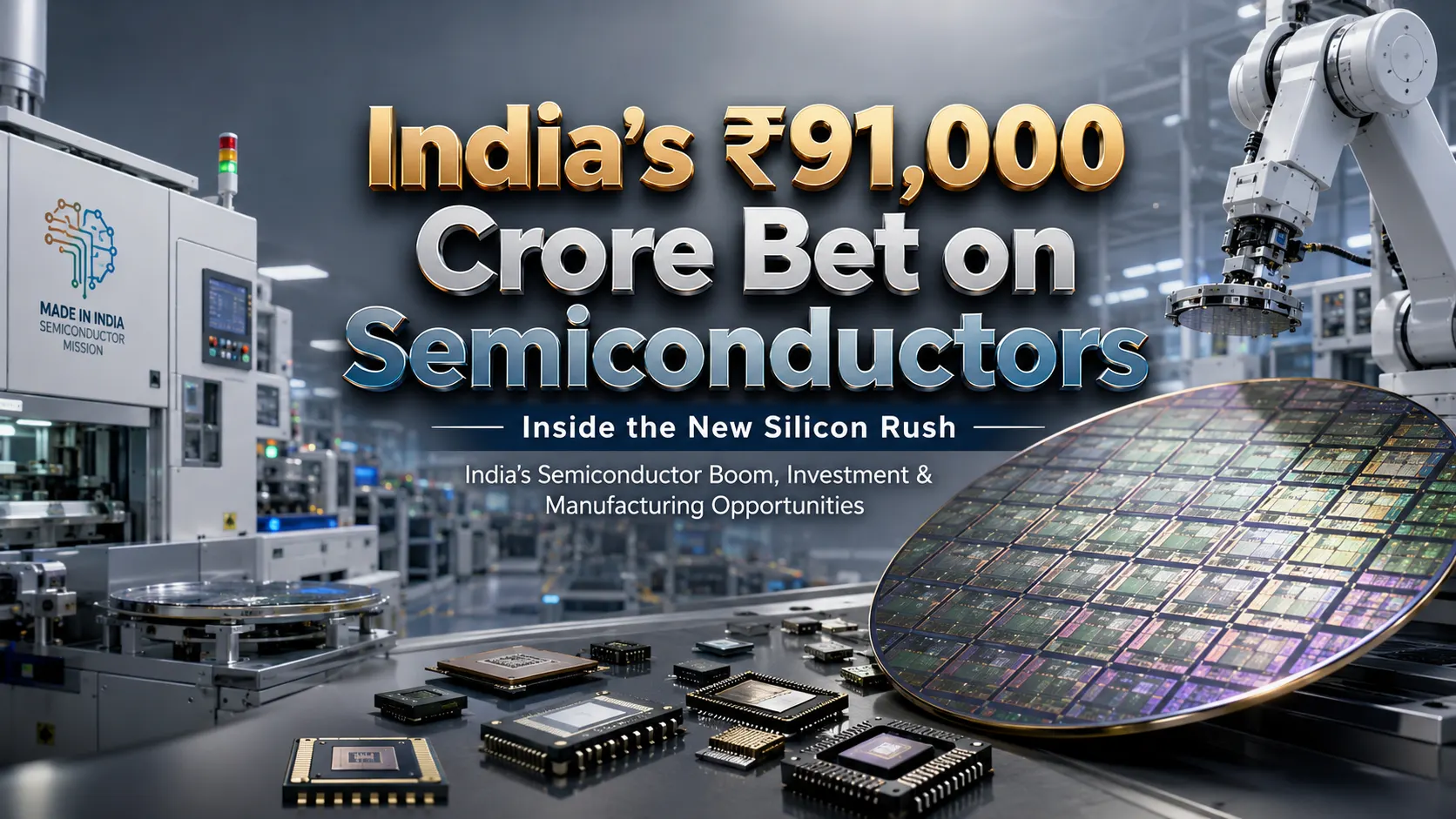
The single largest private industrial investment in India, on the site alone, is ₹91,000 crore and 300mm wafer fab. This is so easy to read as a tale of big business and geopolitics. In fact, it’s the tale of the biggest manufacturing opportunity that the small and mid-sized industrial sector in India has witnessed in the past decade.
Access Complete Business Plan: Transistor and Semiconductor
A Second Wave Bigger Than the First
India’s chip dreams are nothing new — the first India Semicon Mission was established in December 2021 with a promise of offering incentives worth ₹76,000 crore. The scale and the speed are the only things that have changed. As of mid-2026,
Total of twelve semiconductor manufacturing units approved in six states and investment commitment crossed ₹1.64 lakh crore. Three units — Micron’s ATMP plant in Sanand, CG Semi and Kaynes Semicon — have already started commercial production. In July 2026, the Union Cabinet took a step further and approved
India Semiconductor Mission 2.0, a fresh ₹1.27 lakh crore outlay aimed squarely at the layer beneath the headline fabs: equipment, materials, chip design, and — critically for smaller manufacturers — the domestic supplier ecosystem.
The 28-nanometre and below process nodes — not the state-of-the-art 2nm chips that are making headlines around the world — are where the Tata-Powerchip fab at Dholera is focusing its R&D efforts. First silicon is scheduled to be delivered late in 2026, with 100% fabrication readiness by 2028.
Why This Isn’t Just a Big-Company Story
All semiconductor fabs require massive support ecosystems beyond them — such as chemicals, specialty gases, ultrapure water systems and cleanroom infrastructure, precision components, testing services and logistics. None of this is built by the fab operator. It’s constructed by hundreds of smaller, specialised suppliers that are concentrated near the anchor facility.
But according to a guide to semiconductor MSME entry points, a significant portion of companies in any semiconductor ecosystem will not be chip makers themselves, and that’s where most of the new manufacturing companies will be born over the next five years.
An MSME opportunity analysis of the semiconductor supply chain notes that India’s semiconductor strategy is designed to be different from Taiwan’s TSMC-centric and South Korea’s Samsung-led strategy, and is built on a distributed supply chain model, featuring integration of MSMEs, instead of a few large vertically integrated entities. It’s a structural option that has real implications for entrepreneurs – it implies thousands of niches, medium-sized manufacturing and service companies are supposed to proliferate around every fab, rather than just a few billion-dollar contractors.
One number puts the opportunity into reality. Despite being the second largest manufacturer of smartphones in the world and growing focus within industrial automation and defence electronics, India imports about 85% of its Printed Circuit Board (PCB) needs. Less than 5% of the domestic PCB production is meeting the demand and the global PCB market is valued at more than $80 billion. It doesn’t fill because one huge firm chooses to fill it, it fills because hundreds of mid-sized manufacturers build the capacity one facility at a time.
Get Detailed Insights from This Book: Book
Where the Entry Points Actually Are
Applied Materials, ASML and Tokyo Electron, which are the major equipment suppliers for fabs, rely on a network of smaller suppliers for 40–60% of their components. That is the layer where MSMEs of India really face competition, not directly from ASML, but as a part of its supply chain, or as a direct vendor to the fabs and packaging units that are expected to emerge around Dholera, Sanand, Assam and Odisha.
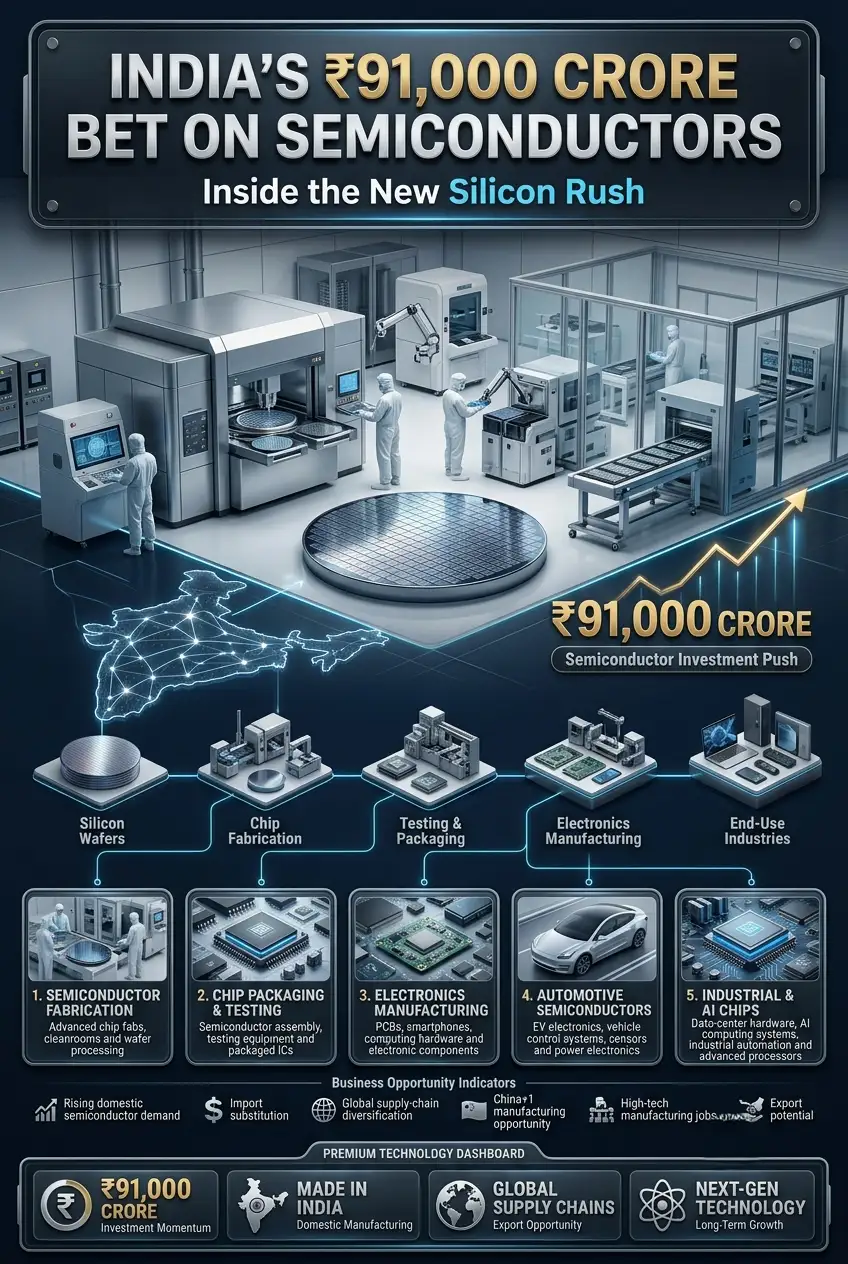
Generally speaking, the entry points are divided into three levels including three levels of capital and technical barriers.
Materials and consumables. Domestic shortage of specialty chemicals, ultrapure water systems and cleanroom grade consumables. These are based on regulatory grade quality systems and have relatively low capital investment to be entered at the component level.
Precision components and tooling. Precision-machined parts, jigs and fixtures are required constantly for the fabrication and packaging units. Even machine shops that cater to the auto-components or aerospace industry may be just one step removed from becoming fab suppliers.
Testing, quality assurance and logistics services. Service-related ventures such as electronic component testing, failure analysis testing and specialised logistics for sensitive goods are lower capital investment points and, unlike fabrication, are not sensitive to changes in the fabrication construction timeline because testing demand is recurring.
The Policy Support Is Real, Not Theoretical
The Design Linked Incentive scheme already approved 24 semiconductor design projects by start-ups and MSMEs, and 105 start-ups and MSMEs have been provided access to industry-standard Electronic Design Automation tools which would otherwise cost them a lot in their own capacity.
What Kotak’s duty exemption opportunity analysis suggests for manufacturers is that duty exemptions on capital goods, bonded warehousing (no duty payment on inventory storage) and deferred duty systems (ease working capital stress) have been designed specifically to reduce the barrier for smaller manufacturers to enter ancillary production, beyond just benefiting the anchor fab operators.
States are piling on their own incentives. Additionally, in the Gujarat Aatmanirbhar Gujarat Schemes for Assistance to Industries, the definition of MSMEs explicitly includes ancillary ecosystem suppliers of goods and services, including equipment, raw materials, and specialty gas providers, beyond just a list of ISM projects under the semiconductor corridor.
Related Article: Semiconductor & Electronics Manufacturing in India: MSME Entry Points, Realistic Costs, and Where the Real Money Is
What This Means for a First-Generation Entrepreneur
The good news first: No one is building a wafer fab with ₹10 lakh. Front end fabrication is still a billion-dollar proposition, and it’s a specialty for large business and multinational companies. That is not where the MSME opportunity is and anyone telling you otherwise is reading in the wrong direction of the sector.
For a quality-minded, disciplined entrepreneur the ancillary level is where they can make a realistic entry — precision component manufacturing, specialty chemical supply, PCB manufacturing, or testing and QA services. These are not to be achieved with minimal investment in quality systems and certification, sector knowledge and a multi-year qualification cycle with anchor customers. But it doesn’t need billion-dollar investment, and increasing visibility has been building, with domestic manufacturers actively seeking to shift a share of their needs from outside the country to local suppliers in a bid to bring in time-sensitive and high-value supplies.
Learning From the Micron and Kaynes Playbook
The Assembly, Test, Marking and Packaging facility in Sanand, Gujarat with an investment of more than ₹22,500 crore, was the first facility to be inaugurated in February 2026, under the current mission cycle. For smaller manufacturers, the number of the investment is not important, it’s the timeframe. Kaynes Semicon’s OSAT (On-Site Assembly and Test) facility in Sanand was making its second commercial production into the market in only 14 months, and its first commercially produced multi-chip modules were shipping to an overseas customer in that timeframe.
This is an anchor facility that requires local sourcing as it moves quickly, and that does not wait for the domestic sourcing base to develop at its own pace. Suppliers that are certified already are the first, and least competitive, to get contracts when a facility such as this opens.
Likewise, the Semicon 2.0 announcement, which comes with an investment of ₹1.275 trillion, has made a clear call to anyone thinking about joining the manufacturer ecosystem: It is not only for the anchor investors who are putting up fabs.
A Practical First Step
For a manufacturer already working in precision engineering, industrial chemicals, or electronic component testing, the realistic path in isn’t a cold call to a fab operator — it’s a feasibility exercise: which part of the manufacturing supply chain already has the machinery and expertise to support the product, what certification is required to meet fab-supplier quality standards, and what will the 18- to 24-month plan be? That is where a detailed techno-economic study of a project is useful and returns its investment many times over, because certification problems that are found after the capital investment is made are much more expensive to deal with than the ones found on paper.
Start with clarity—choose the best business idea
How NPCS Can Help You Get Started
Moving into semiconductor ancillary is not a journey into unexplored territory, but a straightforward feasibility analysis. When entrepreneurs assess their entry into precision component manufacturing, specialty chemical supply, PCB manufacture and electronic testing services, they need to know how to position their existing equipment and know-how against the quality criteria set by the fabricators, and the expected timeline and cost for certification; as well as how to model project financials against realistic anchor-customer contract sizes from the fabricators.
Some business ideas that can be considered for entrepreneurs are PCB (Printed Circuit Board) manufacturing where India imports about 85% of its requirements; electronic component testing and failure analysis laboratory services; precision CNC-machined components for cleanroom and fab equipment; supply of specialty gas and ultrapure waters systems for semiconductor processing facilities; and formulation and packaging of electronic-grade chemicals for semiconductor processing facilities.
The Bigger Picture
By 2028, there will be about 300,000 jobs in the semiconductor supply chain — in quality control, logistics, and supplier — and most of these jobs will be with MSME-scale service and component providers, not with the fabs themselves.
That’s the actual reason behind the headliner of ₹91,000 crore Dholera. The anchor is the forth important factor. The opportunity is what India needs to build around it and, unlike the fab, most of the surrounding ecosystem is being created by companies that don’t even exist.
For manufacturers contemplating entry, the equation is more like what unfolded a decade or two years ago with the auto parts industry in India than anything close to a spec sheet flair-up. Soon, there were anchor plants and within a few years the demand for qualified local suppliers began to grow and the companies that started investing in the certification and quality systems would get long-term contracts, while those that waited until the market was fully mature would have to compete for the scraps from the suppliers already qualified. Semiconductors are playing out the same scenario, only on a shorter timeframe.


