





Semiconductor Manufacturing MSME India
The Number That Should Keep Every MSME Founder Up at Night
Eighty-five. It represents the percentage of Printed Circuit Board (PCB) requirement of India fulfilled by imports. Not 30%, not 50% — eighty-five percent. The country produces the second largest number of smartphones in the world and conducts lines of industrial automation between Pune and Hosur and produces defence electronics in Bengaluru. Those are all on a PCB. And, the overwhelming majority of the PCB is from China/Taiwan or Hong Kong.
As per data shared at the Bengaluru Tech Summit (November 2025), India’s PCB demand is less than 5% domestic. The worldwide PCB market value is more than $80 billion. India’s contribution to domestic production is negligible.
It’s not a market with a low upside. It’s a sector that has a structural supply shortage of such magnitude that the government has sanctioned ₹22,919 crore for a dedicated scheme – Electronics Component Manufacturing Scheme (ECMS) – to address it. The question for every first-generation entrepreneur or MSME founder is very simple: How to get in before this chance is gone?
It’s not about building a chip fab. That requires billions. The solution is to make the components, ranging from passive components (capacitors, resistors, inductors) through precision metal components to electronic sub-assemblies — the entry point of capital is at ₹50 lakh and margins are in the 18-25% range.
The Gap Is Real, the Numbers Are Staggering
Niir Project Consultancy Services has compiled data that shows India imports $35 billion worth of electronics parts in FY2024. The import basket includes almost all PCBs, connectors, sensors, passive components and semiconductors, all from China, Taiwan, Hong Kong and Vietnam. The electronics industry has a low domestic value added at only 18-20% compared to 40% or higher in China and South Korea.
Export values for electronics, for instance, have gone up by 30% and more in two years from $23.5 billion in FY2022–23 to $38.6 billion in FY2024–25. India imports components to make finished goods, and exports the latter. There is the business gap.
The Electronics Component Manufacturing Scheme (ECMS) costing ₹22,919 crore was approved by the Union Cabinet in April 2025 for PCBs, passive components, Li-ion cells, connectors and display modules, which are specific areas of technology in which India has been “heavily import-dependent”, according to the notification issued by MeitY. The scheme promises an investment of ₹59,000 crore and a production of ₹4.56 lakh crore during the six-year period.
Only about 500 MSMEs are present in India for the production of PCBs. The electronics assembly industry is concentrated in the four states of Tamil Nadu, Karnataka, Maharashtra and Uttar Pradesh, which have a high demand for local components. The new industrial clusters are emerging as Sri City in Andhra Pradesh and Neemrana in Rajasthan, which have the capacity to support component suppliers for electronics manufacturing.
The demand isn’t speculative. The Pune based and Chennai based EV manufacturers require PCBs for their battery management systems. They are required by the defence contractors of Hyderabad for avionic purposes. They are required by the telecom equipment assemblers in Noida for 5G base stations. Each of these customers is buying from China at this time as there is no one else.
Get Detailed Insights from This Book: Handbook on Electric Vehicles Manufacturing
TABLE 1: Key Electronics Manufacturing Clusters & MSME Component Demand by State
| State | Key Districts/Clusters | Electronics Activity | Component Demand Focus | MSME Opportunity Rating |
| Tamil Nadu | Chennai, Hosur, Sriperumbudur | Mobile phones, EVs, auto electronics | PCBs, battery connectors, flex circuits | ★★★★★ Very High |
| Karnataka | Bengaluru, Doddaballapura, Mysuru | Aerospace, defence, IT hardware | Multilayer PCBs, passive SMDs, sensors | ★★★★★ Very High |
| Maharashtra | Pune, Mumbai, Nashik, Aurangabad | Auto electronics, industrial control | FR-4 PCBs, connectors, wire harness | ★★★★☆ High |
| Uttar Pradesh | Noida, Greater Noida, Lucknow | Telecom equipment, consumer electronics | Single/double layer PCBs, passives | ★★★★☆ High |
| Andhra Pradesh | Sri City, Tirupati, Visakhapatnam | Hardware OEMs, export processing | PCBs, sub-assemblies, cable harness | ★★★★☆ High |
| Rajasthan | Neemrana, Bhiwadi, Jaipur | Japanese OEM suppliers, EMS units | Passive components, PCBs, packaging | ★★★☆☆ Emerging |
| Telangana | Hyderabad, Medchal | Defence electronics, pharma instruments | Speciality PCBs, precision metal parts | ★★★☆☆ Emerging |
Sources: IMARC Group PCB Market Report 2025 (imarcgroup.com); MeitY Electronics Cluster data; NIIR.org industry analysis
Why the Timing Is Right — and Won’t Stay This Way
Three forces are coming together at the same time. If you miss them, you’ll be doing capacity building after the window has closed.
Diversification of supply chains on the global level. Multinational companies – from Apple’s suppliers to Foxconn to Samsung – are aggressively promoting manufacturing in India. Foxconn will be manufacturing 25-30 million iPhones in India by the end of 2025. For any assembly line, parts must be locally available. These companies are looking to find Indian suppliers that can match the quality. They don’t want to continue to import from China.
Government funds are available. There are four schemes directly benefitting MSME electronics manufacturers:
- Electronics Component Manufacturing Scheme (ECMS): Outlay of ₹22,919 crore, Incremental sales based on turnover linked & capex linked incentives of 4-6% for 6 years, along with capital subsidy of up to 25% for eligible units. PCBs and passive components are specifically addressed.
- Design Linked Incentive (DLI) Scheme (MeitY): Provides financial and infrastructure support to MSMEs / Startups for the design of ICs / chipsets / SoCs. More than 32 start-ups/MSMEs have already benefited with a benefits package of more than ₹500 crore.
- Electronics Manufacturing Clusters (EMC 2.0): Facilities for plug and play sheds, testing labs, common facility centres will be available with provision of capital support which will significantly lower the barrier to entry for new MSME units in industrial parks.
- CGTMSE (Credit Guarantee Fund Trust for Micro and Small Enterprises): Credit guarantee facility of up to ₹5 crore is available for MSME borrowers, which helps them access bank loans without the need for them to pledge any land or property for the first time.
India’s EV production is accelerating rapidly and is emerging as a new demand engine. The 10-25 PCBs used in EV battery management, motor control and infotainment systems make up the complete EV. The Society of Indian Automobile Manufacturers (SIAM) predicts that EV sales will account for more than 30% of new vehicles sold within five years. The demand for PCBs from EV sector alone will need a capacity which is not available in the country yet.
The window is open. The government is providing financial assistance. Customers are all set to purchase.
Get Detailed Project Report (DPR): Electrical, Electronic Industries and Power Projects
Setting Up a PCB / Electronic Component Manufacturing Unit: Step by Step
Minimum Investment
Small scale (Single- and Double-sided PCB) Manufacturing line can be started with total project cost ranging from ₹ 50 lakh to 1.5 crore. This includes basic land (leased industrial shed), important machinery, working capital and compliance. For a medium scale unit targeting multilayer PCBs, the cost is from ₹3 crore onwards. Don’t even consider buying a unit under ₹40 lakh — the minimum cost of the machinery is ₹25–30 lakh and a lack of effluent treatment will prove your downfall as well.
Space Requirements
The minimum space requirement for a starter unit is 2000 to 3000 sq ft of covered industrial space preferably in an Electronics Manufacturing Cluster or SIDCO estate. The sheds of this size can be found in various state industrial development corporations, such as TIDCO (Tamil Nadu), KIADB (Karnataka), and MIDC (Maharashtra) in the electronics special zones where they are offered at subsidized rates on a plug and play basis. Do not build on land without prior tests of demand for use, try to lease first!
Key Machinery
- A station for cutting and cleaning PCBs in the laminate (₹3–5 lakh)
- Cost of the photoresist coating and UV exposure unit: ₹8–12 lakh
- The chemical etching line with effluent treatment tank costs Rs. 10–15 Lacks.
- CNC drilling machine (₹5-8 lakh for entry level and ₹20-30 lakh for precision 4-spindle machine)
- The electroless copper plating bath and through-hole plating (₹5–10 lakh) setup is used.
- The solder mask application and curing oven are valued at ₹ 4-7 lakh.
- As part of the inspection process, this is an essential machine which is priced at ₹8–15 lakh and cannot be left out (Automated Optical Inspection).
- The effluent treatment plant (ETP) is compulsory and needs to be installed at a cost of ₹5–10 lakh.
Raw Material Sourcing
The most important raw material is FR-4 copper-clad laminates (CCLs) which are imported from China, Taiwan and South Korea. Domestic suppliers are Aica India (Gujarat) and India distribution of Ventec International Group. Atotech India (Gurugram) and MacDermid Enthone (Pune) are the suppliers of chemicals (ferric chloride, ammonium persulphate, solder masks). Specialty films and copper foil can be obtained from MMFL Industries (Maharashtra).
Licenses and Regulatory Approvals
- Udyam Registration (MSME): Day 1, Free, online at udyamregistration.gov.in for all scheme benefits.
- GST Registration is compulsory for manufacturing. Apply via gstin.gov.in.
- Under the Factories Act, 1948 — Factory License (Apply to the state’s Labour Department).
- Consent to Establish and Consent to Operate (CTE/CTO): From the State Pollution Control Board. Hazardous chemicals are used in PCB manufacture and this is a ‘Red Category’ clearance; plan 3–4 months for this clearance.
- Authorisation of hazardous waste stores under the Hazardous Waste Management Rules from SPCB.
- If you are manufacturing consumer electronics products that are covered by BIS regulations (categories of products). Check the Electronics and Information Technology Goods (Requirement for Compulsory Registration) Order.
- Industry standard; needed for defence and aerospace customers according to IPC-A-600 / IPC-6012 Quality Certification.
Timeline
Time to first production batch after Udyam registration: 7-10 months. The process can be segmented as Company Registration and Udyam (1 month), SPCB clearance (3-4 months which is the constraint), Procurement and Installation of machines (2 months), Trial production and quality testing (1-2 months). Get SPCB clearance, Day 1.
Related Article: India’s Semiconductor Boom — Here Are 3 Business Ideas to Enter Under ₹5 Crore
Team Size to Start
Standard crew size for a starter unit: 1 process engineer (ITI or diploma in electronics/chemical engineering), 4-6 skilled operators for chemical lines and drilling, 1 QC inspector and 1 plant manager. The number of team members for a commercial production is usually 10 for 10 people. The salary range of line workers in the electronics zones in Tamil Nadu and Karnataka is between ₹14000 and ₹22000 per month.
TABLE 2: Investment Breakdown for a Small-Scale PCB Manufacturing Unit (Entry-Level, Single/Double Layer)
| Cost Head | Minimum (₹) | Recommended (₹) | Notes |
| Industrial shed (leased, 2,500 sq ft) | ₹1.2 lakh/yr | ₹1.8 lakh/yr | Prefer SIDCO/KIADB/MIDC estate |
| Civil works & utilities setup | ₹3 lakh | ₹5 lakh | ETP civil work, power connection, drainage |
| Core machinery (etching, drilling, plating) | ₹25 lakh | ₹45 lakh | Includes UV unit, curing oven |
| AOI & Quality testing equipment | ₹8 lakh | ₹15 lakh | Critical — do not eliminate from budget |
| Effluent Treatment Plant (ETP) | ₹5 lakh | ₹10 lakh | Mandatory for Red Category clearance |
| Initial raw material inventory | ₹5 lakh | ₹10 lakh | FR-4 laminates, chemicals, copper foil |
| Licences, BIS, IPC certification | ₹2 lakh | ₹4 lakh | Including SPCB, factory, GST registration |
| Working capital (3 months) | ₹6 lakh | ₹12 lakh | Wages, utilities, consumables |
| Contingency (10%) | ₹5.5 lakh | ₹10 lakh | Non-negotiable buffer |
| TOTAL | ~₹55–60 lakh | ~₹1.1–1.2 crore | Varies by location & machinery brand |
Sources: Corpseed PCB Plant Setup Guide (corpseed.com); Corpbiz India Manufacturing Setup (corpbiz.io); NIIR.org project cost estimates
ENTREPRENEUR SPOTLIGHT
This is a journey of the MSMEs from Sahasra Group to Fab in Rajasthan.
Located in Rajasthan, Sahasra Electronics started in the PCB assembly and component distribution segment and expanded its operations to the semiconductor manufacturing segment. The company established India’s first memory chip assembly, test and mark (ATMP) facility in Bhiwadi, Rajasthan, one of the first MSMEs in India to venture into chip level manufacturing.
Scale: ₹200-250 crore revenues, >500 employees.
Key lesson: Begin the customer relationship, cash flow and process discipline from the component supply chain (PCBs and sub-assemblies). Only then ascend to the higher margin, higher complexity segments. It’s the quickest route to steady income to join as a sub-vendor to a major OEM.
The feature of the Electronics Component Manufacturing Scheme as per Reference Invest India
Financial Snapshot: What Does the Money Actually Look Like?
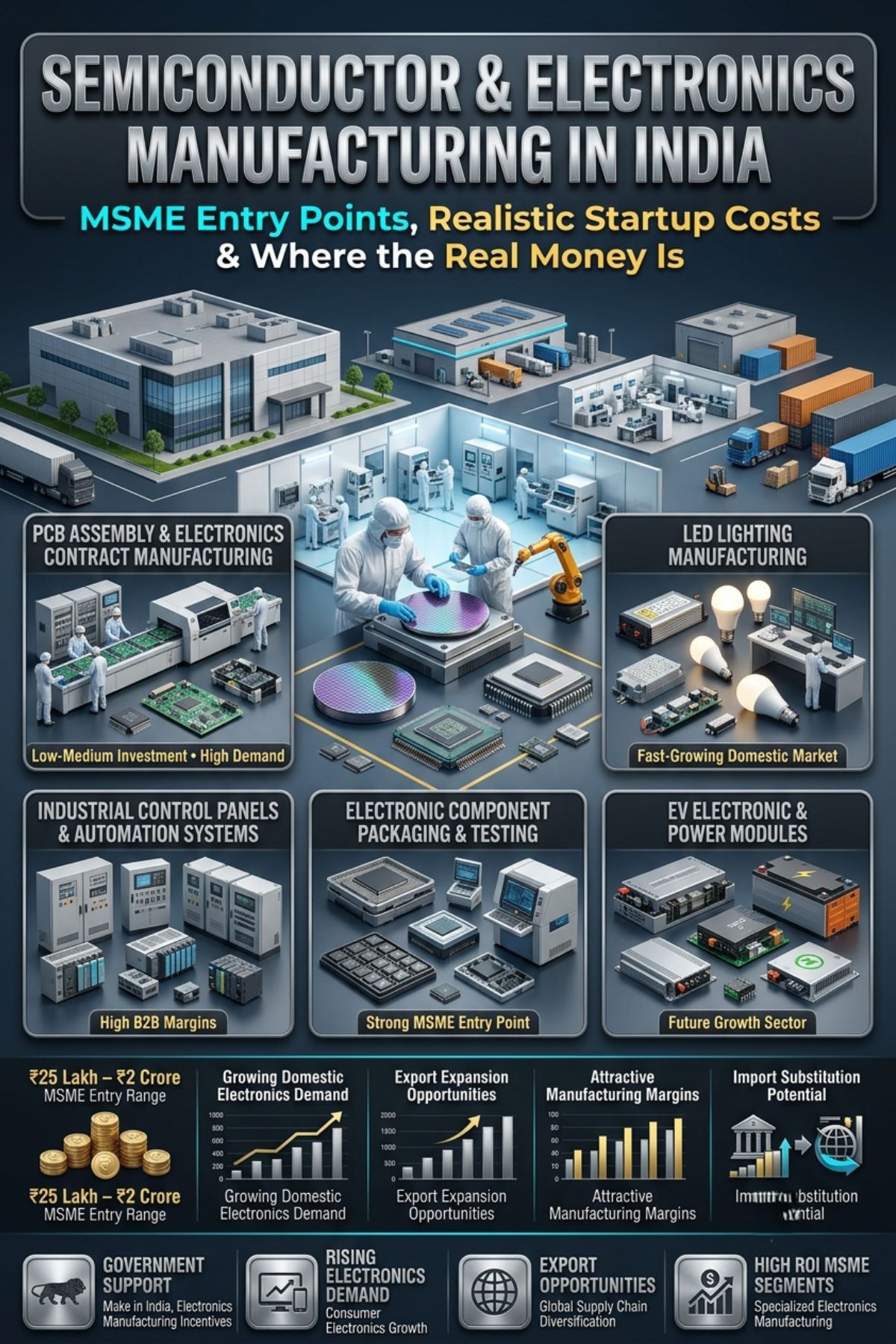
These figures are based upon a single/double layer PCB manufacturing unit having overall project cost of Rs.1 crore running in an electronics industrial area of Tamilnadu or Karnataka.
Capital Expenditure: Rs.55 Lakhs to Rs.1.2 crore as per the choice of machinery and level of automation.
Monthly Operating Costs (60% Capacity): Rs.8-10 lakh including raw material (FR-4 Laminates, Chemicals), 10 staff, power consumption (Power consumption is 20-40 KVA for PCB manufacturing), maintenance, and compliance costs.
Revenue at 60% Capacity: If the unit is running at 5,000 sq ft per month with a monthly PCB price of ₹400 to ₹600 per sq ft, then the monthly turnover of the unit will be ₹20 lakh to ₹30 lakh.
Revenue at 100% Capacity: ₹35–50 lakh/month.
Gross Margin: 35-42% based largely on value addition premium to raw laminates. The price premium for quality certified units (IPC-6012) is 10-15% above uncertified imports.
Net Margin: 18-25% at full capacity with all overheads. It aligns with the published EBITDA data of PCB manufacturers as analysed by NIIR.org.
The payback period of the investment of ₹1 crore is 3-4 years when used at 70% capacity utilisation. Units that enter into a long-term contract with an OEM can see a payback in 30-36 months.
Find high-return business ideas based on your budget & ROI
TABLE 3: Applicable Government Schemes for MSME Electronics/PCB Manufacturers
| Scheme | Nodal Body | Benefit Type | Key Benefit | Where to Apply |
| Electronics Component Manufacturing Scheme (ECMS) | MeitY | Turnover-linked / Capex subsidy | 4–6% on incremental sales + up to 25% capex subsidy over 6 yrs | meity.gov.in / Invest India portal |
| Design Linked Incentive (DLI) | MeitY / C-DAC | Financial + infrastructure | Up to ₹15 crore per startup/MSME; IP ownership retained by applicant | semieonindia.gov.in |
| CGTMSE – Collateral-Free Loan Guarantee | SIDBI / Banks | Credit guarantee | Collateral-free loans up to ₹5 crore for MSMEs; bank bears minimal risk | Via any scheduled commercial bank |
| EMC 2.0 (Electronics Manufacturing Clusters) | MeitY / State Govts | Infrastructure subsidy | 50% of project cost (up to ₹50 crore) for common facility centres in clusters | meity.gov.in |
| MUDRA Loan – Tarun Category | MUDRA / Banks/MFIs | Term loan | Loans up to ₹10 lakh (Shishu), ₹5 lakh–₹10 lakh (Kishore), ₹10 lakh–₹20 lakh (Tarun) for micro-units | mudra.org.in |
| Udyam Registration | MSME Ministry | Gateway benefit | Mandatory for all scheme access; unlocks priority sector lending, NSIC benefits, and tender preferences | udyamregistration.gov.in |
Sources: MeitY (meity.gov.in); SIDBI CGTMSE portal; IMPRI India semiconductor policy analysis (impriindia.com)
Project Consultancy: Getting the Numbers Right Before You Commit
Capital is a prerequisite for a first-generation entrepreneur in electronics manufacturing, but he or she should have more than government brochures to rely on. Found at niir.org, Niir Project Consultancy Services (NPCS) supplies end-to-end project consultancy, plant layout designs, machinery specs etc for manufacturing sectors such as electronics sub-assemblies, passive components and PCBs. They provide project reports that include capital cost estimation, raw material sourcing, regulatory compliance checklists and revenue projections based on market conditions in India. Whether you want to start a business at ₹50 lakh or ₹1.5 crore, a structured project report from NPCS (which is available online at entrepreneurindia.co) can save you from making costly errors when you select the machinery and design the factory layout before you spend even a rupee on construction.
The Decision in Front of You
They’re constructing the components supply chain the Indian govt should have begun constructing twenty years back. And these are paying us to complete. The purchasers — EV vehicle manufacturers, the defence people, telecom set builders and shopper electronics OEMs — are willing to sign off the top in any procurement contracts if anyone makes it in Indian companies.
The one thing you should do next is this: visit the nearest Electronics Manufacturing Cluster in your state and speak to the cluster manager about available shed space and common facility access. Then contact a bank about CGTMSE-backed financing for ₹50 lakh to ₹1 crore. Do not wait for the “perfect” time. There are fewer than 500 PCB MSMEs in a country of 1.4 billion people. The gap is real. The policy is in place. The money is available.
Detailed project reports for PCB manufacturing units are available at niir.org. Apply for the ECMS scheme at meity.gov.in. Register your MSME at udyamregistration.gov.in before anything else.
Frequently Asked Questions
Q1. How much do I need to start a PCB manufacturing unit in India?
You can start minimum to small scale single- and double-layers units from 55 to 60 lakh, including machinery, effluents treatment plant, license and 3 months working capital. Medium-scale PCB unit with the facility of multilayer and testing setup will require an investment between 1 crore and 1.5 crore for a sustainable business. Do not underestimate the cost of SPCB compliance and ETP setup — these alone can run ₹10–15 lakh.
Q2. What licences are mandatory before I can begin production?
Mandatory approvals include: Udyam Registration, GST registration, Factory License (under the Factories Act), Consent to Establish and Consent to Operate from the State Pollution Control Board (the most time-consuming — apply first), and Hazardous Waste Authorisation. If supplying to defence or aerospace, IPC-6012 quality certification is effectively mandatory. BIS registration may apply depending on end-product categories.
Q3. Where can I source raw materials in India?
FR-4 copper-clad laminates are available from Aica India (Gujarat) and via Ventec International’s India distribution. Electronic chemicals (etchants, solder masks) are available from Atotech India (Gurugram) and MacDermid Enthone (Pune). Specialty copper foils and films from MMFL Industries (Maharashtra). For bulk consumables, Chennai and Bengaluru have the deepest distributor networks. Factor 45–60 day import lead time for items not available domestically.
Q4. What are the realistic profit margins for a PCB unit?
At full capacity, net margins of 18–25% are achievable. Gross margins run 35–42%, with quality-certified units (IPC-A-600) commanding a 10–15% price premium over uncertified imports. Units with long-term OEM supply agreements reach payback in 30–36 months. Without a confirmed customer pipeline before you start production, payback stretches to 4–5 years.
Q5. What government support is available specifically for first-time MSME founders?
Three schemes are most accessible for first-time founders: (1) CGTMSE provides collateral-free loan guarantees up to ₹5 crore — critical if you have no property to pledge; (2) ECMS offers capex-linked incentives for electronics component manufacturers; and (3) MUDRA Tarun loans of up to ₹20 lakh for micro-manufacturing units just starting out. All require Udyam Registration as the base eligibility.
Q6. How do I access NPCS project reports and consultancy?
Niir Project Consultancy Services (NPCS) publishes detailed, India-specific project reports for PCB manufacturing, passive component manufacturing, and electronics sub-assembly units. Reports include machinery lists, plant layouts, financial projections, and regulatory checklists. Access them at niir.org or through entrepreneurindia.co. Reports are priced at ₹5,000–₹15,000 depending on the scope — a negligible cost before committing ₹50 lakh or more.


