







ALMM solar manufacturing India 2026
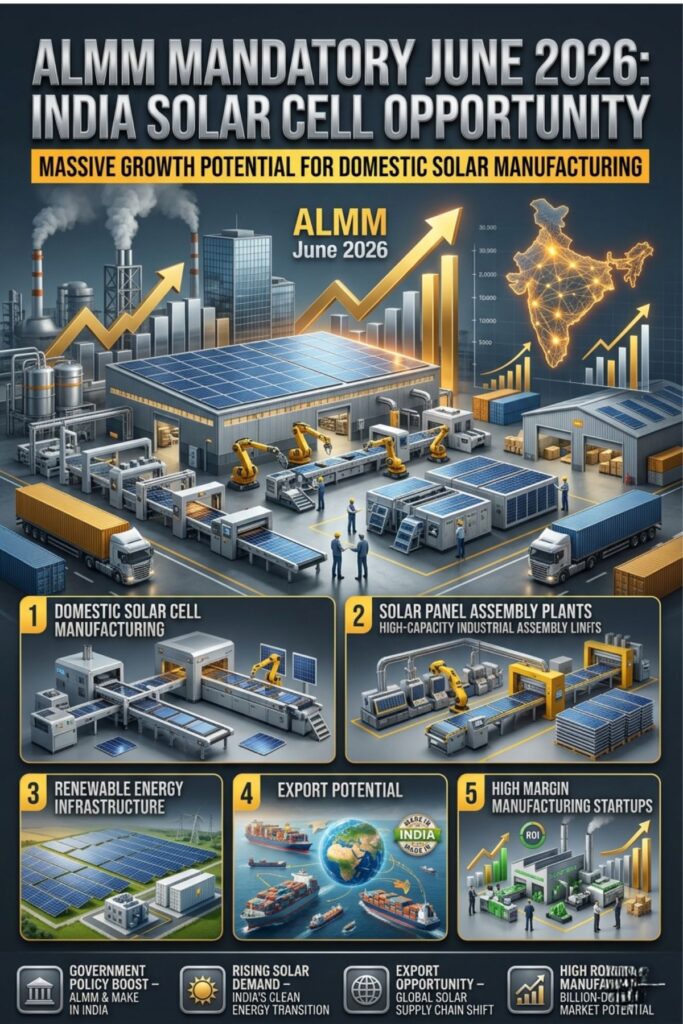
India’s Renewable Energy (RE) sector is undergoing a historic change with the implementation of Approved List of Models and Manufacturers (ALMM) under the Ministry of New and Renewable Energy (MNRE) Ministry of New and Renewable Energy.
Official source: https://mnre.gov.in/
All solar projects in India, from rooftop to Net metering to utility scale projects, will be based on ALMM approved solar modules and cells from 2026.
This implies that products which are not purchased or not listed for projects will not be accepted. The effect is enormous: it is not a market-driven demand, it is a demand guaranteed by the policy.
In the case of Entrepreneurs and MSMEs, this is a once-in-a-lifetime opportunity with the support of business demand directly from the Government regulations.
Table of Contents
ToggleWhat is ALMM and Why It Is So Important?
The ALMM system is intended to keep the quality under check, boost domestic manufacturing expansion, and lessen reliance on imports in India’s solar industry.
It is divided into:
- ALMM List-I: Solar PV module manufacturers
- ALMM List-II: Solar PV cell manufacturers
All approved lists are put on MNRE’s official portal:
Solar products can only be provided for use in Government projects, PM schemes and grid connected installations by companies that are members of ALMM.
This helps to produce a closed, but stable, market environment in which approved manufacturers are given immediate access to demand without intense competition.
Get Detailed Insights from This Book: Solar PV Power and Solar Products Handbook
India’s Solar Demand Growth and Supply Gap
India’s target is to install 500 GW of renewable energy capacity by 2030, of which the bulk is to come from solar power. Installed solar power is already at about 18-22 GW per year and is increasing at a fast pace.
The domestic production, however, remains limited to 8-10 GW of solar cells every year, thus the continuous production shortfall.
Major demand drivers include:
- Solar energy from utility scale solar parks in Rajasthan and Gujarat
- Industrial captive solar plants
- Agricultural solar pump programs
- Rooftop solar expansion under PM Surya Ghar Yojana
Official scheme portal – https://pmsuryaghar.gov.in/#/
This scheme alone is expected to lead to millions of rooftop installations in India—enhancing the demand for ALMM certified modules.
Why ALMM Creates a Strong Business Opportunity
The ALMM solar manufacturing has regulated demand protection, unlike traditional manufacturing industries.
The manufacturer is added to the list once it has been listed:
- It becomes eligible for nationwide solar projects
- Predictable and stable demand occurs.
- There is less competition and pricing pressure eases.
The MNRE has clarified that there will be no relaxation of the ALMM List-II from June 2026 apart from case-to-case reliefs.
This helps to ensure manufacturers have a more secure long-term demand.
Get Detailed Project Report (DPR): Renewable Energy & Green Power Technologies
Investment Required for Solar Manufacturing in India
For solar manufacturing, there are several different levels at which it can be begun, depending on the scale:
The basic module assembly unit needs an investment of ₹3-5 crores and solar cell manufacturing plant requires an investment of ₹13-20 crores depending on automation and technology.
The key cost factors are:
- PECVD systems and diffusion furnaces.
- This is due to the screen printing and metallisation lines.
- EL testing and quality control systems
- Cleanroom infrastructure
- Working capital for raw materials
Although investment is significant, this business is attractive since there is no option attached to the demand, only mandatory according to ALMM.
Government Schemes Supporting Solar Manufacturing
There are various schemes in India supporting solar manufacturing financially, including:
Key Government Support:
- Production Linked Incentive (PLI) Scheme under MNRE Ministry of New and Renewable Energy
https://mnre.gov.in/ - PM Surya Ghar Yojana (Rooftop solar demand creation)
https://pmsuryaghar.gov.in/#/ - PMEGP (MSME capital subsidy support)
- CGTMSE (Collateral-free loans up to ₹2 crore)
- Solar Park infrastructure support
These schemes significantly reduce entry barriers for MSME entrepreneurs.
Step-by-Step Setup Process for Solar Manufacturing Unit
A solar manufacturing plant is organized and usually takes 12-18 months to set up.
Starting with the company registrations Udyam registration, then GST & factory license.
After this has been achieved the land is obtained which should ideally be in industrial estates or solar parks where the required infrastructure is available.
Installation of machinery is the most important stage. To ensure efficiency and BIS compliance, precision equipment needs to be imported from suppliers all over the world.
Once production starts, the unit should be BIS certified to solar standards IS.
Certification reference: https://mnre.gov.in/
After BIS approval, the manufacturer submits an application to MNRE for the ALMM listing of the product.
Official ALMM portal with technical validation and solar compliance testing:
https://solardcrportal.nise.res.in/
Once accepted, the company can supply solar projects throughout India.
Financial Performance and Profitability
The typical production of a 20 MW solar cell manufacturing unit is:
- Annual revenue: ₹29–36 crore
- Operating margin: 12–18%
- Payback period: 5–7 years
The plant becomes operationally stable at 60% and is more profitable with Government incentives such as PLI.
The one single thing that comes with it is the fact that they will have stable pricing. ALMM controlled domestic demand provides a steady flow of cash and is not as volatile as exports.
Role of NPCS in Solar Business Setup
NIIR Project Consultancy Services (NPCS) is one of the best project consultancies in India to assist MSME entrepreneurs.
Official website: https://www.niir.org/
Entrepreneur platform: https://www.entrepreneurindia.co/
NPCS offers full business services such as:
- Detailed Project Reports (DPRs)
- Machinery selection guidance
- Plant layout design
- Financial feasibility studies
- Documentation of loans and subsidies
These reports are recognised by banks and financial institutions which makes business funding approval easier for the entrepreneurs.
NPCS has a vital role to play in transforming the raw business concepts into bankable industrial projects.
Related Article: Solar Policy Tightens: Domestic Manufacturing Gets a Stronger Push
Real Market Insight: Why Timing Matters
In the recent days, the industry has got an update that India has not been playing any softball with ALMM and is taking it seriously and without any delay, thus promoting the growth of domestic manufacturing.
Meanwhile, solar power systems on the roof tops are gaining popularity at a fast pace with millions of installations now completed under the scheme, PM Surya Ghar Yojana.
This combination of:
- Strong demand growth
- Import restriction
- Policy-backed procurement
Establishes a unique “guaranteed demand manufacturing ecosystem”.
References & Data Sources
- MNRE — Office Memorandum No. 283/63/2025-GRID SOLAR (25 May 2026): mnre.gov.in
- NISE ALMM Compliance Portal: solardcrportal.nise.res.in
- PM Surya Ghar: Muft Bijli Yojana National Portal: pmsuryaghar.gov.in
- Bureau of Indian Standards — Solar Module Certification: bis.gov.in
- Ministry of MSME — PMEGP and CGTMSE Scheme Details: msme.gov.in
- Solar Energy Corporation of India: seci.co.in
- Borosil Renewables (domestic solar glass): borosilrenewables.com
- NPCS Detailed Project Reports: niir.org
- Entrepreneur India: entrepreneurindia.co
Conclusion: A Once-in-a-Decade Opportunity
The Indian solar manufacturing industry is moving from global competition to domestic demand system.
The ALMM mechanism allows India to only use approved manufacturers to be part of its solar growth story. This provides stability for the entrepreneurs who have entered early, in the long term.
As the demand increases and the government is pushing for support and imports are strictly controlled, solar manufacturing is emerging as one of the safest businesses for the MSMEs in India.
The entrepreneurs who take action early, get listed on ALMM and scale their production in an efficient way will be the most beneficial in the upcoming decade.
Frequently Asked Questions (FAQ)
What is ALMM in solar industry?
It is a list of manufacturers certified by the government to purchase solar modules and cells in India.
Will solar be a profitable business?
Yes, margins vary from 12-18% and demand is fairly consistent.
What is the lowest amount of money invested?
The cost of module assembly is in the range of ₹3–5 crore and the manufacturing of cells is in the range of ₹13–20 crore.
So, what state is the best place to make solar panels?
Gujarat, Rajasthan and Andhra Pradesh have excellent incentives and infrastructure.
What is the role of NPCS in helping entrepreneurs?
NPCS offers project reports, financial planning and bank loan assistance for MSME projects.


