






India startup revolution
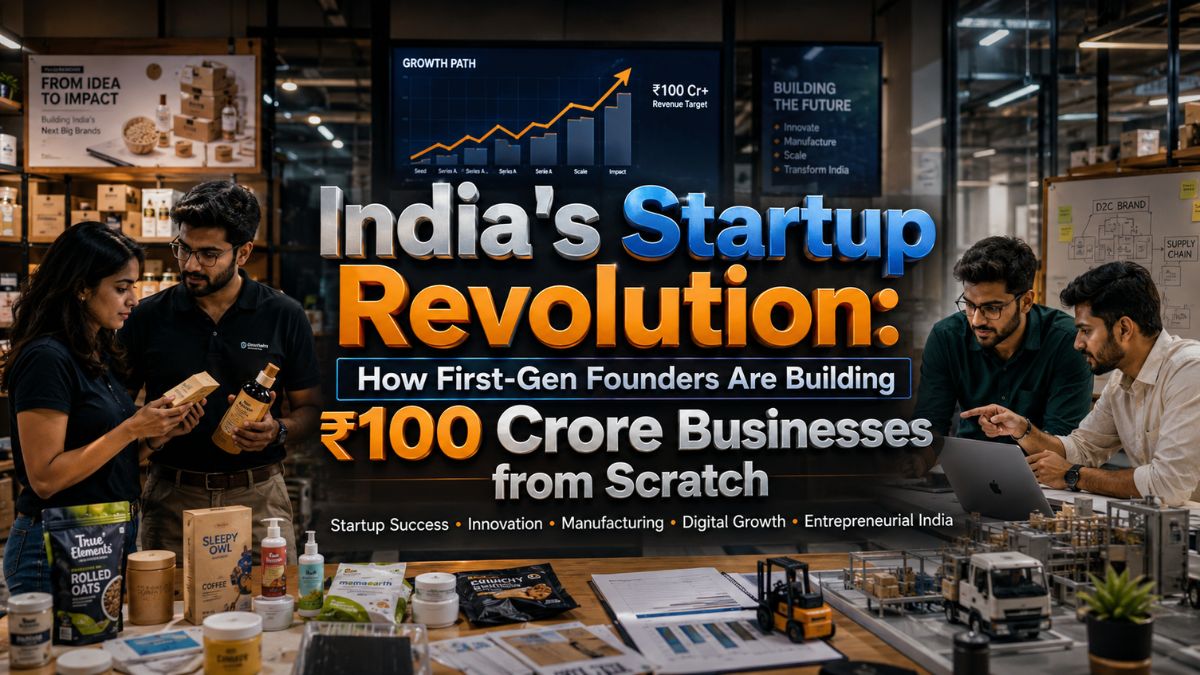
The start-up sector of India has evolved at an enormous pace over the past 10 years. The country which was previously considered only as a provider of IT services has now emerged as one of the world’s top startup destinations. The Indian market is now a host of over 2 lakh startups recognized by DPIIT and more than 100 unicorns, that operate in segments such as Fin-tech, Saas, Edtech, E-commerce, Health-tech and Logistics.
However, another change is also happening, and it’s a more significant one than the media coverage and billion-dollar valuations suggest.
The young entrepreneurs of India are not restricted to the metros of Bengaluru, Mumbai or Delhi any longer. Rather, ambitious first-generation entrepreneurs from cities like Indore, Jaipur, Coimbatore, Surat, Patna, Lucknow, Ludhiana, and other Tier-2 and Tier-3 cities are creating businesses from scratch that are profitable and scalable.
It doesn’t require an elite network or a large round of venture capital to support these founders. They have limited capital, practical business models and a good knowledge of the local market issues. They are creating businesses around manufacturing, food processing, logistics, SaaS, industrial supply chain and regional consumer brands.
This is what the true start up revolution in India is.
While the Indian startup ecosystem has generated huge economic value in the past few years, the next wave of growth will likely be in the form of sustainable and profitable businesses instead of those designed to burn cash, said Tracxn.
The startup scene is changing. Investors are less enthusiastic; customers are more demanding for value and founders are more concerned with profit than hype.
That change is providing one of India’s most significant entrepreneur opportunities in history.
Smart entrepreneurs start here—find your perfect venture
The Hidden Opportunity Inside India’s Startup Ecosystem
Although India boasts a high number of startups, there is still a huge disparity in the ecosystem.
The majority of VC investment continues to be targeted in a few key cities. Startups in smaller cities are still finding it hard to get funding as the majority of investment is still going to Bengaluru, Mumbai, and Delhi NCR, even though they have lower operating expenses and deep knowledge of the market.
This imbalance is all the more interesting in the light of the MSME sector in India.
As of today there are more than 63 million MSMEs in India and according to the MSME annual report 2023-24, MSMEs contribution in Indian GDP is 30% and exports are around 45%.
But, many MSMEs do business in the traditional way. Many lack:
- Digital systems
- Strong branding
- Technology integration
- Scalable operations
- Modern supply-chain management
This sandbagging of the traditional MSMEs and the modern startups is where India’s next economic growth wave is most likely to happen.
The opportunities for those founders that can modernize manufacturing, work to strengthen local supply chains, and build an efficient regional brand are enormous.
Get Detailed Insights from This Book: Just For Starters: How To Start Your Own Export Business
Why This Is the Best Time in India’s History to Start a Business
It is one of the hottest entrepreneurial times in Indian history as several structural changes are taking place at the same time.(India startup revolution)
Investor Mindset Has Changed
Investors are much more disciplined in the past several years. In the past, the focus of rewarding startups was their quick growth and user base. Profitability and sustainability are much more important these days.
TechCrunch is now paying more attention to these:
- Unit economics
- Revenue quality
- Customer retention
- Sustainable margins
- Capital efficiency
This is a big advantage for manufacturing startups, industrial companies, B2B businesses, and product-oriented entrepreneurs.
Many speculative startup models create no real value, and margins and demand are unpredictable, but manufacturing businesses create stable margins, predictable demand, and tangible value.
Related Article: INDIA’S STARTUP ENGINE IS SHIFTING GEARS: ₹32,000 Crore Budget Push, a New Space Unicorn, and the Rise of Manufacturing Founders
Tier-2 Cities Are Becoming Startup Powerhouses
One of the biggest changes in India’s startup ecosystem is the rise of smaller cities.
In last few years the activity of start-ups in Tier-2 cities has grown at an accelerated pace, according to reports from Analytics India Magazine.
Cities like:
- Indore
- Coimbatore
- Jaipur
- Surat
- Ahmedabad
- Lucknow
- Bhubaneswar
The low operating costs and industrial infrastructure are making them attractive.
For instance, office space and industrial rents in smaller cities are 60-80% more affordable than in Bengaluru and Mumbai. Skilled employees are also lower in cost, can be an advantage for payroll during the initial growth phase.
It seems many of the founders are finding that smaller cities present a significant competitive advantage.
Government Support Is Stronger Than Ever
One of the prime factors why entrepreneurship is growing easier in India is because of the enhancement of the government’s assistance for startups.
In the past decade, various schemes have been launched in favor of MSMEs, startups and manufacturing units.
The key projects are:
- Startup Indi
- PMEG
- CGTMSE
- Production Linked Incentive (PLI) Scheme
- Startup India Seed Fund Scheme
These programs offer tax breaks, subsidies, reduced loan requirements and financial assistance.
The neat thing is that most of the registrations and applications are now done digitally.
There are two ways to apply as an entrepreneur:
This has made it much easier for first time entrepreneurs.
How First-Generation Founders Are Building Manufacturing Startups
The key attraction of manufacturing startups is that they offer solutions to actual economic issues and create value for the long-term.(India startup revolution)
Manufacturing businesses can be self-supporting within a few years, if managed properly, rather than depending entirely on investor capital, as is the case with business that depends on investors.
Typically, the initial steps in a startup involve registering a business and gaining recognition as an MSME.
Most entrepreneurs choose:
- An approach of establishing a Private Limited Company for scalability.
- The LLP structure is provided for flexibility.
- Corporate for larger enterprises
Usually, founders apply for DPIIT Startup Recognition in the Startup India portal after registering. This recognition opens numerous benefits, such as tax exemptions and simpler access to startup schemes.
The next big challenge is to find industrial space.
Entrepreneurs like to run their businesses in industrial areas like:
- MIDC in Maharashtra
- GIDC in Gujarat
- SIDCO in Tamil Nadu
- RIICO in Rajasthan
These zones offer subsidised infrastructure, reduced utility costs and improved logistics assistance.
Explore This Book: Handbook On Chemical Industries (Alcohol Based)
Machinery, Production, and Cost Optimization
One of the main issues that the first-generation entrepreneurs are concerned about is about the capital of the start-up business. Luckily, there are many successful entrepreneurs who manage to cut costs wisely in the beginning.
They tend to opt for the following:
- Shopping for used industrial machinery.
- Make use of semi-automatic systems
- Expand production gradually
- Write an initial plan to target one product category at a time.
Coimbatore, Rajkot, Pune and Ludhiana are industrial centres known for providing cheap engineering solutions and machinery.
The profitability can be significantly affected by raw material sourcing as well. To lower procurement costs many Founders source directly from:
- Steps taken by the Farmers Producer Organizations (FPOs
- Industrial clusters
- Local commodity markets
- Direct manufacturers
This is a better way of doing it and can boost margins right from the start.
Licensing and Regulatory Requirements
This means that a manufacturing startup in India will need a few approvals, depending on the manufacturing sector.
The most frequently registered ones are:
- GST Registration
- Factory License
- Pollution Control NOC
- FSSAI License (for food businesses)
- BIS Certification (for regulated products)
Compliance is often a daunting process at first, especially since lots of approvals are now electronic and can be done in a matter of weeks if documents are prepared correctly.
The regulatory landscape in India is becoming increasingly pro-startup
Financial Reality of Manufacturing Startups
Predictable cash flow is one of the best benefits of manufacturing startups.
In India, the average cost of a small or medium-sized manufacturing business startup ranges from ₹20 lakh to ₹1 crore, depending on the size and industry.
The most significant investment areas are:
- Machinery and production equipment
- Industrial shed or factory set-up
- Raw materials
- Utility installation
- Working capital
- Licenses and certifications
Many startups are successful on a lean team during the first year of operations, to keep costs down.
Manufacturing startups can expect to reach:
- Gross margins range between 35% and 45%
- The Net margin is in the range of 18% to 26%.
- Operationally break-even in 6-12 months
This renders manufacturing one of the most sustainable startup business models in India today.
Why Manufacturing Matters for India’s Future
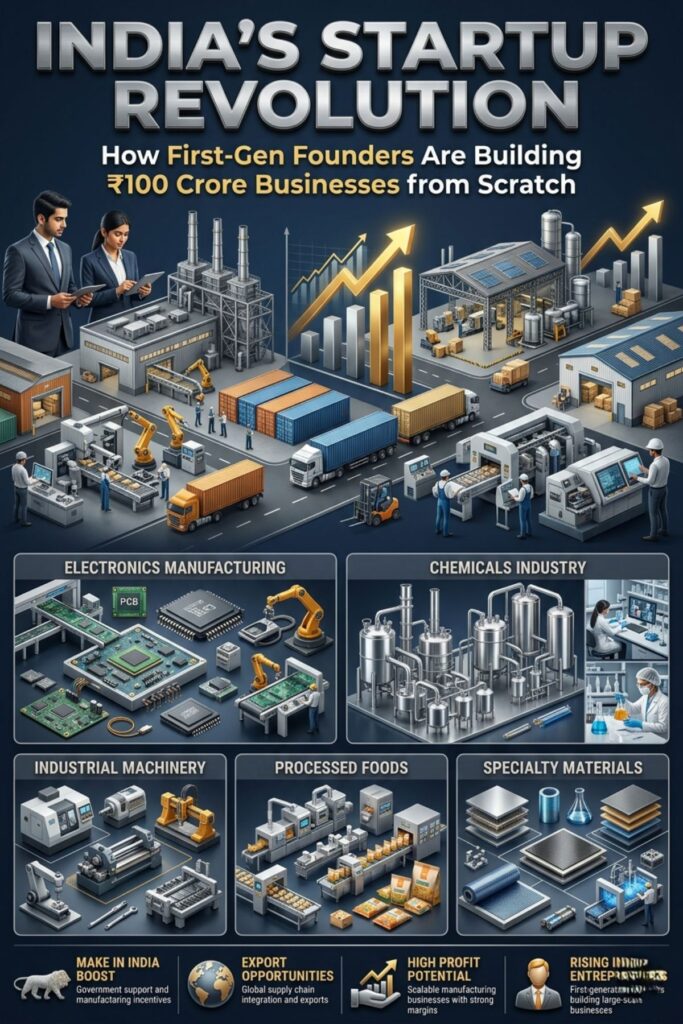
India has an enormous import basket of products annually including:
- Electronics
- Chemicals
- Industrial machinery
- Processed foods
- Specialty materials
There are huge possibilities for import substitution companies.
All successful manufacturing start-ups contribute:
- Reduce imports
- Generate employment
- Develop local value chain
- Strengthen industrial ecosystems
- Increase exports
That is why government policies are increasingly geared towards growth in domestic manufacturing.
There are sectors that are projected to grow rapidly such as:
- Food processing
- EV components
- Industrial automation
- Specialty chemicals
- Packaging materials
- Textile value addition
- Agro-processing
Investors who get in on these industries early could reap massive rewards in the coming decade.
Access Complete Business Plan: Fruits & Vegetables Value Addition and Food Processing
The Importance of Proper Project Planning
Poor planning is one of the main causes of the failure of startups.
Many entrepreneurs underestimate:
- Working capital requirements
- Machinery costs
- Production timelines
- Market demand fluctuations
- Compliance expenses
This is where project planning becomes very crucial.
NIIR Project Consultancy Services has emerged out as one of the most trusted industrial consultancy firms for entrepreneurs planning to start manufacturing and processing businesses in India.
Through NIIR Project Consultancy Services (NPCS) and Entrepreneur India, founders can access:
- Techno-economic feasibility studies
- Industrial market research
- Manufacturing guidance
- Bank-loan-ready business reports
NPCS reports are a common use for:
- PMEGP subsidy applications
- Bank loan approvals
- Investor discussions
- Startup feasibility analysis
Professional project reports are a great way for first generation founders to increase their odds of raising investment capital and preventing them from making costly planning errors.
Real Success Stories Are Emerging Everywhere
What’s fascinating about India’s startup revolution is that there’s no longer a restriction on the urban areas where such success stories happen.(India startup revolution)
Another Indore-based founder used less than ₹20 lakh of startup capital to launch a SaaS solution for the inventory management of a kirana store. The company went not on the metro supermarkets, but on those in small towns.
In a brief amount of time:
- The business acquired hundreds of paying customers
- Having annual revenues of crores
- Became profitable without venture capital funding
This is a general pattern in India.
Owning a business that addresses real-life problems of the local community can prove to be a more solid foundation for a successful business than a startup aiming for valuation growth.
The Future of Indian Entrepreneurship
This is a new era in entrepreneurship in India.
The internet and digital consumer businesses are primarily responsible for the first generation of startups.
The next wave will be propelled by:
- Manufacturing startups
- AI-powered industrial system
- Regional consumer brands
- Supply-chain innovation
- MSME digitization
- Export-focused businesses
This change would lead to the creation of millions of jobs and help India gain greater independence in the field of industry.
Surviving founders will not necessarily be the ones with the most money. They will be the ones who:
- Know the actual challenge of the customers
- Build disciplined operations
- Focus on profitability
- Make use of government assistance wisely
- Scale incrementally and gradually and sustainably
Data Sources & Citations
- DPIIT Startup Dashboard: startupindia.gov.in/recognition-dashboard
- Ministry of MSME Annual Report: msme.gov.in
- SIDBI — Startup Seed Fund & CGTMSE: sidbi.in
- KVIC — PMEGP Scheme: kviconline.gov.in
- DPIIT — PLI Scheme Overview: dpiit.gov.in
- Tracxn India Startup Data: tracxn.com/d/trending-themes/startups-in-india
Conclusion: India’s Biggest Startup Opportunity Is Just Beginning
India’s startup revolution is no longer limited to unicorns and billion-dollar headlines.
Real growth is taking place in factories and industrial clusters, food processing units, B2B platforms and region brands created by first-generation entrepreneurs.
India already has:
- A large domestic market.
- Strong industrial demand
- Government startup support
- Expanding infrastructure
- Rising digital adoption
Now it’s the turn of those entrepreneurs willing to “take their time” and find solutions to real problems.
This could be the most promising window in the first generation of entrepreneurs in India.
FAQs
The question is what is the investment amount to start a manufacturing startup in India?
The amount of capital required for most manufacturing startups ranges from ₹20 lakh to ₹1 crore by industry, machinery and scale of production.
2.What are the government schemes for startups in India?
Some of the important schemes are Startup India, PMEGP, CGTMSE, PLI Scheme and Startup India Seed Fund.
- Is it possible for first time entrepreneurs to be able to obtain loans without any collateral?
Yes. CGTMSE offers loans of up to ₹2 crore without any collateral.
- What are the best cities to start a manufacturing business in India?
Indore, Coimbatore, Surat, Ahmedabad, Jaipur, Pune and Ludhiana are new centres that are becoming robust in terms of startups and industrial development.
- What are the services of NPCS for entrepreneurs?
The NIIR Project Consultancy Services offer detailed project reports, feasibility studies, market research and industrial consultancy services via NIIR.org and Entrepreneur India.
- Do tech startups have a greater impact on sustainability than manufacturing?
In many instances, manufacturing startups can create a stable cash flow and physical assets, making them more sustainable than startups with a high burn rate.


