





A Market Signal Founders Cannot Afford to Miss
A big policy change is shaping India’s manufacturing scene. The government is soon rolling out a dedicated scheme to create a processing value chain for critical minerals, as reported by Economic Times, which experts from the Material Recycling Association of India (MRAI) have long been calling for.
Mines Secretary Piyush Goyal confirmed at the MRAI Conference on India’s Critical Minerals Recycling Landscape (held June 23, 2025) that the Ministry of Mines is in its final stages of designing the scheme. Approval should be received within 3 months. This is not just theoretical policy discussion, it’s a real, tangible, tangible shift in industry, with actual cash, actual incentives and actual start-up windows.
This is a noteworthy sign for entrepreneurs and MSMEs. India loses more than ₹80,000 crore every year on importing minerals such as lithium, cobalt, nickel, and the rare earth elements. The government has already given approval of ₹1,500 crore Incentive Scheme for Critical Mineral Recycling under the National Critical Minerals Mission (NCMM). The next step – a processing value chain scheme – is about to be unleashed. The window of opportunity is quickly closing.
What Recent Economic Times Reporting Means
The upcoming plan will be more than just recycling, says Economic Times report. The emphasis is on developing the “end-to-end” processing capability, from e-waste/battery scrap collection through to the recovery of battery grade critical minerals. This is an important difference.
So far, recycling in India has been in the ‘black mass’ stage — a collection, dismantling and partial processing of waste, leaving behind only partially extracted minerals. All of that is a tremendous loss of value on the table. But the new scheme, as reported by Economic Times, aims at filling exactly this gap.
What This Means for Founders and MSMEs
- The government is developing the financial architecture to enable recycling value chain, beyond the waste collection.
- Priority incentives will be given to companies engaged in actual extraction of minerals from secondary sources.
- A unified digital platform to link recyclers and waste collectors, that would be a B2B marketplace waiting to be built, will be part of the scheme.
- So far, 58 recyclers are already approved through the existing scheme of ₹1,500 crore. The early bird is getting the worm.
Economic Times coverage means that the entire start up world is getting the message, this policy segment is no longer a statement, it is now a journey towards action. The money is there, the purpose of the Minister is obvious and the business models are now investable.
Why This Industry Is Growing: The Numbers Don’t Lie
The problems with critical minerals in India are not cyclical, but structural. Ten of the 30 identified critical minerals are essential for the country to import, with 100% reliance on imports for lithium, cobalt and nickel. These are the foundation in electric vehicles, solar panels, wind turbines, consumer electronics, defence systems and medical equipment. All the EV or solar manufacturing requires almost a 100% foreign supply chain.
Key Market Metrics
- Every year, India produces around 1.75 million tonnes of e-waste and 60,000 tonnes of wasted Lithium-Ion battery scrap, which is expected to increase significantly by 2030.
- Recycling e-wastes in India is less than 10% and collection of used batteries is less than 5%. There is a huge disparity between waste produced and waste that goes into formal processing.
- By 2030, the EV market in India is projected to penetrate 40% with an exponential increase in volumes of end-of-life batteries.
- According to a June 2025 IEEFA-JMK Research report, eight out of the 12 major categories of EV components are still relying on critical sub-components which are not manufactured in India.
- Geological Survey of India has already finished 571 important mineral exploration projects, and in only 2025-26, 300 more were initiated.
Increasingly, India is constructing a manufacturing economy that will depend on secure domestic supplies of critical minerals, and this is the only message that may be discerned from these numbers. The quickest bridge to cross is the recycling and processing of secondary sources, which is the route the government is now taking with its policy energy.
Government Policies and Incentives: The Full Stack
A robust policy framework for critical minerals has been developed in India. It is important for the entrepreneurs to visit the portal of the Ministry of Mines Incentive Scheme.
The Startup India platform to avail connected benefits.
The Critical Mineral Recycling Incentive Scheme (CMRIS) — Cabinet Approved
- Total outlay: ₹1,500 crore over FY 2025-26 to FY 2030-31
- Raising special provisions of ₹700 crore for lithium-ion battery recycling
- ₹650 crore to recycle e-waste
- ₹135 crore for other scrap streams such as catalytic converter and rare earth permanent magnets
- the total funds, one-third (around ₹500 crore) is dedicated to small and new recyclers such as startups.
Financial Incentives Available
- Plant & Machinery / Equipment & Utilities: 20% Capex subsidy for timely plant/commissioning of equipment and commissioning of utilities
- For Opex subsidy, 40% of eligible support in Year 2, and 60% in Year 5, linked to incremental sales growth over the FY 2025-26 baseline.
- The total ceiling of incentives is set at ₹50 crore for each large entity and ₹25 crore for smaller recyclers.
- In Union Budget 2025-26, the import duty for lithium-ion battery scrap was cut, which will help to facilitate availability of feedstock.
National Critical Minerals Mission (NCMM)
The NCMM is the biggest India’s mineral security program, approved by the Union Cabinet in January 2025, with a government outlay of ₹16,300 crore and an additional expected investment of ₹18,000 crore by PSUs. It seeks to exploit 1,000 patents in key mineral technologies by 2030 and to get 2,000 exploration projects operational by 2031. Visit the website for more information on the government’s schemes.
Attracting investments through the Ministry of Mines through the Make in India portal and Invest India platform for project facilitation.
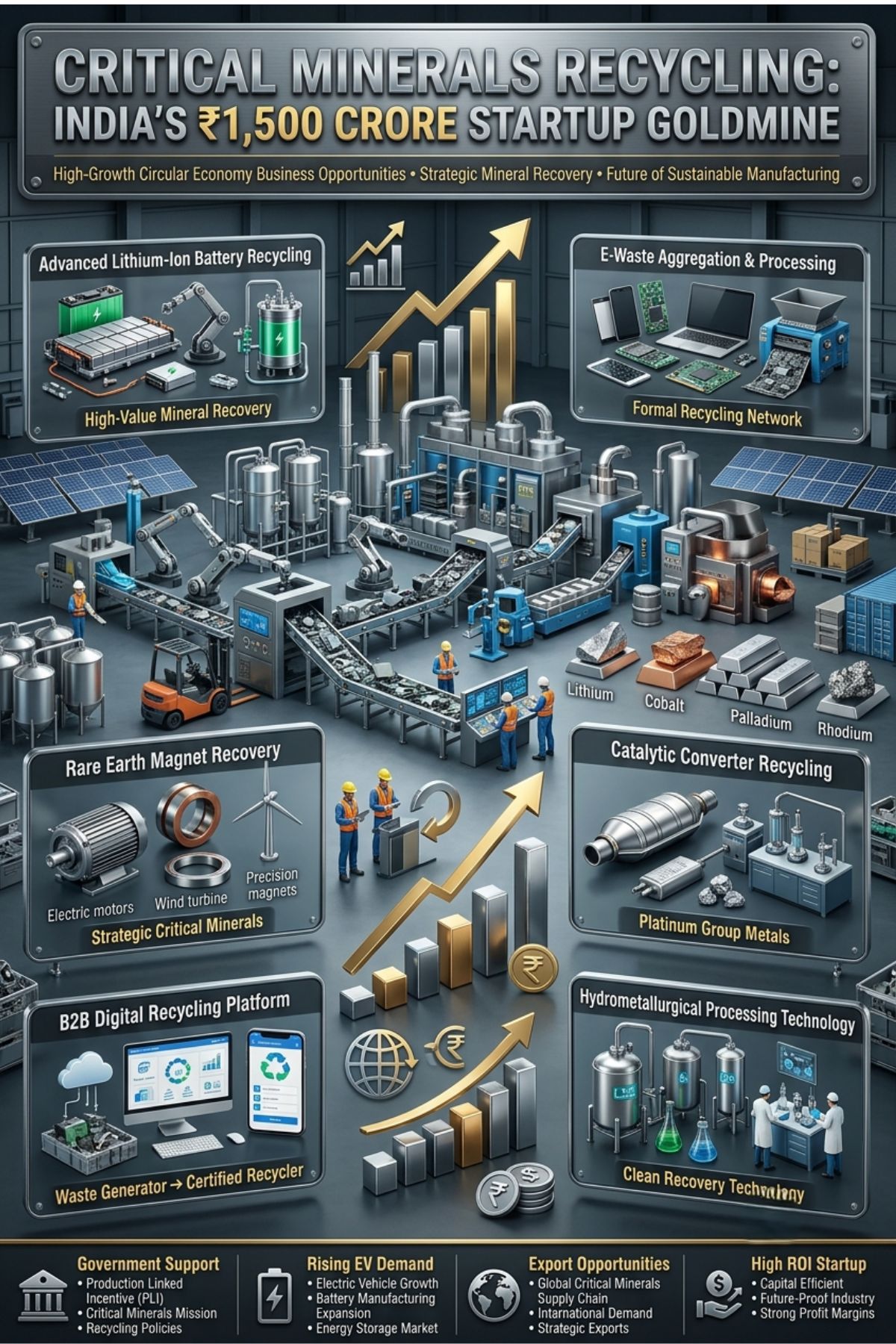
6 Business Ideas for Startups Emerging Directly from This News
All the ideas listed below stem straight from the market signal given by The Economic Times and the policy architecture now in place.
1. Advanced Lithium-Ion Battery Recycling & Mineral Extraction Plant
The scheme also specifically encourages recycling facilities that process more than black mass to recover battery grade lithium, cobalt and nickel. The greenfield recycling plant for recycling these output materials is eligible for both 20% Capex subsidy and Opex incentives. The availability of feedstock is no longer an issue, as 60,000 tonnes of spent LIB scrap is produced every year, while imports of duty-free scrap are now available. Investment size: ₹8 crore to ₹30 crore (capacity dependent).
2. E-Waste Formal Aggregation and Processing Network
E-waste formal collection rate in India is less than 10%. Structured collection networks — established with urban local bodies, corporate IT departments, and consumer electronics retailers — provide a sure supply of feedstock for downstream recyclers. The Extended Producer Responsibility (EPR) rules have introduced the obligation for producers to provide funding for end-of-life collection. This gives aggregation startups a revenue stream that is backed by the regulatory system.
Access Complete Business Plan: E-Waste Recycling: Disposal and Management Projects
3. Rare-Earth Magnet Recovery from End-of-Life Motors and Electronics
High levels of dysprosium, neodymium and other rare-earth elements are found in electric motors, hard drives and wind turbine generators. There is no viable in-country recovery infrastructure for these materials in India. A near zero competition niche with good export potential and direct scheme eligibility would be a Startup in Magnet dismantling, demagnetization and extraction of Rare Earths.
4. Catalytic Converter Recycling — Platinum Group Metals Recovery
At the end of their useful life, these cars are filled with catalytic converters, which include precious resources such as platinum group metals (PGMs) which are one of the most valuable critical minerals on earth. The government scheme is clearly designed to accept the catalytic converter scrap. India’s vehicle population has grown to over 300 million and is adding millions of vehicles to its end-of-life stream every year, with little formal recyclers involvement in this stream.
5. B2B Digital Platform: Connecting Waste Generators with Certified Recyclers
The Ministry of Mines is actively working on a single platform to connect waste generators, waste collection agencies and recyclers. Executions can be done commercially by start-ups before waiting for government execution. The marketplace model, which links IT asset managers, battery manufacturers, auto scrapyards, and certified battery recyclers, generates revenue via transaction fees, ESG reporting tools, and documentation of compliance with EPR. Register your startup with Startup India to avail reward along with associated benefits.
Get Detailed Insights from This Book: The Complete Book on Waste Treatment Technologies
6. Hydrometallurgical and Chemical Processing Technology Startup
The main challenge in India is the processing technology — in this case, advanced hydrometallurgical and chemical processes for converting black mass to battery grade mineral salts — is the weakest link in the critical mineral recycling chain. A domestic startup or deep-tech enterprise that creates and/or licenses these technologies can benefit from the NCMM Centre of Excellence grants and also the CMRIS incentives. The government’s goal of 1000 critical mineral technology patents by 2030 is a clear sign of institutional demand for technology partnerships.
Import–Export Opportunity Analysis
Critical mineral recycling is more than a story of the domestic supply chain; it has export variables that entrepreneurs must consider in their business plans.
Export Opportunity: Refined Mineral Outputs
The Indian recyclers also generate battery-grade lithium carbonate, cobalt sulphate, nickel sulphate and rare-earth oxides that can be sold to South Korea, Japan, the EU and the United States, all of which are keen to diversify away from China’s mineral processing, India said. Growth in recycling capacity and geographic location provide an advantageous supply-chain alternative to India.
Import Advantage: Duty-Free LIB Scrap
In the Union Budget 2025-26, the government had declared that lithium-ion battery scrap imports will be duty-free. This means that Indian recyclers can fill up their plants with European and North American battery waste, which has provided a significant boost to the plant capacity utilisation and its economics. The District Office is available to help you with export guidance and incentive linkages.
The export promotion benefits applicable to value added mineral product are from DGFT (Directorate General of Foreign Trade).
Related Article: EV Battery Materials & Critical Minerals: Startup Opportunities in India
Strategic Export Market
There is robust demand for nonchains sourced critical minerals from both the European Union’s Critical Raw Materials Act and the United States’ Inflation Reduction Act. The Indian recyclers who achieve high-quality output for batteries will have a great opportunity to enter into long-term supply contracts with the battery manufacturers and clean-energy companies in the world.
Indian MSME Success Stories: Early Movers Are Already Winning
India’s formal recycling segment is still in its nascent stage, and there is definitely an early mover’s advantage.
58 Recyclers Already Approved
At the MRAI conference it was confirmed that 58 recyclers are already formally selected and approved by the CMRIS programme with funds of ₹1,500 crore. The first applications were submitted from October 2025 to April 2026 and these are now at the front of the queue to receive the first payments as the scheme grows. Their benefit: They interacted with the policy early.
The Black Mass Graduation Challenge
In Maharashtra, Gujarat and Tamil Nadu, several existing informal recyclers have started the process of upgrading their operations from black mass production to able to complete mineral extraction, the crucial step needed to be able to qualify for scheme benefits. The benefit of this transition will be greatest for those who make the shift the earliest, given that there is a combination of Capex and Opex subsidies available through CMRIS.
The Aggregation Niche
Meanwhile, there are now more of the collection and aggregation businesses, which have successfully established structured supply chains from consumer electronics retailers, corporate IT departments and telecom towers in cities such as Bengaluru, Hyderabad and Pune. Many of these businesses (with revenue under ₹5 crore) are MSMEs and are being tapped as sources of feedstock to larger recycling units, while also looking at vertical integration options.
Business Intelligence and Feasibility Support
Feasibility information is crucial for entrepreneurs who are considering entering the critical mineral recycling industry to obtain bank financing, investors, and to develop their government incentive applications. There are some institutions such as NPCS (Niir Project Consultancy Services) which provide detailed industrial project reports for recycling-based businesses where they present all the detail information regarding plant set-up cost, machinery required, process flowchart, need of licensing, profit projection, and ROI analysis etc.
These kinds of reports are of significant value when submitting applications to CMRIS subsidies as detailed project proposals, which align with the scheme guidelines, are required. In a similar way, the SIDBI (Small Industries Development Bank of India) provides financing assistance to various projects in the green and recycling sector for MSMEs. Visit
The SIDBI’s official portal for MSME loan schemes for critical mineral recycling business.
Identify high-growth industries before others do
Critical Mineral Recycling: Key Data at a Glance
| Parameter | Detail | Opportunity Indicator | Relevant Scheme |
| E-waste Generated Annually | 1.75 million tonnes | Collection rate <10%; massive gap | CMRIS E-waste vertical |
| LIB Scrap Generated | 60,000 tonnes/year | Rising sharply toward 2030 | CMRIS LIB vertical ₹700 Cr |
| CMRIS Total Outlay | ₹1,500 crore | ₹500 Cr reserved for startups | FY 2025-26 to 2030-31 |
| Capex Subsidy Rate | 20% on P&M | Reduces setup cost significantly | Timely commissioning required |
| Annual FX Outflow (Minerals) | ₹80,000+ crore | Import substitution potential | NCMM ₹16,300 Cr mission |
| Approved Recyclers (CMRIS) | 58 entities | Early movers rewarded | Rolling approval process |
| Greenfield Mines (2025-26) | 36 operationalised | Supply chain integration play | MMDR Act 2023/2025 |
Frequently Asked Questions (FAQ)
Q1. Who is eligible for CMRIS subsidies?
Registered recyclers (India) carrying out mineral extraction in e-waste, spent Li-Ion Batteries or any other eligible waste (e.g. Used Catalytic Converters). – (a) Greenfield Projects; and (b) Brownfield Expansion Projects. Startups were allowed.
Q2. Can a startup with no prior recycling experience apply?
Yes. The scheme reserves one-third of its total outlay for small and new recyclers, including startups. You do not need an established track record, but you must invest in actual mineral extraction infrastructure — black-mass-only operations do not qualify.
Q3. What is the maximum incentive a startup can receive?
Smaller entities can receive up to ₹25 crore as the combined ceiling on Capex plus Opex subsidies. Large entities can receive up to ₹50 crore. The Opex component is tied to incremental sales growth over the FY 2025-26 base year.
Q4. What licences and registrations do a recycler need?
Requires CPCB registration, authorization for recycle, relevant EPR authorization as per e-waste management rules 2022 / battery waste management rules 2022, GST registration & facility’s EC if relevant.
Q5. How does duty-free LIB scrap import help my business model?
It lowers your input cost significantly and allows you to supplement limited domestic feedstock with imported battery waste from Europe and North America — improving plant capacity utilisation and making unit economics more favourable from an earlier stage of operations.
Q6. What is the upcoming ‘processing value chain scheme’ referenced by Economic Times?
As reported by Economic Times and confirmed by Mines Secretary Piyush Goyal at the MRAI Conference, the government is finalising an additional scheme specifically targeting the processing value chain — ensuring that minerals extracted by recyclers can be refined into battery-grade materials domestically, rather than being exported as semi-processed intermediates.
Conclusion: The Window Is Open — Act Before It Gets Crowded
The Economic Times report on the government’s forthcoming critical mineral processing value chain scheme is not just a policy update. It is a market entry signal — one that founders, MSMEs, and industrial investors should treat with urgency. As Economic Times reporting confirms, the Ministry of Mines is in its final stages of designing a scheme that will directly incentivise the part of the value chain that India currently lacks most: the transformation of recycled materials into usable, battery-grade critical mineral outputs.
India already has the demand side locked in — a booming EV sector, a fast-growing electronics market, and an ambitious clean energy transition. It has the policy architecture in place through the NCMM and CMRIS. What it still needs is scale on the supply side: more recyclers, more processors, more technology innovators, and more entrepreneurs willing to build in this space.
The ₹1,500 crore recycling scheme has already approved 58 early movers. The processing value chain scheme is about to add another layer of incentives. Greenfield mines are being operationalised. Exploration projects number in the hundreds. The foundation is being poured.
The question is not whether this sector will grow. It will. The question is whether you will be among the founders who positioned early — when incentives were generous, competition was limited, and the government was actively hunting for entrepreneurs to back — or whether you will arrive late, when the easy wins are gone.
The signal from Economic Times is clear. The time to act is now.


