





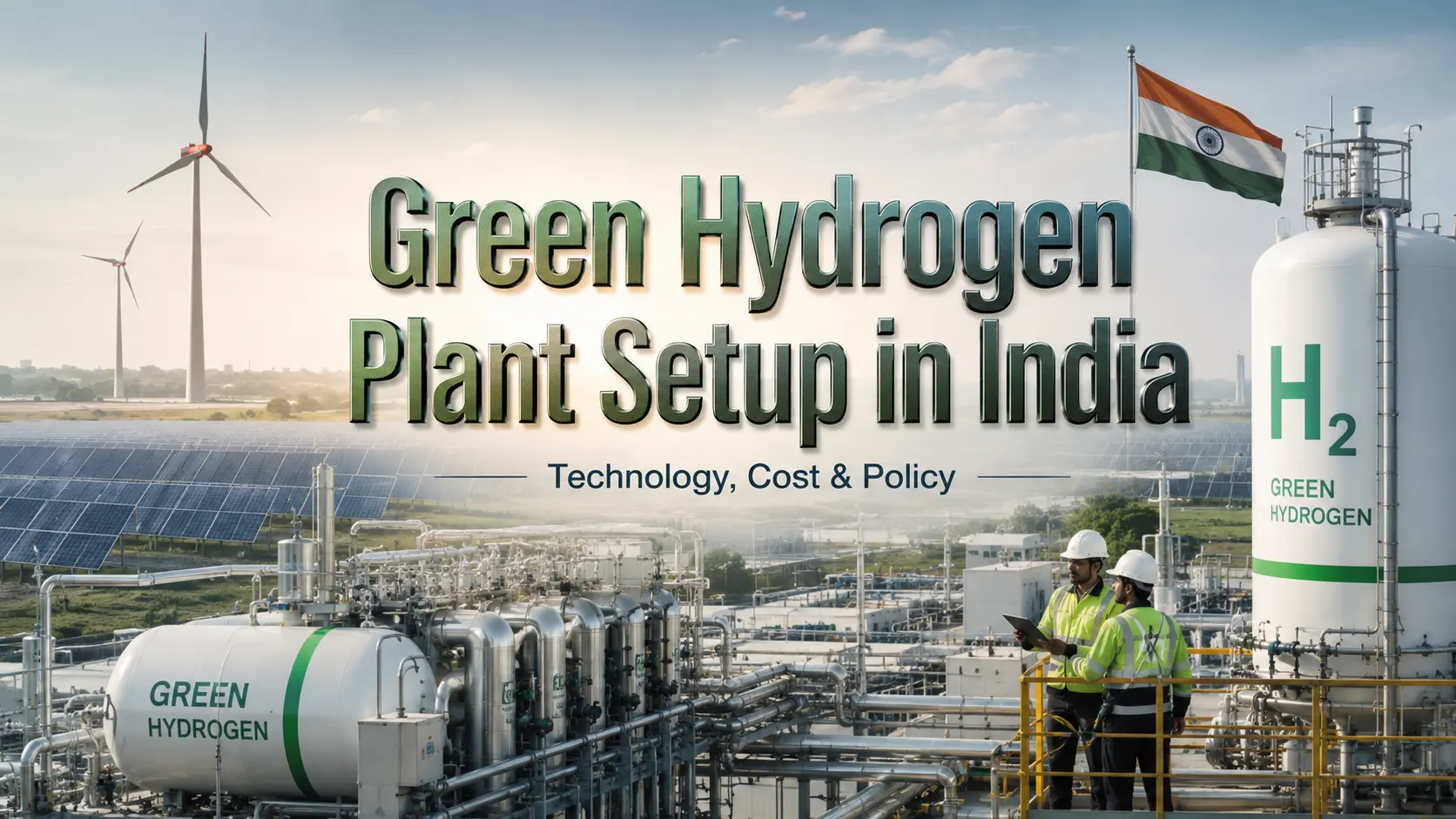
Green Hydrogen Plant Setup in India
When the Cheapest Fuel Costs the Earth — And That’s About to Change
Data from the Ministry of Petroleum & Natural Gas showed that India now imports nearly 85% of its crude oil needs and the country spends nearly ₹12 lakh crore a year on importing crude oil. However, the western and southern belt of the country gets more than 300 sunny days each year allowing the production of hydrogen at an end-of-decade price less than diesel. That dichotomy is right smack dab in the middle of this business.
So is Green Hydrogen (hydrogen made from renewable electricity and split water) no longer a laboratory experiment. Domestic green hydrogen suppliers are being aggressively sought after by India’s steel plants in Odisha, fertiliser plants in Gujarat, and refinery clusters in Maharashtra as it is not economically or geopolitically viable to import grey hydrogen or ammonia. When the first entrepreneur constructs a mid-scale green hydrogen plant close to an industrial corridor, it’s not only the enterprise they’ve created, it’s the critical link in the chain of India’s supply.
The window is open. It will not stay open indefinitely.
The Gap Is Real — And It’s Measured in Millions of Tonnes
Currently, India’s annual hydrogen demand is about 6 million metric tonnes (MMT) of grey hydrogen (which is hydrogen produced from natural gas or coal). The current capacity of domestic production of green hydrogen is less than 20,000 tonnes per annum or 0.3% of the total demand, per the Ministry of New and Renewable Energy (MNRE). That is not a “niche gap. That’s a lack in the industry.
Nearly 50% of hydrogen use is in fertilisers, approximately 30% in petroleum refining and an increasing amount in steelmaking. Gujarat, Maharashtra, Odisha, Andhra Pradesh and Tamil Nadu are the top five unmet demand states, each having a significant number of industrial clusters and/or port facilities.
The Confederation of Indian Industry (CII) estimates that India will require at least 5 MMT of green hydrogen per year to achieve the country’s decarbonisation commitments and export goals. If just 1% of this can be plugged, it is equivalent to a market of ₹3,000–5,000 crore for producers in the early stages.
Related Article: Green Hydrogen Production in India: The Next Trillion-Rupee Opportunity for Entrepreneurs
Table 1: State-wise Green Hydrogen Demand Clusters & Industrial Anchors
| State | Key Industrial Cluster | Primary Demand Sector | Annual H₂ Demand (est.) | Green H₂ Gap |
| Gujarat | Dahej, Hazira, Kandla | Refinery, Fertiliser | 1.2 MMT | ~1.18 MMT |
| Odisha | Angul, Paradip, Jharsuguda | Steel, Refinery | 0.9 MMT | ~0.88 MMT |
| Maharashtra | Ratnagiri, Nagpur, Pune | Chemicals, Refinery | 0.8 MMT | ~0.78 MMT |
| Andhra Pradesh | Visakhapatnam, Krishnapatnam | Fertiliser, Export | 0.6 MMT | ~0.59 MMT |
| Tamil Nadu | Tuticorin, Chennai | Ammonia Export, Steel | 0.5 MMT | ~0.49 MMT |
| Rajasthan | Barmer, Jodhpur | Solar-linked H₂ Prod. | 0.3 MMT | ~0.30 MMT |
Source: MNRE, CII Green Hydrogen Report, Invest India Sector Brief
Why This Is the Right Time to Enter
Three forces are coming together at once — and that’s unusual. First, the cost of electrolyser has reduced by almost 60% over the last 5 years, and this cost has been estimated at around ₹6–8 crore per 1 MW system for PEM in India after importing, according to International Energy Agency. Second, the tariff for solar power in Rajasthan, Gujarat, and Andhra Pradesh has dropped below ₹2.20/kWh for long-term PPAs, making it commercially viable for making hydrogen for the first time.
The National Green Hydrogen Mission, with an outlay of ₹19,744 crore, has been launched by the Government of India, with an aim to achieve 5 MMT annual green hydrogen production capacity and 125 GW renewable energy capacity by 2030. Under the Strategic Interventions for Green Hydrogen Transition (SIGHT) programme by MNRE, financial support is available directly for factory manufacturing of electrolyser and for the production of green hydrogen up to ₹50/kg to eligible green hydrogen producers in the first tranche.
More policy support is through:
- Electrolyser input cost for the plant operators will be reduced by including PLI Scheme for electrolysers with an outlay of ₹4,455 crore.
- CGTMSE (Credit Guarantee Fund Trust for Micro and Small Enterprises): Collateral free loan of up to ₹2 crore for eligible micro and small enterprises (MSME) entrepreneurs taking up clean energy manufacturing.
- Offtake tenders by SECI (Solar Energy Corporation of India) – To be on the safe side of the investment, it is advisable to get an offtake before the plant construction.
- Customs duty exemption on components of Electrolysis imported for manufacturing (Notified by CBIC).
The Invest India Green hydrogen portal also introduces a single window clearance process for investors with an asset size of over ₹75 crore, thereby cutting down on the approval process.
Get Detailed Insights from This Book: Solar PV Power and Solar Products Handbook
How to Set Up a Green Hydrogen Plant: Step by Step
Step 1: Choose Your Scale and Technology
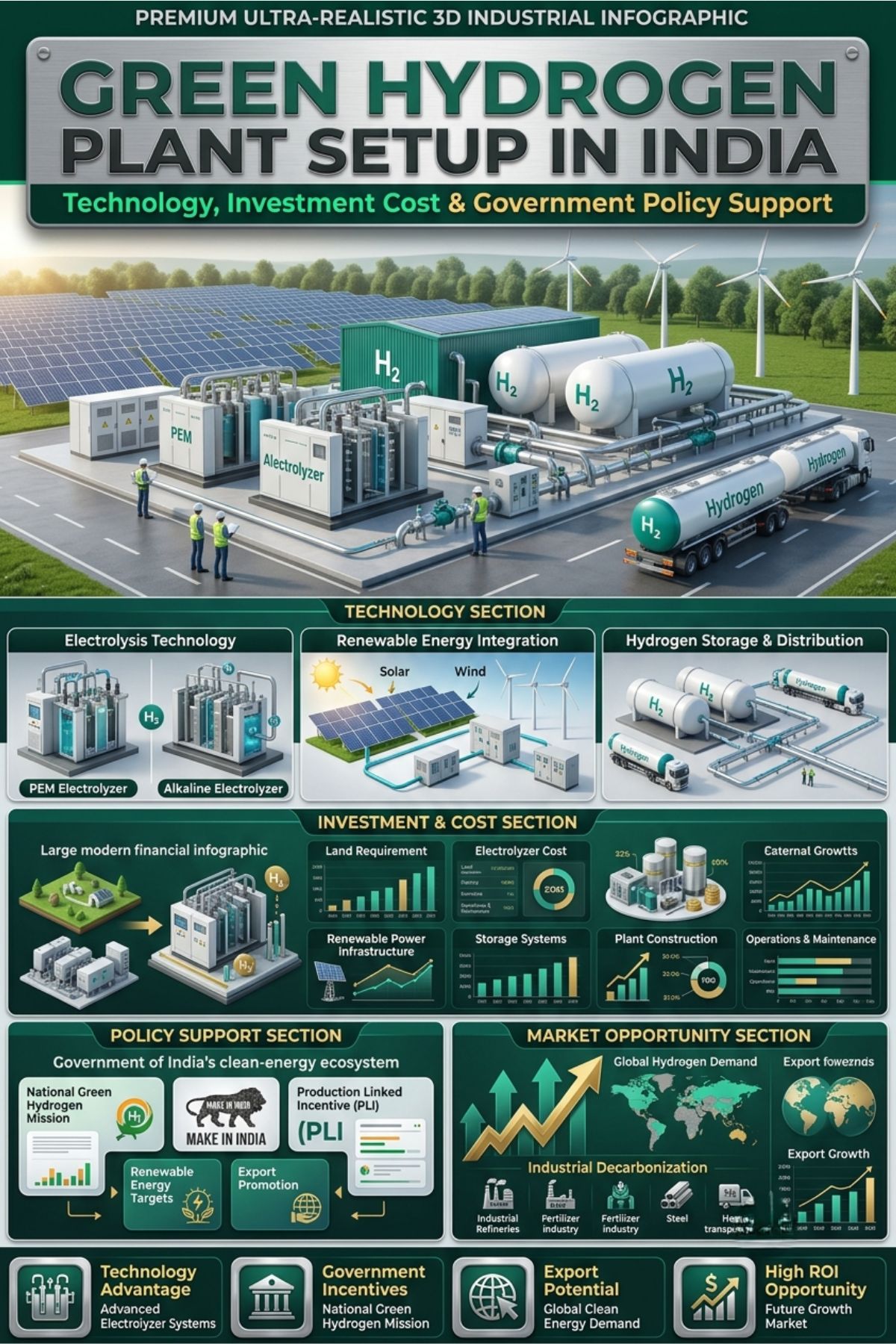
The first-time entrepreneur could start the plant anywhere between 500 kg/day and 2000 kg/day (or 1MW – 4MW electrolyser capacity). The size of this scale is big enough to appeal to industrial buyers, but small enough to be operated without institutional debt. Currently, there are two technologies for electrolyser that are commercially viable in India.
- Alkaline Electrolysis (AEL): Lower capital cost of around ₹4-6 crore/MW, Proven at scale, Suitable for steady state operation. This is used in most Indian pilot plants. Key suppliers: Greenko, Thermax and L&T Hydrocarbon.
- Proton Exchange Membrane (PEM): High efficiency, rapid start/stop cycles (solar coupled plants are best suited), costs ₹6 – 9 crore/MW. International suppliers like Nel ASA and ITM Power have India distribution; domestic supply through KPIT Technologies and Hydrogen Pro partners.
Step 2: Site Selection and Land
If you are generating power, a 1 MW plant requires some 0.5–1 acre of core plant area and spaced 3–5 acres apart solar panels. Water is essential (must have demineralized water supply — around 9 liters per kg of hydrogen) and grid connectivity, and an industrial offtake within 50 km are non-negotiable. The best combination of solar irradiation, water availability and industrial demand is available in the coastal Andhra, southern part of Rajasthan and in the Saurashtra belt of Gujarat.
Step 3: Regulatory Approvals and Licences
- Udyam Registration (MSME Ministry) — compulsory for MSME category benefits and CGTMSE.
- Factory Licence under the Factories Act, 1948 — mandatory for any plant with >10 workers using power.
- Pollution NOC (State Pollution Control Board): Category B or C (depending on state), hydrogen production is pollution free, but necessity of consent may be required for electrolyser cooling systems.
- Hydrogen is a flammable gas, Hydrogen Storage and Pipeline requires PESO approval (Petroleum and Explosives Safety Organisation) Explosive NOC from its Chief Controller of Explosives.
- GST Registration (18% on Green Hydrogen supply with concessional rates under
- consideration by the GST Council).
- An Electricity connection or an Open Access certificate from State Electricity Regulatory Commission (SERC) for the electricity procurement involving renewable energy.
- Environmental clearance (if capacity of the plant is more than 25 MW) — through online portal of MoFE &CC.
Step 4: Raw Material and Water
The first raw material you use is demineralised (DM) water. The consumption of DM water is approximately 3,600 litres per day in a 1 MW plant with a capacity of 400 kg/day. Local water treatment plants or install a Reverse Osmosis + DM unit locally (Cost: ₹15-25 lakh for a 5KLPD unit). The second major input is renewable electricity (solar PPA or open access arrangement).
Step 5: Timeline
- Months 1-3: Site acquisition, DPR, regulatory applications, Udyam and GST registration.
- 4-8 months: Environmental Clearance, PESO Clearance, Electricity connection.
- At month 9 – 15, the procurement of Electrolyser, civil construction, installation, and commissioning are to be undertaken.
- First hydrogen production is at Month 16 and onwards; quality testing and delivery to offtakes starts.
Team to start: Plant manager (chemical/mechanical engineer), 2 electrolyser operators, 1 electrical technician, 1 QC analyst, 1 accounts and compliance officer. Total: 6–8 people.
Table 2: Capital Investment Breakdown for a 1 MW Green Hydrogen Plant (500 kg/day)
| Cost Head | Specification | INR Estimate (₹ Lakh) | % of Total CapEx |
| Electrolyser System (AEL, 1 MW) | Including rectifier, gas separator | 450–600 | 38–42% |
| Solar Power Plant (1.5 MW co-located) | Modules + inverter + mounting | 500–650 | 35–40% |
| Civil Construction & Plant Infrastructure | Foundation, piping, storage | 120–160 | 9–11% |
| Hydrogen Storage & Compression | 250 bar cylinders or tube trailer | 80–120 | 6–8% |
| Water Treatment (RO + DM unit) | 5,000 LPD capacity | 18–25 | 1–2% |
| Safety, Fire, Electrical & Instrumentation | SCADA, sensors, safety interlocks | 40–60 | 3–4% |
| Pre-operative & Working Capital (3 months) | Salaries, consumables, licences | 60–90 | 4–5% |
| Contingency (8–10%) | On civil + equipment | 100–130 | 7–9% |
| Total Project Cost | 1 MW plant, 500 kg/day | ₹13–17 Crore | 100% |
Source: MNRE project cost benchmarks, IRENA electrolyser cost database, field estimates from Thermax and L&T Hydrocarbon project disclosures.
Get Detailed Project Report (DPR): Hydrogen Peroxide Manufacturing Plant Report
Financial Snapshot: What the Numbers Actually Look Like
The central economics are the following at 1 MW capacity and green H2 production of ~500 kg of green hydrogen per day. Assumptions are made for a plant in Rajasthan/ Gujarat, on 25-year solar PPA pricing of ₹2.20/kWh, and selling the hydrogen at a price of ₹350/kg to an industrial offtaker, which has been the benchmark for captive supply contracts according to NITI Aayog’s Hydrogen Roadmap.
- Capital Expenditure: ₹13–17 crore (central estimate: ₹15 crore)
- Monthly Operating Cost at 60% Capacity: ₹18 – ₹22 lakh (Expected Power Cost: ₹11 lakh, Salaries: ₹4 lakh, Maintenance: ₹3 lakh, Water & Consumables Cost: ₹2 – 4 lakh)
- Monthly Revenue at 60% capacity: ~9,000 kg × ₹350 = ₹31.5 lakh
- Monthly Revenue at 100% capacity: ~15,000 kg × ₹350 = ₹52.5 lakh
- Gross Margin at full capacity: 54–58%
- Net Margin at full capacity (Post Depreciation + Debt Service): 18-24%
- Payback period: 6–8 years (Without subsidy) / 4–5 years (With SIGHT subsidy of ₹50/kg).
When the SIGHT incentive is taken into account for the first 3 years (₹50/kg x 15,000kg/month = ₹7.5 lakh additional monthly inflow), the payback becomes around 4 years. It’s not a quick flop: it’s a long-cycle infrastructure investment, and it pays off over the years once the debt is paid off.
Table 3: Applicable Government Schemes, Eligibility & Benefit
| Scheme | Nodal Agency | Eligibility | Benefit | Max Assistance |
| SIGHT Programme (Incentive for H₂ Production) | MNRE | Green H₂ producers, SIGHT-registered | ₹50/kg incentive for 3 yrs (Tranche 1) | Uncapped per tranche |
| PLI Scheme for Electrolysers | MNRE / DPIIT | Domestic electrolyser manufacturers | 4–18% PLI on incremental sales | ₹4,455 crore total pool |
| CGTMSE (Credit Guarantee) | SIDBI / MoMSME | MSMEs with ≤₹2 Cr loan | Collateral-free lending guarantee | ₹2 crore per unit |
| MUDRA Tarun Loan | SIDBI / Banks | MSMEs, clean energy preferred | Loan ₹5–10 lakh, reduced interest | ₹10 lakh |
| PMEGP (PM Employment Generation Programme) | KVIC / Banks | New manufacturing unit, EDP trained | 15–35% margin money subsidy | ₹25 lakh subsidy (mfg) |
| Startup India (DPIIT Recognition) | DPIIT | Incorporated < 10 yrs, innovative model | Tax exemption, fast-track IPR, fund access | 3-yr income tax exemption |
| State Renewable Energy Policy (e.g. GERC Gujarat) | State ERCs | Plants using state RE quota | Open access charges waived or reduced | State-specific |
Sources: MNRE, DPIIT, SIDBI, KVIC official portals. Verify current tranche details at mnre.gov.in and investindia.gov.in.
Your investment deserves the right opportunity
ENTREPRENEUR SPOTLIGHT
Manoj Bhatt, Founder, Sun Fuel Technologies (Rajasthan): Bhatt, being a first-generation entrepreneur from Barmer, who has background in solar EPC, commissioned a 300 kg/day alkaline electrolyser plant in collaboration with a textile dyeing cluster in the area which was in need of process heat and hydrogen. His investment in capital was ₹7.2 crore, with 40% from SIDBI green energy loan and 60% from personal resources. The plant achieved 80% capacity utilisation in just over 14 months. His bottom-line message: “Don’t order the electrolyzer before you have a buyer signed up or you’re building a solution with no problem.
Project Planning Resources
Niir Project Consultancy Services (NPCS), available at entrepreneurindia.co, provides comprehensive project reports, techno-economic feasibility studies, plant layout designs and consultancy services for the entire project development for green hydrogen and electrolyser-based business ventures to those entrepreneurs who require a bankable project report before taking the initiative to approach the lenders. They provide cost modelling, equipment vendor comparisons, regulatory checklists and financial projections specific to the Indian market in their reports. When you walk in a bank or impact fund for the first time, a professional DPR from NPCS helps to cut down on the back-and-forth and speeds up the loan appraisal timeline.
The Decision Is Binary — Enter Now or Explain Later Why You Didn’t
Green hydrogen is no longer a gamble in India. It is a current procurement issue for the thousands of fertiliser plants, refineries and steel mills in five states. The policy structure is established. The cost curves are off their places. The demand is real and increasing.
Your next step is to find one industrial plant that is within 100 km of a site with good solar irradiation and get in touch with the hydrogen procurement manager for any one fertiliser or refinery plant in the cluster. Discuss with them the price and volume that they would be willing to offer for committing to a 5-year offtake contract. There is more that can be learned in that one conversation than in any consultants’ report. After the offtake number is determined, work back to your plant economics. The electrolyser vendor, financing, the approvals, all that comes after that anchor.
The plants that are being constructed over the next three years will determine the clean hydrogen supply chain of the future for India for the next 30 years.
Frequently Asked Questions
Q1. What is the Minimum investment in Green Hydrogen Plant In India?
The minimum commercially viable entry point for a Green Hydrogen plant in India would start at Rs. 13-17 Cr for 1 MW capacity(500kg/day) coupled with co-located solar PV. While pilot-scale units of 100-200 kg/day capacity can be set up in the range of Rs 3-5 Cr, there would be challenges in selling at competitive price to the industrial consumers. CGTMSE scheme and SIDBI Green Energy Loan scheme offers up to 75% of project costs to the eligible MSME promoters.
Q2. What licences and permissions are required for a Green Hydrogen Plant?
An entity has to get the Udyam registration, factory license, SPCB consent (NOC), PESO (Chief controller of explosives for safe storage of hydrogen), GST registration, and an Open Access or PPA for the renewable electricity supply. In cases where the capacity is > 25MW, then MoEF & CC environmental clearance would also be required. All approval takes an average of 10-14 months and can be pursued simultaneously.
Q3. What is the right source for water and electricity for a Green Hydrogen Plant?
Demineralised Water can be arranged via an in-house DM plant which could cost around 15-25 Lakhs for a 5000 Liters per day unit (based on RO + DM process). Renewable electricity (best source for H2 generation) should be procured via an agreement of 25 yrs. Solar PPA with any solar developer in Rajasthan, Gujarat or Andhra Pradesh at a rate of 2.10-2.40 per kWh or via open access with a certified RE power trader, without any dependency on state grid power (unless you get certified RE-power). Using the standard grid power without RE PPA or open access will not allow claiming green hydrogen benefits and would result in immediate loss of green premium on the H2.
Q4. What are the realistic profit margins for this business?
Based on an efficient plant operating at full load capacity of 500 kg/day and selling H2 at 350 per kg, you would be looking at a gross margin of 54-58%, whereas a post-debt net margin ranging from 18-24% would be achievable. If the production incentive of 50 per kg (as per MNRE’s SIGHT programme) is applied for the first 3 years, then the net margins may go up to 28-32%. Payback for the project can be in the range of 6-8 years (without any incentives) and 4-5 years (with incentives). These projections assume sourcing of solar power at 2.20/kWh and zero dependency on state grid power.
Q5. What Government Schemes and incentives are available for Green Hydrogen Entrepreneurs in India?
The Ministry of New and Renewable Energy (MNRE) offers a production incentive of 50 per kg of Green Hydrogen produced for first 3 years under the SIGHT program. There is a PLI scheme to encourage domestic electrolyzer manufacturing. The CGTMSE scheme and SIDBI Green Energy Loan provides collateral free loans/loan guarantee to eligible MSME entrepreneurs, with up to 75% of project financing. A Startup India DPIIT recognition for your firm/company could get you tax benefits for 3 years. Additionally, States like Gujarat, Andhra Pradesh, Tamil Nadu have their own State Hydrogen policies with various incentives like capital subsidy, waiving off wheeling charges etc.
Q6. Where can I get a Project Report for Green Hydrogen Plant?
You can procure a ready-made or custom detailed project report (DPR) from Niir Project Consultancy Services (NPCS) which can be downloaded from their website -niir.org and entrepreneurindia.co. The report typically includes equipment selection matrix, comparative cost, supplier data, regulatory check list, bankable financial analysis for a green hydrogen project of the desired capacity. You can also look up the guidelines and schematics on the official website of MNRE (mnre.gov.in) and investindia.gov.in (for one stop shop investment portal).


