





Battery Recycling Business India
A Rs 1,500 Crore Policy Signal You Cannot Ignore
The clean-energy economy has had a major breakthrough in India, Down To Earth just reported. The Union Ministry of Mines is towards the end of launching a dedicated scheme to develop a domestic processing value chain for battery minerals and 58 battery recyclers are already allotted under Rs 1,500 crore Critical Mineral Recycling Incentive Scheme (CMRIS) scheme. In his address at the MRAI Conference on June 23, 2026, Mines Secretary Piyush Goyal said the Cabinet approval of the battery minerals processing policy would be granted in the next three months.
This is not a step-by-step policy. It’s a change in India’s sourcing, processing and production of the components used in electric vehicles, solar panels and high-tech electronics. The time to act is now, especially for entrepreneurs, MSMEs and startups championing sustainable business models.
Mines Secretary Piyush Goyal said that 850 kilotonnes of recycling capacity has been received against a target of 270 kilotonnes of recycling capacity in the MRAI Conference held on June 23, 2026.
The government’s initial goal of 10 per cent has already been tripled by commitments for recycling. The critical mineral processing parks are emerging in Andhra Pradesh, Odisha, Gujarat and Maharashtra. Also, a national digital port is being developed to link scrap collectors, the industry and recyclers. The market message is loud and clear – India needs to be a part of the critical mineral economy, and early movers will shape the decade ahead.
What Recent Down-To-Earth Reporting Means for Your Business
Three signals here in the Down-To-Earth report on the battery minerals processing scheme in India are a clear sign of India’s transformation.
Signal 1 — The Supply Gap Is Massive
India is structurally vulnerable regarding the EV ecosystem. An IEEFA-JMK Research report, released together with the MRAI Conference, revealed that the degree of localisation for traction motors at present is merely 50-60 percent as India imports all its rare earth magnets. Foreign semiconductors are key components in motor controllers and vehicle control units. China has about 90 percent of the world’s rare-earth magnet production. If India wants to achieve the goal of making EVs a reality, the country needs to have domestic capability in critical mineral processing to mitigate geopolitical risks.
Get Detailed Insights from This Book: The Complete Technology Book on E-Waste Recycling
Signal 2 — The Government Has Already Put Money on the Table
The Rs 1500 crores scheme is live, structured and oversubscribed. The government has provided Rs 700 crore for recycling of lithium-ion batteries, Rs 650 crore for e-waste recycling and Rs 135 crore for other critical mineral streams. Incentives include 20 per cent capital expenditure subsidy and progressive subsidy on operational expenditure until FY 2030-31. This is not something that will be offered in the future. The funds have been allocated and applications are already closed and commitments for 3 times the target.
Signal 3 — The MSME Window Is Deliberately Open
The smaller players are explicitly provided for in the scheme. The input capacity criteria of Group B (companies having less than Rs 200 crore Global Manufacturing Revenue) have been cut by 50 percent from their counterparts with higher turnover. This is available to well-planned MSMEs and growth stage startups that want to enter recycling and processing with total incentive caps of Rs 25 crore per small entity, which includes Rs 5 crore for Opex support.
Why India’s Critical Mineral Recycling Industry Is Set to Explode
This is no coincidence. The recycling of critical minerals is one of the key sectors that will be most commercially interesting in India by 2030 and beyond, thanks to several macro forces.
- India is the third largest auto market in the world. With the government’s FAME and PM E-Drive programmes, battery demand will go up when EV penetration reaches over 30 percent by 2030.
- India is scaling up production of batteries beyond 100GWh – all of which demands lithium, cobalt, nickel and graphite as key ingredients.
- By 2031, electronics production will be USD 500 billion, more than ten times larger than current levels of USD 125 billion, and generate a huge amount of recyclable e-waste that is rich in critical minerals.
- India is the third largest renewable energy power producer in the world. By 2028, solar panel waste will be a significant recoverable stream.
- Rare-earth magnet export bans by China, of which the latest one occurred in early 2025, have highlighted the importance of local supply chains.
- The Geological Survey of India has already finalised 571 exploration projects, and has 300 more in the offing this year, which will help create a long-term domestic supply pipeline to be supplemented by recycling.
This sector has been closely followed by Down To Earth, which has pointed out that the commitments made by India’s critical mineral recycling industry have already tripled the government’s target, a reflection of confident industry that this space has commercial promise.
Government Policies & Incentives Fuelling the Opportunity
The policy framework has become one of the most extensive in Asia for critical mineral recycling in India. New entrants who are the founders or MSMEs in this segment have access to a layered incentive framework through various initiatives.
National Critical Mineral Mission (NCMM)
The National Critical Mineral Mission (Rs 34,300 crore) is the base of the Indian critical mineral policy. The Rs 1,500 crore recycling scheme is a part of NCMM and will be effective till FY 2030-31. The four Critical Mineral Processing Parks in Andhra Pradesh, Odisha, Gujarat and Maharashtra are being established under this mission and recycling is an integral part of the processing.
Get Detailed Project Report (DPR): Battery Manufacturing & Recycling
Critical Mineral Recycling Incentive Scheme
There are already 58 approved recyclers. The incentives are 20 percent subsidy on Capex for plant, machinery, equipment and utilities. Opex subsidies are based on incremental sales through Year 2. The maximum amount of incentive that can be availed by large entities is Rs 50 crore while for small entities and startups it is Rs 25 crore.
The Ministry of Mines is also working on setting up a pilot framework and national digital platform to link formal recyclers with informal scrap collection network, by creating new business models for aggregation and logistics in the grassroots level.
Startup India & MSME Support
Startup India provides business support, fund-of-funds support and tax exemption to entrepreneurs. MSME Ministry schemes and SIDBI’s green lending programmes can be used by the MSMEs to access credit guarantee, equipment financing and technology upgrading. Smaller firms and startups get one-third of the total money available under the recycling scheme with the policy-makers’ conscious decision.
Battery Waste Management Rules, 2022
All the eligible recyclers are required to get black mass from EPR registered entities under the Central Pollution Control Board (CPCB). This regulation would establish a framework for certain traceable supply chains and provide a market opportunity for compliance services offered by tech startups developing a platform for provenance and traceability.
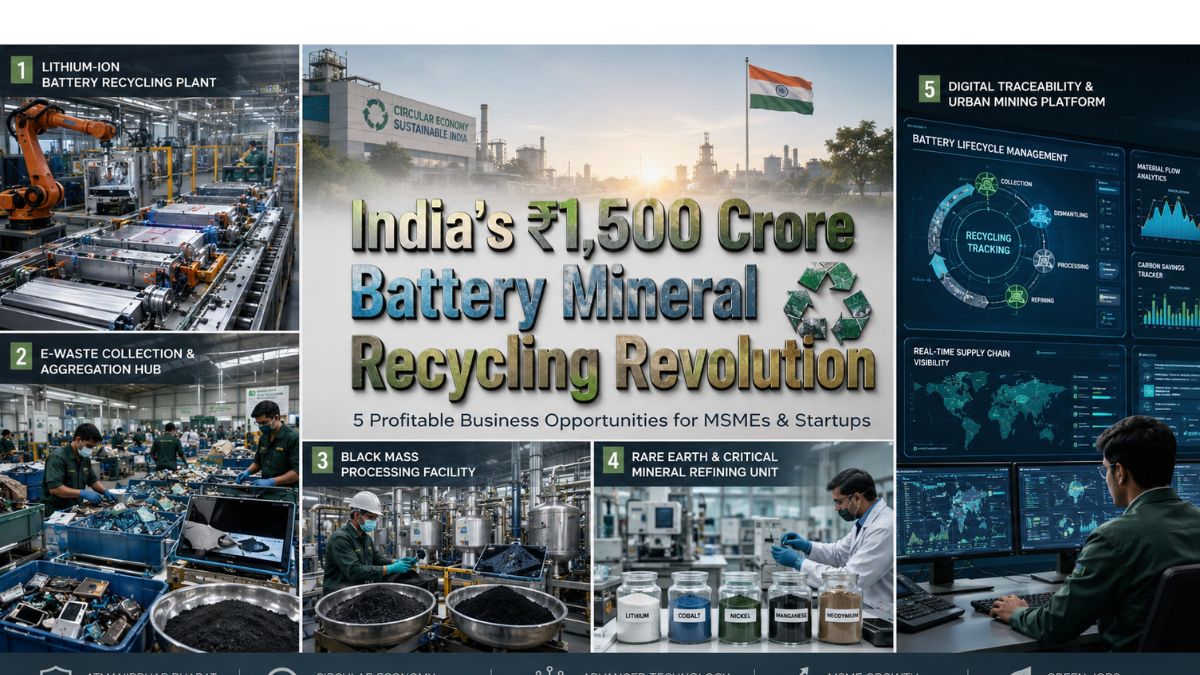
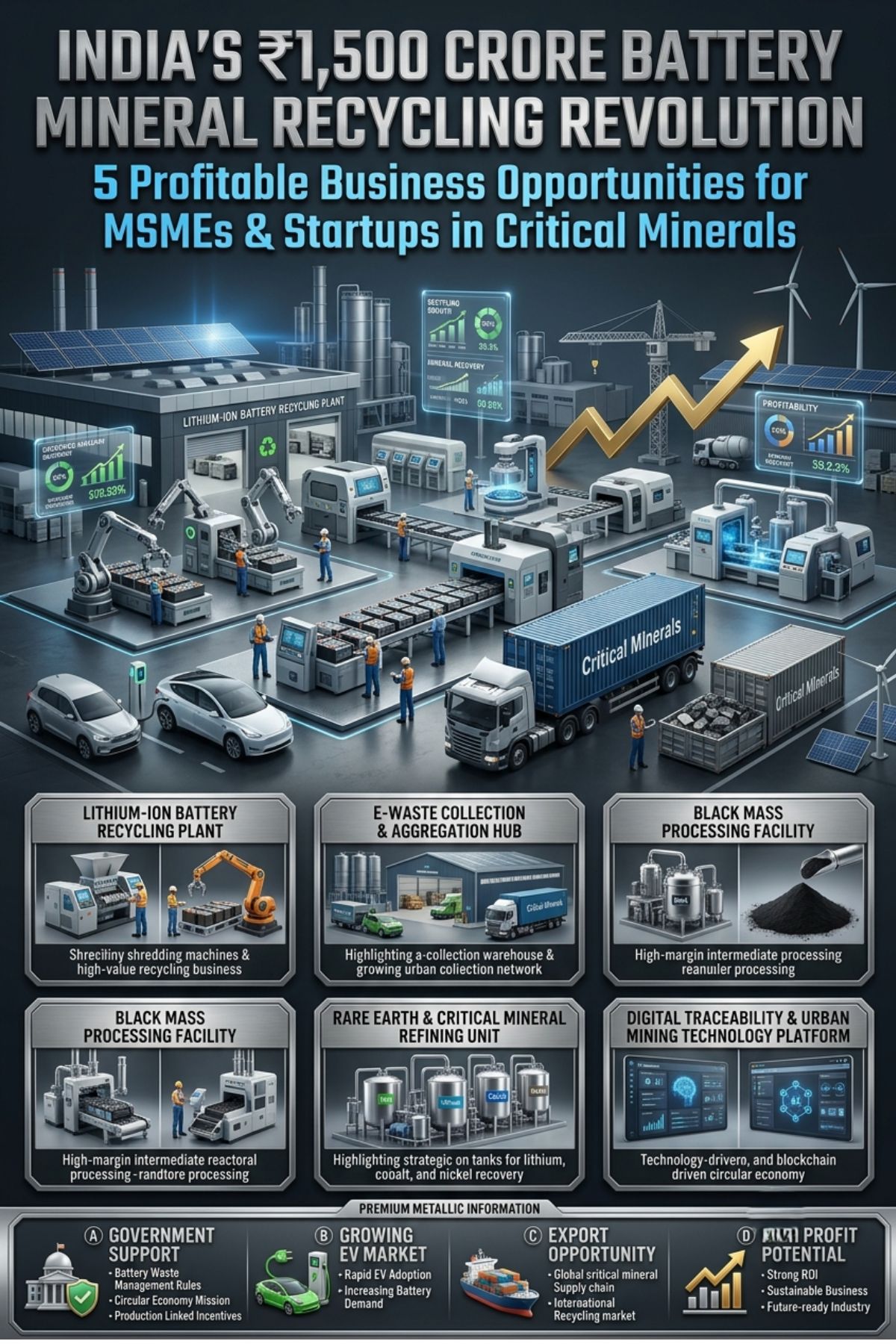
5 High-Potential Business Ideas for MSMEs and Founders
1. Lithium-Ion Battery Recycling Plant
Spent EV batteries and batteries for consumer electronic applications are India’s fastest growing secondary source of minerals. Recycling of lithium, cobalt, nickel and manganese from end-of-life cells (ells) is performed by the lithium-ion battery recycling plant using the hydrometallurgical or pyrometallurgical process. This is an immediate opportunity for MSMEs with the government providing 20 percent Capex subsidy and the recycling scheme approved under reduced thresholds for Group B entities. Investment range: Rs 3 to 10 crore (based on capacity). Target customers: battery gigafactory operators, EV-OEMs and component makers.
2. E-Waste Collection and Aggregation Hub
There is a huge leak in the critical mineral recycling value chain because India does not have a robust collection system. Structured e-waste aggregation hubs, with a feedstock base of e-waste collected from corporate buyback programs, Extended Producer Responsibility programs, and municipal collection programs can provide a feedstock backbone for larger recyclers. It is a capital light model (Rs 50 – 75 lakh) which has fixed money inflows of tipping fees and margins on material trading. This model presents an opportunity for the government’s national digital collection portal to be integrated with technological solutions.
3. Black Mass Processing Facility
The key ingredient in the final critical mineral extraction is black mass, the powdered intermediate product of shredded lithium-ion batteries. A special black mass processing plant is the market segment between collection and refining. This is a more technologically advanced game that requires expertise in hydrometallurgy, but has good margins and long-term offtake contracts with the downstream manufacturers. Investment period: Rs 5-15 crore. The scheme emphasis on processing and recovery rather than black mass production, gives greater incentive support to the facilities further in the value chain.
Related Article: Lead Acid Battery Recycling: Unlocking Sustainable Growth Opportunities in India
4. Rare Earth and Critical Mineral Refining Unit
The government of India has laid out its target to become self-reliant in zirconium and titanium by 2030 and ready to export by the next decade. A domestic rare earth element refining facility from secondary sources, such as defence, EV motors and solar companies, is a crucial play. Investment: Rs 10 to 25 crore. The co-location benefits are realized by four Processing Parks located in the coastal and industrial states in India. Industry: defence electronics, EV powertrain suppliers and renewable energy equipment manufacturers.
5. Digital Traceability and Urban Mining Technology Platform
All recyclers under the scheme will need to demonstrate EPR compliance and mineral traceability. This presents a huge technology services opportunity. A SaaS or IoT solution that could monitor battery origin, validate feedstock sources, link informal battery scrap collectors to formal scrap collectors and produce compliance reporting may be a critical infrastructure element for the sector as a whole. The range of investment: Rs 30 to 80 lakh. This model is country scalable with minimal investment and is supported by the government’s planned initiative of creating a national digital portal.
Import–Export Opportunity Analysis
The push in India to develop critical minerals has many implications for trade on both sides of the coin.
Import Substitution: The Primary Driver
Today, India gets almost all of its lithium, cobalt and rare-earth magnets from abroad. By 2030 a domestic recycling system generating 40 kilotonnes of critical minerals a year will supplant high cost, geopolitically sensitive imports. This isn’t the margins; it’s a structural decrease in India’s trade exposure in a segment where China has already affected supply chains in 2025.
Export Potential: The Decade-After Opportunity
India wants to be a net exporter of processed products of rare earth and critical mineral products by the end of the 2030s”, Mines Minister Goyal made it clear. Coastal states such as Andhra Pradesh and Gujarat have processing parks with the focus of export. The certification and quality standards that Indian recyclers need to meet to comply with EU Battery Regulation, which will require minimum recycled content levels starting 2031, could make them top choices for European EV companies that are buying critical minerals with traceability and sustainable sourcing.
Invest India and the DGFT should follow the developments of the EU Critical Raw Materials Act (CRMA) and the US Inflation Reduction Act (IRA) provisions on the supply chain, which would provide an export market pull to the critical mineral processors in India that comply with the International provenance requirements.
Indian MSME Success Stories in Critical Mineral Recycling
Attero Recycling: From E-Waste to Strategic Resource
Headquartered in Roorkee, India, Attero Recycling is one of the early lithium-ion battery recyclers. The company has developed the hydrometallurgical processing capacity within the country and has established international technology upgradation partnerships. Its journey shows how Indian MSMEs can transform from e-waste collectors to value-added mineral recovery if their technical approach is appropriately focused and early government interventions are put into place.
Lohum Cleantech: Battery Circularity at Scale
Lohum Cleantech has grown its operations to turn used batteries into black mass, and then extract lithium, cobalt and nickel for use in new battery cells. The model that it is promoting to close the battery life cycle within its own country, not exporting black mass abroad, is exactly what India’s new scheme wants to encourage and emulate through more MSMEs.
Discover business ideas that actually make money
The Informal Sector Opportunity
The informal e-waste industry in India is estimated to have 1.5 million people employed in the process of recycling e-waste and batteries. The government’s intention to have a national collection portal and viability gap funding for pilot collection projects is an opportunity for formalisation. Structured aggregation and logistics enterprises can be formed around the informal sector by MSMEs, enabling them to tap this resource base and enhance environmental and occupational health, by offering training, safe dismantling facilities, and digital traceability.
How NPCS Can Help You Enter the Critical Mineral Recycling Market
Niir Project Consultancy Services (NPCS) has assisted Indian entrepreneurs, MSMEs and industrial investors with project feasibility reports, techno-economic assessment, market entry strategies, etc. for more than 40 years. India’s key mineral recycling industry is on the cusp of policy to project, where NPCS provides the technical bedrock for which the founders can have confidence to act.
The NPCS project reports for lithium-ion battery recycling, e-waste processing and rare earth refining plants include detailed plant capacity sizing, raw material sourcing strategy, process technology benchmarking, capital cost estimation, revenue modelling, payback period analysis and integration plans for government incentives.
Entrepreneurs who are willing to take one step further from market signals and bankable project plans will benefit from the detailed feasibility work that NPCS offers. The project reports of NPCS are the beginning of a solid investment case, whether you are considering your first unit or expanding your e-waste enterprise.
Business Opportunity Summary Table
Key business models emerging from India’s Rs 1,500 crore Critical Mineral Recycling Incentive Scheme:
| Business Opportunity | Est. Investment | Government Support | Target Market | Key Minerals |
| Lithium-Ion Battery Recycling Plant | ₹3–10 Crore | 20% Capex + Opex subsidy (NCMM) | EV OEMs, Battery Makers | Lithium, Cobalt, Nickel |
| E-Waste Collection & Aggregation Hub | ₹50–75 Lakh | Startup India, SIDBI Loans | Recyclers, EPR Producers | Cobalt, Rare Earths |
| Black Mass Processing Facility | ₹5–15 Crore | NCMM Capex Subsidy | Battery Manufacturers | Lithium, Graphite |
| Critical Mineral Refining Unit | ₹10–25 Crore | Make in India, DPIIT | Defence, EV, Solar | Zirconium, Titanium, REE |
| Battery Mineral Tech Startup (SaaS/IoT) | ₹30–80 Lakh | Startup India, DPIIT | Recyclers, Regulators | Data-driven Traceability |
| Urban Mining & Scrap Collection Network | ₹20–50 Lakh | MSME Schemes, SIDBI | Informal Sector Upgrade | Mixed Critical Minerals |
Source: Compiled from National Critical Mineral Mission, Ministry of Mines, MRAI Conference proceedings, and Down-To-Earth reporting.
Frequently Asked Questions (FAQs) for Founders
Q1. Which people are eligible for the Rs 1.50 lakh crore Critical Mineral Recycling Incentive Scheme?
Eligible is Indian recyclers who are involved in the recovery and extraction of critical minerals from secondary sources like e-waste, spent lithium-ion batteries and other industrial scrap. The scheme demarcates the applicants as Group A (Global Manufacturing Revenue of Rs 200 crore or above) and Group B (Global Manufacturing Revenue below Rs 200 crore – including Start-ups). The input capacity thresholds for group B entities are set at lower rates and the aggregate incentive ceiling is set as Rs 25 crore for small entity. This round was closed with applications and the next round will be run as a scaling up of the scheme.
Q2. What does the scheme provide and how are these incentives structured?
The scheme provides two categories of incentives: a capital expenditure subsidy for projects that commence production within a certain period; and an operational expenditure (Opex) subsidy based on incremental production over the base year FY 2025-26. The Opex subsidy will be 40 percent eligible in Year 2 and 60 percent eligible beginning in Year 5 and continue through FY 2030–31. Large entities are limited to Rs 50 crore for the total Capex and Opex incentives, while the small entities are limited to Rs 25 crore for the total Capex and Opex incentive.
Q3. Which minerals are in the scheme and what feedstocks are acceptable?
The 27 critical minerals included in the scheme are lithium, cobalt, nickel, graphite, manganese, zirconium, titanium and rare earth elements. Qualifying feedstocks include e-waste, lithium-ion battery scrap, and other industrial scrap that contains critical minerals. According to the Battery Waste Management Rules, 2022, the recyclers are required to procure the black mass from the entities registered under the Extended Producer Responsibility (EPR) Rules of Central Pollution Control Board.
Q4. What is the opportunity of urban mining and integration of informal sector?
Yes — indeed, this is one of the biggest white space moments in the entire value chain. The government is working on a national digital platform to link the recyclers to collection networks including the informal sector scrap collectors. NITI Aayog has been requested to look in-depth into the viability gap funding model for pilot collection projects. Structured Aggregation, Logistics and Formalisation services for informal waste collectors can be a vital infrastructure for approved recyclers in the scheme for MSMEs and startups.
Q5. What are the implications of EU Battery Regulation and global Trade Policy for the Indian recyclers?
The EU Battery Regulation will introduce minimum recycled content targets for EV batteries from 2031, with exports being a major new pull for certified traceable critical mineral producers. If India’s recyclers start establishing quality systems, sourcing documentation, and sustainability certification, they will have a solid leg to stand on with the ability to provide EU battery manufacturers with non-China batteries that comply with EU standards. The U.S. Inflation Reduction Act also provides a boost for supply chain diversification. Both provide long-term export opportunity to the Indian critical mineral processors.
Q6. How much could a small battery recycling operation invest and when would it be recouped?
The estimated investment for a small group B entity, which enters into lithium-ion battery recycling, is from Rs.3 crore to Rs 10 crore in the beginning including plant, equipment and working capital. Effective Capex subsidy is 20 percent and progressive Opex support makes effective net investment light on the foot. Realistic payback periods are 4-7 years for facilities with secured feedstock supply contracts and with battery manufacturers or EV OEMs that are willing to sign an offtake contract. It is advisable to hire a certified consultant to prepare a feasibility report before investing.
Conclusion: The First-Mover Window Is Now
The reporting from Down To Earth on India’s battery minerals processing scheme is a momentous occasion for the market. From aspiration to architecture — the government has allocated Rs 1,500 crore, approved 58 recyclers, is developing Processing Parks and has brought a battery minerals processing policy close to Cabinet approval. India’s critical mineral recycling ecosystem is being created live.
The policy arithmetic is compelling for MSMEs. The industry is already strongly supporting the government’s recycling targets, with commitments already three times higher. This is not just a scheme for big industrial conglomerates as it has explicitly provided for small entities and start-ups. Founders who get started on feasibility planning, find EPR partnerships and establish technical teams will be in a better position when the battery minerals processing scheme is up and running for applications.
Materials needed for India’s electric vehicles, solar power, and defence electronics should not be completely dependent on foreign suppliers in geopolitically volatile markets. India is working on the infrastructure for it. Down To Earth has signalled a business opportunity that is both real and time sensitive and funded.
Critical minerals recycling is no longer a niche sustainability play. It is the backbone of industrial infrastructure for India’s growth for next decade. The sector will be shaped by founders who are forward-thinking.
Please visit the DPIIT portal and the Ministry of Mines website for complete details of the scheme. NPCS project reports offer your business plan the technical and financial support it needs for project feasibility and investment analysis.


