




Transparent LPG Cylinder Manufacturing
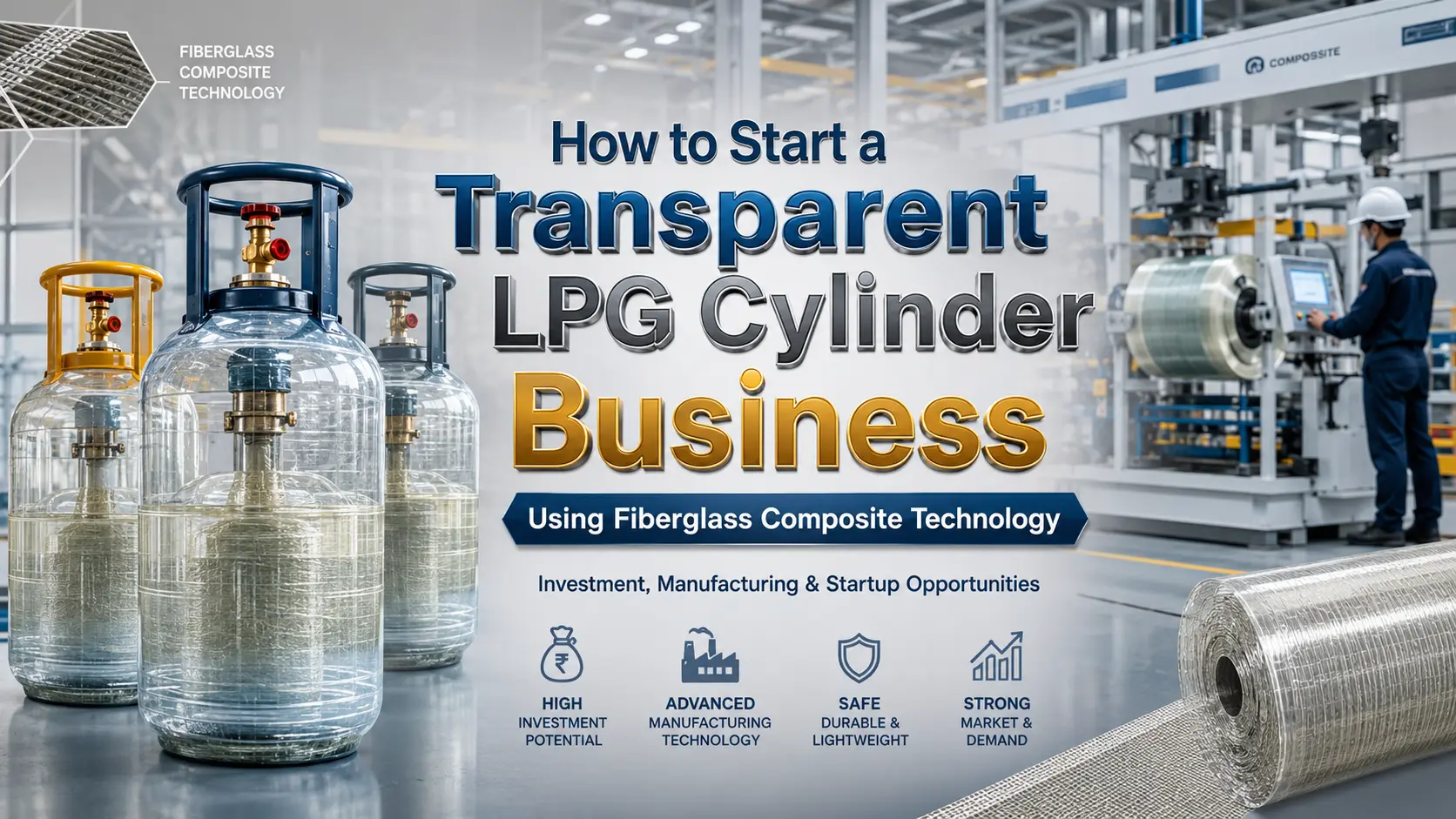
The LPG industry in India is getting a facelift with the introduction of transparent fiberglass composite LPG cylinders. A new product category that merges safety, visual fuel monitoring and modern design. This is a haven for entrepreneurs looking for new business opportunities, as domestic competition is low, there is strong government support and there is a high demand from consumers.
Homemakers would like to know how much of the gas is left in the cylinder. Hotels and restaurants need lighter, rust-free cylinders that can last for years of harsh handling and usage. This has given rise to the composite cylinder manufacturing industry from a niche import product to a true manufacturing opportunity in India.
In this article, you will understand the reasons for the expansion of the sector, the government schemes that enable new players and what business ideas are suitable for first-generation entrepreneurs, MSME investors and industrial consultants.
Get Detailed Project Report (DPR): LPG Cylinder Manufacturing Project Report
Why This Industry Is Growing Fast in India
Today, the LPG market in India is dominated by steel cylinders. They have definite drawbacks, however. They deteriorate in wet conditions. They have a significant impact on delivery personnel and grizzled consumers. Furthermore, users are unable to see the fuel level without lifting or shaking the cylinder.
Problems are directly addressed through the use of transparent and translucent composite cylinders. A composite cylinder is usually constructed of a blow-moulded HDPE liner inside, surrounded by fiberglass composite and covered by an outer HDPE jacket. Indian Oil is already marketing this design under its Xtralite brand, and it states that the translucent body enables the user to inspect the level of gas by lighting it up, while the tare weight is close to half of what a similar steel cylinder would be.
Consumer Demand Is Shifting Toward Design and Safety
Most contemporary kitchens are opting for appliances that are clean and modern. This is a logical fit for a clear cylinder. Furthermore, buyers are always looking for cylinders that are designed to be safe, and that will not rust, corrode, or stain from any leaks.
Commercial and Export Demand Adds Scale
Hotels, catering units and construction sites also appreciate composite cylinders as they are quicker and less tiring for workers to handle. In parallel, a number of markets in Africa and in Southeast Asia are growing LPG access without a local steel cylinder manufacturing industry. Thus, Indian manufacturers can cater to the orders of both domestic and foreign customers from one production line.
Government Policies and Support for New Entrepreneurs
This business is much more accessible for first-time entrepreneurs thanks to the government support. There are several schemes which are applicable directly to the manufacture of composite cylinders.
New units can register under Udyam Registration through the Ministry of MSME, which unlocks priority lending, subsidy access, and protection against delayed payments.
The Prime Minister Employment Generation Programme (PMEGP) is a scheme for providing capital subsidy to a new manufacturing undertaking and thus the burden on the founder is kept to a minimum. In the meantime, the Credit Guarantee Fund Trust for Micro and Small Enterprises (CGTMSE) offers an opportunity to the entrepreneurs to avail bank loans without any collateral, which is one of the biggest advantages for the entrepreneurs who do not have large personal assets.
The composite cylinder production also finds its place in the Make in India campaign aimed at making industrial goods which are being imported from abroad. The production of fiberglass composite cylinders is still carried out partly with imported technology of resin and filament winding, thus a value addition in the local market is directly helpful to the national manufacturing targets.
Cylinder design approval, testing and licensing is regulated by the Petroleum and Explosives Safety Organisation (PESO) in accordance with the Gas Cylinders Rules. It is important to note that with new manufacturers they must receive PESO design approval or they will not be able to commercially produce it; therefore, this process safeguards genuine investors from inferior competition.
The Bureau of Indian Standards (BIS) also has technical specifications which manufacturers are required to abide by in order for composite cylinders to be sold in the domestic market and also sold in foreign countries to meet international standards like EN 14427 and ISO 11119-3.
Last but not least, Startup India comes with tax advantages, quick patent approval and ease of compliance for startups that are registered as eligible startups, making it ideal for the younger generation to step into the advanced manufacturing of materials.
Multiple Business Ideas in Transparent LPG Cylinder Manufacturing
There are numerous entry points in the transparent LPG cylinder value chain. In the initial stages, founders don’t have to establish a full end-to-end factory. Rather, they are able to select a segment that aligns with their fund capability and technical ease.
Small-Scale Composite Cylinder Assembly and Filling Unit
A founder may not choose to begin with a manufacturing facility but instead with an assembly and bottling facility. In this model, the cylinder shells are purchased from a certified composite cylinder manufacturer and a PESO-licensed LPG bottling plant is brought on stream close by. The unit fills cylinders, confirms the weight and delivers the cylinders to the local dealers and housing societies. This technique will require less capital investment than a full-scale manufacturing since the founder will not invest in winding machines.
But there are still many rules that must be strictly followed, employees who are trained, and a fireproof storage area that must be available for the business. Many first-generation entrepreneurs opt for this as the first step since they want to build market relationships before expanding to upstream manufacturing.
Fiberglass Winding and HDPE Liner Manufacturing Unit
Technically more capable entrepreneurs can get involved in the value chain by manufacturing the composite shell. In this unit, the inner liner, which is made of HDPE, is blow moulded, and automatically wound with resin-soaked fiberglass filament. This requires fine tuning as uneven wind tension yields lower burst strength. Thus, the business idea is appropriate for entrepreneurs who can recruit expert polymer/molecular or mechanical engineers right from the start.
Capital requirements are higher than assembly units, because filament winding machines and curing ovens constitute a significant cost of project. However, there is good margin in this segment since the manufacturers are not selling their products only in the local market, but in the market of various brands and in the export market too, of cylinder shells.
Get Detailed Insights from This Book: The Complete Technology Book on Plastic Films, HDPE and Thermoset Plastics
LPG Valve, Regulator and Safety Fitting Manufacturing
Each composite cylinder is required to have a certified valve, pressure relief device, and, in some cases, an integrated regulator fitting. Many manufacturers in India are still procuring precision valve components from other countries, thereby providing an opportunity for domestic ancillary units. A founder might launch a focused workshop for the manufacturing or assembly of valves, under license, test such valves for leak-proof capability and sell them straight to a cylinder manufacturer. It is a good concept for MSME investors having a precision machining or moulding business, as the creation of the valve complements the existing skills of tooling.
In addition, the company makes recurring revenue from the business every time a cylinder needs replacing, as opposed to the one-time sale, leading to a more predictable cash flow over time.
View Full Project Details: LPG Valves Manufacturing – Detailed Project Report
Export-Oriented Composite Cylinder Manufacturing Plant
Indian processing costs for plastics are lower than international markets, thus providing a true opportunity for export of composite cylinders. Some African countries, as well as parts of Southeast Asia, are increasing access to household LPG, but they do not have domestic steel cylinder production. If these markets are export markets, a plant can address these markets directly, provided it certifies its cylinders to EN 14427 or ISO 11119-3 standards, as well as for domestic PESO.
This business concept requires a more significant initial investment and a quality team as well, since the international buyers inspect manufacturing plants carefully before ordering. The founders who make it here, however, create a defensible position as very few Indian MSMEs at present have a PESO clearance as well as an international composite cylinder certification.
Testing, Inspection and Third-Party Certification Services
Independent testing capability is a must as more manufacturers get involved in this field. For cylinder manufacturers who use composites, a materials testing or mechanical engineering expert can establish a test lab that conducts hydrostatic pressure testing, burst testing, UV resistance testing and fire resistance testing. This is a service-based business idea which would require a lesser amount of capital compared to the manufacturing business but would give a regular income every time a fresh batch of products are produced and need to be certified for sales.
PESO and BIS both require certain testing periodicity, so there will be an increasing demand for accredited third-party testing laboratories as the manufacturing base expands, which will be an appealing opportunity for technically literate entrepreneurs.
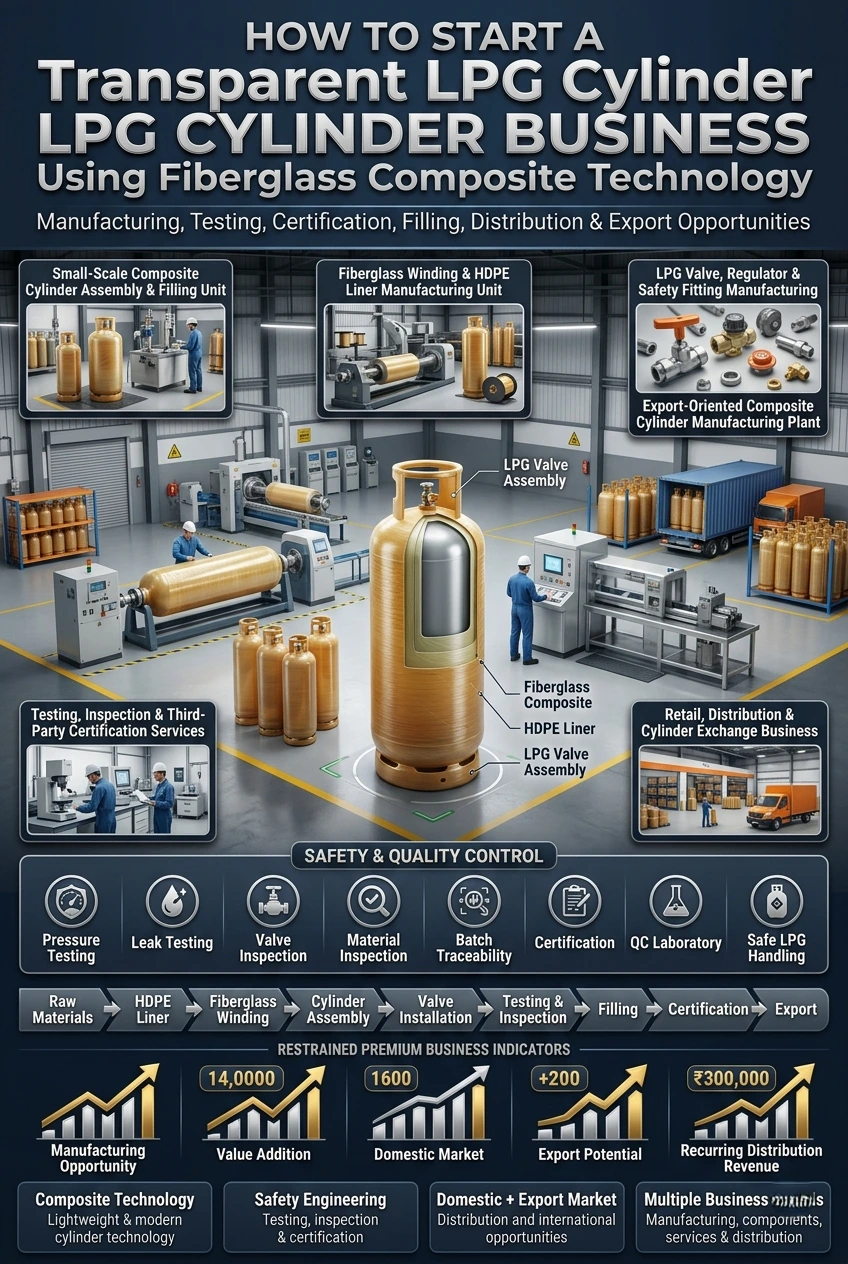
Retail, Distribution and Cylinder Exchange Business
Only a small number of entrepreneurs would like to participate in manufacturing. A retail/distribution company can purchase composite cylinders from reputable manufacturers and establish a network of dealers/exchanges in housing societies, restaurants, and small hotels. This model is especially beneficial in the urban cluster, where consumers are actively looking for lighter options to steel cylinders without all the rust.
Founders may offer variety of options, such as exchange at the door or subscription refill plans or safety inspection add-ons. Distributors must take the time to inform customers of the long-term savings that composite offers due to durability and corrosion resistance since it is a more expensive cylinder to begin with. This approach is ideal for entrepreneurs who have extensive local connections and have limited technical knowledge.
Import-Export Opportunity Analysis
Demand for lightweight LPG cylinders is growing steadily worldwide, especially in the remaining regions where access to basic cooking gas has been expanded. Composite cylinders are imported into several African markets and Pacific island countries due to low production of steel cylinders in the region. Thus, Indian composite cylinder exporters can tap the market of established European suppliers like Norwegian company Ragasco, but not always on a competitive price level as this is because of the lower manufacturing costs in India.
In India, there is still some dependency on foreign suppliers for raw material, as resin, some grades of fiberglass roving and precision valve components are still imported. This dependence can be mitigated by bringing fiberglass roving manufacturing or valve manufacturing closer to home, both of which are import substitution in the overall thrust towards Make in India.
On the export front, exports enjoy schemes like Remission of Duties and Taxes on Exported Products (RoDTEP), which are duty exemptions on the export shipments. This, along with India’s existing plastic processing capabilities, makes it a true cost advantage for the founders looking to sell their LPGs to overseas distribution companies, energy stores and camping gear companies and to marine and off-grid energy consumers.
Related Article: LPG Shortage in India: A Growing Challenge Creating New Business Opportunities
Indian MSME Success Stories in Composite Cylinder Manufacturing
The following are three examples of Indian start-ups taking on different routes to enter the space, and their stories can provide valuable tips for new entrepreneurs.
Supreme Industries: From Plastic Processor to Composite Cylinder Pioneer
Supreme Industries started in 1942 as a small trading and manufacturing company and the Taparia family since 1966 has transformed it into a plastic processing company. In 20 years under the leadership of Chairman B.L. Taparia and Managing Director M.P. Taparia, Supreme Industries expanded its product line gradually, and then initiated the introduction of the KAVACH range of composite LPG Cylinders. The message for new entrepreneurs is pretty clear: diversification into composite cylinders does not just occur overnight. Decades of plastic processing experience came first for Supreme, which gave it the manufacturing discipline to be well-positioned to successfully enter the safety-critical product category.
Time Technoplast: Building a Global Composite Cylinder Business From Scratch
Things are different with Time Technoplast. In 1991, three people including Anil Jain quit a medium sized packaging firm and set up the company with a mere capital of 9 lakh rupees. The founding team has developed industrial packaging first, and then it has expanded its activities to the production of composite LPG and CNG cylinders via its acquisition of Kompozit-Praha and LiteSafe brand. Time Technoplast is now manufacturing plants in over a dozen countries. This is a story that proves that for the first generation of founders, lack of start-up capital need not be a barrier to ultimately scaling, when the founding team are willing to invest consistently and learn through technical efforts.
Superindia Composites: A Focused MSME Model From Goa
Superindia Composites from Goa is a more targeted MSME journey. The company has been focused on the manufacture of glass and carbon fiber composite since 2008 and subsequently introduced its brand of SuperLite LPG composite cylinder for the domestic and export market. Contrary to the big diversified conglomerates, Superindia demonstrates that a specialised MSME can be a successful player in this industry, confined to a niche product area of composite technology and not expanding into unrelated product lines.
Choose the right startup backed by real market demand
About NPCS: Feasibility Support for New Entrants
Before starting up a composite cylinder manufacturing business, it is essential to plan carefully as they have different impacts on the viability of the business depending on the scale of the project, such as the cost of the machinery, the time it takes to be certified, and the sourcing of the raw materials. Entrepreneurs who consider an industrial project of this nature should consider preparing the Market Survey cum Detailed Techno-Economic Feasibility Report at Niir Project Consultancy Services (NPCS).
We provide our reports covering manufacturing process flow, market and demand analysis, machinery and raw material requirements, product mix planning and complete financials of the project with profitability analysis. If the business is to be based on a transparent LPG cylinder, then this type of feasibility study can provide some justification for the investment amount, the returns to be made, and the realistic time to construct the facility.
Transparent LPG Cylinder Business: Estimated Cost and Market Snapshot
The table below gives indicative planning figures across different entry points in this industry.
| Business Model | Approx. Investment Range | Approx. Payback Period | Key Regulatory Requirement |
| Small-scale assembly & bottling unit | Rs. 25 lakh – Rs. 75 lakh | 2-3 years | PESO bottling plant license |
| Fiberglass shell manufacturing unit | Rs. 1.5 crore – Rs. 4 crore | 3-5 years | PESO design approval, BIS compliance |
| Valve & fitting manufacturing workshop | Rs. 40 lakh – Rs. 1.2 crore | 2-4 years | BIS valve certification |
| Export-oriented manufacturing plant | Rs. 4 crore – Rs. 10 crore+ | 4-6 years | PESO + EN 14427 / ISO 11119-3 |
| Testing & certification lab | Rs. 60 lakh – Rs. 2 crore | 3-4 years | NABL / BIS accreditation |
| Retail & distribution network | Rs. 10 lakh – Rs. 30 lakh | 1-2 years | Dealer registration with OMC/manufacturer |
Note: Figures are indicative estimates for planning purposes; actual costs vary by location, scale, and machinery choice.
Conclusion
Transparent LPG cylinders are currently in a unique position concerning safety, design and industrial opportunity. Not all the demand drivers (rust resistance, lighter weight and fuel level visibility) are fads.
However, entrepreneurs willing to tread carefully on the path of PESO and BIS compliance are already enjoying a range of government schemes for credit guarantee, capital subsidy and domestic manufacturing. Supreme Industries and Time Technoplast do not need to be emulated by the founders on day one.
Instead, a focused entry, through assembly, valves, testing services, or regional distribution, offers a realistic and less capital-intensive starting point. Readers can also explore relevant sector data through industry bodies such as FICCI, which regularly publishes manufacturing and MSME growth reports. For those ready to commit to the sector’s safety and quality standards, this remains one of the more promising manufacturing and business ideas within India’s evolving LPG ecosystem today.


