






Manufacturing business ideas in India
Resilience and creativity have always influenced the entrepreneurial culture in India. Business owners-created companies were decades old and operated in hard-to-reach areas with scarce capital and primitive infrastructure. These restrictions did not lead to stagnation but rather a spirit of efficiency, flexibility and common sense in solving problems. The attitude can be characterized as the term jugaad, which is an Indian idea that means to create something with limited resources.
The definition of jugaad has changed today. Indian entrepreneurs are no longer resorting merely to improvisation; they are establishing well-structured, technology-based enterprises which compete at the international level. Firms that used to make products that only served local markets are now exporting their products globally, embracing automation, and investing in research and development. The pharmaceutical and food processing industries, specialty chemicals, electric vehicle parts, and renewable energy equipment are expanding at an alarming rate due to this change.
This is one of the brightest times in the industrial history of India as far as those who intend to start a manufacturing business are concerned. This is because demand is growing, government policies are favourable and financial institutions are more than ever before willing to finance new projects.
Table of Contents
ToggleWhy Indian Entrepreneurs Continue to Succeed
Indian entrepreneurs have been successful not by chance. It is the outcome of stable attention to the efficiency, cost management, and the planning of the long-run. There exist several business owners who begin small, pick up fast and grow slowly by slowly. They know that profitability does not just rely on the sale of products but also on the production cost and quality level.
There are a number of structural strengths behind this success. India possesses a huge supply of technically skilled labor, rising domestic market, and an enhanced infrastructure. Meanwhile, global enterprises are in the process of finding reliable manufacturing partners beyond the conventional supply centres, and this provides new possibilities to Indian manufacturers.
The following are some of the strengths that characterize Indian entrepreneurship:
- Good cost management and efficiency in operations.
- Skills in adjusting to evolving market dynamics.
- Hands-on problem-solving skills in manufacturing settings.
- Pay attention to the long-term customer relations.
- Ready to invest into quality improvement and certification.
These attributes enable the businesses to stay competitive even in the economic uncertainty times.
Government Support Is Accelerating Industrial Growth
The government has been offering one of the highest policy supports to the entrepreneurs today. Industrial development has come to be a national agenda and a number of programs have been established in order to promote new manufacturing units.
One of the most important initiatives is the Production Linked Incentive (PLI) scheme. It encourages firms to produce more and enhance manufacturing capacity within the country. Some of the industries covered by this scheme include electronics, pharmaceuticals, food processing, and automotive components.
Other government initiatives are aimed at making finance more accessible, and business registration easier. Business people who incorporate their businesses in the MSME bracket are entitled to financial aid, tax incentives and easier credit access.
Some of the support systems that could be of help to new entrepreneur are:
- Small business and start up MUDRA loans.
- PMEGP scheme of employment generation projects.
- Udyam Registration to be officially recognized as an MSME.
- Machinery and infrastructure development subsidies.
- Exporter Facilities: Facilities to support international trade.
The programs also decrease the financial risk and simplify the process of starting a manufacturing business.
High-Growth Manufacturing Sectors in India
The most important decision of any entrepreneur is to select the appropriate sector. High demand, technology and market trends in the world make some industries to grow faster than others. This knowledge of these areas can enable investors to know where to invest and make profits.
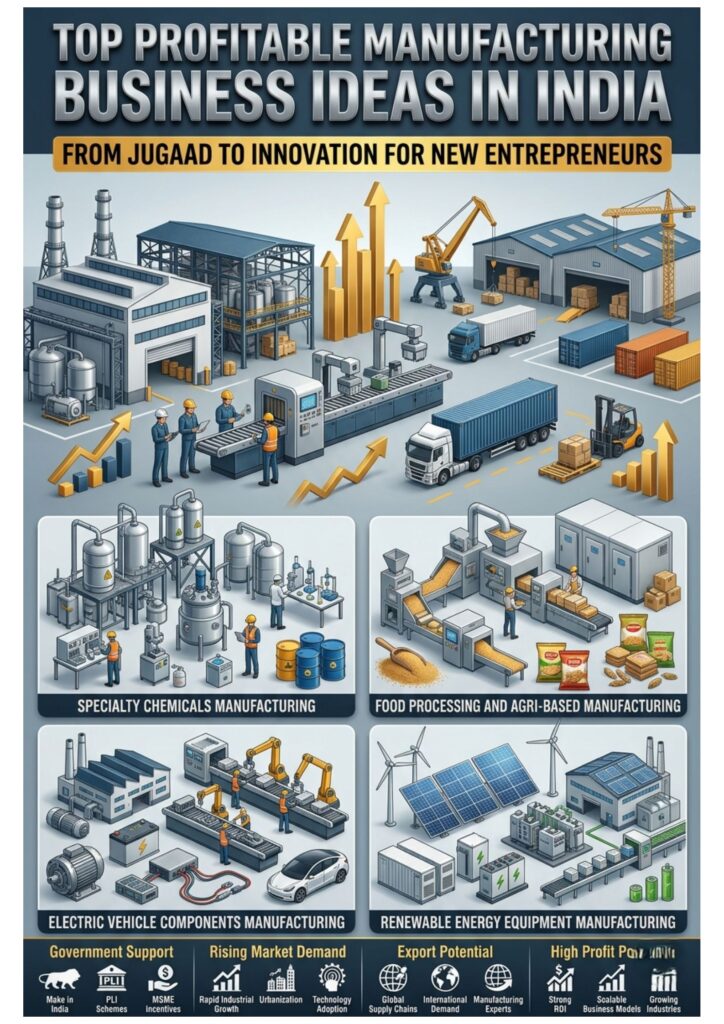
Specialty Chemicals Manufacturing
One of the most rapidly expanding sectors of the manufacturing economy of India is the specialty chemicals. Multinational corporations are spreading out their supply chains and Indian manufacturers are developing a reputation of quality and reliability. The industrial chemicals, cleaning agents and performance materials are on continuous demand locally and internationally.
The benefits of entering into the specialty chemicals industry are usually:
- High export potential
- Strong profit margins
- Increasing demand by various industries.
- Product innovation opportunities.
This sector is especially appealing to business people who have technical expertise or can access qualified chemical engineers.
Get Detailed Insights from This Book: Handbook On Chemical Industries (Alcohol Based)
Food Processing and Agri-Based Manufacturing
India is a major agricultural commodity producer in the world but much of the commodities are marketed without processing. Processing of the raw materials into packaged foods enhances shelf life and profitability. Demand of convenient food products is being fueled by changing consumer lifestyles and increased incomes in urban areas.
The typical food processing business opportunities are:
- Grinding and packaging spices.
- Ready-to-eat meals
- Snacks and bakery products.
- The processing of fruits and vegetables.
Food manufacturing: dairy and beverage manufacturing.
This industry has relatively low investment requirements as compared to the heavy industries and therefore, it is ideal in cases of first-time entrepreneurs.
Electric Vehicle Components Manufacturing
The shift to electric mobility is developing a new industrial ecosystem. Due to the increase in popularity of electric vehicles, the need to use special components increases. A significant number of these components continue to be imported, which gives a chance to domestic manufacturers.
The products that are usually manufactured in this industry are:
- Battery components
- Wiring harnesses
- Motor controllers
- Charging equipment
- Structural components
Companies that provide components to automobile producers usually enjoy the long-term contracts and constant revenues.
Get Detailed Project Report (DPR): Electric Vehicle and E-Rickshaw Guide
Renewable Energy Equipment Manufacturing
India is increasingly becoming a country dedicated to clean energy, and this factor is leading to a fast increase in renewable energy production. Residential, commercial and industrial sectors are increasing in the use of solar installations and energy storage systems. The demand is bound to remain steady in the years to come in companies that produce supporting equipment.
The industry is especially appealing, as it is both environmentally friendly and profitable.
The Importance of Planning Before Starting a Manufacturing Business
The establishment of a factory is a costly venture in terms of finances and operation. Even promising ideas can be subject to serious challenges without proper planning. Effective entrepreneurs start by critically analysing market demand, production cost and financial viability.
A professional feasibility study gives one a clear picture on whether a project is viable or not. It looks into the availability of raw materials, production technology, regulations and likely profitability. This knowledge assists entrepreneurs in making the right decision and taking risks that are not vital.
Another reason why financial institutions consider detailed documentation during the process of evaluating loan applications is because of their reliance on the documentation. A properly written project report evidences that the entrepreneur has critically examined the business opportunity and has come up with a realistic implementation plan.
How NPCS Helps Entrepreneurs Build Successful Industries
Niir Project Consultancy Services (NPCS) is a top-ranking industrial consultancy organization in India. Having more than 30 years of experience in business planning and technical advisory services, NPCS has helped thousands of entrepreneurs to open manufacturing units in various sectors.
NPCS offers a full-fledged consulting services that take the client through concept phase to full-scale production. The organization deals in compiling Market Survey and Detailed Techno-Economic Feasibility Reports on which investment decisions and loan approvals are based.
The major services which NPCS provides are:
- Drawing up of Detailed Project Reports (DPR)
- Demand and market research.
- The choice of machinery and the layout planning of a plant.
- Profitability analysis and financial projections.
- Direction on government approvals and compliance.
NPCS assists entrepreneurs to transform business ideas into profitable industrial ventures by using technical expertise, and market insight.
The Future of Indian Manufacturing
The manufacturing industry in India is in a period of long-term growth. The increasing consumer demand, the development of the infrastructure and the rise of foreign investments are bringing good conditions to the industrial growth. Meanwhile, the digital technology and automation are enhancing efficiency and quality of products in production plants.
Businessmen investing in production today are preparing to enjoy the benefits of economic growth in the long term. Success is in planning, execution and improvement.
Industries will in the future be dominated by those that devote themselves to innovation, sustainability and quality. Companies who embrace new production techniques and have close customer associations will be the ones who will realise maximum profitability.
Conclusion
The shift to structured innovation out of jugaad is one of the most important shifts in the Indian business environment. Previously improvised entrepreneurs are currently developing advanced manufacturing companies that can compete on the international level. The environment has been provided by government support, technological development and growing markets in which new businesses can flourish.
The opening of a manufacturing business nowadays is not merely an occasion but a well-thought-out choice that may precondition the financial prosperity in the long run. Through proper planning and expert advice of organizations such as NPCS, entrepreneurs are assured of venturing into the industrial sector and establishing sustainable businesses that can help in developing the economy.
Frequently Asked Questions (FAQ)
Q1. What is the most lucrative manufacturing business in India?
The food processing, specialty chemicals, pharmaceutical, renewable energy equipment, and electric vehicle parts are some of the most lucrative industries at the moment with high demand, and government-friendly policies.
Q2. What is the capital amount needed to establish a manufacturing business?
The investment will be based on the industry and the production capacity. Small-scale manufacturing can be initiated with investments of about twenty-five lakh rupees and medium-scale projects might need a few crores.
Q3. What is the significance of a Detailed Project Report prior to venturing into business?
A Detailed Project Report assists entrepreneurs in considering the viability of their business idea. It gives monetary forecasts, market research, and operation strategy, which are vital in obtaining bank loans and drawing investors.
Q4. Is the government able to provide financial aid to first-time entrepreneurs?
Yes, there are various government programs which offer loans, subsidies and technical assistance to new business. These programs are aimed at promoting industrial growth and entrepreneurship.
Q5. What does NPCS do to assist new manufacturing companies?
NPCS is a firm that provides professional consulting services to enable entrepreneurs to plan, finance, and establish manufacturing units. Their experience makes them technically viable, financially viable and regulatory requirements.


