





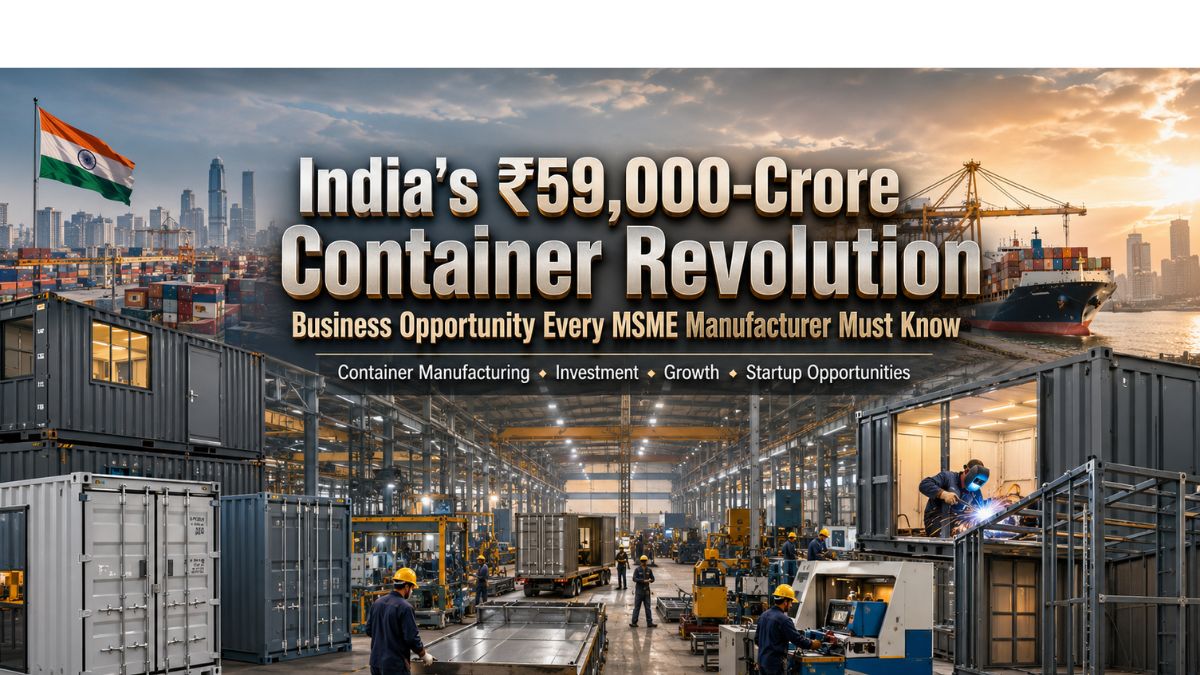
The Box That Controls Your Business — And India Doesn’t Make It
It’s a scenario which every auto-parts manufacturer in Pune, every spice trader in Ernakulam and every garment exporter in Tirupur has experienced: container shortage panic. In the height of the season, call your freight forwarder, and you will always get the same response: boxes are in some Chinese port. At the peak of the global supply-chain crisis, the price of a single 20-foot container was breaching ₹4.5 lakh, a rate it would not have matched in normal times if it had been trading at less than ₹80,000. Indian exporters had to pay through the nose. Their competitors didn’t.
The grim reality is that the Ministry of Ports, Shipping and Waterways estimates India imports less than 15 thousand containers a year locally, while 350 lakh TEUs (twenty-foot equivalent units) of cargo are handled at the country’s key ports. More than 95 per cent of the world’s container box is made in China, where they have helped to establish their own export dominance. India imports nearly all empty boxes which carry their cargo.
That one void—the unmanufactured box—is the focus of one of India’s biggest logistics infrastructure moves in decades. And finally, it’s opening for Indian entrepreneurs.
Related Article: Steel Container Manufacturing Business Guide: Market Size, Profit, Demand & Startup Opportunities
The Supply Chain Wound Nobody Fixed for 30 Years
The dependency on import of containers in India is not a new issue. It is a structural failure that successive governments recognised and then put to bed. The impacts, however, are very real and very measurable. Absence of a strong domestic container carrier has historically proved to be a vulnerability of Indian exporters and importers, in terms of freight rates and global supply shocks, according to data cited by the Press Information Bureau. Indian trade bleeds when Maersk/MSC/COSCO blanks a sailing or reroutes through Colombo.
The figures are alarming. The volume of EXIM cargo by containers in India is increasing at a rapid pace, with manufacturing centres such as the Gujarat and Maharashtra ports, and the new industrial corridors of Odisha and Andhra Pradesh, seeing a surge in containerised cargo. The Container Corporation of India (CONCOR) which has the bulk of inland container movement in India reported over 49 lakh TEUs in the previous full fiscal year. According to the Indian Ports Association, the demand for it is expected to increase by 7-9% annually in the coming 10 years.
But the domestic manufacturing capacity is in the near zero commercial scale level. Those few units that do make containers in India are very small, cater to small niche markets and are mostly based in Gujarat and Andhra Pradesh. At present, there is no any large scale export quality container manufacturing facility in India. The manufacturing chain for the production of container grade Corten steel fabrication, corner casting, flooring assembly and the manufacturing of refrigerated (reefer) units is almost non-existent.
Consequences: When the box market tightens, Indian MSMEs in port linked cities have no pricing power, wait longer for boxes, and pay a premium for freight rates. This is a painful reality for clusters in Kandla SEZ, export zone of Nhava Sheva in JNPT, Manali Industrial Area in Chennai and port in Visakhapatnam.
Table 1: India’s Container Trade Gap — Port-wise TEU Volumes and Domestic Manufacturing Deficit
| Major Port / Hub | Annual TEU Handled (approx.) | Key Export Clusters Served | Container Import Dependency |
| JNPT (Navi Mumbai, Maharashtra) | 60+ lakh TEU | Auto parts, pharma, engineering goods | ~99% imported boxes |
| Mundra Port (Kutch, Gujarat) | 65+ lakh TEU | Textiles, chemicals, agri-commodities | ~99% imported boxes |
| Chennai Port (Tamil Nadu) | 18+ lakh TEU | Auto, garments, electronics | ~98% imported boxes |
| Vizag Port (Andhra Pradesh) | 8+ lakh TEU | Steel, fertilisers, aqua exports | ~99% imported boxes |
| Cochin Port (Kerala) | 6+ lakh TEU | Spices, seafood, cashew | ~99% imported boxes |
| Kolkata / Haldia (West Bengal) | 7+ lakh TEU | Jute, tea, engineering | ~99% imported boxes |
Sources: Indian Ports Association (ipa.nic.in), CONCOR Annual Reports, Ministry of Ports, Shipping and Waterways (shipmin.gov.in)
Why This Window Is Different — And Why It Won’t Stay Open Long
The Union Budget announcement of the Container Manufacturing Assistance Scheme (CMAS) with a budgetary allocation of ₹10,000 crore over 5 years is no typical scheme. It’s a policy signal with institutional muscle. The scheme aims to bring in an annual domestic manufacturing capacity of 1 million TEUs by the end of the next decade, the Business Standard quoted official Budget notes. If only 30% of this target is achieved, it leads to the downstream business opportunity for MSMEs of the several thousand crores.
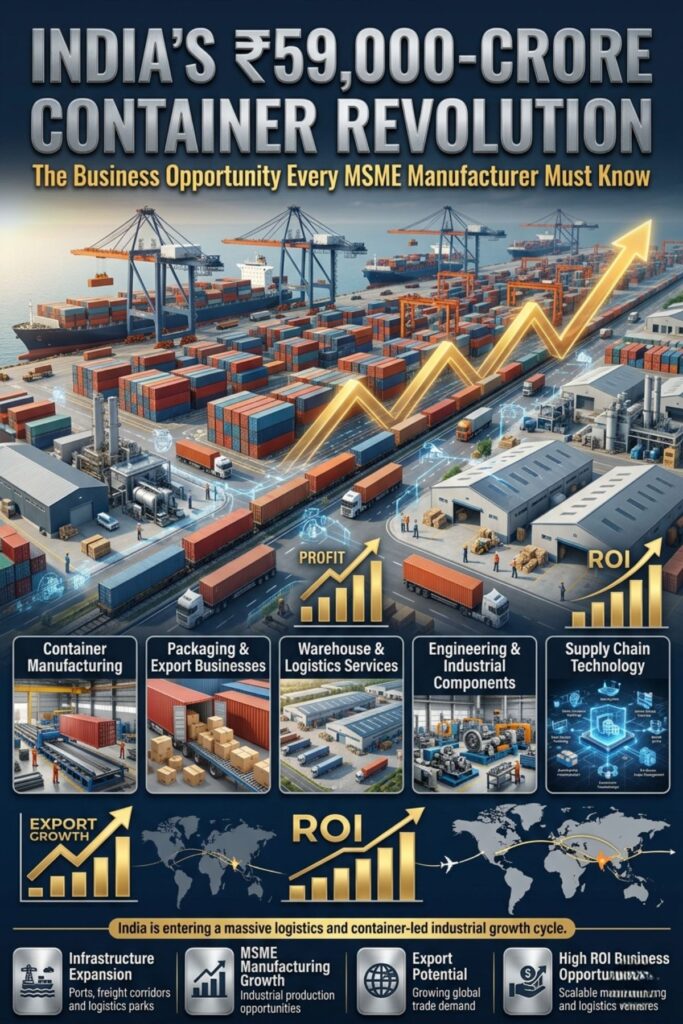
The Bharat Container Shipping Line (BCSL) MoU was inked by a group of India’s most powerful port and logistics institutions on 3 February 2026. Total investment plans of BCSL & allied domestic Container manufacturing: ₹59,000 crore. This is NOT a pilot or a working group. It’s commitment at the procurement scale.
The policy tailwind is multiple – PM Gati Shakti (Multimodal Infrastructure Planning), Sagarmala Programme (port-led development), Maritime India Vision 2030 (target of top-10 global maritime nation) and the newly introduced policy CMAS (all of this points in a single direction). The Ministry of Ports, Shipping and Waterways has placed CMAS in the PM Gati Shakti and Sagarmala framework, so all the approvals, infrastructure and funding avenues are already in place.
For MSMEs, there are three levels of opportunities: Tier 1 – direct manufacturing of container boxes (capital-intensive, larger MSMEs); Tier 2 – component manufacturing (corner castings, lashing rings, container floor, reefer insulation panels, door seals, hinges, container repair, maintenance, modification, depot services near port clusters). Tier 2 and Tier 3 is exactly where MSMEs fit in.
CMAS offers direct financial support to the manufacturers and is complementary to the existing support provided to MSMEs by the Government of India under the Prime Minister’s Employment Generation Programme (PMEGP — subsidised project finance up to ₹50 lakh for MSMEs in the micro sector and ₹2 crore for service sector MSMEs), Credit Guarantee Fund Trust for Micro & Small Enterprises (CGTMSE — collateral-free loans up to ₹5 crore) and MUDRA Tarun (loans up to ₹10 lakh for micro businesses). There are also tax holidays for startups recognised by the Startup India programme in this sector.
Get Detailed Insights from This Book: Steel and Iron Handbook
Table 2: Government Schemes Supporting Container Manufacturing & Logistics MSMEs
| Scheme | Implementing Body | Benefit for Container-Sector MSME | Eligibility Threshold | Max Assistance |
| CMAS (Container Manufacturing Assistance Scheme) | MoPSW / Sagarmala | Direct financial subsidy for box & component manufacturers | Manufacturing enterprises | Pro-rata from ₹10,000 cr pool |
| PMEGP | KVIC / Banks | 25–35% capital subsidy on project cost | New micro/small mfg. units | Up to ₹35 lakh subsidy |
| CGTMSE | SIDBI / MoMSME | Collateral-free credit guarantee | Micro & small enterprises | ₹5 crore credit guarantee |
| MUDRA Tarun | Banks / MFIs | Unsecured working capital loans | Micro enterprises | Up to ₹10 lakh |
| Make in India (PLI-aligned) | DPIIT | Production-linked incentives for mfg. output | Eligible manufacturing sectors | As notified per sector |
| Startup India | DPIIT | Tax exemption, faster incorporation, fund access | DPIIT-recognised startups | 3-year income tax holiday |
Sources: Ministry of Ports Shipping and Waterways (shipmin.gov.in), KVIC, SIDBI, DPIIT (startupindia.gov.in)
How to Set Up a Container Component Manufacturing Unit — Step by Step
Choosing Your Entry Point
For a first-time entrepreneur, the smart move is to manufacture container components such as corner castings, lashing rings and twist locks and container floor panels. These components are universal; no alternative exists and all container boxes in the world are used. India imports almost all these today. The per-unit value is low but volumes are big, initial offtake can be secured via the BCSL order pipeline.
Minimum Investment
The cost of the small-scale corner casting and lashing hardware unit is approximately ₹45-65 lakh per square feet, for a 1,500 Sq ft unit. A medium fabrication unit for making bamboo composite or tropical hardwood flooring for containers calls for an investment of ₹1.2–2 crore. Costs of land lease in a container repair depot near a port cluster (JNPT belt in Mundra and Chennai) are ₹60-90 lakh and equipment and working capital is required.
Land and Space Requirements
Shed (1,500-3000 sq ft) covered on industrial plot at MIDC (Maharashtra), GIDC (Gujarat), SIPCOT (Tamil Nadu) or APIIC (Andhra Pradesh) on industrial plots, rental charge is ₹18-35 per sq ft per month as per zone. The size of the open yard and the workshop shed for a repair depot for containers is 5000/10000 sq ft, with a 1200 sq ft workshop shed preferably located within 15 km of a container terminal ICD/CFS.
Key Machinery
Equipment used for corner casting fabrication: CNC plasma cutting machine (₹8 lakh – 12 lakh), Hydraulic press brakes (₹5 lakh – 8 lakh), MIG/MAG welding sets (₺1.5 lakh – 2 lakh per set, minimum 4), shot blasting unit (₺6 lakh – 9 lakh), epoxy coating line (₺4 lakh – 6 lakh), dimensional inspection jigs (₺1.5 lakh – 3 lakh). Container flooring machine (bamboo/hardwood lamination press: Rs 15-20 lakh, CNC router: Rs 8-12 lakh, and surface coating machine: Rs 5-8 lakh). The companies supplying the domestic market are Precihole Machine Tools (Thane), Baileigh Industrial (Pune) and some unique CNC fabricators from Rajkot itself.
Raw Material Sourcing
Corten steel (weathering grade A606/A242) is coming from SAIL’s Burnpur & Bokaro plants (Jharkhand/West Bengal) and Tata Steel’s Jamshedpur. The steel coming from secondary producers in Mandi Gobindgarh, Punjab and Bhavnagar, Gujarat are standard structural steel. The Northeast region has the bamboo corridor as Assam, Tripura, and Arunachal Pradesh are primary raw material states which fits the government’s thrust on value added bamboo products for the bamboo composite flooring.
Licences and Regulatory Approvals
The necessary approvals required are: Udyam Registration (MSME classification— free, online registration at udyamregistration.gov.in); Factory Licence under the Factories Act from the State Labour Department; GST Registration (mandatory above ₹40 lakh turnover); Consent to Establish and Operate from the State Pollution Control Board (metal fabrication falls under Orange Category in most states); and if exporting components, IEC (Import-Export Code) from DGFT. Approximate total licensing time: 45-75 days.
Timeline and Team
4-6 months for a component unit, from company registration to first production. Team size in Startup: 1 Production Supervisor, 4 to 6 Fabrication Workers (need to be ITI trained as welder, press man, available in Industrial Clusters at Rs.18,000 to 28,000 per month) 1 QC, & 1 Commercial/Dispatch Person. Number of people to start: 8-10.
Get Detailed Project Report (DPR): HDPE Containers Manufacturing Plant Report
Table 3: Investment Breakdown — Medium-Scale Container Component Manufacturing Unit
| Cost Head | Small Unit (₹) | Medium Unit (₹) | Notes |
| Land / Shed (lease deposit + fit-out) | 3,50,000 | 8,00,000 | Industrial plot — GIDC/MIDC/SIPCOT |
| Core Machinery (plasma, press, welding) | 28,00,000 | 65,00,000 | New; 10–15% lower for refurbished |
| Material Handling & Jigs | 4,00,000 | 9,00,000 | Includes EOT crane for medium unit |
| Electrification & Utilities | 2,50,000 | 6,00,000 | 3-phase connection + transformer |
| Working Capital (3 months raw material) | 6,00,000 | 18,00,000 | Corten steel / bamboo billets |
| Licences, Compliance & Contingency | 2,00,000 | 4,50,000 | Pollution NOC, factory licence, GST |
| Total Project Cost | 45,00,000 | 1,10,50,000 | Eligible for CGTMSE / PMEGP support |
Estimates based on NPCS feasibility benchmarks and MSME cluster cost indices. Actual costs vary by state and scale.
Financial Snapshot: What the Numbers Actually Look Like
Capital expenditure: small – ₹45 lakh and medium – ₹1.1 crore. The entry level of a JNPT container repair depot begins at around ₹60–75 lakh.
Monthly operating cost: For a medium component unit — raw material ₹5–7 lakh, power ₹35,000–50,000, wages ₹2.5–3 lakh, overheads ₹60,000–80,000. Total: ₹8.5–11 lakh per month.
Revenue at 60% capacity: ₹14–18 lakh per month (corner casting + lashing rings, assuming ₹280–320/piece at 500–600 pieces/day). At 100% capacity: ₹22–28 lakh per month.
Gross margin: 38-45% on the container hardware parts. Once the fixed costs are covered, 18 – 24% net margins can be found at full capacity.
Payback period is : 28-36 months at 70-80% utilisation. Since low Capex and steady per unit income of ₹3,500-8,000 per container repair job with port cluster units taking 40-80 containers per month at start makes container repair depots quick to pay back (18-24 months)
As the CMAS pipeline expands, the FICCI Maritime Committee has estimated that the domestic container manufacturing and services will create direct jobs of more than 2 lakh in the fabrication, logistics and ancillary supply chains. Such an employment signal is also an increasing supply of trained manpower for MSME investors.
ENTREPRENEUR SPOTLIGHT
Rajan Mehta | Founder, Samarth Container Services | Mundra, Gujarat
Rajan Mehta started a container cleaning and depot service unit on the outskirts of Mundra Port’s CFS belt with an investment of ₹55 lakh — most of it funded through a CGTMSE-backed bank loan. Within three years, his unit was handling 1,200 container cleaning and minor repair jobs per month for three freight forwarders and a major NVOCC. Monthly revenue crossed ₹22 lakh in the fourth year. “The box always needs maintenance. When shipping lines started cutting maintenance crews to reduce costs, small depots like ours became essential,” he says. His advice: locate within 10 km of an active container terminal and sign your first MOU with a freight forwarder before investing.
Identify high-growth industries before others do
Startup Business Ideas in the Container Ecosystem
The ₹59,000-crore thrust generates a broad spectrum of startup possibilities beyond manufacturing. The most viable ones for the first-generation founders are:
- Container Depot and Repair Services (MTO/NVOCC-linked): Establish a certified container cleaning, repair and storage depot adjacent to any major ICD/port cluster. Startup cost: ₹60–90 lakh. Revenue source: per unit service fee with storage fee.
- Reefer Container Pre Trip Inspection (PTI) Services: Growing volumes of cold chain products from Pharma and Perishables exporters. There are few reefer PTI technicians available. A 3-person certified PTI team with diagnostic equipment can earn ₹8-12 lakh per month near Chennai or Nhava Sheva.
- Take advantage of the sustainable packaging trend (Container Flooring Panel Manufacturing, Bamboo Composite): Bamboo flooring for containers is lighter, stronger and more popular. Raw material from the North East Region of India. To export potential to South East Asia and Europe.
- Container Hardware Trading and Distribution: Import substitution of corner castings, twist locks, lashing belts and door seals with CMAS units. Start to distribute and carry these products for repair depots and fleet operators. Low CapEx and high velocity.
- Digital Freight and Container Tracking SaaS: Develop a basic SaaS solution for small freight forwarders and exporters to be able to track the status of containers, detention charges and demurrage alerts with JNPT, Mundra and Chennai. Chargeable at ₹2,500–5,000/month per user. Scalable from Day 1.
- Convert old ISO containers to offices, site cabins, pop-up retail units and modular classrooms. Expansion from construction sites, rural schools and defence establishments. Per-conversion revenue: ₹1.5–4 lakh. No manufacturing licence requirement other than normal fabrication registration.
How NPCS Can Help You Plan Your Entry
Any entrepreneur that has had a serious look at entering into container manufacturing, repair services or fabrication of any parts of containers needs solid technical and financial back-up before investing funds. NIIR Project Consultancy Services (NPCS) operates at niir.org and entrepreneurindia.co. It is one of India’s older and well-respected industrial consultants that has, over the past 45 years, developed and prepared over 2000 DPRs, techno-economic feasibility studies, plant layout plans and end to end project consultancy for MSME entrepreneurs and industrial investors. In a capital-intensive field such as metal container fabrication, in which the machinery selection, process yields and BIS requirements all are closely related to project feasibility, a DPR is not merely cosmetic-it is what earns you the sanction from the bank, the subsidy from the government, and the trust of your first major customer.
The Decision Point Is Now
This is not a number, the 59,000-crore BCSL and CMAS push is a procurement pipeline. There will be demand for containers for BCSL. There will be demand for components for BCSL. There will be demand for repair depots and service infrastructure in port clusters across Tamil Nadu, Gujarat, Maharashtra, Andhra Pradesh and West Bengal. The question isn’t if this demand will come-it will come within the next 4-7 years. The question is-are you ready to supply it?
It is the MSME entrepreneurs that will take action in the next 12-18 months, putting component units in place, signing contracts with freight forwarders or CGTMSE backed finance etc, who will establish positions as anchors in this chain. The rest, who will be waiting until demand is “fully proven”, will be fighting for the remaining pieces in a very crowded space.
So, the next step: Download or buy the Detailed Project Report from NPCS (niir.org) for your choice-container corner casting unit, flooring panel manufacturing or container repair depot. Go through the financial models. Walk in to your bank branch with it. The scheme money, the port demand and the policy window is aligned. What remains is your choice.
Frequently Asked Questions
Q1. What is the minimum investment to start a container-sector manufacturing unit in India?
A container component manufacturing unit (corner castings, lashing rings, twist locks) can start at ₹45–65 lakh total project cost for a small-scale unit. A container repair depot near a port cluster can begin with ₹55–75 lakh. Medium-scale flooring panel manufacturing needs ₹1.2–2 crore. Most of these are eligible for CGTMSE-backed collateral-free loans and PMEGP capital subsidies.
Q2. What licences are mandatory to start container component fabrication?
You need: Udyam Registration (free, online), Factory Licence from the state labour department, GST registration, and Pollution Control Board’s Consent to Establish and Operate (metal fabrication is Orange Category in most states). BIS certification of product is required if you are selling to BCSL or through government purchase. You would require IEC only when the exporting of the products.
Q3. Where should I source raw materials for container manufacturing in India?
Corten grade weathering steel is available from SAIL (Bokaro, Burnpur) and Tata Steel (Jamshedpur). Structural steel is available from secondary steel producers in Mandi Gobindgarh (Punjab) and Bhavnagar (Gujarat). Bamboo can be purchased for composite floor panel from Assam, Tripura and Meghalaya – emerging bamboo value chain clusters exist in North East corridor. Adhesives, sealants and door fittings can be bought from the chemical clusters at Ankleshwar (Gujarat) and Taloja (Maharashtra).
Q4. Is this a profitable sector? What margins can I realistically expect?
Yes, for component manufacturers and service depots. Net margins of 18–24% are achievable at full capacity for a component fabrication unit. Container repair depots in port-cluster locations run gross margins of 40–55% per job. Payback period is 28–36 months for manufacturing and 18–24 months for depots. The key to profitability is location (proximity to active port or ICD) and securing 2–3 anchor customers (freight forwarders or shipping lines) before starting.
Q5. What government support is available under CMAS and other schemes?
CMAS (Container Manufacturing Assistance Scheme) provides direct financial assistance from a ₹10,000-crore pool over five years — details on per-unit quantum are still being notified by the Ministry of Ports, Shipping and Waterways. Additionally, PMEGP offers 25–35% capital subsidy, CGTMSE provides collateral-free credit guarantees up to ₹5 crore, and MUDRA Tarun offers up to ₹10 lakh for micro units. Startups recognised under DPIIT’s Startup India get a 3-year income tax holiday.
Q6. Can NPCS provide a Detailed Project Report for container manufacturing or depot setup?
Yes. NIIR Project Consultancy Services (NPCS) at niir.org and entrepreneurindia.co prepares Detailed Project Reports, plant layout designs, and techno-economic feasibility studies for metal fabrication, industrial equipment manufacturing, and logistics infrastructure — including container sector units. These reports are specifically structured for bank financing, subsidy applications, and investor presentations. Contact NPCS at 106-E, Kamla Nagar, New Delhi or through the website for project-specific consultancy.


