







Pharmacy Franchise in India
India’s retail industry in the medical field is one of the most recession resistant business ventures in India. Increased demand for organized medical retail is being seen as the middle class grows, lifestyle diseases are also on the rise and health services are now becoming more accessible in rural areas. But many budding entrepreneurs think that it requires huge investment in this industry to start a business. The truth is quite the opposite. Even today, there are several good pharmacy franchise opportunities available where the medical store owner can start a franchise business with a very low investment of less than ₹10 lakhs within these franchise systems with a reasonable amount of revenue and with the backing of the brand starting day 1.
The Indian Pharmacy retail market is estimated to be worth more than ₹2.5 lakh crore and expanding at a rate of 12–15% per year. Importantly, organized retail (including franchise chains) only accounts for around 10-12% of this market at this stage. This creates a huge potential for expansion. This low investment opportunity, high demand, and brand support make the medical store franchise the most feasible and lucrative business venture of the day for first-generation entrepreneurs and MSME investors.
Why the Pharmacy Retail Sector Is a Strategic Entry Point Now
The reasons for pharmacy franchising being more appealing than ever before are compounding. India’s aging population, the rise of chronic diseases and the government’s drive towards easy access to affordable medicines through Pradhan Mantri Bhartiya Janaushadhi Pariyojana (PMBJP) have all contributed to a high volume, demand-driven retail environment. This tailwind directly laps the benefits of the franchisee partners without any burden of costs and risks of creating the brand.
The demand is especially high in Tier-2 and Tier-3 cities. The urban metro market is over-saturated but towns between 50,000 and 5 lakh are far under-served by organised pharmaceutical retail. Many of the franchise brands are seeking to work with local entrepreneurs in these locations – an ideal time for entry.
Furthermore, margins in the retail sector have not come under pressure at any point in the pharmacy sector, and they are consistently solid. The generic drug margin is in the 20–50% range and the margins for branded generics are in the 15–25% range. If you have a medical store business, then you can expect to earn a monthly income in the range of ₹3 lakh to ₹6 lakh in the initial year of operation if the business is well located. This makes the ROI pretty good for any founder with a budget of ₹10 lakh.
Get Detailed Insights from This Book: Drugs & Pharmaceutical Technology Handbook
Government Policies and Schemes Supporting Pharmacy Franchisees
The Government of India has put in place several support measures which directly impact the small pharmacy franchise operators. It is important to understand these schemes before taking any investment decision.
Pradhan Mantri Bhartiya Janaushadhi Pariyojana (PMBJP)
The Bureau of Pharma PSUs of India (BPPI) is the promoter of this flagship scheme which will provide one of the most structured opportunities in the pharmacy business. PMBJP allows entrepreneurs to set up Janaushadhi outlets without needing to deposit any money and provides incentives of up to ₹2.5 lakh, including ₹1.5 lakh as a one-time payment for Janaushadhi stores and 15% on monthly sales up to ₹15,000 per month. This makes it a near zero net investment model for rural and semi-urban.
MSME Credit Guarantee and Mudra Loan Schemes
MSMEs registered under the Credit Guarantee Fund Trust for Micro and Small Enterprises (CGTMSE) are eligible for credit guarantees up to ₹2 crore which is available without collateral. Besides this, there is the Pradhan Mantri MUDRA Yojana (PMMY) which provides loans up to ₹50,000 for the working capital of pharmacy franchise business called Shishu loans and loans up to ₹5 lakh called Kishor loans. These financial tools have a huge impact on making it easier for first time entrepreneurs to get a foothold.
Startup India and DPIIT Recognition
Pharmacy Franchise operators in the form of Company/LLP can avail Startup India (DPIIT) benefit. This will help in unlocking income tax exemption for 3 years, self-certification compliance as well as avail the Fund of Funds for startups. This recognition offers a great financial and regulatory advantage to multi-outlet operators who intend to grow.
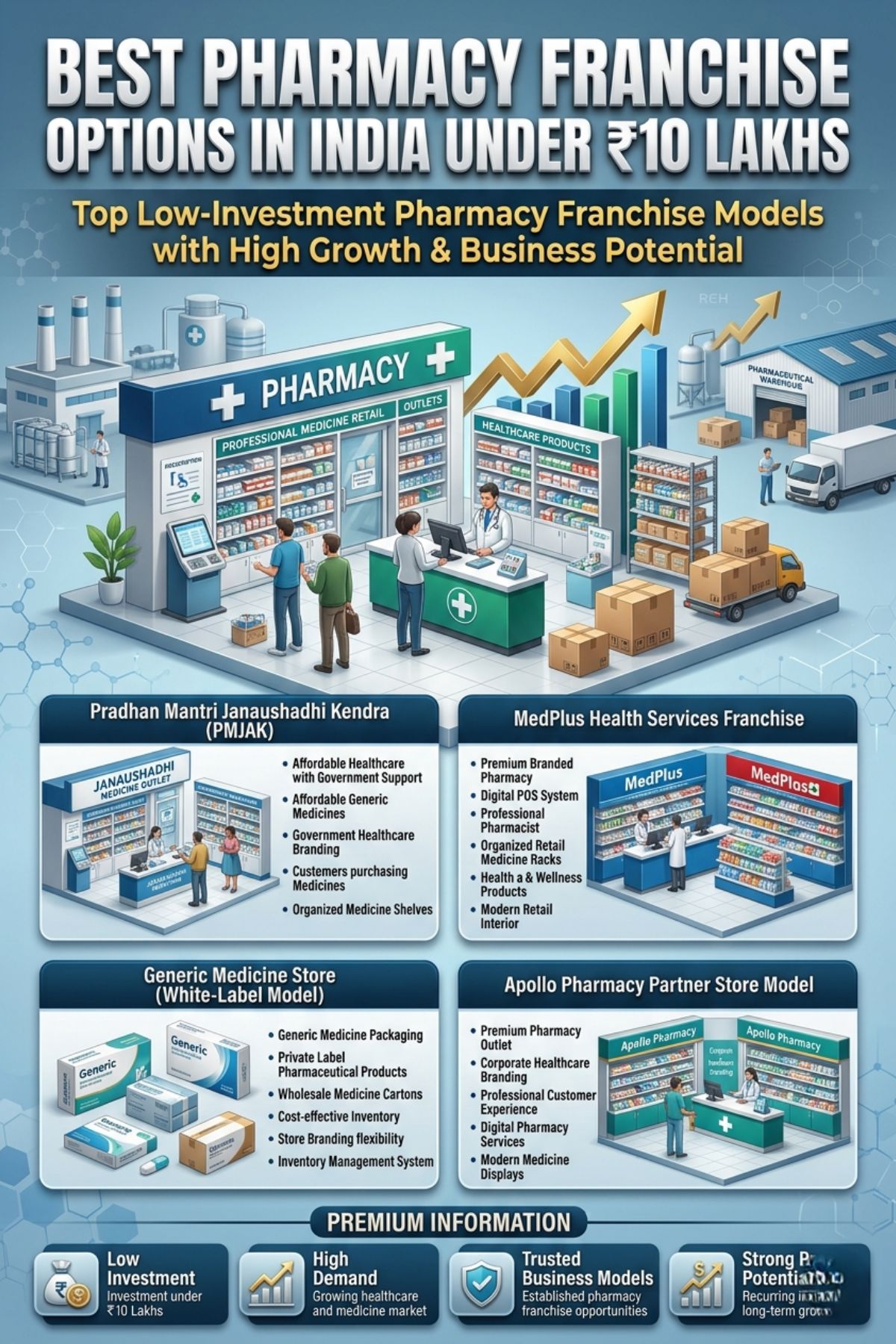
Top Medical Store Franchise Business Ideas Under ₹10 Lakhs
1. Pradhan Mantri Janaushadhi Kendra (PMJAK)
This is the simplest and most formal path into the retail pharmacy sector, with government backing. Prices of PMJAK franchise medicines are generally 50-90% cheaper than those of branded medicines, which are approved by the Drugs Controller General of India (DCGI). The investment requirement, whether in the form of security deposit, interior or working capital, is manageable and can be done with ₹5-7 Lakhs. Initial stock support along with a sales incentive of 15% per month (maximum ₹15,000) gives the government a predictable cash flow from the first month onwards. The addressable market of PMJAK stores in Tier-2 or Tier-3 towns is enormous and there is little competition from organised stores. The franchisees need a 120 sq. ft. area, a qualified pharmacist and a drug retail business license. Importantly, the bureau actively assists the franchisees in product training and logistics of the supply chain, thereby reducing complexity in the operation.
View Full Project Details: Complete Guide to Pharmacy Institution Establishment
2. MedPlus Health Services Franchise
MedPlus is one of the biggest retail chains of pharmacies in India with more than 3,500 outlets mostly in South and East India and is expanding its presence rapidly across the country. They generally charge a minimum of ₹7-10 lakhs for a standard outlet and the investment includes franchise fees, initial stock, POS software, and interior fixtures. MedPlus is a high volume, low margin enterprise — its stores have an average of 200-400 customers per day, in well-chosen micro-markets. Another advantage is the brand’s built-in diagnostics offering: franchise partners can also provide lab testing collection services, which provides an added value secondary revenue stream. The MedPlus model would be an effective playbook for urban and semi-urban founders who have access to high street or residential colony locations, backed by a strong playbook of technology support and a reliable supply chain.
3. Generic Medicine Store Franchise (White-Label Model)
There are now several wholesale medicine distributors and aggregators that provide franchise practices particularly in retailing generic medicine. The models are designed to enable entrepreneurs to open a generic pharmacy having a regional or national umbrella brand, the investment involved is ₹4-8 lakhs. Compared to the retail branded pharmaceutical business, margins on generic medicines are significantly higher (between 30-60%, depending on the product category). This model is ideal for entrepreneurs operating in semi-urban regions where the awareness of the brand is not very strong and the sensitivity to price is very high. The business model is lean as fundamentals like a pharmacist (usually on a part-time contract) and a valid drug retail license are required along with basic store infrastructure. Procurement benefits from the aggregated supply via the franchisor’s network, thus minimizing procurement expenses and stock management.
4. Apollo Pharmacy Partner Store Model
Apollo Pharmacy, a subsidiary of Apollo Hospay Hospitals Enterprise has launched its partner store programme which offers entrepreneurs to operate under the Apollo brand without having to pay a complete franchise fee package. The entry barriers for their partner programme, which is meant for smaller markets, are around the ₹8–10 lakh mark while the flagship franchise is a higher investment model. The Apollo brand has tremendous level of trust from the consumers, especially among the people who are aware of health-conscious people in urban and semi-urban areas. Partner stores enjoy the consolidated buy through Apollo and consistent product availability and competitive purchase pricing. Online order fulfil and app-integrated loyalty programs also contribute to regular customer retention, which is also aided by the brand’s digital integration. Entrepreneurs in the presence of residential townships, hospital catchment areas, and organized markets clusters will find an Apollo partner store to be an extremely good risk adjusted return.
Find the most profitable startup for your investment range
Import-Export Opportunity: A Downstream Avenue for Pharmacy Entrepreneurs
Most medical store franchisees operate the stores domestically, but there is a significant export market for the franchisees who expand to multi outlet or warehouse stores. India is one of the biggest exporters of generic pharmaceutical formulations, exporting them to more than 200 countries in the world. Small and mid-sized pharmaceutical companies can avail export markets with the help of the Pharmaceuticals Export Promotion Council of India (Pharmexcil).
Franchise operators with good wholesalers’ relations with Indian API (Active Pharmaceutical Ingredient) manufacturers or generic formulation companies can be involved in the export supply chain either as sourcing agent or merchant exporters. This applies especially to people who are running a one-store business and go into distribution. The government’s Production Linked Incentive (PLI) scheme for pharmaceuticals has helped in building capacity of domestic manufacturing, which is now resulting in a continuous flow of products ready for export at competitive prices. MSMEs can add a revenue stream to this downstream value chain, irrespective of the scale, which is uncorrelated with local retail footfall.
Indian MSME Success Stories in Pharmacy Retail
Vivek Dahiya — From Single Store to MedPlus Master Franchisee
Vivek Dahiya began his business as a MedPlus franchisee in the second market in Hyderabad. Early on, he saw that he could expand and invest the profits in a second and third location within three years of opening. He thus chose a conventional strategy – to remain in his brand universe and gain expertise in the operations of retail pharmacies. Today, there are five outlets of Dahiya and their combined annual turnover is more than ₹1.2 crores. The lesson that new entrepreneurs should take away is that disciplined reinvestment and brand loyalty in any business that has a high demand for products yields greater returns than capital diversification, especially in the cases of businesses that are in high demand.
Sumati Devi — Rural Janaushadhi Kendra Operator, Rajasthan
With an initial investment of only ₹4.5 lakhs, which includes security deposit, interior, and working capital requirements for the first month, Sumati Devi opened a Janaushadhi Kendra in the semi-rural block in Rajasthan. In six months, her practice had expanded to become a store that would see more than 150 patients a day, mostly through referral from patients who were low income and could no longer afford high-priced branded drugs. Just her monthly incentives from the government paid for about 60% of her fixed costs. Sumati’s case is not unique of the PMJAK model; it is not solely a franchise model, but a true social infrastructure play that is also considered a higher-return commercial enterprise in markets where they are not well served.
Rajan Nair — Apollo Partner Store, Kerala
A private hospital cluster lies next to the Apollo partner store in a Tier-2 town in Kerala, where Rajan Nair had invested ₹9.5 lakhs. In 18 months of time, his monthly earnings went over the ₹5 lakhs mark, owing to the prescription fulfilment from the nearby hospitals and the tie-up with Apollo’s diagnostics at his store. His main criterion of choosing a location is the one that every successful pharmacy franchise operator emphasises, “location is everything”. Brand is important but the key driver for the footfall and ultimately the profitability is the proximity to health-care demand, i.e. elderly residential clusters, hospitals, clinics.
Related Article: Semaglutide Patent Expiry in India: ₹5000 Crore Pharma Business Opportunity
Pharmacy Franchise Investment Comparison Table
| Franchise Model | Investment Range | Avg. Monthly Revenue | Key Strength | Best For |
| PMJAK (Govt. Scheme) | ₹4–7 Lakhs | ₹1.5–3 Lakhs | Govt. incentives + low risk | Rural / Tier-3 towns |
| MedPlus Franchise | ₹7–10 Lakhs | ₹3–6 Lakhs | High footfall brand | South/East India urban |
| Generic White-Label Store | ₹4–8 Lakhs | ₹2–4 Lakhs | High margin generics | Semi-urban / Tier-2 |
| Apollo Partner Store | ₹8–10 Lakhs | ₹4–6 Lakhs | Premium brand trust | Hospital catchment areas |
| Regional Generic Chain | ₹5–9 Lakhs | ₹2.5–4.5 Lakhs | Local brand + flexibility | Tier-2 cities |
Frequently Asked Questions (FAQs)
Q1. What is the lowest investment required for opening a pharmacy store franchise in India?
The lowest investment for a pharmacy franchise can be as low as Rs 4-5 lakhs to launch a Pradhan Mantri Janaushadhi Kendra (PMJAK) center which covers security deposit (refundable), interiors and initial working capital. The Government offers an incentive amount of Rs 1.5 lakhs for eligible entrepreneurs on a one-time basis to reduce investment out-of-pocket even further.
Q2. Is a degree in pharmacy mandatory for becoming a pharmacy store franchisee?
While you need a registered pharmacist on your premises at all times to comply with licensing procedures, it is not mandatory for you to be a pharmacist yourself to open a pharmacy franchise. Most franchisors would be able to facilitate hiring of a pharmacist either on full time/part-time basis. The drug retail license would be granted on the name of the pharmacist while ownership of business would remain with entrepreneur without a degree in pharmacy.
Q3. What are the best pharmacy franchise options for Tier-2 and Tier-3 cities?
PMJAK and generic medicine white label outlets are ideally suited for Tier-2 and Tier-3 markets. These outlets cater to price-conscious population with low rent requirements. MedPlus and Apollo franchise outlets would suit better in towns with higher density of healthcare infrastructure and consumer disposable incomes.
Q4. How long is the break-even period for a pharmacy franchise business?
For most Rs 10 lakh pharmacy franchises, with the right location, it could take anywhere from 12 to 24 months to reach the break-even point. A PMJAK center in a high demand rural or semi urban location can even reach the break-even in 8-10 months because of the Government incentivized model and walk-in demand for affordable medicine.
Q5. Can I obtain a bank loan to invest in a pharmacy franchise?
Yes. Franchise for pharmacy businesses are eligible for MUDRA loan under Kishor and Tarun (from 5 lakhs to 10 lakhs) and collateral free credit facility for MSME units can be obtained from banks under the CGTMSE scheme. A number of nationalised banks like State Bank of India, Bank of Baroda, Canara Bank etc provide dedicated MSME loans under priority lending norms from their respective business loan desks.
Q6. What are the main risks associated with a pharmacy franchise business?
The primary risks include location dependency (poor footfall directly affects revenue), regulatory compliance (drug license requires timely renewal and maintaining of drug storage standards), inventory management (expired stock translates to direct loss) and franchisor dependency (fluctuations in franchisor’s pricing and supply chain affect profit margins). Most of the risks can be mitigated by appropriate site selection, engaging a qualified pharmacist and choosing a franchisor with a good track record.
Conclusion: A Business That Combines Purpose with Profitability
Medical stores franchise: one of the easiest, demand-based and institutional backed business ideas in India today. Under 10 lakhs, there are choices-from government supported Janaushadhi stores to big brands like Med Plus & Apollo. This sector has stable non-cyclical demand, healthy margins and good social contribution.
When it is handled with rigor by founders (right model, well-located store, professional compliance), it provides the potential for attractive returns as well as contributing to India’s healthcare infrastructure. The right market trends, support from the government and reliable franchise models makes it a segment where the cards are stacked for a prepared novice.
Do some good feasibility study before injecting the money; consider the population profile, the franchising terms and the financial projection for your new venture very closely. When you make such a preparation, your pharmacy franchise can serve you as both a good investment and a perpetual part of the society.


