






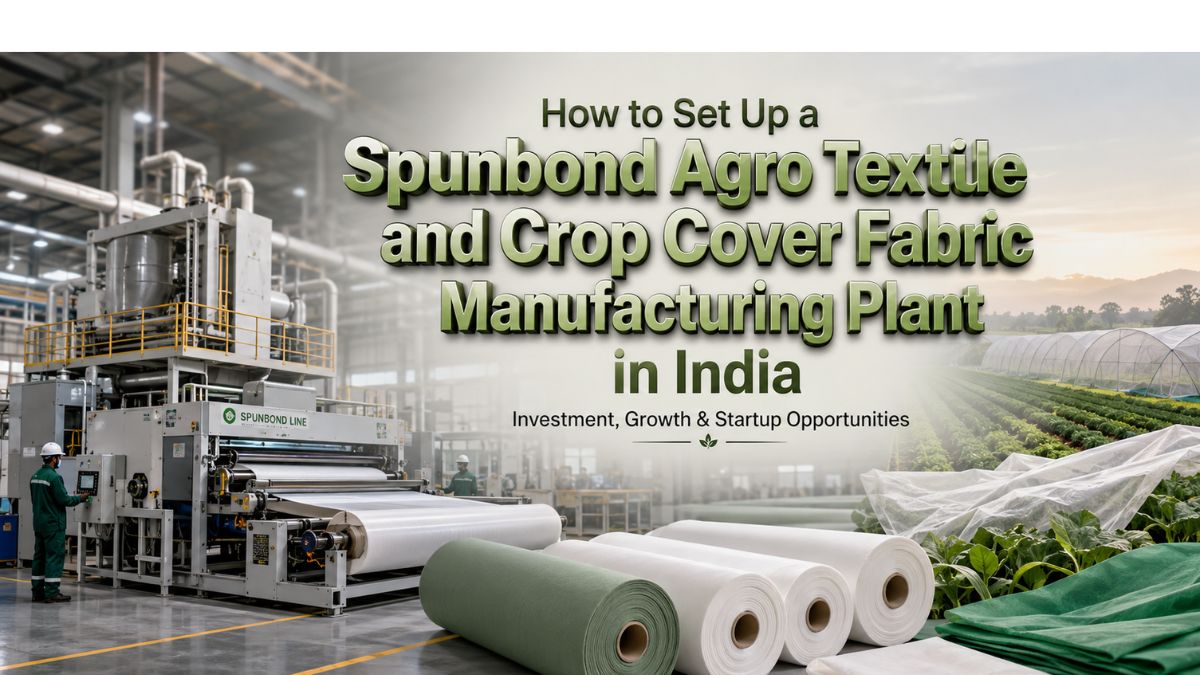
Spunbond Agro Textile Manufacturing Plant in India
A farmer in Nashik, Maharashtra boosted his grape production by 30% without altering the soil, water and fertiliser use. He just put the white, spunbond polypropylene over his rows of vines during the important growth stage. Instead of proceeding to destroy entire orchards in a single afternoon as it happened in the past in Himachal Pradesh, the same material is now being used to protect the blossoms from hailstorm damage. The retail price of fabric is approximately INR 8–15 per square metre. The cost of material for a hectare of crop coverage is approximately INR 40,000-80,000. It can save lakhs of crop losses.
Spunbond agro textile isn’t a niche product. It has soared in unheralded importance to India’s protected cultivation sector, which has been rapidly expanding in the face of ever-changing weather patterns, pest challenges and export quality standards. But still India has got to import significant amounts of its requirement from China, Taiwan and South Korea. Domestic manufacturing capability has not been able to meet demand. It’s in that space where the business opportunity lies, and that’s a big gap.
Why Domestic Supply Cannot Meet Demand
The National Horticulture Board (NHB) data shows that India has more than 27 million hectares of horticulture cultivation. As farmers move into high value vegetables, floriculture and export grade fruit, the use of protected cultivation (greenhouses, shade nets, crop covers) is growing at 12-15% per year. Spunbond crop cover fabric is one of the fastest moving inputs in this space.
The major consumers of agro textiles today are the states of Maharashtra, Karnataka, Andhra Pradesh, Gujarat, Himachal Pradesh and Punjab. The home agro textile market is estimated to be more than INR 3500 crore at CAGR of around 11% as estimated by the Textile Ministry of India. Even with this scale, domestic manufacturers, mostly in Surat, Ahmedabad and Tamil Nadu, supply about 55-60% of the demand. The remainder is import reliant.
The import gap is at high GSM (gram per square metre) level technical spunbond fabrics for UV stabilized crop covers, frost protection blankets and root zone mulch mats. The import duty on these products is 12–18% and the logistics cost makes them costly for the MSME farmers. Any domestic plant operating in this segment can compete in price, and make decent profits. Agricultural and Processed Food Products Export Development Authority (APEDA) has identified agro inputs such as protective fabrics as one of the key areas to help India achieve the horticulture export goals.
Get Detailed Insights from This Book: The Complete Technology Book on Textile Processing with Effluent Treatment
Table 1: State-wise Demand Concentration and Key Agro Textile Clusters
| State | Primary Crop Use | Agro Textile Demand (Est.) | Key Districts | Supply Gap Status |
| Maharashtra | Grapes, Pomegranate, Vegetables | INR 620 Cr+ | Nashik, Pune, Sangli | High — 40% import dependent |
| Karnataka | Floriculture, Tomato, Capsicum | INR 410 Cr+ | Belagavi, Bagalkot, Kolar | Moderate — local supply insufficient |
| Andhra Pradesh | Chilli, Papaya, Cotton | INR 380 Cr+ | Guntur, Krishna, Kurnool | High — mostly imported |
| Gujarat | Cotton, Castor, Groundnut | INR 340 Cr+ | Saurashtra belt, Anand | Moderate — some local production |
| Himachal Pradesh | Apple, Pea, Ginger | INR 210 Cr+ | Kinnaur, Shimla, Kullu | High — remote supply chain gaps |
| Punjab / Haryana | Wheat, Potato, Vegetables | INR 280 Cr+ | Jalandhar, Karnal, Ambala | Growing — awareness phase |
Source: National Horticulture Board (nhb.gov.in), Textile Ministry of India (texmin.nic.in)
Why This Is the Right Time to Enter
At present there are three driving forces coming together to provide a good back wind to domestic spunbond agro textile manufacturers.
Export quality pressure: Indian fruit and vegetable exporters supplying Europe, the Middle East, and Southeast Asia now face mandatory quality benchmarks that require pest-free, blemish-free produce. Crop covers reduce post-harvest rejections. The APEDA annual export data shows fresh produce exports crossing USD 4 billion, with volume ambitions that require scale-up of protected cultivation inputs.
Technical textiles, which are part of the agro textiles segment and technical textile segment of the Production Linked Incentive (PLI) Scheme for Textiles are made in India. The general policy bent is to give more favourable treatment to the technical textile units; though large-scale PLI applications need INR 100 crore+ investment.
The Prime Minister’s Employment Generation Programme (PMEGP), under the KVIC, offers subsidy of 15–35% of the project cost to the manufacturing units. PMEGP can greatly minimize the actual outflow of capital for a first-time entrepreneur establishing a small spunbond unit. The manufacturing project ceiling of the scheme has recently been upgraded so that it is more accessible.
Moreover, the Credit Guarantee Fund Trust for Micro and Small Enterprises (CGTMSE) offer collateral-free credit guarantees of up to INR 5 crore to MSMEs, addressing the top constraint faced by the first-generation entrepreneurs, which is lack of collateral for bank loans. A well-prepared Detailed Project Report (DPR) for a spunbond agro textile unit is acceptable.
Get Detailed Project Report (DPR): Technical Textiles Projects
Setting Up the Plant: Step-by-Step
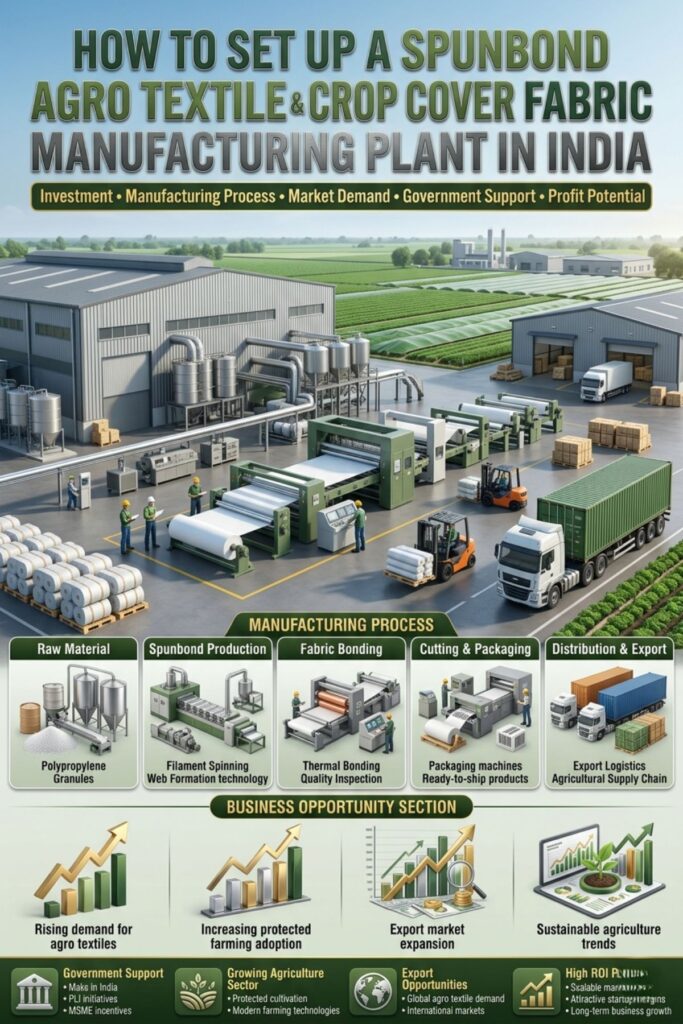
The Cost of Investment: The small scale spunbond unit for production of crop cover fabric (30-80 GSM) requires INR 1.2 crore to INR 2.5 crore based on the type of machinery, land cost and working capital requirement. INR 5–9 Crore will be needed for a mid-size plant of 2000-3000 kg/day.
Land and Space: A small plant needs about 5,000- 8,000 sq ft of covered shed. The size for a mid-scale plant is 15,000–20,000 sq ft. Ideally, the land must be within or near an industrial zone to be able to get access to three-phase power supply (which is necessary for extrusion lines) and logistic infrastructure. The States such as Gujarat, Maharashtra and Tamil Nadu have developed a dedicated facility for Textile Parks with plug and play infrastructure under Scheme for Integrated Textile Parks (SITP) with considerable saving in land and setup cost.
Key Machinery Required:
- Spunbond extrusion line (Single or Double beam) — Core Equipment Imported from China or Germany — INR 60-180 lakh depending on capacity of production line.
- Calender / bonding unit is used for thermal bonding of PP fibres.
- Winding and slitting machine, which will wind and slit rolls to the required width (standard width is 1.5m to 3.2m)
- Dosing system for UV stabiliser — is critical for agro-grade UV protection certification.
- Quality testing equipment (GSM balance, tensile tester, elongation tester)
- Generators set (100-250 KVA) for power back-up
Raw Material Sourcing: The key raw material is polypropylene (PP) granules which are sourced from Reliance Industries (Jamnagar), ONGC Petro Additions Ltd (OPaL, Dahej, Gujarat) and HPCL-Mittal Energy. The UV masterbatch is a compulsory ingredient of agro textiles used outdoors and is available from Cabot India, PolyOne India and smaller compounders in Mumbai and Surat. The price of PP can be volatile on crude oil ranging from INR 100 – INR 130 per kg and coloured pigment master batch for white, black and green crop covers range from INR 140 – INR 180 per kg.
Licences and Regulatory Approvals:
- Udyam Registration (mandatory for MSME benefits) — free, online via udyamregistration.gov.in\
- Mandatory GST registration – Agro Textiles are liable to 12% GST.
- Factory Licence – issued by the state’s Labour Department (needs to be obtained when staffing reaches 10)
- Pollution NOC — Green/Orange category unit typically; from State Pollution Control Board
- BIS certification — voluntary but preferred for export and institutional supply contracts
- Fire NOC — local fire authority to ensure safety of production sheds and warehouse.
It takes 8-14 months from company registration to first production: 1-2 months for company registration and site finalisation, 3-5 months for procurement of machinery and civil work, 1-2 months for installation and trial runs and 1-2 months for product approval and initial sales. The Leadtime for imported machinery from China is 90-120 days while the domestic options are quicker.
Team Size: For a small plant, 10 to 15 workers are required, including between 3 and 4 machine operators, 2 to 3 helpers for each shift, one quality supervisor, maintenance technician, and 1 to 2 workers for packing and dispatching. Experience in polymer/textile production is highly recommended for the production manager/plant-in-charge.
Table 2: Investment Breakdown for a Small-Scale Spunbond Unit (500–800 kg/day)
| Cost Head | Details | INR (Lakh) — Low End | INR (Lakh) — High End |
| Land (leased or purchased) | 5,000–8,000 sq ft industrial shed | 10 | 30 |
| Civil Work / Shed Setup | Flooring, drainage, electrification | 8 | 18 |
| Spunbond Extrusion Line | Imported single-beam, ~500 kg/day | 60 | 120 |
| Calender / Bonding Unit | Thermal bonding for PP fabric | 10 | 20 |
| Winding / Slitting Machine | Automatic, 1.5m–3.2m width | 8 | 15 |
| UV Dosing + Quality Testing | Including lab instruments | 5 | 10 |
| Generator Set (DG) | 150 KVA backup power | 5 | 8 |
| Working Capital (3 months) | PP granules, wages, utilities | 25 | 50 |
| Pre-operative & Contingency | Registration, interest, misc. | 5 | 10 |
| Total Estimated Investment | 136 | 281 |
Source: NPCS primary research; machinery quotes from Indian and Chinese equipment suppliers
Turn your budget into a successful business plan
Financial Snapshot: What the Numbers Look Like
Capital Expenditure: INR 1.2-2.5 crore (per 500-800 kg/day unit) as shown above.
Monthly Operating Cost: At 500 kg/day capacity (25 working days), monthly PP consumption is approximately 12,500 kg. Raw Material at Rs 115/kg on average comes toRs 14.4lakhs/month. Include wages (Rs 1.5-2.5lakhs), electricity (Rs 1-1.5lakhs), packaging & logistics (Rs 1-2lakhs), overheads etc., which brings the total monthly operating cost to roughly Rs 20-22lakhs.
Revenue: Standard 30-50GSM white crop cover fabric is available in the market for a wholesale of INR 55-80/kg. UV Stabilized 60-80GSM fabric is available for INR 90-130/kg. At a 60% utilization (7500Kg/month) revenue is calculated as INR 6.4 Lacs/month at the actual realisations of the blended price at INR 85/Kg, while at full capacity(12,500 Kg/month) it is calculated to be INR 10.6 Lacs/month. These figures assume a realistic product mix.
Gross Margin: 18-24% (assuming full capacity utilisation). Net margin (after depreciation and finance cost): 12-18%.
Payback: Payback will occur in 3-4.5 years at 70-80% capacity utilisation. The units with direct farmer / FPO supply relationship and institutional buyers (state horticulture departments / Nafed) generally are able to achieve the payback quickly, as they incur lesser distribution expenses.
Table 3: Key Government Schemes for Spunbond Agro Textile Manufacturing Units
| Scheme | Administering Body | Benefit for This Unit | Eligible Investment | How to Apply |
| PMEGP | KVIC / KVIB / DIC | 15–35% subsidy on project cost | Mfg: up to INR 50 lakh | kviconline.gov.in |
| CGTMSE | SIDBI / MoMSME | Collateral-free loan guarantee up to INR 5 Cr | All MSMEs | Through partner banks |
| PLI — Technical Textiles | Ministry of Textiles | 5% incentive on incremental turnover | Min. INR 100 Cr base | texmin.nic.in |
| SITP (Textile Parks) | Ministry of Textiles | Subsidised plug-and-play infra in textile parks | New manufacturing units | State textile departments |
| MUDRA — Tarun | MUDRA Bank / SIDBI | Collateral-free loans INR 10–20 lakh | Small/micro units | mudra.org.in |
| Udyam Credit Link. | MoMSME / Banks | Priority sector lending + interest subvention | All Udyam-registered MSMEs | udyamregistration.gov.in |
Source: Ministry of Textiles (texmin.nic.in), KVIC (kviconline.gov.in), CGTMSE (cgtmse.in), MUDRA (mudra.org.in)
ENTREPRENEUR SPOTLIGHT
This is an Entrepreneur Spotlight on Ramesh Patel from Gujarat.
Ramesh Patel has a mid-scale spun bond agro textile plant with 2200 kg per day capacity in surat, gujrat. He began by supplying to the grape farmers in Sangli, Maharashtra, with only one imported Chinese beam line. After four years, he grew to a second line and now directly supplies to three government horticulture departments under government tender. The big takeaway: “FPOs and farmer groups are the first to buy — they pay promptly, buy in bulk and spread the word of mouth faster than any distributor. Currently his unit can see a turnover of around INR 8 crore with a utilisation of 75%.
Where to Get Technical and Financial Guidance
If entrepreneurs are thinking of venturing into this business, it is advisable to have a Detailed Project Report (DPR) prepared by experts before they contact the banks or government scheme offices. NIIR Project Consultancy Services (NPCS), a recognized industrial consultancy firm in India with more than 40 years of experience, also offers techno-economic feasibility studies, plant layout designs, technical machinery procurement assistance and end to end project consultancy to manufacturing plants such as spunbonded and technical textiles plants. All banks, NBFCs and state industrial development agencies accept NPCS reports as loan supporting document. They have published books and project reports available at niir.org and entrepreneurindia.co. As a beginning point, an NPCS DPR is a worthwhile investment for any entrepreneur who is looking for a reliable starting point prior to investing capital.
Related Article: Technical Textile Business Ideas in India: Profitable Manufacturing Opportunities for Entrepreneurs
Your Next Move
The spunbond agro textile market is waiting with no fingers crossed. Farmer awareness is increasing, protected cultivation is increasing, and the import competition has driven a large segment of the market for domestic manufacturers out of the market. It is available, there is a domestic supply chain for the raw materials, and financing methods exist within the government.
A specific action to be taken now: obtain a Detailed Project Report that is based on your target capacity and location. Before you invest a rupee in land or machinery you must have a document that helps you to define your capital requirement, the break-even point output and benefits under the scheme applicable to your state and scale. The one document decides if your bank loan is approved and which subsidies you are eligible for.
The market is real. The numbers work. The challenge is to be the first to move before the next manufacturer in your district.
FAQ’s
Q1. What is the minimum investment required to set up a spunbond agro textile unit in India?
For small scale unit (300-500 kg/day), entry level investment would range from INR 80 lakh-INR 1.5 crore, for single extrusion line, civil work and working capital of 3 months. Investment for medium capacity unit (1500-2000 kg/day) is in range of INR 4-7 crore and it varies with sourcing of machinery from indigenous or foreign manufacturer and own land/rented land.
Q2. What licenses and registrations do I need before I begin manufacturing?
The compulsory licenses that need to be taken prior to starting the venture are: Udyam Registration (required for MSME registration and benefits), GST Registration, Factory License from State’s labor department, and NOC from State Pollution Control Board (in case of any pollution). BIS certification is voluntary but if you supply to the government/institutional bodies or export it’s advisable. Fire NOC is needed for the shed.
Q3. Where do I find polypropylene granules for this unit?
Polypropylene (PP) granules used for spunbond applications can be purchased from Reliance Industries (Jamnagar, Gujarat), ONGC Petro Additions (OPaL, Dahej, Gujarat) and HPCL-Mittal Energy Limited (HMEL, Punjab). Local distributors in Surat, Mumbai and Chennai stock them up for you. The going rate ranges from INR 100-130/kg and is dependent on crude oil prices. UV masterbatch – a critical addition to the PP granules for use in agro textiles – can be bought from Cabot India and some compounders in Mumbai and Surat.
Q4. What is the likely profit margin in this business?
The likely gross profit margins are 18-24% at full capacity utilisation and 12-18% as net margins (after depreciation and finance charges). The margin on UV stabilised agro fabrics is significantly higher than commodity grade ones. FPOs, state horticulture departments and NAFED contract buyers fetch better realization rates than those relying on distribution networks.
Q5. Which government schemes are available for supporting such units financially?
The following government schemes can help in financially supporting your project: PMEGP (PM’s Employment Generation Program) provides 15-35% of project cost as subsidy, CGTMSE provides collateral free credit guarantee for loan amount of up to INR 5 crore, MUDRA under Tarun category provides financial loan up to INR 20 Lakh for micro-scale units. PLI scheme is available for the technical textiles sector for large projects. Incentives are also offered at state level by Gujarat, Maharashtra and Andhra Pradesh (subsidies on power tariff and stamp duty waivers).
Q6. How can NPCS help me in setting up my plant?
NIIR Project Consultancy Services (NPCS) has prepared a number of Detailed Project Reports (DPRs) for spunbond and other technical textile manufacturing units, including those producing agro textiles. A DPR from NPCS comprises comprehensive technoeconomic feasibility, plant layout and specifications, information about sources of raw material, detailed project financials, and details on applicable subsidies/schemes. Our reports are Bank/ Government friendly. Visit: niir.org or entrepreneurindia.co.
Key Data Sources & References
- National Horticulture Board (NHB) — https://nhb.gov.in/
- Ministry of Textiles, Government of India
- APEDA — Agri Exchange Portal — https://agriexchange.apeda.gov.in/
- KVIC — PMEGP Portal — https://www.kviconline.gov.in/pmegpeportal/
- CGTMSE — Credit Guarantee Fund Trust for MSEs — https://www.cgtmse.in/
- MUDRA Bank / SIDBI — https://www.mudra.org.in/


