







Best Business Ideas in India
India’s entrepreneurial ecosystem is undergoing a structural shift — and the best business concepts of today are combination of lifestyle services, agriculture and infrastructure. The choice of investment options is now broad, ranging from professional photo shoot studios to hydroponic farms, from a biogas plant to service apartments. For all the first-generation founders and all the seasoned MSME planners alike the challenge is no more about finding the opportunity, it’s on how to plan it. It’s choosing the right ones that have a clear understanding of capital efficiency, demand sustainability, and scalability.
This sector blend is especially interesting at this time because of three strong forces. Increased aspirations of the middle class are driving the demand for all the verticals discussed here. Rising aspiration amongst the middle class is driving the demand in all the verticals discussed here. Secondly, the risk of new businesses has considerably reduced due to the aggressive government programmes such as PMEGP and CGTMSE. Thirdly, the maturing green economy is making businesses such as Bio-CNG plants, biogas units and aquaponics units commercially viable even at the micro, small and medium enterprises scale.
Why This Sector — and Why Now
India’s services sector accounts for more than 54% of GDP but underserved areas of Tier 2 and Tier 3 markets exist. There is a severe shortage of cold storage, assisted living and convention facilities in many of the rapidly expanding urban areas. Innovation in agriculture, on the other hand, has progressed past agrarian states. Hydroponic and aquaponic businesses are now emerging within industrial areas, rooftops and peri-urban areas, directly challenging traditional food production systems.
As urbanisation grows, so do the lifestyle economy (photo studios, water parks, planetariums, and hotel-restaurants). The demand will continue to be robust in India for another 20 years or more due to demographic dividend. The side that is good, is that bio-CNG and biogas plants are commercially viable at surprisingly small investment levels, as the push for renewable energy and waste management has made these plants more feasible.
The estimated post-harvest losses in India are more than ₹1.5 lakh crore per year, which is a pressing need of the hour for cold storage and warehousing facilities. The ministry of New and Renewable Energy (MNRE) is supporting both bio-CNG and biogas technologies through specific national programmes, hence making these investment categories more valueable.
Government Policies and Incentives Supporting These Business Ideas
Government support is wide and strong in all sectors included in this. The following key programmes are recommended for the entrepreneurs entering in these verticals:
- PMEGP (PM Employment Generation Programme): Offers subsidy of up to 35% for entrepreneurs in the rural areas, 25% for entrepreneurs in the urban areas, in both manufacturing and service sectors.
- CGTMSE: Loans up to ₹2 crore with no collateral required — suitable for cold storage, service apartments and recycling business.
- NABARD rural infrastructure support: Capital investment subsidy for cold storage and agriculture processing units.
- SATAT Initiative and NBMMP: Provides support for Bio-CNG and biogas plants under Viability Gap Funding and Off take Guarantee.
- Supports aquaponics and hydroponic farming, plantation ventures- National Horticulture Board (NHB) and PM Kisan SAMPADA.
- PLI Scheme and Swachh Bharat Grants: Covers packaging businesses and recycling units respectively.
- State Tourism Investment Incentives: Available in Gujarat, Maharashtra, Rajasthan, and other states for convention and hospitality infrastructure.
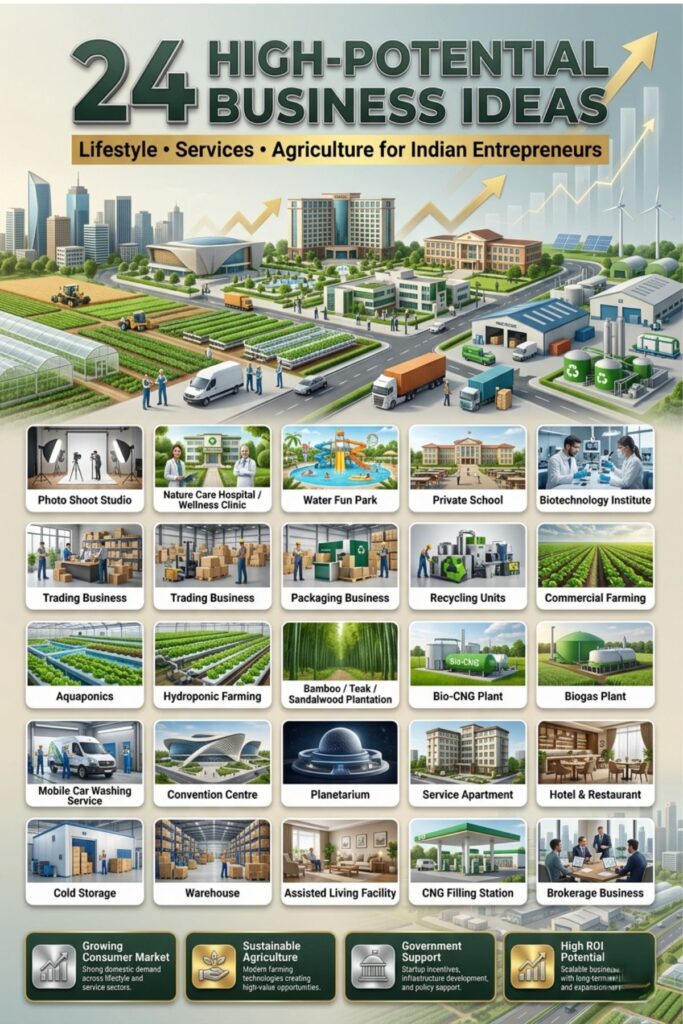
24 Business Ideas: Detailed Sector Analysis
1. Photo Shoot Studio
Whether it is for fashion, e-commerce product photography, the corporate photos, or social media content, a professional photo shoot studio is a business with a high margin and low footprint. The setup cost of Tier-2 city is between ₹8 to ₹18 lakh. Demand is exploding: India’s e-commerce market alone needs millions of product photos every year! A professional photographer in a professional studio with proper lighting can get ₹3,000 to ₹15,000 per session; and the investment can be recovered in 18 months. This is available for the first time founders with the financing of PMEGP.
2. Nature Care Hospital / Wellness Clinic
The naturopathy and wellness hospitals are expanding at a double-digit rate, as urban Indians are looking for alternatives to conventional medicine. A nature care clinic is built on lower costs of input for medicines and with better repeat clientele. By investing in infrastructure and AYUSH certification, it is possible to earn monthly income of ₹3 to ₹8 lakh in any mid-sized city with an investment of ₹25 to ₹60 lakh.
3. Water Fun Park
The water park is a unique leisure segment in India with favourable climate which allows near year-round running in majority of the states. The investment required for a small-to-mid-scale water fun park is ₹2 crore to ₹8 crore and it needs 2-5 acres. The daily footfall during the peak summer is in excess of 1500 people which can earn one between ₹15 lakh and ₹25 lakh monthly. Tier-2 cities with fewer entertainment facilities provide the most straight forward route to market leadership.
Related Article: India’s Water Park Market Is Growing 10% Annually — Here’s Why
4. Private School
The education sector is also one of the few sectors in India that has proved to be the most resilient in the business. The fees for a CBSE or ICSE affiliated private school range from ₹40,000 to ₹1.5 lakh per student per year. A school becomes operationally profitable in 3 academic years with 200 students and medium scale fees. Capital cost is from ₹1.5 crore to ₹5 crore, but with lease setup, the entry has been drastically reduced. Long term reputation is built of quality differentiation, via sports infrastructure and co-curricular programmes.
5. Biotechnology Institute
The India biotech manpower shortage is huge. Today, the sector has more than 7 lakh professionals in it but in coming years, there will be a rapid increase in demand. The cost to setup a private biotechnology training institute where diplomas in bioinformatics, fermentation technology and clinical research are provided is in the range of Ranges ₹50 lakh to Ranges ₹1.5 crore. The tie-up with industries and NAAC accreditation brings credibility. The monthly collections from a batch of 200 students may be able to generate between ₹25 Lakhs and ₹60 Lakhs per academic year.
6. Trading Business
With a niche agricultural commodity or industrial raw material trading enterprise, there is increased potential for revenue generation and low asset intensity. However, there are specialised traders who are aware of the buying and selling season in mandis and who know about the price difference of various mandis who can make the margin of 3% to 12% in volume turnover. They have alleviated the information asymmetry that had been prevalent in the margins with big players through platforms such as Agmarknet. A well networked person can create a business with annual revenue of ₹2 crore to ₹5 crore in 2 years with a working capital ranging from ₹20 lakh to ₹50 lakh.
7. Packaging Business
With the ecommerce, FMCG and pharmaceutical segments seeing explosive growth, India’s packaging industry has been valued at over ₹4.5 lakh crore. The corrugated box/flexible pouch unit can be set up for Rs 25 lakh to Rs 1.5 crore based on the level of automation. There’s a steady demand from local FMCG and pharma companies, plus premium price from the D2C brands for customised packaging. The margins within this area range from 15% – 25% and given that packaging is a consumable product, clients are not reluctant to retain the business.
View Full Project Details: Packaging Industry: A Comprehensive Guide to Beverage Cans, Bottles, Blister Packs & Flexible Packaging
8. Recycling Units
Annually, India produces more than 3.5 million tonnes of plastic waste. EPR (Extended Producer Responsibility) regulations are now in force under Plastic Waste Management Rules, which means there is now a guaranteed feedstock supply for recycling units. The mid-scale PET recycling units cost from ₹40 lakh to ₹1.5 crore to start-up and can earn ₹60 lakh to ₹2.5 crore income per year by providing recycled PET pellets to packaging and auto-parts industries. The margins for e-waste recycling are even higher because of the added value of precious metal recovery.
9. Commercial Farming
The price uncertainty that is a historical concern of educated entrepreneurs is eliminated in contract and commercial farming where the farmer is linked to food processing companies or export companies. Crop prices like strawberry, dragon fruit, bamboo and medicinal plants fetch three times to eight times higher than conventional crops at the farm gate with buyers signing up as per MoUs. After third year of stabilisation along with institutional linkages, net margins can be achieved ranging from 30% to 45% with 5 to 10 acres under managed cultivation.
10. Aquaponics
Among today’s possibilities, aquaponics, which combines fish farming and vegetable farming in a recirculating water system is one of the most capital-intensive options for high-value food production for Indian entrepreneurs. A 500 sq. metre unit is capable of raising fish (Tilapia) and vegetables (leafy greens) for ₹12 to ₹25 lakh and yields a profit of ₹1.5 to ₹3 lakh a month, while consuming very less water. Organic food retailers, urban restaurants and hotels are premium, willing buyers of organic food. When the technology is learned, it becomes an enduring competitive advantage.
11. Hydroponic Farming
Today, hydroponics has come a long way from being a horticultural novelty to commercialization in India. Microgreens, lettuce, spinach, basil, cherry tomatoes are now selling at premium prices in the metro markets. The initial investment required for a 1,000 sq. ft. NFT is in the range of ₹8 lakh to ₹20 lakh and at hotel supply prices, it can generate a revenue of ₹60,000 to ₹1.2 lakh per month. This is particularly convenient for non-agricultural land, for urban terraces, and for controlled environment greenhouses, and as such opens up the area of land that can be used.
Explore This Book: Profitable Farming & Allied Projects (2nd Revised Edition)
12. Plantation (Bamboo, Teak, Sandalwood)
Plantation forestry, especially bamboo, teak, sandalwood and tissue-cultured eucalyptus is a long duration tax efficient asset class with a guaranteed demand from paper mills, furniture industry and pharmaceutical industry. The cost of setting up a 10-acre bamboo plantation is between ₹4 to ₹8 lakh and the plantations start yielding commercial bamboo crops from the third year onward. Plantation investments receive a planting subsidy from the National Bamboo Mission and the carbon credit registration generates a secondary source of income which was not available to the previous generations of plantation investors.
13. Bio-CNG Plant
Bio-CNG is the best green fuel opportunity for the MSME market in India. The initiative SATAT requires the oil marketing companies (OMC) to buy bio-CNG from registered CNG producers which provides a guaranteed off-take channel. Plant processing 10-15 tonnes/day of organic waste produces 400-600 kg/day of bio-CNG which requires project investment of ₹1.5 to ₹4 crore per day. Revenue is generated from selling the Bio-CNG, organic manure and carbon credits. Often municipal bodies provide feedstock for free, which can result in margins of between 35% and 45%.
14. Biogas Plant
Biogas is still very relevant for decentralised energy production for farm clusters, food processing parks and rural communities. A community-based plant to treat cattle dung and food waste can provide cooking gas and electricity to 50 to 100 households and generate compost for sale. The project cost is 30-50% subsidized by NBMMP. Biogas plants are low-cost at commercial scale (poultry farm, dairy or vegetable market) with a return period of 3-5 years and an asset lifetime of 20 years.
15. Mobile Car Washing Service
The mobile car washing is a real solution to a problem that people in congested cities in India have: not enough time to visit a garage. A fully equipped Van, with waterless or pressurised cleaning and a booking App, can take care of 15 to 25 vehicles per day. A fleet of 3 vans account for ₹4-8 lakh monthly with subscription fees of ₹800-₹1500 per month. Some of the fastest-paying mobile service models are available and the capital outlay is low — ₹8 to ₹15 lakh for a 3-van setup.
16. Convention Centre
There is an acute lack of equipped convention and banquet facilities for Tier-2 cities of India. The price for a centre that can host 300 to 500 delegates, complete AV setup and catering space will be ₹1.5 to ₹4 lakh per event. There are 12-20 events per month and the revenue can go up to ₹30 lakh. The investment in the project is in between the range of ₹3 crore to ₹8 crore. Diversifying revenue by providing in-house catering, equipment hire and training room hire is a huge step up from just weekend events in terms of effective asset utilisation.
17. Planetarium
The digital planetarium is a singular investment in education and entertainment and is not a solution which has a direct competitor who is not in metro markets – supported by the latest and most affordable dome projection technology available from Indian manufacturers. A dome of 40-60 seats can be set up for ₹80 lakh-2 crore and can earn money through programmes of school visits, evening shows and science tourism packages. The government school network is a willing institutional buyer network and project economics could be further supported with CSR funding from the corporate sector.
18. Service Apartment
Service apartments are in between the luxury of hotels and the rigidity of long-term rentals. Structural vacancy gap in each leading tier-1 and tier-2 city has been caused by the demand of the corporate executives, project consultants and medical tourists. It is possible to earn a monthly income of ₹4 to ₹10 lakh from a 10-unit property with a 65% to 80% occupancy, and the operational expenses are much less than that of a full-fledged hotel. The cost of capital investment on a newly constructed property is from ₹1.5 to ₹4 crore.
19. Hotel and Restaurant
The themed restaurants, rooftop restaurants, ethnic special restaurants and eco-resorts in tier-2 cities are very well differentiated and enjoy high pricing power and consumer loyalty. In a mid-scale restaurant that has 80 to 120 covers and a well-defined culinary identity, the monthly turnover in a restaurant could range between ₹12 to ₹25 lakh and the EBITDA margins could be between 30% to 40%. There are only three factors that differentiate successful hospitality businesses from the not so successful ones: site selection, kitchen design and brand identity.
20. Cold Storage
There is a lack of cold chain infrastructure in India for the perishable produce, which directly equates to enormous losses post-harvest and clear investment needs. The investment in setting up a fruit and vegetable growing belt of 1000 to 2000 tonnes falls under the NABARD subsidy category of ₹1 crore to ₹2.5 crore. It helps farmers, traders, food processors to earn rental income of ₹12-25 per kg per season. The revenues on a per unit basis are much higher for multi-commodity cold stores that provide further grading and packaging.
21. Warehouse
The logistics and warehousing industry is currently in a structural growth mode, with e-commerce fulfilment and the consolidation of India’s historically decentralised storage system, triggered by the introduction of the GST regime. A Grade-A next to a highway node warehouse having space of 20,000 to 50,000 sq. ft. can generate rental yield of ₹18 to ₹35 per sq. ft. per month. Co-investment models available to MSME scale entrepreneurs are increasingly being adopted by developer-builders who are entering into collaboration with 3PL operators.
22. Assisted Living Facility
While the organised assisted living sector is addressing only a small proportion of the elderly population, the number of elderly in India is expected to cross 20 crore by half a century. A medium sized medical supervision, activity programmes, nutritional meal and housing block can be put together with a monthly cost to residents of ₹25000 to ₹75000. Investment amount from ₹1 crore to ₹3 crore. Corporate NRI families that are willing to pay for long-term care to their parents are one of the most neglected groups of their parents.
23. CNG Filling Station
The number of CNG vehicles in India is now over 60 lakh and is steadily increasing with the growing availability of factory-fitted CNG variants by OEMs. There is a need of Rs. 80 lakhs to Rs. 1.5 crore for installation of a new CNG station which includes compressor, cascade storage, dispensing set up, and civil work. The dealers get ₹2.50 to ₹3 per kg dispensed. With the infrastructure already paid for and earnings of ₹2 to ₹4 lakh per month, the prospect of earning at 2,000 to 4,000 kg per day is looking promising. Throughput is greatly influenced by the location near the highway corridors, bus depots or auto rickshaw zones.
24. Brokerage Business
The brokerage industry, which includes real estate, commodities, insurance, mutual funds, and business loans, is one of the most viable businesses for a domain expert who has a network to take advantage of. The SEBI registered models of sub-broker and mutual fund distributor provide an opportunity to create the revenue operation of ₹25 to ₹50 lakh annually in 3-5 years with a very small number of investments. In tier-2 markets that have kick-started this sector with compliance of RERA, brokerage fees of ₹1.5 lakh to ₹5 lakh per transaction are available on mid-market residential units.
Discover business ideas that actually make money
Import-Export Opportunity Analysis
Many of these business types have elements of trade that are not considered by many founders when planning. India’s flexibility in packaging and corrugated fibreboard export is on the rise and Indian companies are now emerging as competitive suppliers to FMCG brands in Middle East and Africa. Organically certified aquaponics and hydroponic produce fetches export premiums in the Gulf markets where consumers are more concerned about the safety of food and are looking for clean produce.
These recyclers keep processed plastic pellets, copper granules and rare earth elements extracted from e-waste that are all in demand of Southeast Asian manufacturers and sold on an export angle. The plantation-grown bamboo and eucalyptus are of export interest to Chinese, European and Japanese industrial buyers. Exportable fertilisers can also be mixed with Bio-CNG’s organic manure co-product.
The entrepreneurs planning to venture into these industries should apply for agricultural export support to APEDA (Agricultural and Processed Food Products Export Development Authority) and for general export support to the Federation of Indian Export Organisations (FIEO). They are both inexpensive and can help to enhance the potential for buyers’ networks and export finance.
Indian MSME Success Stories Worth Studying
Three realities from Indian entrepreneurial landscape provide some useful takeaways for entrepreneurs considering business opportunities in these areas.
Devraj Farms — Hydroponic Pioneer, Bengaluru
It all started with Founder Rajesh Kumar, who started with a 2000 Sq. Ft. Hydroponic Greenhouse which cultivated iceberg lettuce and basil for five star hotels. His first and most important step: skipping the retail altogether and starting to develop hotel contracts directly from the beginning, ensuring price stability. His operation has grown to 15,000 sq. ft. today. The lesson learned here is that it is more important to anchor clients at launch and then scale up production, than the other way around.
Ecozen Solutions — Cold Chain Innovation
Founded by students of IIT Kharagpur, Ecozen has created solar-powered cold storage facilities that can be set up at farms’ gate, even without electric power connection. They had tackled the last-mile problem in the Indian cold chain industry between farm and transport. Their unit economics were validated by early support of NABARD. The lesson: Identify gaps in the supply chain, not existing infrastructure.
Heads Up for Tails — Lifestyle Services Premium Model
Founder Rashi Narang proved that after attaining quality and trust, Indian consumers are ready to pay a premium price for curating their service journeys. Heads Up For Tails began as a pet lifestyle company, which grew into a grooming studio, veterinary practice and service-apartment-style boarding business. The service entrepreneur takeaway: If you are able to build trust in a first, say, lifestyle vertical, it’s a lot easier to cross-sell than to capture new verticals.
Reference Data: Business Category Snapshot
| Business | Investment (₹) | Revenue/Month | Payback | Key Scheme |
| Photo Shoot Studio | 8–18 Lakh | 1–3 Lakh | 18–24 mo. | PMEGP |
| Nature Care Hospital | 25–60 Lakh | 3–8 Lakh | 24–36 mo. | AYUSH |
| Water Fun Park | 2–8 Crore | 15–25 Lakh | 3–5 yrs | State Tourism |
| Private School | 1.5–5 Crore | 20–60 Lakh | 3–6 yrs | PMEGP |
| Biotech Institute | 50L–1.5 Cr | 10–30 Lakh | 3–4 yrs | DST |
| Trading Business | 20–50 Lakh | 15–40 Lakh | 6–12 mo. | CGTMSE |
| Packaging Business | 25L–1.5 Cr | 8–25 Lakh | 2–4 yrs | PLI/PMEGP |
| Recycling Unit | 40L–1.5 Cr | 5–20 Lakh | 2–4 yrs | Swachh Bharat |
| Commercial Farming | 10–30 Lakh | 3–10 Lakh | 3–5 yrs | PM-KISAN |
| Aquaponics | 12–25 Lakh | 1.5–3 Lakh | 18–30 mo. | NABARD |
| Hydroponic Farming | 8–20 Lakh | 1–3 Lakh | 18–24 mo. | NHB |
| Plantation | 4–8 Lakh/10ac | Long-term | 5+ yrs | Bamboo Mission |
| Bio-CNG Plant | 1.5–4 Crore | 15–40 Lakh | 3–5 yrs | SATAT/MNRE |
| Biogas Plant | 15L–1.5 Cr | 2–10 Lakh | 3–5 yrs | NBMMP/MNRE |
| Mobile Car Washing | 8–15 Lakh | 4–8 Lakh | 12–18 mo. | PMEGP |
| Convention Centre | 3–8 Crore | 20–40 Lakh | 4–6 yrs | State Tourism |
| Planetarium | 80L–2 Crore | 5–15 Lakh | 3–5 yrs | DST/CSR |
| Service Apartment | 1.5–4 Crore | 4–10 Lakh | 4–7 yrs | SIDBI |
| Hotel/Restaurant | 50L–3 Crore | 12–25 Lakh | 3–5 yrs | State Tourism |
| Cold Storage | 1–2.5 Crore | 8–20 Lakh | 4–6 yrs | NABARD |
| Warehouse | 2–6 Crore | 25–80 Lakh | 4–7 yrs | Industrial Policy |
| Assisted Living | 1–3 Crore | 8–20 Lakh | 4–6 yrs | NHB/State |
| CNG Filling Station | 80L–1.5 Cr | 1.5–3 Lakh | 3–5 yrs | PNGRB |
| Brokerage Business | 2–10 Lakh | 2–15 Lakh | 6–12 mo. | SEBI/RERA |
How NPCS Helps You Evaluate and Launch These Business Ideas
As part of the project life cycle, we assist entrepreneurs from the stage of opportunity identification through to full commissioning at Niir Project Consultancy Services (NPCS). From a bio-CNG plant in Madhya Pradesh to a hydroponic unit in Pune and a cold storage plant in Punjab, our Market Survey cum Detailed Techno-Economic Feasibility Reports (DPRs) provide you with the solid financial and technical insights that will allow you to make informed investments.
Our reports include:
- Detailed manufacturing and operational processes
- Market demand analysis with realistic revenue projections
- Process flow diagrams and plant layout specifications
- Machinery specifications and vendor sourcing guidance
- Complete financial projections with IRR and payback calculations
- Raw material cost modelling and procurement strategy
We’re not selling you hope and a rosy outlook. We’re selling you a scientific, rigorous approach to finding out whether or not you have a viable project, to what extent, and for how long, all before a single rupee is invested.
FAQ (Frequently Asked Questions)
Q1: Lowest investment & quickest pay-back among business categories?
Mobile car washing, brokerage, trading. These can require lowest investment- 2-15 lakh & payback is between 6-18 months. Photo shoot studio, hydro-farm etc are also quick pay-back options between 8-20 lakh.
Q2: Can I get bank finance for Bio-CNG or cold storage project?
Yes, both are well-recognized categories in PSU & cooperative banks under NABARD linkage, PMEGP, & green financing by SIDBI. Bio-CNG also has project finance ties with MNRE, & registration under SATAT boosts bankability.
Q3: Is hydro-farming viable without a premium market near the farm?
Yes, but margins can shrink considerably in the absence of demand from hotels, premium groceries or consumers (direct selling) as it will need a specific niche buyer. In the absence of these markets, aquaponics (integrating fish production) could prove a more robust business model, given mainstream pricing of fish.
Q4: What is the expected ROI on a convention center in a tier-2 city?
With around 15-18 events per month with an average billing of 2-3 lakh per event, EBITDA margin can range between 28%-38%. Overall return on total capital typically ranges between 14%-20% on a stabilised basis, post-2 years operation.
Q5: How do margins on assisted living vs nursing home differ?
Nursing homes need a clinical license and have higher staff costs due to 24×7 medical attendance. Assisted living caters to elderly requiring independent or semi-independent support rather than 24×7 clinical services. It generally shows higher EBITDA margins- 30%-45%, especially when positioned mid to premium.
Q6: Does the operation of CNG filling station requires special licensing?
Yes, you require a dealership/ franchise from a suitable Oil Marketing Company (OMC- like BPCL, HPCL, IGL, etc) or a City Gas Distribution company regulated by PNGRB. There is also a requirement under the petroleum act, apart from local authorization. The system can be relatively transparent if applied through the authorized CGD entities registered with PNGRB.
Conclusion: Right idea, Right intelligence
All the 24 business ideas presented above has only one similarity in it: “Right idea at right place”, i.e. Market driven, government encouraged and feasible with adequate capital structure at MSME level. Identification of opportunity is only one stage of the process. Right approach to analyse the project critically, realistic capital planning, realistic working capital, precise understanding of working inputs are to be considered before first rupee comes in.
Whether you take to Green Energy or Agri Tech, Hospitality or lifestyle segment, it is same drill. Measure the market size. Build your unit economics realistically. Leverage available government help. Invest in expert level feasibility study before pumping in cash to get it on ground.
The entrepreneur who wins here are not the ones who have highest amount of cash in hand. It’s the one who will do the analysis- market research, supplier survey, finance modelling and compliance due diligence, before anyone in their territory does it. Those analytics driven insight is the sustainable competitive edge in all the business ideas listed here.


