





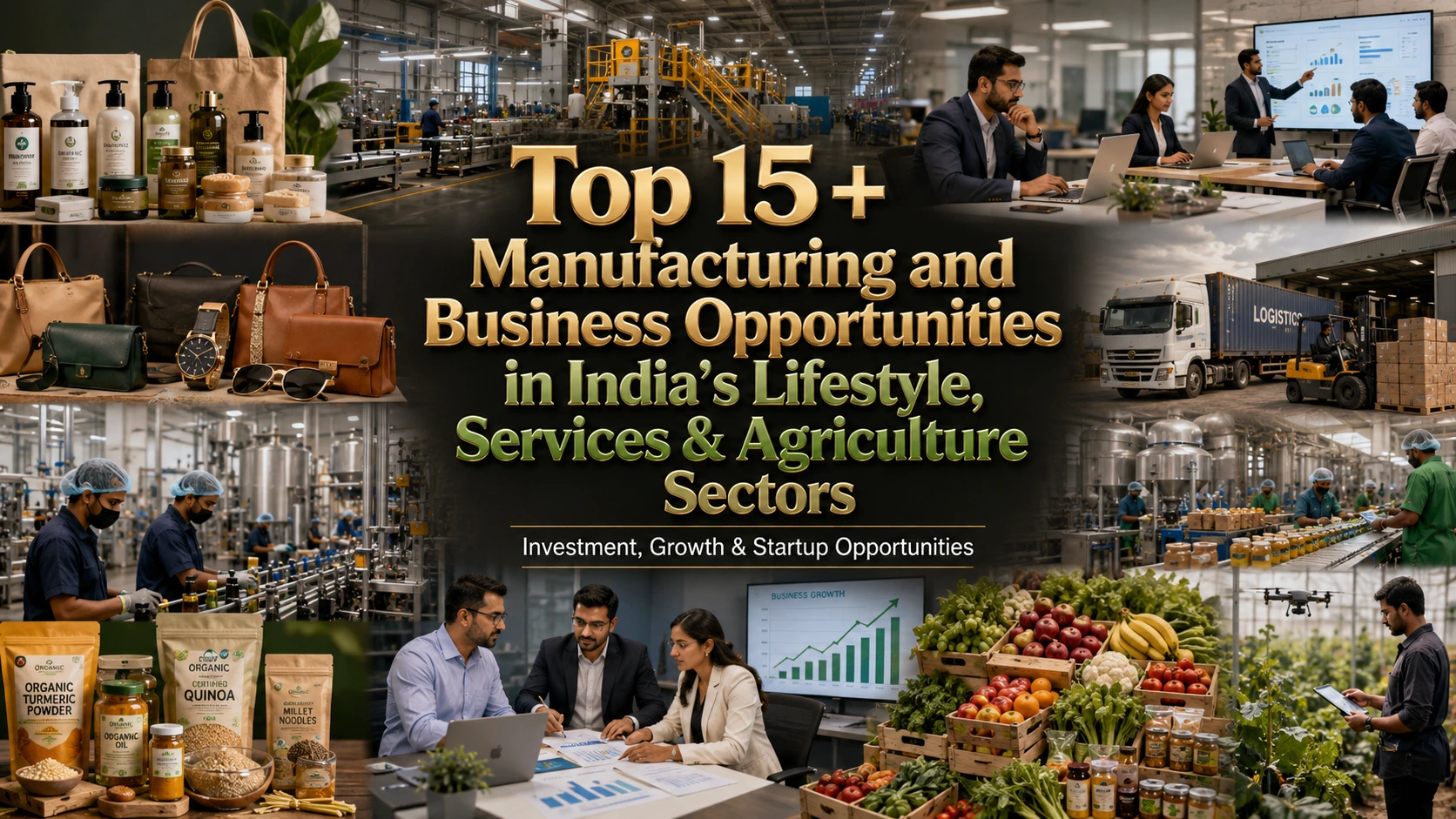
Business opportunities in India
This is indeed an inflection point for India. The two forces of rapid urbanisation and growing middle class are changing the face of demand in sectors that were assumed to be mature or stable. The concepts of business ideas and opportunities were found in various ways, from purpose-built hotels for the domestic leisure market, to cold storage networks for a digitally connected farm economy. This decade is fascinating, however, because the shortage of supply and demand can be measured, the overall government policy backdrop is quite favourable, and financing opportunities are greater than ever in the past two decades.
This guide is designed for entrepreneurs who want some substance, not slogans! Every sector in this report is a true commercial opportunity and is based on a real capital requirement, real commercial dynamics and the operational complexity that differentiates between a successful industrial venture and a well-intentioned one. They vary from asset-rich enterprises such as convention centres and planetariums to knowledge-oriented enterprises such as brokerage and trading. The range of possibilities in the fields of education, agri-processing, recycling, logistics and green energy are huge between these two poles.
By this decade, the Indian economy is projected to attain the five trillion dollar mark. The sectors covered in the following article are not the sideshows in that pursuit. It is integral to their existence. The constituents of a mature economy are food security, quality of education, transition to energy, and urban services. The businessmen who are choosing to be in these areas today are not following the trends. They are betting on structural changes that will take place over decades.
Part One: Hospitality and Real Estate Services
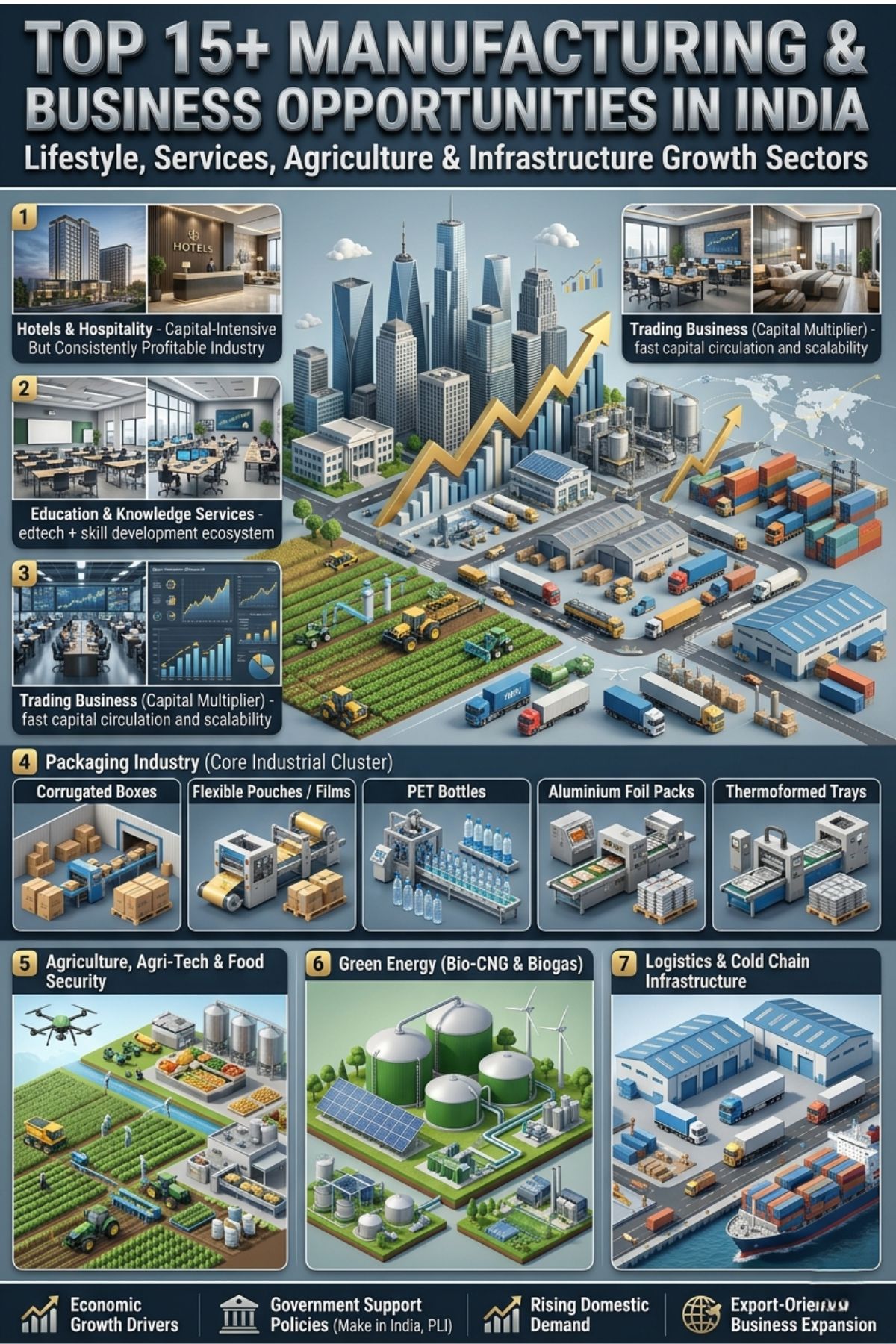
Hotels: Capital-Intensive But Consistently Profitable
The Indian hotel industry is making a strong and promising comeback from the turbulence of the early 2020s. Domestic travel, which was widely underestimated as a growth engine, has become the springboard for all levels of occupancy. The rush of business travellers, destination weddings and the huge circuit of pilgrimages have all cut inventories from the Varanasi to Goa markets.
When establishing a hotel, you should clearly think from the beginning to position the segment. The economics is pretty different from a 30-room budget property in a Tier-2 city than a 200-room full-service property close to a major airport. A midscale property located in a high-growth pilgrimage corridor or district headquarters can give better risk adjusted returns to the entrepreneurs in the first phase entering with a small investment than in the metros that are saturated.
The main factors driving to the demand are:
- The domestic tourism sector is expected to grow to ₹32 lakh crore by 2030.
- Government sponsored circuits under PRASAD Scheme
- An increasing market share of the organised food and beverage services.
- Franchise models where the mid-market brands like Lemon Tree Hotels and Sarovar Hotels are involved.
| Category | Investment Range (₹ Cr) | EBITDA Margin | Breakeven (Years) |
| Budget Hotel (20–30 keys) | 2–5 | 25–30% | 5–7 |
| Mid-Scale Hotel (50–100 keys) | 8–20 | 30–38% | 6–9 |
| Full-Service (150–200 keys) | 40–100+ | 35–42% | 8–12 |
| Service Apartment (20–40 units) | 5–15 | 40–50% | 5–8 |
Service Apartments: The Quiet Compounder
Service apartments are in a sweet spot between hotels and traditional rentals. They are usually company employees on medium-term assignment, consultants undertaking projects or international workers on deputation. Demand is not cyclical, it is structural.
As far as operation, service apartments have definite advantages over full-service hotels. They are less labour intensive, less complicated F&B systems, and have more predictable occupancy due to corporate tie-ups. For a 25-unit property, which is well situated in a city with active IT, pharma or manufacturing activity, it can be expected to be 70–80 percent occupied on an annualised basis. Capital needed is moderate, in the range of ₹8-15 crore, considering construction and fit out. Operating costs are 45-50% of the revenue, resulting in healthy margins. Key success factors are:
- Educational institutions in the vicinity
- The value of fit-out, compared to the price point of the fit-out
- Active enterprise development work with leading employers’ HR teams
Part Two: Education and Knowledge Services
Schools: Infrastructure, Social Purpose.
India’s school education system is one of the most under-financed in the world in comparison to the scale of its challenge. Parents will pay for quality, and though much is invested, the private sector is much bigger, especially in urban and peri-urban areas. The National Education Policy 2020 has laid down the structural changes that will further increase the role of private players, such as provisions for multi-disciplinary learning and early childhood care.
Navigating the regulatory landscape of setting up a private school involves a whole different set of requirements and standards such as CBSE, ICSE, and state board affiliations with their respective infrastructure and faculty needs. The cost of setting up a 500-student school in a Tier-2 city may be anywhere between ₹3–8 crore. The financial model is based mainly on fee income, and is projected to pay back in 7-10 years on a conservative basis. The real competitive edge is being about the results, rather than the infrastructure. It is a power that builds over time and schools that invest in teacher quality, learning management systems and parent communication platforms early enjoy pricing power.
Colleges and Vocational Training: The Credentialing Economy
In India around 1.5 crore graduates are produced annually. But the skills gap between higher education and the labour market is still a wide one. Vocational and skills training institutes have light regulation. Structured funding and accreditation architecture provided by the government in NSDC framework and Pradhan Mantri Kaushal Vikas Yojana, which can be accessed directly by private players.
An institute which is truly doing a better job in providing job opportunities for its students creates a momentum of improved reputation which cannot be easily replicated through large marketing budgets. Education entrepreneurs who consider their work in terms of institution building, not a real estate transaction with a short life cycle, create much more valuable and durable enterprises.
Part Three: Trade, Packaging, and Recycling
Trading Business: The Original Capital Multiplier
Business trade is a subject which is not given due recognition, but which is very interesting in terms of the dynamics of a well-managed business. Core competencies are working capital efficiency, supplier relationship management and demand aggregation. If entrepreneurs can learn them, they can create businesses that can yield very high returns, but require only moderate fixed capital investment.
The important economic factor is the difference between the price the buyer is willing to pay and the price the seller is willing to accept, and the rate of inventory turnover. A trading business with 15 days inventory turns and 12 percent margin could see a lot more annual return on capital than a manufacturing business with 90 day inventory turns and 12 percent margin. But it’s vital to have the discipline of using risk management. Commodity price fluctuations, credit risk of customers and logistics disruptions can quickly cut margins.
Packaging: Where Every Industry Converges
One of the few industries that have diversified demand is packaging. Whether it’s food and drink, medicine, or e-commerce products, there’s a type of packaging for every product manufactured. The packaging industry in India is estimated to be worth of ₹3 lakh crore and is expected to increase by 13-15 per cent annually till the end of the decade due to the growth of FMCG, pharmaceutical exports and the phenomenal growth of e-commerce.
There are entry points across various investment sizes in sub-sectors. The key to success is location, as packaging is low-margin, unit and logistics expenses quickly eat away profits.
Access Complete Business Plan: Packaging Industry Guide: Bottles, Cans, Cartons, and Flexible Packaging
| Packaging Sub-Sector | Entry Investment (₹ Lakh) | Key Raw Material | Primary Demand Driver |
| Corrugated Boxes | 50–150 | Kraft Paper | E-commerce, FMCG |
| Flexible Pouches/Films | 300–1500 | LDPE/BOPP Films | Food & Pharma |
| PET Bottles | 200–800 | PET Granules | Beverages, Personal Care |
| Aluminium Foil Packs | 150–500 | Aluminium Foil | Pharma, Food |
| Thermoformed Trays | 100–400 | PVC/PET Sheets | Food Service, Retail |
Recycling and Aluminium: The Circular Economy Opportunity
India produces more than 62 million tonnes of solid waste each year, with just 20 per cent being processed. The recycling industry is thus not only commercially appealing, but also structurally required. The government’s Plastic Waste Management Rules, EPR policies and the circular economy movement are providing regulatory and financial support for the formal recycling industry.The government’s Plastic Waste Management Rules, EPR policies and the circular economy movement are providing regulatory and financial support to the formal recycling industry.
Aluminium recycling is of special interest. The energy use for virgin aluminium production is huge – using about 15,000 kWh to produce one tonne of aluminium from bauxite. Recycled aluminium uses about 5 per cent of that energy in contrast. Capital investment is in the range of ₹2 to 6 crores per month for an aluminium recycling plant of medium size (500-1,000 tonnes/month). The output, secondary aluminium ingots or remelt alloys, fetches 85-92 percent of the LME primary aluminium, giving a clear and transparent price benchmark.
Part Four: Agriculture, Agri-Tech, and Food Security
Farming: Where Scale Creates Profitability
Commercial agriculture is undergoing a change of generations in India. Business-minded entrepreneurs will focus on farming as a business instead of a means of livelihood, which can help them optimize their inputs, choose their crops, manage their post-harvest, and link themselves to the market and result in substantially higher returns per acre. The most easily available entry points are: contract farming, lease-based cultivation, and aggregation.
Crop choice is very critical. Higher value horticulture (berries, exotic vegetables, flowers), spices and seeds tend to yield much greater per acre incomes than commodity grains, but these crops also involve considerable production risk. If cold storage or processing is available, entrepreneurs can combine crops with commercial interests that are perishable in their raw form with commercial crops that can be sold with longer value windows.
Explore This Book: Profitable Farming & Allied Projects (2nd Revised Edition)
Aquaculture: The Blue Economy’s Ground Floor
India is the third big fish producing country in the world and second largest exporter of fishery products. However, there is a great potential for aquaculture development, especially for shrimp, freshwater fish and ornamental products. The initial investment in a shrimp farm is about ₹50-150 lakh per hectare for a 10–20-hectare farm. The production cycle of Vannamei shrimp is about 100-120 days and in Andhra, a well-managed farm can produce 4-6 tonnes per hectare per cycle.
Greenhouse Farming and Hydroponics: Controlled Environment Agriculture
The Indian entrepreneurs can cultivate crops throughout the year even if they are not in the season. The cost of a basic 1,000 square metres vegetable polyhouse is ₹5-12 lakh. The cost of the advanced climate-controlled greenhouses for export crops is between ₹25 to 60 lakhs per 1,000 sqm. Well-designed greenhouses will return a profit over a 3–5-year period for crops such as capsicum and floriculture.
Hydroponics (without soil) has become a viable way to grow food. It’s especially good for leafy greens, herbs, strawberries and lettuce. But being located near the city is indeed a boon to the hydroponic farm, because the product is perishable and premium-priced, freshness is its value proposition.
| Agri-Tech Format | Setup Cost | Yield Advantage | Target Market | EBITDA Margin |
| Open-Field Commercial | ₹1–3L/acre | Baseline | Wholesale/Mandis | 10–20% |
| Polyhouse (Basic) | ₹5–12L/1000 sqm | 3–5x | Local Retail/Hotels | 25–35% |
| Climate Greenhouse | ₹25–60L/1000 sqm | 8–12x | Premium/Export | 30–40% |
| Hydroponics (NFT) | ₹20–50L/1000 sqm | 10–15x | Premium Urban Retail | 25–35% |
| Aquaponics | ₹15–40L/1000 sqm | Dual Output | Niche Markets | 20–30% |
Plantation Crops: Long-Term Wealth Creation
There is a specific type of agricultural investment—the plantation culture of rubber, coffee, tea, coconut, areca nut, cardamom etc. They are patient businesses that take three to seven years to bear fruit, but have relatively low maintenance costs compared to the value of the production once established and can operate for decades. In addition, there is a new entrepreneurial interest in bamboo, moringa and sandalwood which have high per unit value.
Part Five: Green Energy — Bio-CNG and Biogas
Bio-CNG: Turning Agricultural Waste into Commercial Energy
Compressed biogas processed to natural gas quality specifications or Bio-CNG is one of the most commercially promising segments of India’s clean energy transition. The government has designed a structured offtake framework with oil marketing companies to buy certified bio-CNG at defined price through SATAT scheme (Sustainable Alternative Towards Affordable Transportation). This significantly reduces offtake risk for well-structured projects.
Favourable economics for feedstock: There is significant availability of agricultural residue (paddy straw, sugarcane bagasse, press mud, cattle dung, and municipal organic waste) in India. An 8-15 crore capital investment is estimated for a 2TPD bio-CNG plant. Formal feedstock supply agreements are beneficial than spot purchasing for successful projects.
Related Article: India Budget 2026 Climate-Tech Opportunities: CCUS, Bio-CNG, BESS, Solar Glass & Lithium-Ion Cells
Biogas: The Decentralised Energy Foundation
Biogas at small scale has great value for industrial, institutional and agricultural applications where generating energy from organic waste on-site is economically beneficial. 500 cattle can produce 50-75 cubic metres of biogas per day from their dung. Institutional biogas plants are now a mandatory requirement under Swachh Bharat and solid waste management guidelines for institutions, hotels and food processing units. Retention opportunities for entrepreneurs can be compounded over time when they sell plant in addition to an operations and maintenance services contract.
Part Six: Logistics, Cold Chain, and Infrastructure
Cold Storage: The Missing Link in India’s Agri-Value Chain
India has one of the highest post-harvest losses, around 40 per cent of fresh produce is lost between farm and consumer. The most direct intervention to minimize this waste is cold storage. The Indian cold storage sector is expanding rapidly at 14-15% per year, propelled by organized retail, rapid commerce, and government incentives. The gross investment required for a single commodity cold store having a capacity of 5,000 MT is around ₹ 3–5 crore.
The National Horticulture Board (NHB), under the Ministry of Food Processing Industries provides direct subsidy for the construction of cold storage which can cut down the capital cost by 35-50 per cent. The experience of successful cold storage entrepreneurs has shown that the farmers’ payment per crate-month of storage is a reliable source of income and flexible.
Warehousing: The Backbone of Modern Supply Chains
GST has eliminated the economic basis for state-wise fragmentation of warehouses in India and fast-tracked the consolidation of warehouses into big, professionally managed and multi-client settings. The cost of construction of a Grade A warehouse of size 50000 sqft in a Tier-2 logistics node like Nagpur or Ludhiana is between ₹8-15 crore. With rentals at ₹18–28 per square foot per month, a property which is well occupied can provide cash yields of 10–14 percent on invested capital, which is comparable to other types of commercial real estate.
Part Seven: Community, Leisure, and Mobility Business Ideas
Convention Centres: Infrastructure for India’s Events Economy
India’s Meetings, Incentives, Conferences, and Exhibitions (MICE) sector experiences a yearly growth rate of about 12 percent. The physical infrastructure on which this industry operates is convention centres, banquet halls and event venues. The cost of a standalone convention centre with a capacity of 1,000 people is estimated to be between ₹20 crore and ₹80 crore, based on the land price and the quality of the finish. Mixed-use developments are where developers can realize a better economics by dividing the fixed costs and generate a virtuous cycle of customers for each component via convention infrastructure.
Planetarium: Education Meets Entertainment
Planetariums are an elite segment of the infrastructure sector in India that is poorly served. There are only 40 working planetaria in a nation of more than 1.4 billion people, the need for accessible science education infrastructure is immense. The cost of a mid-scale digital planetarium (100 – 150 seats) is around ₹5 – 12 crores, consisting of the dome, full-dome projection system, audio system and content library licensing. The success of the Indian space technology story with ISRO’s lunar missions and Chandrayaan series have kindled the public interest in astronomy, making it an engine of demand that needs to be nurtured with good placement of planetariums.
Taxi and Mobility: Technology Meets Transport
Electric vehicle-based taxi fleets are not only desirable for the total cost of ownership benefits, but because it’s a worthwhile option. An EV running cost of ₹0.8-1.2 per km as compared to CNG taxi’s running cost of ₹3.5-5 per km offers a strong cost benefit, especially on high utilisation urban routes. The corporate transportation contracts, such as shuttle services used for IT parks, hospital-to-residential transportation, airport transportation contracts and so on, generate more predictable revenues compared to pure ride-hailing services. Entrepreneurs who develop these institutional relationships can create EBITDA margins of 20-28 percent.
Brokerage: Connecting Capital to Opportunity
At the core of brokerage businesses, be it in commodities or real estate or financial instruments, is information asymmetry and trust. The broker who can alleviate uncertainty for both parties involved in the transaction; offers support to that transaction; and has an excellent reputation for being honest and responsible creates a business with a very high rate of return on equity and very few capital costs. The real estate brokerage industry in the country’s residential and commercial sectors is a ₹25,000 crore+ business, but it is very fragmented. The challenge is to create a practice that provides true value-added services: market analyses, legal services, property management, tenant sourcing.
Explore proven business ideas with high success potential
Part Eight: The Role of Techno-Economic Feasibility in Good Decision-Making
Regardless of the industry covered in this article, there’s one common denominator in the success of entrepreneurs and the ones that fail: the standard of pre-investment analysis. The urge to get from ideas to capital commitment is truly irresistible. The difference between a viable business and an attractive-sounding idea, however, is the very difference that a thorough feasibility analysis is supposed to uncover.
Niir Project Consultancy Services (NPCS) is one of the most trusted sources on this field in India. NPCS creates detailed and comprehensive Market Survey cum Detailed Techno-Economic Feasibility Report for all kinds of manufacturing, services, agri-processing and infrastructure industry and business ventures. Such reports include information on the manufacturing process, plant layout, raw material sourcing plans, capital cost estimates and financial projections for the enterprise under consideration. An NPCS feasibility report serves as a logical and firm base for decisions by the entrepreneur and the financing of a bio-CNG plant, a cold storage facility, a packaging unit or a hotel project.
Part Nine: Market Intelligence Overview
| Sector | Current Market Size (₹ Cr) | CAGR (2024–30) | Key Demand Driver |
| Hotels & Hospitality | ₹1,80,000+ | 10–12% | Domestic Tourism |
| Private Education (K-12) | ₹3,50,000+ | 12–15% | NEP 2020, Urbanisation |
| Packaging Industry | ₹3,00,000+ | 13–15% | FMCG, E-commerce |
| Recycling (Formal) | ₹40,000+ | 18–20% | EPR Regulations, ESG |
| Cold Storage | ₹2,800+ | 14–15% | Agri Export, Retail |
| Warehousing | ₹1,20,000+ | 13% | GST Consolidation |
| Bio-CNG / Biogas | ₹5,000+ | 22–25% | SATAT Scheme, MNRE |
| Aquaculture | ₹90,000+ | 8–10% | Protein Demand, Exports |
| Greenhouse / Hydroponics | ₹8,000+ | 20–22% | Premium Food Demand |
| MICE / Convention | ₹5,500+ | 12% | Corporate Events, Weddings |
Part Ten: Lessons from Indian Industry Leaders
The practical intelligence gained from the understanding of how successful Indian entrepreneurs have built their business without any textbook or feasibility report could only be garnered from them. The patterns, though not exact, show patterns of principles.
To build a company of ₹2,500+ crore, Patanjali Keswani of Lemon Tree Hotels identified a structural gap in the midscale market and did not budge from his customer proposition even when faced with competition. The logic was straightforward – ‘buy a piece of it now or expand the portfolio’. Kumar Mangalam Birla’s Hindalco Industries is an example of vertical integration. Their purchase of Novelis added a worldwide recycled aluminium capability that is becoming more and more useful as automotive and beverage customers are making it a point to source lower-carbon materials.
Ramachandra Rao of Avanti Feeds established a near-monopoly position in shrimp feed and processing, based on a robust model of giving the farmer support, technical inputs, and guaranteed buy-in. In return, the farmer would be loyal and ensure quality inputs. This is a widely replicable model in agriculture, dairy and aquaculture (B2B2C). In a contrasting approach, Nithin Kamath disrupted the financial brokerage business by defying industry logic. His strategy was to charge less, empower the client with education, and build underlying technology infrastructure. The result was a clientele that stayed longer, recommended more enthusiastically, and incurred lower compliance risks.
Frequently Asked Questions
Q1: What are the initial investment requirements to set up a cold storage business in India?
A single-commodity cold store of a capacity of 3000-5000 MT can be set up on a gross investment of 2-5 crore. By availing of subsidy (35-50 percent of the project cost) from NHB or PMKSY schemes, the net investment can be limited to 1-2.5 crore, with an additional working capital provision for the first season of operation required.
Q2: How do I evaluate the feasibility of a hotel project in a Tier-2 city?
Key indicators to evaluate feasibility of a hotel project are Average Room Rate (ARR) & Occupancy rate, RevPAR. Benchmark against comparable properties in the chosen market for at least a period of 12-18 months. Simple Payback Model at 70% of peak case projections compared with total project cost may give a reliable indication of feasibility.
Q3: Which all regulatory compliances are required to set up a Bio-CNG plant?
A Bio-CNG plant would require environmental clearance under the EIA notification, consent to establish and consent to operate from the state pollution control board, registration under the SATAT scheme to facilitate offtake from OMC, and BIS certification if the gas is intended to be supplied as a fuel for vehicular use. The Ministry of New and Renewable Energy and the Ministry of Petroleum and Natural Gas websites would specify all applicable regulatory compliance norms and updates.
Q4: Is a hydroponics farm commercially feasible without any government subsidy?
Yes, although location and crop selection remain crucial. Hydroponic farms producing niche crops (herbs, micro-greens and baby leafy greens) for urban premium retail or hotel supply chains are commercially viable without subsidy for scales larger than 5000 sq mtr. Crucially, secure an offtake with pre-determined higher prices before committing to a large capital expenditure.
Q5: How does regulatory compliance vary between a textile dyeing unit and a garment manufacturing unit?
The regulatory compliances required to set up and run a textile dyeing unit is significantly more intensive than a garment manufacturing unit. A textile dyeing unit would require an ETP to comply with CPCB standards, and would fall under ‘Red’ category under state pollution norms; while garment manufacturing is generally a ‘Green’ or ‘Orange’ category.
Q6: Can I set up a brokerage business with very little capital?
Yes. For real estate, it can be established on a capital outlay of 2-5 lakh comprising initial expenses for office setup, stationery and market-related expenses plus statutory registration fees. Financial brokerage however requires SEBI registration and exchange membership that can range between 15-30 lakh. The key constraint here is credibility rather than capital as establishing a good network and track record would take considerable effort.
Conclusion: Building Businesses That Matter and Last
The breadth of sectors covered is large precisely because the economy is so structurally broad-based. Hotels and serviced apartments meet a deficiency in hospitality services; schools and colleges address a lack of adequate educational infrastructure; packaging and recycling play roles in consumption patterns and environmental health; bio-CNG and biogas enable energy transition; cold storage and warehousing address a food supply chain where we waste close to half of all that is grown; convention centers and planetariums are components of cultural and intellectual infrastructure that an economy needs to develop to the next level.
Underlying all these is not necessarily the connection to government or capital. Underpinning them is not necessarily a proprietary product. Underlying each of these successful entrepreneurs in each of these domains is an understanding of the business model. There has to be operational rigor beyond a single entrepreneur. The relationship with customers has to be a partnership to be sustained and deepened rather than a transaction to be exploited.
India 2025 and beyond provides an extraordinary mix of growth in demand, developing infrastructure, capital availability, policy support. This period, before the market is mature and highly institutionalized, does not last forever. If entrepreneurs understand what the business is, focus on the operational model and are committed to the sector that they invest in, they will establish enduring businesses in the next half century.


